You launched a Facebook campaign that drove hundreds of clicks. A week later, those same prospects searched your brand on Google and clicked through. Then they opened your email newsletter, visited your pricing page, and finally converted. When you check your analytics, Google gets 100% of the credit because it was the last click before conversion. Facebook? Zero credit. Your email campaign? Invisible.
This is the problem with single-touch attribution—it pretends customers make decisions in a straight line when the reality is far messier. Multi-touch attribution (MTA) solves this by distributing credit across every interaction that influenced the conversion, giving you a complete picture of what's actually driving revenue.
Understanding how multi-touch attribution works isn't just about better reporting. It's about making smarter budget decisions, identifying which channels work together to convert customers, and stopping the waste of cutting campaigns that assist conversions even if they don't close them. Let's break down exactly how MTA captures the full customer journey and how you can use it to transform your marketing strategy.
The Mechanics Behind Multi-Touch Attribution
Multi-touch attribution works by tracking every interaction a prospect has with your brand and connecting those touchpoints into a unified journey. Think of it like assembling a puzzle where each piece represents a different marketing touchpoint—ad clicks, website visits, email opens, social media engagement, and more.
The foundation of MTA is data collection. When someone clicks your Facebook ad, attribution platforms capture that event using a combination of first-party cookies, UTM parameters embedded in your URLs, and tracking pixels. The same thing happens when they visit your website directly, click a Google ad, or open an email. Each interaction gets logged with a timestamp, source information, and user identifier.
Here's where it gets interesting: attribution platforms use sophisticated identity resolution to stitch together these seemingly disconnected events into a single customer journey. If someone clicks your ad on their phone during lunch, then visits your website on their laptop that evening, the platform needs to recognize these are the same person. This happens through a combination of logged-in user data, device fingerprinting, and probabilistic matching based on behavior patterns.
Server-side tracking has become increasingly critical for accurate MTA. As browsers restrict third-party cookies and iOS privacy features limit tracking, server-side solutions send conversion data directly from your servers rather than relying on browser-based tracking. This approach captures events that browser-based tracking would miss entirely, ensuring your attribution data remains accurate even as privacy regulations tighten.
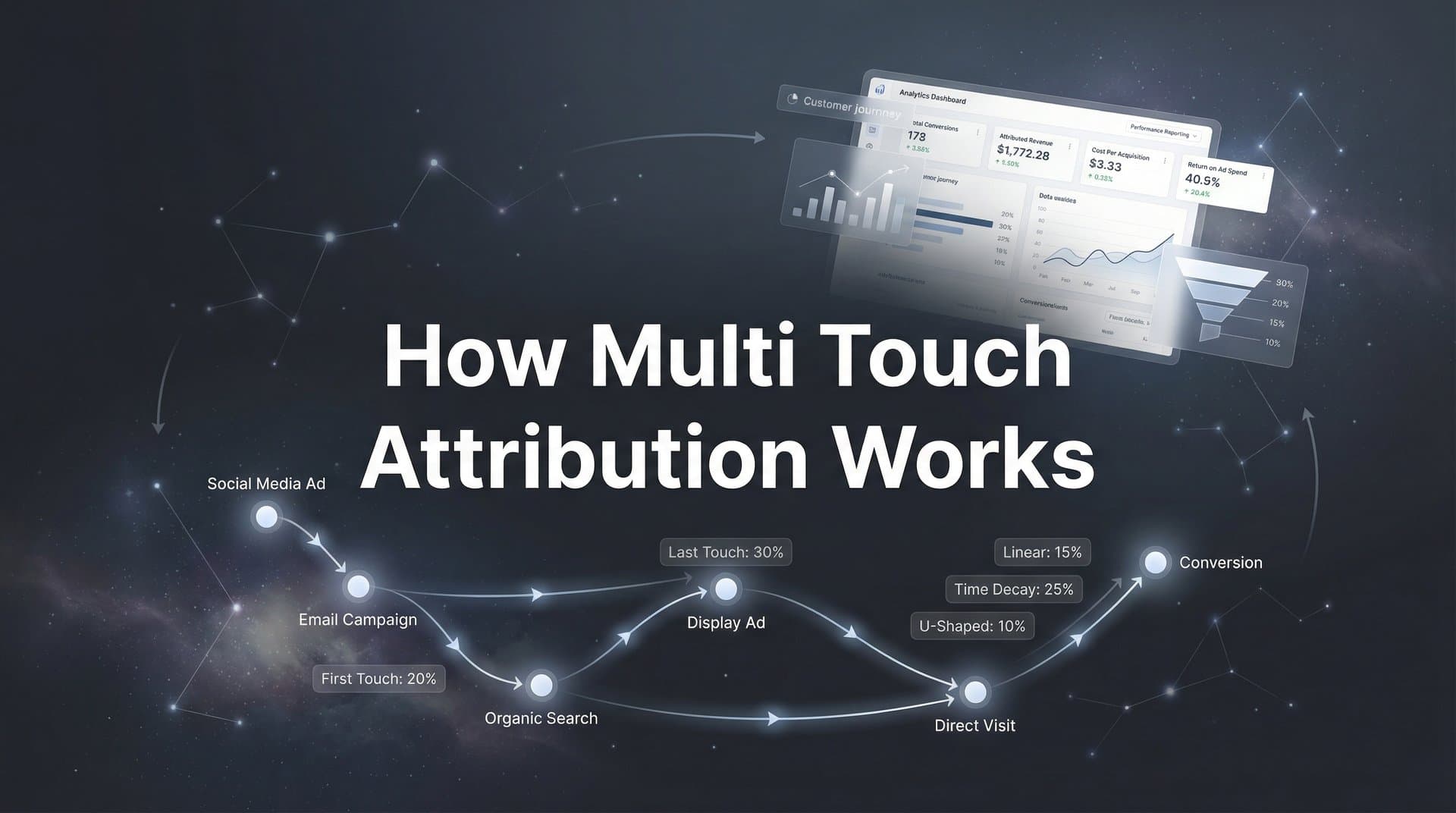
The technical process looks something like this: A prospect clicks your Facebook ad (Event 1: Facebook Ad Click, 2:15 PM, Monday). They browse your site but don't convert (Event 2: Website Visit, 2:16 PM, Monday). Three days later, they search your brand name on Google and click through (Event 3: Google Search Click, 10:22 AM, Thursday). They read a blog post and leave (Event 4: Blog Visit, 10:25 AM, Thursday). That afternoon, they open your email campaign and click a product link (Event 5: Email Click, 3:40 PM, Thursday). Finally, they return to your site and convert (Event 6: Conversion, 4:15 PM, Thursday).
An attribution platform captures all six events, connects them to the same user, and creates a complete journey map. This is the raw material that makes multi-touch attribution possible—without it, you're just guessing which channels matter. Understanding how to measure touchpoints accurately is essential for building this foundation.
Breaking Down the Major Attribution Models
Once you've captured the full customer journey, multi-touch attribution models determine how to distribute credit across those touchpoints. Different models answer the same question differently: which interactions deserve credit for the conversion?
Linear Attribution: This is the most straightforward approach. Every touchpoint in the journey receives equal credit. In our six-event example above, each interaction would get 16.7% of the credit for the conversion. Linear attribution makes sense when you have a relatively short sales cycle and want to acknowledge that every interaction played a role in moving the prospect forward. Think about ecommerce purchases or simple service signups. For a deeper dive into implementation, explore how to use the linear attribution model effectively.
The advantage of linear attribution is simplicity and fairness. No single channel gets disproportionate credit, which prevents you from over-investing in last-click channels while starving awareness campaigns. The downside? It assumes all touchpoints are equally influential, which isn't always true. Your first brand awareness ad and your final retargeting ad probably don't deserve the same credit.
Time-Decay Attribution: This model gives more credit to interactions that happened closer to the conversion. The logic is simple: recent touchpoints had more influence on the final decision than interactions from weeks ago. Using a typical time-decay model, that email click right before conversion might receive 40% of the credit, while the Facebook ad from three days earlier gets only 10%.
Time-decay attribution works well for businesses with shorter sales cycles where momentum matters. If you're running limited-time promotions or selling products with relatively quick decision timelines, this model reflects reality better than linear attribution. It helps you identify which channels are effective at closing deals, not just initiating interest.
Position-Based (U-Shaped) Attribution: This model takes a different approach by emphasizing the first and last touchpoints while still acknowledging everything in between. A typical U-shaped model gives 40% credit to the first interaction, 40% to the last interaction, and distributes the remaining 20% equally among the middle touchpoints.
The reasoning here is that first touch deserves credit for creating awareness and getting the prospect into your funnel, while last touch deserves credit for closing the deal. The middle interactions matter, but they're supporting players rather than stars. This model is popular with B2B companies and businesses with longer sales cycles where both discovery and conversion moments are clearly valuable. You can learn more about the first touch attribution model to understand its role in position-based approaches.
Position-based attribution helps you avoid the trap of only valuing bottom-funnel activities. It ensures your awareness campaigns get credit for starting journeys that eventually convert, even if they don't directly close deals. This prevents the common mistake of cutting top-funnel spend because it doesn't show immediate last-click ROI.
Some platforms also offer W-shaped attribution, which adds emphasis to a middle conversion point—like a free trial signup or demo request between initial awareness and final purchase. This three-peak model (first touch, middle conversion, last touch) works well for complex B2B sales with clear milestone events.
The key insight across all these models is that they reveal different truths about your marketing. Linear shows overall contribution, time-decay highlights closing power, and position-based balances awareness with conversion. Many experienced marketers don't pick just one—they compare multiple models side-by-side to understand the complete picture.
Choosing the Right Model for Your Marketing Mix
The best attribution model isn't the most sophisticated one—it's the one that matches how your customers actually buy. A model that works perfectly for an ecommerce store selling impulse purchases will mislead a SaaS company with a 90-day enterprise sales cycle.
Start by considering your sales cycle length. If customers typically convert within days or a couple of weeks, time-decay attribution makes sense because recent interactions genuinely have more influence on quick decisions. Think about ecommerce, local services, or low-cost SaaS products. The prospect who sees your ad today and converts tomorrow was probably most influenced by that final retargeting ad or email that pushed them over the edge.
For longer sales cycles—30 days or more—position-based models often provide better insights. B2B software, high-ticket coaching programs, and complex service offerings all benefit from recognizing that the initial touchpoint that created awareness months ago deserves credit alongside the demo or consultation that closed the deal. The middle touchpoints matter too, but the journey's beginning and end are particularly influential.
Your business model also shapes which attribution approach works best. Lead generation businesses that nurture prospects through multiple stages should lean toward models that credit the full journey, not just the final form submission. You want to understand which channels generate quality leads at the top of the funnel, not just which email campaign happened to be open when they finally converted.
Ecommerce businesses often find success with time-decay or linear models because purchase decisions can happen quickly once intent is established. If someone is shopping for running shoes, the touchpoints from the past week matter far more than a brand awareness ad they saw a month ago. The recent product review they read, the retargeting ad showing the exact shoes they viewed, and the free shipping email all deserve substantial credit.
SaaS companies with free trials or freemium models might benefit from W-shaped attribution that emphasizes three moments: initial awareness, trial signup, and paid conversion. This reveals which channels are best at generating awareness, which drive trial activations, and which convert free users to paying customers—three distinct questions that require different marketing strategies. For more guidance, read about how to choose the right attribution model for your specific situation.
Here's the reality many marketers discover: comparing multiple attribution models side-by-side reveals more than picking a single "correct" model. When you see that Facebook gets 30% credit in position-based attribution but only 15% in time-decay, you learn something valuable—Facebook is strong at creating awareness and starting journeys, but other channels are better at closing. That insight helps you allocate budget strategically rather than trying to force Facebook to be something it isn't.
The goal isn't finding the perfect attribution model. It's finding the model—or combination of models—that helps you make better decisions than last-click attribution would allow. Even an imperfect multi-touch model beats pretending your customers only interact with your brand once before converting.
From Data to Decisions: Using Attribution Insights
Multi-touch attribution data is only valuable if it changes how you allocate budget and optimize campaigns. The insights you gain should directly inform which channels get more investment, which campaigns get paused, and where you're leaving money on the table.
One of the most powerful insights MTA reveals is the difference between channels that initiate journeys and channels that close them. You might discover that LinkedIn ads generate very few last-click conversions but show up as the first touchpoint in 40% of your high-value customer journeys. Under last-click attribution, you'd think LinkedIn is failing. With MTA, you realize it's your most effective awareness channel—it just doesn't close deals directly.
This distinction matters enormously for budget allocation. If you cut LinkedIn spend because it doesn't show last-click ROI, you're actually strangling the top of your funnel. Conversions might not drop immediately, but over the next few months, you'll have fewer prospects entering your ecosystem. MTA prevents this mistake by showing you which channels deserve credit for starting valuable customer relationships.
Reallocating budget based on true revenue contribution often means shifting investment toward "assist" channels that influence conversions without getting last-click credit. Content marketing, display advertising, and social media awareness campaigns frequently fall into this category. They rarely close deals directly, but they play crucial roles in educating prospects, building trust, and keeping your brand top-of-mind during the consideration phase. Understanding multi-channel attribution for ROI helps you quantify these contributions.
Look for patterns in your highest-value conversions. If your enterprise customers consistently interact with 8-10 touchpoints before converting, and specific channels appear repeatedly in those journeys, those channels deserve more investment even if they don't dominate last-click metrics. The goal is optimizing for the entire journey, not just the final step.
Multi-touch attribution also helps you spot diminishing returns. If adding a fifth retargeting touchpoint doesn't increase the attribution credit for conversions compared to four touchpoints, you're probably over-saturating prospects. That budget might generate better returns in awareness channels that start new journeys instead of hammering the same prospects repeatedly.
Use attribution data to test hypotheses about channel synergies. You might notice that prospects who interact with both Facebook ads and email campaigns convert at higher rates than those who only see one or the other. That insight suggests increasing investment in both channels simultaneously rather than choosing between them. Some channels work better together than alone, and MTA reveals these relationships.
The most sophisticated use of attribution insights is feeding better data back to ad platforms. When you understand which touchpoints truly drive revenue, you can send more accurate conversion signals to Facebook, Google, and other platforms. This improves their algorithm optimization, helping them find more prospects who match your actual high-value customer patterns rather than just your last-click converters. Learn more about Facebook multi-touch attribution to maximize your social advertising ROI.
Common Implementation Challenges and How to Solve Them
Getting multi-touch attribution right isn't as simple as flipping a switch. Real-world implementation comes with challenges that can undermine your data accuracy if you're not prepared to address them.
Cross-device tracking remains one of the biggest obstacles. Your prospect sees your Instagram ad on their phone during their morning commute, researches your product on their work laptop at lunch, then converts on their home computer that evening. Without proper identity resolution, your attribution platform sees three different anonymous users rather than one customer journey. This fragments your data and makes accurate attribution impossible.
The solution is implementing robust user identification wherever possible. Encourage account creation or email capture early in the journey so you can connect sessions across devices using logged-in user data. For anonymous sessions, server-side tracking improves cross-device matching by capturing more reliable identifiers than browser-based tracking alone. The more you can connect fragmented sessions into unified journeys, the more accurate your attribution becomes.
iOS privacy changes, particularly iOS 14.5 and later versions, have significantly limited what browser-based tracking can capture. When users opt out of tracking, traditional pixel-based attribution loses visibility into their journey. Many marketers discovered this painfully when their Facebook attribution data suddenly showed massive gaps after iOS updates rolled out.
Server-side tracking addresses this challenge by sending conversion data directly from your servers rather than relying on browser-based pixels. This approach captures events that browser restrictions would otherwise block, ensuring your attribution data remains comprehensive even as privacy features expand. Platforms that support server-side tracking give you more complete journey visibility in a privacy-first world.
Offline conversions create another common gap. If prospects interact with your digital marketing, then convert via phone call, in-store visit, or sales rep conversation, those conversions might not connect back to the digital touchpoints that influenced them. Your attribution data shows all the marketing activity but never sees the final conversion, making it look like your campaigns aren't working when they actually are.
Solving this requires connecting your CRM and offline conversion data to your attribution platform. When a sales rep closes a deal, that conversion event should flow back into your attribution system with the customer identifier that connects it to their earlier digital journey. This completes the picture and ensures offline conversions get attributed to the marketing touchpoints that generated them.
Data silos between platforms cause similar problems. Your email platform knows about email engagement, your ad platforms know about ad clicks, and your website analytics know about site visits—but if these systems don't share data, you can't build complete customer journeys. Breaking down these silos is essential for accurate MTA. If you're struggling with inconsistent data, learn how to fix attribution discrepancies in data across your marketing stack.
The solution is choosing attribution platforms that integrate with all your marketing tools or implementing a customer data platform (CDP) that centralizes data from multiple sources. The goal is creating a single source of truth where all touchpoint data flows together, enabling accurate journey reconstruction and attribution.
Putting Multi-Touch Attribution Into Practice
Understanding multi-touch attribution conceptually is one thing. Actually implementing it effectively is another. The difference between marketers who get value from MTA and those who don't often comes down to execution fundamentals.
Start with clean tracking before you worry about sophisticated attribution models. If your UTM parameters are inconsistent, your tracking pixels are missing from key pages, or your conversion events aren't properly configured, no attribution model will give you accurate insights. Audit your tracking setup first. Ensure every marketing channel uses consistent UTM parameters, every important page has proper tracking, and every conversion event fires correctly. Following multi-channel attribution best practices from the start prevents costly mistakes later.
This means testing your tracking across the actual customer journey. Click your own ads, fill out your own forms, complete your own checkout process. Verify that every step gets captured in your attribution platform. The time you invest in tracking hygiene pays dividends in data accuracy that makes all your subsequent analysis meaningful.
Once you have clean data flowing in, start simple with your attribution analysis. Don't immediately jump to complex custom models. Begin by comparing last-click attribution to a basic multi-touch model like linear or position-based. The differences you see will immediately reveal channels that are undervalued by last-click metrics. This gives you quick wins—reallocating some budget to high-assist channels that deserve more investment.
Feed your attribution insights back to your ad platforms to improve their optimization. When you identify which touchpoints truly drive high-value conversions, send those conversion signals back to Facebook, Google, and other platforms. This trains their algorithms on your actual valuable outcomes rather than just last-click conversions. Over time, the platforms get better at finding prospects who match your real customer patterns, improving your overall campaign performance.
Treat attribution as an ongoing practice, not a one-time setup. Customer behavior changes, new marketing channels emerge, and privacy regulations evolve. Your attribution strategy needs to evolve with these changes. Review your attribution data monthly, test new models as your business grows, and adjust your approach when you spot patterns that suggest your current model isn't capturing reality accurately. For managing complex campaigns, explore attribution tracking for multiple campaigns to maintain consistency at scale.
Most importantly, use attribution insights to drive actual decisions. The goal isn't having perfect data—it's making better marketing choices than you would without MTA. If your attribution analysis reveals that content marketing assists 60% of high-value conversions but gets only 10% of your budget, that's actionable. Shift investment accordingly and measure the results. Multi-touch attribution is a decision-making tool, not just a reporting dashboard.
The Path Forward: Making Attribution Work for You
Multi-touch attribution transforms marketing from educated guesswork into data-driven strategy. Instead of crediting the last click and ignoring everything that came before, you see the complete journey—which channels create awareness, which nurture consideration, and which close conversions. This visibility changes everything about how you allocate budget and optimize campaigns.
The goal isn't achieving perfect attribution. That's impossible in a world of cross-device journeys, privacy restrictions, and offline conversions. The goal is having significantly better attribution than single-touch models provide. Even imperfect multi-touch attribution reveals insights that last-click metrics completely miss, helping you invest in the channels that actually drive revenue rather than just the ones that happen to be last.
Start where you are. If you're currently relying on last-click attribution, implementing even a basic multi-touch model will immediately show you which channels you're undervaluing. As you get more sophisticated, you can compare multiple models, implement server-side tracking for better accuracy, and use attribution insights to optimize your ad platform algorithms. The journey toward better attribution is iterative, not all-or-nothing.
Ready to elevate your marketing game with precision and confidence? Discover how Cometly's AI-driven recommendations can transform your ad strategy—Get your free demo today and start capturing every touchpoint to maximize your conversions.