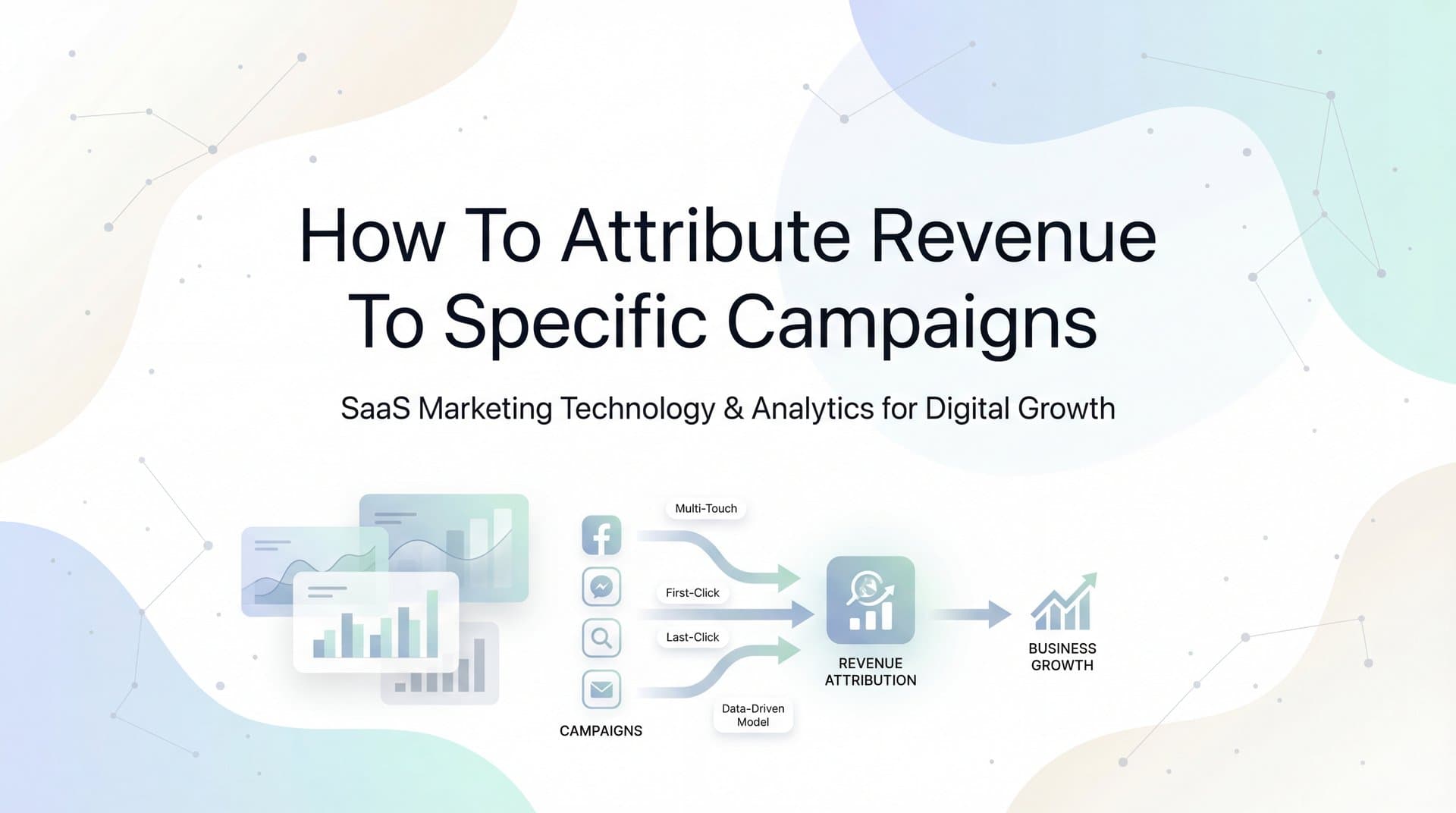
You've just spent $50,000 on campaigns across Meta, Google, and LinkedIn this month. Your dashboard shows thousands of clicks, hundreds of leads, and your sales team closed $200,000 in new business. Success, right? But here's the problem: you have absolutely no idea which specific campaigns generated that revenue.
Was it the LinkedIn thought leadership ads that warmed up prospects? The Google search campaigns that captured high-intent buyers? Or the Meta retargeting that closed the deal? Without accurate revenue attribution, you're flying blind—making budget decisions based on gut feeling rather than data.
This isn't just frustrating. It's expensive. Every dollar you pour into underperforming campaigns is a dollar stolen from the channels actually driving revenue. And the challenge has only gotten harder: iOS privacy updates block tracking, ad platforms report conflicting conversion numbers, and the gap between "conversions" and actual closed deals keeps growing.
The reality is that most marketing teams are drowning in data but starving for insight. Your ad platforms show one set of numbers, your CRM shows another, and your CFO wants to know why marketing spend keeps climbing while you can't prove which campaigns are worth it.
Here's what makes this particularly painful: your best-performing campaigns might be getting starved of budget while you accidentally scale the ones that look good on paper but don't actually drive revenue. You need a system that connects the dots from first ad click through every touchpoint to the final sale—and attributes revenue accurately to the campaigns that earned it.
This guide walks you through a practical six-step framework for building that system. You'll learn how to map customer journeys, connect your data sources, implement tracking that actually works, choose the right attribution model, validate your data, and build reports that drive smart budget decisions. By the end, you'll have a clear process for knowing exactly which campaigns deserve more investment and which ones are wasting your budget.
Step 1: Map Your Customer Journey Touchpoints
Before you can attribute revenue to campaigns, you need to understand the path your customers actually take. Most marketers skip this step and jump straight to installing tracking pixels—which is like trying to measure a marathon without knowing the route.
Start by documenting every interaction point where prospects engage with your marketing. This includes obvious touchpoints like clicking ads and visiting landing pages, but also the less obvious ones: opening emails, attending webinars, downloading resources, requesting demos, and having sales conversations. For B2B companies especially, the journey is rarely linear—prospects might see your LinkedIn ad, ignore it, Google your company three weeks later, download a guide, get retargeted on Meta, and finally book a demo.
Pull data from multiple sources to build this map. Interview your sales team about how leads typically find you. Review your CRM to see the actual sequence of events before deals close. Check your email marketing platform, webinar software, and content downloads. You're looking for patterns: Do most customers interact with your brand 3 times before converting? 10 times? 20 times?
Create a visual representation of these touchpoints. This doesn't need to be fancy—a simple flowchart showing how campaigns feed into different stages works perfectly. The key is identifying which campaigns serve as entry points (awareness), which ones nurture prospects (consideration), and which ones close deals (decision).
Here's what this looks like in practice: Your LinkedIn ads might introduce prospects to your brand. They visit your site but don't convert. Two weeks later, they see your Google search ad when researching solutions. They download a comparison guide. Your email nurture sequence keeps them engaged. They attend a webinar. Finally, a retargeting ad reminds them to book a demo, and they close as a customer.
Document the typical timeframe too. B2B sales cycles often span 30-90 days or longer, which means you need attribution that can track touchpoints across months, not just days. If you only look at last-click attribution, you'll credit that final retargeting ad and completely miss the LinkedIn campaign that started the entire relationship.
Your success indicator here is simple: Can you trace a theoretical customer from their first interaction with any campaign through to becoming a paying customer? If you can map that journey with reasonable accuracy, you're ready for the next step. If you're still guessing about how prospects move through your funnel, spend more time in this research phase—everything else builds on this foundation.
Step 2: Connect Your Data Sources Into One System
Now comes the technical foundation: connecting all your marketing and sales data so it flows into one place. This is where most attribution efforts fail—not because of wrong models or bad tracking, but because the data lives in silos that never talk to each other.
Think about where your critical data currently lives. Your ad platforms (Meta Ads Manager, Google Ads, LinkedIn Campaign Manager, TikTok Ads) each track their own clicks, impressions, and conversions. Your website analytics shows visitor behavior but doesn't know which visitors became customers. Your CRM holds the revenue data but has no idea which ads those customers clicked before converting.
The solution is a central attribution system that pulls data from all these sources. Start with your ad platforms—you need integrations that automatically import campaign performance data including spend, clicks, impressions, and conversions. Most marketing attribution platforms with revenue tracking connect directly through APIs, which means data syncs automatically without manual exports.
Next, connect your CRM. This is non-negotiable because your CRM is where revenue actually lives. Whether you use HubSpot, Salesforce, Pipedrive, or another system, you need a direct integration that pulls in lead data, deal values, and closed-won revenue. The attribution system should be able to match CRM contacts back to their original marketing touchpoints.
Your website tracking is equally critical. Implement tracking that captures UTM parameters from every campaign link, records user behavior across sessions, and maintains visitor identity even when they return weeks later. This creates the thread that connects ad clicks to website visits to form submissions to CRM records to closed deals.
Here's the common pitfall that derails this step: treating each platform as its own source of truth. Meta says you got 50 conversions. Google says 35. Your CRM shows 40 new leads, but only 25 came from paid ads according to your attribution. Which number is right? All of them—and none of them. Each platform sees only its slice of reality. Meta counts anyone who clicked their ad and later converted. Google does the same. Your CRM might be missing UTM data on 15 leads because forms didn't capture it.
This is why unified tracking matters. When everything flows into one system, you can see the complete picture: which campaigns drove initial awareness, which ones assisted along the way, and which ones closed the deal. You stop arguing about whose conversion numbers are "correct" and start looking at the full customer journey.
The technical setup varies depending on your attribution tool, but the process generally involves generating API keys or OAuth tokens for each platform, authorizing data access, and mapping fields so the system knows which CRM fields correspond to which tracking parameters. Most modern attribution platforms handle this through guided setup wizards.
Your success indicator: log into your attribution dashboard and confirm you can see campaign data from all your ad platforms, visitor data from your website, and revenue data from your CRM—all in one place. If any source is missing or showing stale data, troubleshoot the integration before moving forward. Incomplete data means incomplete attribution, which means bad decisions.
Step 3: Implement Server-Side Tracking for Accurate Data
Here's an uncomfortable truth: if you're relying solely on browser-based tracking pixels, you're probably missing 20-40% of your actual conversions. And that missing data is quietly destroying your attribution accuracy.
The problem is that traditional pixel tracking happens in the user's browser, which means it's vulnerable to everything that blocks or limits browser tracking. iOS privacy updates restrict cross-site tracking. Safari blocks third-party cookies by default. Ad blockers eliminate tracking scripts entirely. Privacy-conscious users clear cookies regularly. Each of these scenarios creates blind spots where conversions happen but your tracking never sees them.
Server-side tracking solves this by moving data collection from the browser to your server. Instead of relying on JavaScript pixels that can be blocked, your server captures conversion events directly and sends them to your attribution system and ad platforms. This approach survives privacy restrictions because it uses first-party data collection that doesn't depend on third-party cookies or cross-domain tracking.
Here's how it works in practice: When someone submits a form on your website, your server captures that conversion event along with all the relevant data—which campaign they came from, their user identifier, what they converted on, and the value of that conversion. Your server then sends this data to your attribution platform and can also send it back to ad platforms like Meta and Google to improve their optimization algorithms.
Setting up server-side tracking typically involves implementing a server-side tag manager or using an attribution platform that handles this automatically. You'll need to configure your server to capture conversion events, maintain user identity across sessions, and send data to the appropriate destinations. The technical complexity varies, but modern attribution tools have simplified this significantly compared to building it from scratch.
The impact is immediate and measurable. When you compare server-side tracked conversions against pixel-only tracking, you'll typically see 20-40% more conversions captured—these are real conversions that were happening all along but your pixel-based tracking was missing. This isn't about inflating numbers; it's about seeing the complete picture of what's actually working.
There's a critical business implication here: if your attribution is missing 30% of conversions, you're systematically undervaluing the campaigns that drive those conversions. You might be cutting budget from campaigns that are actually profitable because your tracking makes them look less effective than they are. Understanding what a tracking pixel is and how it works helps you recognize why server-side tracking provides more reliable data.
Your success indicator for this step: compare your tracked conversion numbers against actual CRM records of new leads and closed deals. If there's a significant gap—say your CRM shows 100 new leads but your tracking only captured 65—you've got a tracking problem that server-side implementation will solve. After implementing server-side tracking, that gap should shrink dramatically, with tracked conversions matching closely to actual CRM records.
Step 4: Choose and Configure Your Attribution Model
Now that your data is flowing accurately into one system, you need to decide how to distribute credit for conversions across the multiple touchpoints in each customer journey. This is where attribution models come in—and choosing the wrong one can lead you to completely opposite conclusions about which campaigns work.
Let's break down the main attribution models and when each one makes sense. First-touch attribution gives 100% of the credit to the first campaign a customer interacted with. This model is useful if you're primarily focused on awareness and want to understand which campaigns are best at introducing new prospects to your brand. The downside? It completely ignores everything that happened after that first click, even if it took 10 more touchpoints to close the deal.
Last-touch attribution does the opposite—it gives all credit to the final touchpoint before conversion. This model works well for direct response campaigns where the customer journey is short and linear. Someone searches for your product, clicks your ad, and buys immediately. But for longer sales cycles with multiple touchpoints, last-touch attribution creates a distorted picture where you overvalue bottom-funnel campaigns and undervalue the awareness and nurture efforts that made the final conversion possible.
Linear attribution spreads credit equally across all touchpoints. If a customer interacted with five campaigns before converting, each campaign gets 20% of the credit. This model acknowledges that multiple touchpoints contributed, but it treats every interaction as equally important—which often isn't true. The webinar that educated the prospect probably deserves more credit than the generic display ad they scrolled past.
Time-decay attribution gives more credit to touchpoints closer to the conversion. This model assumes that recent interactions had more influence on the decision than older ones. It's particularly useful for longer sales cycles where early touchpoints might have been exploratory while later ones drove the actual decision.
Position-based attribution (also called U-shaped) gives the most credit to the first and last touchpoints—typically 40% each—with the remaining 20% distributed among the middle interactions. This model recognizes that both introducing the prospect and closing the deal are critical, while still acknowledging the nurturing touchpoints in between.
So which model should you choose? It depends on your sales cycle and what you're trying to optimize. For B2B companies with 30-90 day sales cycles and multiple touchpoints, multi-touch models like position-based or time-decay typically provide more actionable insights than single-touch models. They show you which campaigns are strong at generating awareness, which ones excel at nurturing, and which ones close deals. Understanding what attribution model is best for optimizing ad campaigns requires analyzing your specific customer journey patterns.
Here's a practical approach: don't commit to just one model. Most attribution platforms let you run multiple models simultaneously and compare the results. Look at the same campaign performance through first-touch, last-touch, and position-based lenses. If a campaign shows strong performance across all three models, you can be confident it's genuinely effective. If it only looks good in one model, that tells you something about its specific role in your funnel.
Configure your chosen model in your attribution platform by setting the credit distribution rules and the lookback window—how far back in time the system should look for touchpoints. A 30-day window might make sense for e-commerce, while B2B companies often need 90 days or more to capture the full journey.
Your success indicator: you can pull a report showing the same set of campaigns with revenue attributed according to your chosen model. Each campaign should show not just clicks and conversions, but actual revenue attributed based on the touchpoints it contributed to closed deals. This is the foundation for making data-driven budget decisions.
Step 5: Validate Attribution Data Against Actual Revenue
You've built the system, connected the data, and configured your attribution model. But before you start making budget decisions based on this data, you need to validate that it's actually accurate. Trust but verify—especially when millions in marketing budget are at stake.
Start with a manual audit of a sample of closed deals. Pull 20-30 recent customers from your CRM and trace their complete journey from first touchpoint to closed deal. For each customer, document every marketing interaction you can verify: which ads they clicked, which emails they opened, which pages they visited, which content they downloaded. Then compare this manual reconstruction to what your attribution system shows for those same customers.
This audit will reveal gaps quickly. You might find that your attribution system is missing touchpoints because UTM parameters weren't properly set on certain campaigns. Learning what UTMs are and how marketers use them is essential for ensuring consistent tracking across all your campaign links. Or that form submissions aren't being captured because the tracking script isn't firing correctly. Or that CRM records aren't matching to website visitors because the email field isn't being passed consistently.
Next, compare your total attributed revenue against your actual revenue. Pull your closed-won revenue from your CRM for the past 30 or 90 days. Then check what your attribution system shows as total attributed revenue for that same period. These numbers should be close—within 5-10% is reasonable, given that some deals might not have complete attribution data and some attribution might be spread across time periods differently.
If there's a large discrepancy—say your CRM shows $500,000 in closed revenue but your attribution system only attributes $300,000—you've got a problem that needs fixing. Common causes include incomplete CRM integration, missing tracking on key conversion points, or deals closing through channels you're not tracking (like direct sales outreach or partner referrals).
Pay special attention to high-value deals. Pull your top 10 deals from the past quarter and verify that your attribution system correctly captured and attributed them. These deals often have the most complex journeys with the most touchpoints, which means they're also most vulnerable to tracking gaps. If your attribution is missing or misattributing your biggest wins, your data will lead you to wrong conclusions about campaign performance.
Fix the gaps you find systematically. If certain campaigns are missing UTM parameters, implement a process to ensure all future campaign links are properly tagged. If form submissions aren't being tracked, add the necessary tracking code. If CRM data isn't syncing properly, troubleshoot the integration or adjust field mappings.
Here's the uncomfortable reality: most marketing teams skip this validation step and make budget decisions based on attribution data they've never verified. They trust that the system is working correctly because it's showing them data that looks reasonable. But "looks reasonable" and "is accurate" are very different things. You wouldn't make financial decisions based on unaudited accounting data—don't make marketing decisions based on unvalidated attribution data.
Your success indicator: after validation and fixes, your attributed revenue should match closely with actual CRM revenue (within 5-10%), and when you manually trace customer journeys, they should align with what your attribution system shows. If you can confidently say "yes, this data accurately represents which campaigns are driving revenue," you're ready to use it for budget decisions.
Step 6: Build Reports That Drive Budget Decisions
You've built an attribution system that accurately tracks revenue back to campaigns. Now it's time to turn that data into reports that actually change how you allocate budget—because attribution without action is just expensive analytics.
Start by building campaign-level revenue reports that show the metrics that matter for budget decisions. For each campaign, you need to see: total spend, attributed revenue, return on ad spend (ROAS), cost per acquisition, and ideally, customer lifetime value for the customers that campaign generated. These metrics together tell you which campaigns are genuinely profitable and which ones are burning money.
Create different views for different attribution models. Build one report showing last-touch attribution—this tells you which campaigns are best at closing deals. Build another showing first-touch attribution—this reveals which campaigns excel at generating new prospects. And build a multi-touch view that shows the full contribution of each campaign across the entire journey. Looking at all three perspectives prevents you from over-optimizing for one stage of the funnel while starving others.
Set up a regular reporting cadence that matches your decision-making rhythm. For active campaigns with daily spend, review performance weekly. Look for campaigns that are consistently delivering strong ROAS and campaigns that are underperforming. For strategic planning, create monthly executive reports that show overall marketing ROI, top-performing channels, and budget allocation recommendations based on attributed revenue.
Here's where attribution becomes powerful: use these insights to reallocate budget in real time. If your LinkedIn thought leadership campaigns are generating high-value leads that close at 3x ROAS while your generic display ads are barely breaking even, shift budget accordingly. If your Google search campaigns are excellent at closing deals (strong last-touch performance) but weak at generating new prospects (weak first-touch), you might need to increase top-of-funnel awareness campaigns to feed more prospects into that high-converting channel.
Build reports that segment by customer value, not just conversion volume. A campaign that generates 100 leads worth $50,000 in revenue is more valuable than a campaign that generates 200 leads worth $30,000—but if you only look at lead volume, you'll miss this. Attribution tied to actual revenue reveals which campaigns attract your best customers, not just the most customers. Mastering how to measure marketing ROI ensures you're evaluating campaigns based on true business impact.
Feed your conversion data back to ad platforms to improve their optimization algorithms. Most attribution systems can send conversion events back to Meta, Google, and other platforms—including offline conversions that happened in your CRM. This creates a feedback loop where ad platforms learn which users are most likely to become valuable customers, not just which ones are most likely to click or submit a form. The result is better targeting and optimization over time.
Create accountability around attributed revenue metrics. Instead of measuring marketing success by vanity metrics like clicks or impressions, shift your team's focus to attributed revenue and ROAS. When everyone is aligned around these metrics, decision-making becomes clearer—you're not debating whether a campaign "performed well," you're looking at whether it generated profitable revenue.
Your success indicator for this final step: you're making concrete budget decisions based on attributed revenue data. You're scaling campaigns with proven positive ROAS. You're cutting or optimizing campaigns that aren't delivering revenue. You're having strategic conversations about which campaigns serve which role in the customer journey, and you're allocating budget accordingly. When attribution data directly influences where you spend money, you've successfully closed the loop.
Putting It All Together
Accurate revenue attribution isn't a one-time project—it's an ongoing system that continuously improves your marketing efficiency. Let's recap the six steps that get you there:
Map your customer journey touchpoints so you understand the path from first click to closed deal. Connect your data sources into one system so you can see the complete picture across ad platforms, website, and CRM. Implement server-side tracking to capture accurate conversion data that survives privacy restrictions. Choose and configure your attribution model to distribute credit appropriately across touchpoints. Validate your attribution data against actual revenue to ensure accuracy. Build reports that drive budget decisions based on attributed revenue and ROAS.
Each step builds on the previous one, creating a foundation for marketing decisions based on real revenue impact rather than surface-level metrics. When you know exactly which campaigns are driving profitable revenue, you stop wasting budget on what looks good and start investing in what actually works.
The difference this makes is tangible. Instead of spreading budget equally across channels and hoping for the best, you can confidently scale the campaigns delivering 5x ROAS while cutting the ones barely breaking even. Instead of arguing with your CFO about marketing's value, you can show exactly which campaigns generated which revenue. Instead of making decisions based on last-click conversions that miss most of the journey, you can optimize across the entire funnel.
Cometly simplifies this entire process through a unified platform that handles each of these steps. It connects your ad platforms, CRM, and website tracking automatically, implements server-side tracking to capture accurate conversion data, and provides multi-touch attribution that shows exactly which campaigns drive revenue. The AI-powered recommendations identify your highest-performing campaigns and suggest where to reallocate budget for maximum ROI. And the conversion sync feeds enriched data back to ad platforms, improving their targeting and optimization over time.
The result is marketing attribution that actually works—not just dashboards full of data, but actionable insights that make you more profitable. You capture every touchpoint from initial ad click through CRM events, connect revenue to specific sources with confidence, and make budget decisions based on what's genuinely driving results.
Ready to elevate your marketing game with precision and confidence? Discover how Cometly's AI-driven recommendations can transform your ad strategy—Get your free demo today and start capturing every touchpoint to maximize your conversions.