
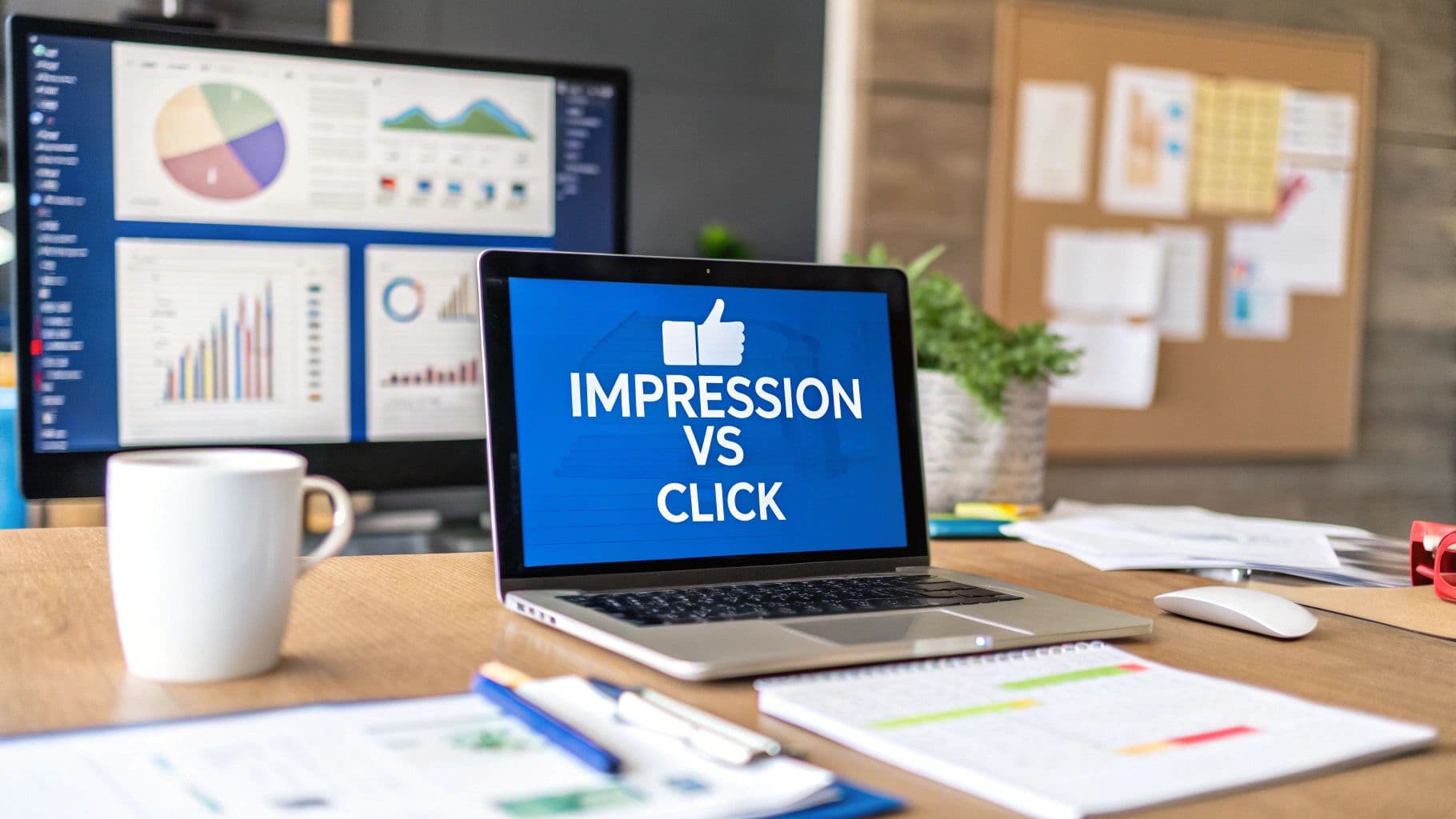
The real difference between an impression and a click is pretty simple when you boil it down. An impression means your ad was seen, while a click means someone actually interacted with it. Think of impressions as building brand recognition just by showing up, and clicks as the measure of active interest from your audience.
Defining the Core Metrics Impression vs Click
 Impression vs Click A Guide for Modern Marketers
If you want to build a winning ad strategy, you first have to get fluent in its language. At the heart of every campaign report are two of the most foundational metrics every marketer lives and dies by. Getting a handle on the unique role each one plays is the first step toward optimizing your ad spend and hitting your goals.
Impressions and clicks give you completely different insights into how your campaigns are performing. An impression is counted every time an ad is displayed on a user's screen, whether they interact with it or not. A click, on the other hand, represents a direct action—it measures how many times someone was interested enough to engage with your ad. You can dig deeper into what are impressions to really get a feel for their value in brand visibility campaigns.
Impressions vs Clicks At a Glance
These metrics aren't in competition with each other; they work together to paint the full picture of your advertising efforts. An impression is the opportunity, while a click is the result of you capitalizing on that opportunity. Each one serves a distinct strategic purpose, depending on what you’re trying to achieve.
Here’s a quick breakdown to keep things straight:
MetricDefinitionPrimary GoalKey Performance Indicator (KPI)ImpressionA single instance of an ad being displayed on a webpage or in an app.Brand Awareness & ReachCost Per Mille (CPM)ClickA user's interaction with an ad by clicking on it.User Engagement & ActionCost Per Click (CPC)
This table gives you a solid starting point, but the real magic happens when you understand how these two metrics are connected.
The Link Between Visibility and Action
While they measure different things, impressions and clicks are fundamentally linked. It’s impossible to get a click without first getting an impression. The metric that connects them is the Click-Through Rate (CTR), which shows you the percentage of impressions that successfully turned into clicks.
CTR is calculated by dividing the total number of clicks by the total number of impressions, then multiplying by 100. It's a powerful signal of your ad's relevance and how well your creative is landing.
A high CTR tells you that your targeting and messaging are on point and resonating with your audience. It means people are seeing your ad and are compelled to take the next step. On the flip side, a low CTR often means there's a disconnect somewhere that you need to fix.
To really get a grip on this relationship and see how these metrics combine into a critical KPI, it’s worth diving into understanding and improving Click-Through Rates (CTR). Mastering CTR is key to turning eyeballs into action and getting the best possible return on your campaigns.
The Strategic Value of Impressions in Brand Building
 Impression vs Click A Guide for Modern Marketers
While clicks give you a clear signal of someone's immediate intent, impressions are the bedrock of brand building. They're all about shaping perception and building trust long before a person is even thinking about making a purchase. In top-of-funnel marketing, choosing to focus on impressions isn't a passive choice—it's a strategic one.
Think of it like a billboard on a busy highway. Thousands of people drive past it every single day. Very few will pull over right then and there to buy something, but that’s not the point. The goal is to plant a seed, to build that mental real estate so that when a need finally arises, your brand is the first one that pops into their head.
When Impressions Take Priority
Maximizing your reach through impressions is the main goal in a few key scenarios. If you’re launching a new product, a huge volume of impressions is how you introduce it to the market and start the conversation. The same goes for crowded, competitive industries—consistent visibility is what keeps your brand from getting drowned out by rivals.
This focus on getting seen is supported by pricing models built for awareness. The most common is Cost Per Mille (CPM), or the cost per thousand impressions. Ever since the first banner ad was sold back in 1994, impression-based buying has been a staple for advertisers. Today, the average CPM for display ads hovers around $3.12, offering a predictable and scalable way to manage your awareness budget.
For a plain-English breakdown, read our explainer on what is cost per share.
Evaluating the Quality of Your Reach
Here’s the thing: not all impressions are created equal. Just having your ad load on a page isn't enough. It has to actually be seen. This is where viewability becomes a non-negotiable metric for judging the true quality of your reach.
Viewability tells you whether an ad actually had a chance to be seen by a human. The industry standard, set by the Media Rating Council (MRC), is pretty specific. A display ad impression is considered "viewable" only if at least 50% of its pixels are on the screen for at least one continuous second. For video ads, that threshold is 50% visibility for two continuous seconds.
A high impression count is just a vanity metric if those impressions aren't viewable. You have to prioritize platforms and placements with high viewability rates. That’s how you know your ad spend is actually building genuine brand recognition, not just hitting a number on a spreadsheet.
Focusing on viewable impressions is your best defense against wasting money on ads that no one ever lays eyes on.
The Long-Term Impact of Impressions
The value of an impression doesn't end the second someone scrolls past it. A strong awareness campaign has a powerful ripple effect on future behavior, driving things like organic searches and direct website traffic down the line. Someone might see your ad on social media today, forget about it, and then search your brand name on Google next week when they're ready to learn more.
This delayed impact is exactly why impressions are so vital. They lay the groundwork for future clicks and conversions by growing your overall share of visibility—a critical piece of owning your market. You can read our guide on how to calculate and increase your share of visibility to really dig into its strategic importance. By consistently showing up where your audience spends their time, you’re not just buying ad space; you’re building a brand that customers will remember and actively seek out when it matters most.
Why Clicks Drive Direct Response and Performance
While impressions build the foundation for awareness, clicks are the engine that powers direct-response marketing. Every single click is a deliberate action—a clear signal that a user has shifted from passively scrolling to actively engaging. This is what makes the click an absolutely essential metric for any campaign focused on immediate results like sales, leads, or downloads.
Think of it this way: a click isn't just a number. It's a potential customer raising their hand to say, "I'm interested." That active intent is precisely what separates performance-focused advertising from broader brand-building efforts. When your goal is to drive a specific, measurable outcome, each click pulls a qualified visitor one step closer to converting.
The Power of Intent in Performance Marketing
The fundamental difference in the impression vs. click debate for performance marketers comes down to user intent. An impression might catch someone's eye as they browse, but a click confirms they are actively looking for a solution or are genuinely intrigued by your offer. This powerful signal of intent is why clicks are the cornerstone of any bottom-of-funnel marketing strategy.
We break down the leading options in our performance marketing reporting software guide.
It’s also why pricing models like Cost Per Click (CPC) are so common in performance channels. With CPC, you only pay when someone takes that crucial step to engage with your ad. This model directly links your ad spend to generating traffic, making it a highly efficient way to acquire potential customers who've already shown they're interested in what you have to say.
When you pay for a click, you're not just buying traffic—you're investing in a user's demonstrated curiosity. This makes CPC an incredibly powerful and transparent way to allocate your budget toward tangible business outcomes and measure direct ROI.
Optimizing for High-Quality Clicks
Of course, not all clicks are created equal. The real goal isn't just to generate a high volume of clicks, but to attract clicks from the right people—the ones who are actually likely to convert. Nailing this requires a strategic approach to optimizing every single element of your ad creative and targeting.
We compare the leading options in our AI ecommerce creative roundup.
Here’s how to make sure your clicks are driving real performance:
- Compelling Ad Copy: Your headline and description need to speak directly to the user's pain point or desire. Use action-oriented language and clearly state your value proposition to make that click irresistible.
- Striking Visuals: Whether it's an image or a video, your creative has to stop the scroll and grab attention. It should be high-quality, relevant to your offer, and perfectly aligned with your brand.
- A Clear Call-to-Action (CTA): Tell people exactly what you want them to do next. Vague CTAs cause confusion, while strong commands like "Shop Now," "Download Free Guide," or "Book a Demo" set clear expectations and drive action.
By meticulously refining these components, you can significantly boost your Click-Through Rate (CTR). A higher CTR doesn't just lower your CPC on many platforms; it also signals that your ads are highly relevant to your audience, which in turn attracts more qualified traffic to your landing pages.
For a deeper look into this model, our guide on how pay-per-click works offers a complete breakdown. Ultimately, a click is the bridge between your ad and your business, making it the definitive metric for measuring and driving growth.
Matching Your Metric to Your Marketing Goal
Choosing between impressions and clicks isn't just a technical detail—it's the core of your campaign strategy. The right choice aligns your measurement with your actual business outcome, making sure every dollar you spend is pushing you closer to your goal. The whole "impressions vs. clicks" debate gets settled the moment you define what success really looks like for any given campaign.
Here’s a simple way to frame it: impressions build audiences, while clicks activate them. If your main objective is to introduce your brand to a new market or just stay top-of-mind, then maximizing your reach with impressions is the obvious path. On the other hand, if you need to drive immediate action—like sales or lead submissions—clicks are your most direct route to getting it done.
When to Prioritize Impressions for Awareness
Impressions are the currency of visibility. They're most valuable at the very top of the marketing funnel, where their main job is to build familiarity and trust over time.
You should anchor your strategy on impressions when your goals involve:
- Launching a New Brand or Product: When nobody knows who you are, your first job is to get on their radar. A high volume of impressions ensures you’re introducing your solution to the widest possible (and relevant) audience.
- Building Brand Recall: In crowded markets, being memorable is everything. Consistent exposure through impression-based campaigns helps your brand become the first one that comes to mind when a customer has a need.
- Shifting Public Perception: If you're rebranding or trying to change how customers see your company, a widespread impression campaign can help you control the narrative and get your new message out at scale.
For these kinds of objectives, your primary metric isn't immediate engagement but reach and frequency—how many people you're reaching and how often they see your message.
When to Prioritize Clicks for Action
Clicks represent active interest. They're the lifeblood of performance marketing and the clear winner when your campaign is built to generate a direct response from the user.
You should build your strategy around clicks for goals like:
- Driving E-commerce Sales: Every click on a product ad is a potential customer walking into your digital storefront. It's a direct signal of purchase intent.
- Generating Qualified Leads: For B2B or service-based businesses, a click on a "Request a Demo" or "Download Whitepaper" ad brings a high-intent prospect straight to your lead capture form.
- Promoting a Limited-Time Offer: When urgency is in play, you need to drive traffic now. Clicks measure how effectively your offer is compelling people to act immediately.
This flowchart breaks down the decision-making process for when to prioritize clicks for your action-oriented goals.
 Impression vs Click A Guide for Modern Marketers
The visual drives home a simple rule: if your campaign requires a specific user action like a purchase or a sign-up, your primary focus has to be on maximizing high-quality clicks.
Prioritize impressions to educate the market; prioritize clicks to activate it. This simple distinction is the key to aligning your metrics with your marketing objectives and ensuring you're measuring what truly matters for each campaign.
Aligning Goals with Metrics and Channels
The metric you choose also points you toward the most effective advertising channels. Goals focused on awareness pair nicely with platforms designed for broad reach, while action-focused goals demand channels where user intent is already high.
Think of this table as a quick guide for matching your campaign goal with the right metric and the best channels to use.
Campaign Goal and Primary Metric Alignment
Campaign Goal | Primary Metric | Secondary Metric | Ideal Channels |
|---|---|---|---|
Brand Awareness | Impressions | Reach and viewability | Display networks, social media feeds, YouTube ads |
Lead Generation | Clicks | Conversion rate and cost per lead | Google Search ads, LinkedIn ads, retargeting campaigns |
Ecommerce Sales | Clicks | ROAS and cost per acquisition | Google Shopping, social commerce ads, search ads |
Event Registration | Clicks | Cost per registration | Social media event ads, email marketing, search ads |
Content Promotion | Impressions | Clicks and engagement rate | Social media discovery, content discovery networks |
By starting with your end goal and working backward to select the right metric and channel, you build a cohesive strategy where every part works together. This approach takes you beyond a simple "impression vs. click" debate and helps you make smarter, goal-driven decisions that deliver results you can actually measure.
How Attribution Models Reframe the Debate
The old-school impressions vs. clicks debate usually misses the point entirely, because it ignores the customer journey. For a long time, marketers were stuck on last-click attribution, a model that hands 100% of the credit for a sale to the very last thing a user clicked before buying.
This simplistic view created a warped reality where clicks were king. Impressions? They were often shrugged off as a fluffy, untrackable expense. But that model ignores the subtle, cumulative power of brand exposure and fails to answer the most important questions. What made someone search for your brand by name? How many times did they see your ad on Instagram before finally clicking a Google ad a week later? Last-click pretends those earlier touchpoints never happened, leading to bad budget decisions that pump money into bottom-funnel channels while starving the awareness campaigns that feed them.
Moving Beyond the Final Touchpoint
Modern marketing requires a much more sophisticated view. The customer journey is rarely a straight line from one ad to a purchase—it’s a winding path with multiple stops along the way. Someone might see your video ad on YouTube (an impression), then get a retargeting ad on Instagram a few days later (another impression), and finally click a branded search ad to buy.
In a last-click world, that search ad gets all the glory. But was it really the only thing that drove the sale? Or did those initial impressions build the brand recognition and trust needed to spark that final, decisive search? This is where multi-touch attribution changes the game.
Multi-touch attribution models distribute credit for a conversion across multiple touchpoints in the customer journey. This provides a holistic view of performance, revealing the powerful synergy between impressions and clicks instead of pitting them against each other.
How Impressions Influence Future Actions
Impressions are often the silent heroes of the customer journey. They plant seeds that blossom into conversions down the road by building brand salience—making it more likely your brand comes to mind in a buying situation. When someone sees your ads consistently, you become a familiar, trusted option.
This familiarity directly shapes their future behavior. Instead of searching a generic term like "running shoes," a user who has seen your ads is far more likely to search for "Nike running shoes." That search leads to a higher-intent click that’s more likely to convert, but its origin story started with an impression. To truly grasp how both contribute to conversions, digging into concepts like marketing attribution is a must for any modern marketer.
Choosing the Right Attribution Model
When you embrace a multi-touch perspective, you can finally assign proper value to both your awareness efforts and your conversion-driving campaigns. Several models offer different ways to slice the data, each giving you a unique lens to view performance.
- Linear Attribution: This model gives equal credit to every single touchpoint in the journey. It’s a balanced approach that acknowledges the contribution of both early impressions and later clicks.
- Time-Decay Attribution: This model gives more credit to touchpoints that happened closer to the conversion. It still values early impressions but recognizes that the most recent interactions had a more immediate impact.
- U-Shaped (Position-Based) Attribution: This model assigns the most credit to the first touch (the impression that kicked off the journey) and the last touch (the click that sealed the deal), distributing the rest among the interactions in the middle.
By using these advanced models, you can finally see the true ROI of your awareness campaigns. You’ll have the data you need to justify your spend on impression-based channels and understand how they work together with your direct-response efforts. For a detailed breakdown, check out this guide on the comparison of attribution models for marketers. It helps you pick the right framework to measure what’s actually driving growth.
Common Reporting Mistakes and How to Avoid Them
 Impression vs Click A Guide for Modern Marketers
Knowing the difference between an impression and a click is step one. Accurately reporting on them is where a lot of marketers stumble, turning valuable data into misleading noise that leads to wasted ad spend.
The most common mistake? Getting distracted by vanity metrics. A huge impression count looks great on a slide, but it means very little without context. If those impressions don't eventually lead to clicks or conversions, they're just empty numbers. This is a classic pitfall that can easily mask a poorly performing campaign.
Misinterpreting Key Performance Indicators
Another frequent slip-up is misreading Click-Through Rate (CTR). A high CTR isn't automatically a win, and a low one isn't always a failure. For example, a high CTR on an ad that leads to a landing page with a dismal conversion rate points to a major disconnect between your ad's promise and your page's experience.
On the flip side, a low CTR on a top-of-funnel brand awareness campaign might be perfectly fine, especially on display networks where the goal is visibility, not immediate action. Judging that campaign solely by clicks completely misunderstands its strategic purpose. Building effective dashboards requires a holistic view, a skill you can sharpen by exploring best practices for digital marketing reporting.
A key reporting mistake is treating all data equally. Segmenting your performance by audience, device, and placement is essential. A campaign might be failing on mobile but thriving on desktop—without segmentation, you would never know where to optimize.
Protecting Your Data from Inaccuracy
Finally, a major oversight is failing to account for ad fraud. Invalid clicks and fraudulent impressions can seriously skew your data, making your campaigns look far more effective than they really are. With the global digital ad industry projected to hit $1.16 trillion by 2030, the risk from bad actors only grows. Savvy marketers have to use fraud detection tools to ensure their data is clean and reliable.
To avoid these common errors, focus on metrics that tie directly to business outcomes. Combine impression and click data with post-click metrics like conversion rates, cost per acquisition (CPA), and return on ad spend (ROAS). This creates a complete performance story, allowing you to make decisions based on profit, not just visibility.
Frequently Asked Questions
Let's clear up some of the common questions marketers run into when they're digging into campaign performance and trying to figure out what really matters.
Is a High Impression Count with a Low CTR Always Bad?
Not necessarily. Context is everything here. If you're running a brand awareness campaign, your main goal is to get as many eyeballs on your ads as possible. In that world, a massive number of impressions is a win, even if the Click-Through Rate (CTR) is low.
This is especially true on platforms like social media feeds or display networks where people are scrolling for entertainment, not actively looking to buy something. But if your campaign is built for direct response—like generating leads or sales—a low CTR is a red flag. It means there’s a disconnect between your creative, your audience, and your offer, and you need to fix it fast.
How Do Social Media Impressions Differ from Google Ads Impressions?
The biggest difference is the user’s mindset. An impression on Google Search Ads happens when someone is actively searching for something specific, and your ad pops up. That’s a high-intent moment—they’re looking for a solution right now.
On social media platforms like Instagram or Facebook, an impression happens when your ad appears in their feed while they’re in discovery or entertainment mode. They aren't looking for you. This is why CTRs are often lower on social, but it’s also what makes these platforms so powerful for top-of-funnel marketing and building a brand over time.
Impressions on search platforms capture existing demand, while impressions on social media platforms help create future demand. Understanding this distinction is crucial for allocating your budget effectively across different channels.
Can I Track the ROI of an Impression-Based Campaign?
Yes, but you can’t measure it the same way you would a click-based campaign where the path to a sale is more direct. The trick is to look past last-click attribution and start measuring the delayed impact of your awareness efforts.
There are two solid ways to connect impressions to actual revenue:
- View-Through Conversions: This metric tracks people who saw your ad, didn't click, but ended up converting later through another channel.
- Brand Lift Studies: This involves surveying people to see if seeing your ads actually increased how well they remember your brand, their awareness of it, or their intent to buy.
This is where tools with multi-touch attribution become essential. They’re built to connect those early impressions to the sales they eventually influence down the road.
Ready to get crystal clear on which marketing efforts are actually driving your revenue? Cometly provides the advanced attribution you need to see the full customer journey, from the first impression to the final sale. Eliminate wasted spend and scale with confidence by visiting https://www.cometly.com to start your journey toward smarter marketing decisions.