You've spent months optimizing your ad campaigns. Your dashboards show clicks, impressions, and conversions climbing steadily. But here's the question that keeps you up at night: would those customers have converted anyway, even without seeing your ads?
This isn't just philosophical pondering—it's the difference between wasting budget on people already convinced and actually driving new revenue. Traditional attribution tells you which touchpoints customers interacted with, but it can't prove your ads caused the conversion. That's where incremental lift testing comes in.
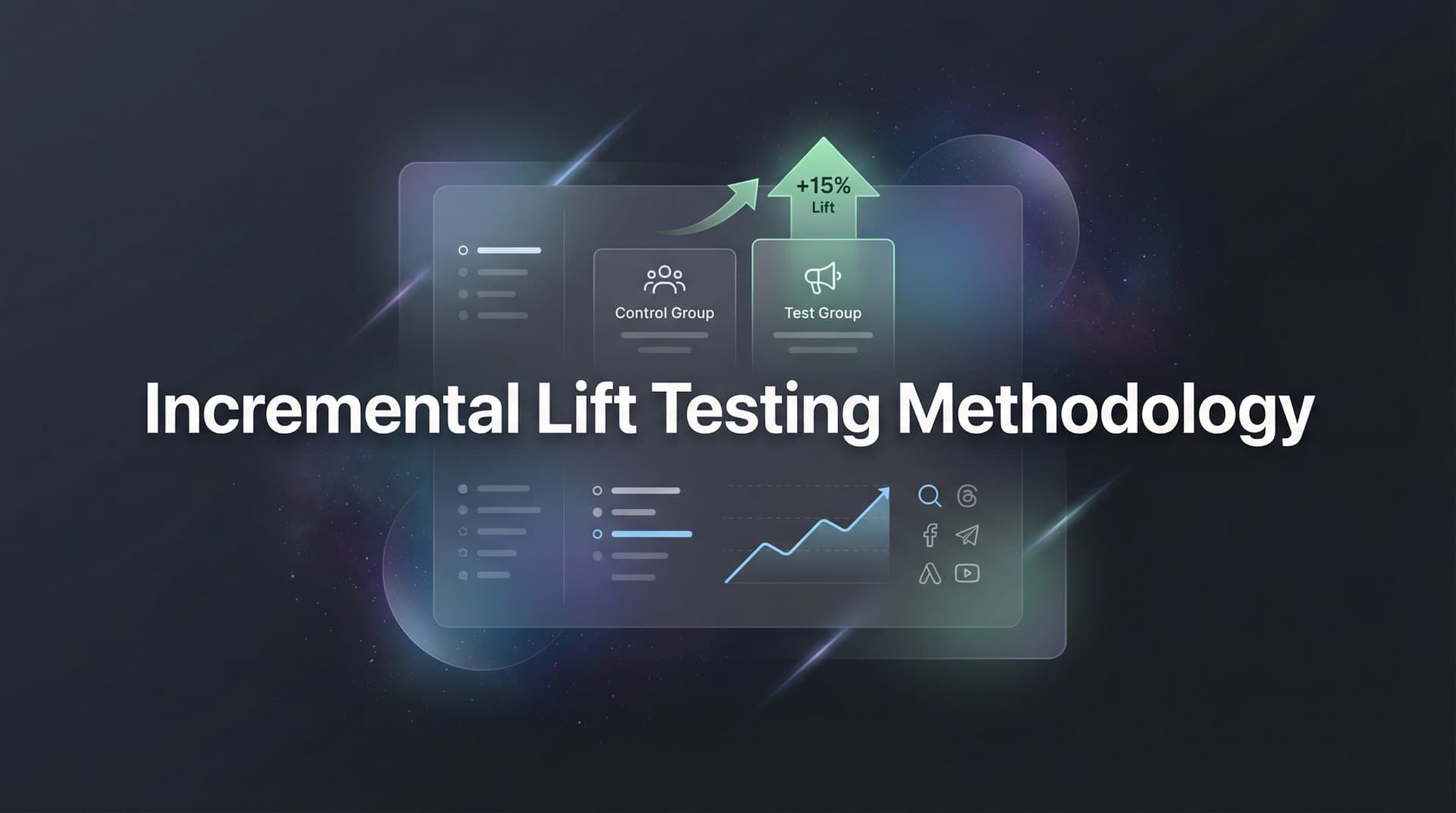
Incremental lift testing is the scientific method for measuring true advertising impact. Instead of tracking correlation, you're proving causation by comparing two groups: one exposed to your ads and one deliberately kept in the dark. The difference in conversion rates between these groups reveals your ads' real impact—the incremental lift they generate.
Why does this matter more than ever? Privacy changes have made traditional attribution increasingly unreliable. iOS tracking limitations, cookie deprecation, and stricter data regulations mean you're flying blind if you rely solely on last-click or multi-touch models. Lift testing sidesteps these challenges by measuring aggregate group behavior rather than individual user tracking.
Think of it like a clinical trial for your marketing. You wouldn't trust a drug company claiming their medication works without a control group, right? The same logic applies to your ad spend.
By the end of this guide, you'll know exactly how to design, execute, and analyze your own lift tests. You'll learn how to set up proper test and control groups, avoid common pitfalls that invalidate results, and calculate the true incremental value your campaigns deliver. Whether you're running Meta ads, Google campaigns, or multi-channel strategies, this methodology will transform how you prove marketing ROI.
Let's get started.
Step 1: Define Your Test Objective and Success Metrics
Before you touch a single campaign setting, you need crystal clarity on what you're actually testing. Fuzzy objectives lead to meaningless results.
Start by choosing your lift type. Are you measuring brand lift (awareness, consideration, brand recall), conversion lift (purchases, sign-ups, leads), or sales lift (revenue impact, average order value)? Each requires different measurement approaches and timelines.
For most performance marketers, conversion lift is the sweet spot. You're proving whether your ads drive actual business outcomes—purchases, qualified leads, or subscription sign-ups—not just awareness or clicks. Understanding what lift in conversion rate means is essential before designing your test.
Next, establish your primary KPI. This is the single metric that determines success or failure. If you're an e-commerce brand, it might be completed purchases. For SaaS companies, it could be free trial sign-ups or demo requests. Choose one metric that directly ties to revenue.
Don't stop there. Define 2-3 secondary metrics that provide context. If your primary KPI is purchases, secondary metrics might include average order value, time to conversion, or repeat purchase rate. These help you understand not just whether your ads work, but how they work.
Here's where it gets critical: determine your minimum detectable effect (MDE). This is the smallest lift percentage that would make the test worthwhile. If you need at least a 10% increase in conversions to justify your ad spend, that's your MDE. Setting this upfront prevents you from celebrating a statistically significant but economically meaningless 2% lift.
Your MDE directly influences your required sample size and test duration. Detecting a 5% lift requires a much larger sample than detecting a 20% lift. Be realistic about what matters for your business.
Finally, document your hypothesis clearly. Write it down: "We believe that our prospecting campaigns on Meta will generate at least a 15% lift in new customer acquisitions compared to organic conversion rates." This keeps you honest and prevents post-hoc rationalization of results.
A clear hypothesis also helps you design the right test. Are you testing a specific campaign, an entire channel, a new creative approach, or a budget increase? The tighter your focus, the more actionable your insights.
This upfront work feels tedious, but it's the foundation of valid results. Skip it, and you'll end up with data you can't interpret or action.
Step 2: Design Your Test and Control Groups
Your test design makes or breaks everything. Get this wrong, and you're measuring noise instead of signal.
First, determine your required sample size through power analysis. This statistical calculation tells you how many people need to be in each group to detect your minimum detectable effect with confidence. The math accounts for your baseline conversion rate, desired lift, and significance threshold.
Most marketers aim for 95% confidence (p-value of 0.05) and 80% power. If your baseline conversion rate is 3% and you want to detect a 15% lift, you might need 10,000 users per group. Lower baseline rates or smaller expected lifts require larger samples.
Don't have enough traffic? You'll need to extend your test duration or increase your MDE. There's no shortcut here—underpowered tests waste time and money.
Now choose your randomization method. You have three main options, each with tradeoffs.
Geographic holdouts: Exclude certain cities, states, or countries from seeing your ads. Compare conversion rates between exposed and holdout regions. This works well for broad awareness campaigns and eliminates individual-level tracking concerns. The downside? Regional differences in demographics, purchasing behavior, or seasonality can contaminate results.
Audience-based holdouts: Randomly split your target audience, withholding ads from the control group. This is the gold standard for digital campaigns because randomization eliminates systematic bias. Platforms like Meta and Google offer built-in tools for this. The challenge is ensuring true randomization and preventing control group members from seeing your ads elsewhere.
Time-based tests: Alternate exposure periods—run ads for two weeks, pause for two weeks, compare results. This is easier to implement but vulnerable to external factors like seasonality, promotions, or market changes that coincide with your on/off periods.
For most digital campaigns, audience-based holdouts deliver the cleanest results. Just ensure your platform's randomization is truly random and not influenced by factors like engagement history or likelihood to convert.
Here's the crucial part: your test and control groups must be truly comparable. They should match on demographics, past purchase behavior, engagement patterns, and any other factors that influence conversion likelihood. Randomization handles this automatically if done correctly, but verify it.
Check that your groups have similar age distributions, geographic spread, and historical conversion rates before the test starts. If your control group skews older or includes more previous customers, your results will be biased.
Calculate your test duration based on two factors: your conversion cycle and traffic volume. If customers typically take 7 days to convert after first exposure, your test needs to run at least 14 days—one full cycle plus buffer. Higher-consideration purchases require longer tests.
Traffic volume matters too. If you need 10,000 users per group and get 1,000 visitors daily, you'll need at least 20 days to reach sufficient sample size. Add extra time to account for weekday/weekend variations and ensure you capture full behavioral cycles.
Most lift tests run 2-4 weeks minimum. Shorter tests risk missing delayed conversions. Longer tests increase the chance of external factors contaminating results. Consider implementing an accelerated testing strategy to optimize your test timeline without sacrificing validity.
Step 3: Set Up Your Testing Infrastructure
Now comes the technical work that determines whether your data will be trustworthy.
Start by configuring holdout audiences in your ad platforms. Meta's Conversion Lift tool lets you create a holdout group directly within Ads Manager. You specify the percentage to withhold (typically 5-10% of your audience), and Meta randomly excludes them from seeing your ads while tracking their behavior.
Google offers similar functionality through Brand Lift and Conversion Lift studies. You'll work with your Google rep to set parameters, or use the self-serve tools in Google Ads for simpler tests.
The key is ensuring your holdout group is truly held out across all campaigns. If you're testing Meta's impact but also running Google ads to the same audience, your control group isn't really unexposed. Coordinate across channels or test one platform at a time.
Next, implement tracking that captures both groups' behavior. This is where many tests fail. You need to track conversions from both the exposed group (who saw ads) and the control group (who didn't) without relying on ad platform pixels alone.
Server-side tracking becomes essential here. Unlike browser-based pixels that rely on cookies, server-side tracking captures conversion events directly from your website or app backend and sends them to your analytics platform. This ensures you measure control group conversions accurately, even without ad interaction.
Connect your CRM and conversion events to track full-funnel impact. If you're measuring lead quality, not just lead volume, you need to see which leads from each group actually became customers. This requires integrating your ad platforms, website analytics, and CRM into a unified data flow. Improving your lead tracking process is fundamental to accurate lift measurement.
Attribution platforms excel at this infrastructure piece. They connect all your marketing touchpoints, capture conversion events across the customer journey, and provide the data foundation for accurate lift measurement. Without proper data connectivity, you're measuring incomplete pictures.
Before launching, verify data is flowing correctly. Run a small test campaign and confirm you're seeing conversions attributed to both test and control groups. Check that your tracking captures all conversion types—online purchases, offline sales, phone calls, form submissions.
Common pitfalls to avoid: Make sure your tracking pixels fire consistently across all pages. Verify that users aren't dropping out of groups mid-test due to cookie deletion or device switching. Confirm your conversion window matches your test duration—if you track 7-day conversions but run a 14-day test, you'll miss delayed impact.
Test your exclusion logic too. Spot-check that control group members genuinely aren't seeing your ads. Log into a test account, place yourself in the holdout group, and verify ads don't appear. It sounds basic, but misconfigured exclusions invalidate entire tests.
Double-check your event tracking schema. Are you measuring the same conversion event consistently across both groups? If the test group triggers a pixel on purchase confirmation but the control group only fires on checkout initiation, you're comparing apples to oranges.
This infrastructure work isn't glamorous, but it's non-negotiable. Garbage in, garbage out applies ruthlessly to lift testing.
Step 4: Launch and Monitor Your Lift Test
You're ready to launch. But first, run through your pre-flight checklist.
Verify audience sizes match your power analysis requirements. If you calculated you need 10,000 per group but only have 7,000 in your holdout, either extend the test duration or adjust your minimum detectable effect expectations. Launching with insufficient sample size guarantees inconclusive results.
Check tracking pixels one final time. Fire test conversions and confirm they appear in both your ad platform reporting and your analytics dashboard. Verify the data matches—if your analytics shows 100 conversions but your ad platform shows 85, you have a tracking gap to fix before launching. Understanding ad platform reporting discrepancies helps you identify and resolve these issues.
Review budget allocation. Your test group should receive the full campaign budget you'd normally spend. Don't artificially reduce spend because you're running a test—that changes the variable you're measuring. The point is to measure normal campaign performance, not reduced-budget performance.
Once live, resist the urge to peek at results prematurely. This is where most marketers sabotage their own tests. Checking results daily and making decisions based on early data introduces bias and invalidates statistical significance.
Set monitoring checkpoints instead. If you're running a 21-day test, check in at day 7 and day 14—not to evaluate results, but to ensure everything is running correctly. Look for technical issues, not performance metrics.
What should you monitor? Watch for contamination between groups. If control group members start seeing your ads due to misconfigured exclusions or audience overlap with other campaigns, your test is compromised. Monitor impression delivery to the holdout group—it should be zero.
Keep an eye on external factors that could skew results. Did a major competitor launch a campaign mid-test? Did you run an unexpected promotion? Did a viral social media moment drive organic traffic? Document these events. They don't necessarily invalidate your test, but they provide context for interpretation.
Track your conversion volume daily. If you're getting far fewer conversions than projected, you may need to extend the test to reach statistical significance. Conversely, if you're seeing dramatically higher volume, you might reach conclusions faster.
Know when to extend, pause, or stop early. Extend if you're not reaching sufficient sample size by your planned end date. Pause if you discover technical issues—fix them, then restart with fresh data. Stop early only if you detect serious problems that invalidate the test, not because early results look good or bad.
The hardest part of this step is patience. Your instinct will be to optimize, adjust, or react to what you're seeing. Don't. Let the test run its full course. Disciplined execution beats clever optimization every time in lift testing.
Step 5: Analyze Results and Calculate True Incremental Lift
Your test is complete. Now comes the moment of truth: what did you actually learn?
Start by calculating your lift percentage using this formula: (Test group conversion rate - Control group conversion rate) / Control group conversion rate. If your test group converted at 3.3% and your control group at 2.8%, your lift is (3.3 - 2.8) / 2.8 = 17.9%.
This tells you that your ads drove an 18% increase in conversions beyond what would have happened organically. That's your incremental impact. Understanding incrementality in marketing helps you interpret these results in the broader context of your strategy.
But wait—is that result real or just random chance? This is where statistical significance comes in. Calculate your p-value using a standard proportion test. If your p-value is below 0.05, you can be 95% confident your result isn't due to random variation.
Most statistical calculators or platforms will compute this automatically. Input your test and control group sizes and conversion counts, and you'll get a significance indicator. No significance? Your test was either underpowered, ran too short, or your ads genuinely don't drive incremental lift.
Don't confuse statistical significance with practical significance. A statistically significant 3% lift might not justify your ad spend. This is why you set your minimum detectable effect upfront. Did you meet or exceed it? If not, your ads may work, but not well enough.
Now calculate incremental cost per acquisition. Take your total ad spend and divide by the incremental conversions (not total conversions). If you spent 10,000 dollars and generated 500 conversions in the test group versus 400 in the control group, your incremental CPA is 10,000 dollars / 100 = 100 dollars per incremental conversion.
This number matters more than your platform-reported CPA because it reflects true new business, not conversions that would have happened anyway. Measuring incremental revenue gives you the clearest picture of your campaign's actual financial impact.
Calculate true ROAS the same way. If those 100 incremental conversions generated 15,000 dollars in revenue, your incremental ROAS is 1.5x. Compare this to your target ROAS to determine campaign viability.
Here's where it gets interesting: dig into segment-level insights. Break down your results by audience characteristics, geographic regions, or device types. You might discover that your ads drive 30% lift among new customers but only 5% among existing customers. Or that mobile users show twice the lift of desktop users.
These segments reveal where your ads deliver real value versus where you're wasting spend on people who'd convert anyway. Look for patterns in demographics, behaviors, or contextual factors that correlate with higher incremental lift.
Analyze the conversion funnel too. Did your ads drive lift in top-funnel actions (site visits, product views) but not bottom-funnel conversions? That suggests awareness impact without purchase influence. Did you see lift in conversions but not in average order value? Your ads drive volume but not necessarily high-value customers.
Document everything: your methodology, sample sizes, test duration, results, and confidence levels. Future you (and your CFO) will want this documentation when making budget decisions or designing follow-up tests.
One final consideration: look at your control group's conversion rate. If it's surprisingly high, your organic/brand strength is doing heavy lifting. If it's very low, your ads are essential for driving any conversions at all. Both scenarios inform strategy differently.
Step 6: Apply Insights to Optimize Your Marketing Strategy
Data without action is just expensive trivia. Now you need to actually use what you learned.
Start with budget reallocation. If your lift test proved a channel or campaign drives strong incremental impact, shift more budget there. If another showed minimal lift, reduce or eliminate that spend. This sounds obvious, but many marketers keep funding campaigns out of habit rather than evidence. Addressing ad spend optimization challenges becomes much easier with lift test data backing your decisions.
Be strategic about reallocation timing. Don't slash budgets immediately if you find low lift—test different creative, audiences, or messaging first. A poorly performing campaign might just need optimization, not elimination.
Combine lift test findings with multi-touch attribution for a complete picture. Lift testing proves your ads drive incremental value. Attribution shows which touchpoints contribute along the customer journey. Together, they tell you both "do my ads work?" and "which specific tactics work best?"
For example, your lift test might prove Meta ads drive 20% incremental lift overall. Your attribution data can then show that video ads drive more lift than static images, or that retargeting delivers higher lift than prospecting. Layer these insights to optimize at both strategic and tactical levels.
Server-side tracking and robust ad attribution tools make this combination possible. They provide the data infrastructure to measure lift accurately while also tracking detailed touchpoint interactions. Without this foundation, you're stuck choosing between proving impact and understanding tactics.
Build a testing roadmap based on your findings. What should you test next? If you just validated Meta's impact, test Google next. If prospecting campaigns showed high lift, test different prospecting audience strategies against each other. If creative A outperformed creative B, test variations of creative A's approach.
Prioritize tests by potential impact and learning value. Test big budget items first—proving or disproving a major channel's effectiveness matters more than optimizing a small experimental campaign. Test hypotheses that could fundamentally shift your strategy over minor tactical tweaks.
Create benchmarks for future tests. Your first lift test establishes a baseline: "Our Meta prospecting campaigns typically drive 15-20% incremental lift." Future tests can measure whether new strategies beat this benchmark. Over time, you'll build an evidence base that guides all marketing decisions.
Document your learnings in a format your team can reference. Create a simple database: test objective, methodology, results, confidence level, and strategic implications. When someone proposes a new campaign idea, you can check whether you've already tested something similar and what you learned.
Share results beyond the marketing team. Your CFO needs to understand that not all conversions are incremental—it changes how they should evaluate marketing ROI. Your executive team should know which channels truly drive growth versus which ones get credit for inevitable conversions. Lift testing transforms marketing from a cost center to a growth driver with provable impact.
Finally, make lift testing a regular discipline, not a one-time project. Run tests quarterly on major channels, annually on smaller tactics, and ad-hoc when launching significant new strategies. The marketing landscape changes constantly—what drove lift last year might not work today.
Putting It All Together
You now have a complete methodology for proving your marketing's true impact. Let's recap the six essential steps:
Step 1: Define your test objective, primary KPI, and minimum detectable effect before starting.
Step 2: Design properly sized test and control groups using randomization that ensures comparability.
Step 3: Set up tracking infrastructure that accurately measures both groups' behavior across the full conversion funnel.
Step 4: Launch with discipline, monitor for technical issues without peeking at results, and let the test run its full course.
Step 5: Calculate incremental lift, assess statistical significance, and dig into segment-level insights that reveal where your ads truly drive value.
Step 6: Apply learnings to reallocate budget, optimize tactics, and build a continuous testing program that keeps improving your marketing effectiveness.
Incremental lift testing transforms marketing from educated guessing to scientific proof. You're no longer wondering whether your ads work—you're measuring exactly how much value they create and where to invest for maximum impact.
The beauty of this methodology is that it works regardless of privacy changes, tracking limitations, or platform restrictions. You're measuring aggregate group behavior, not individual user tracking. As the digital landscape becomes more complex, lift testing becomes more valuable.
Start small if you're new to this. Pick one major channel or campaign, run a focused test, and learn the process. The insights from your first test will pay for themselves many times over in optimized budget allocation.
As you build your testing program, remember that lift testing and attribution are complementary, not competing approaches. Lift testing proves causation at the campaign level. Attribution reveals contribution at the touchpoint level. Modern marketing requires both.
The infrastructure matters tremendously. Accurate tracking, proper data connectivity, and reliable conversion measurement separate valid tests from wasted effort. Investing in robust attribution software that supports lift testing methodology gives you the foundation for confident decision-making.
Ready to elevate your marketing game with precision and confidence? Discover how Cometly's AI-driven recommendations can transform your ad strategy—Get your free demo today and start capturing every touchpoint to maximize your conversions.