
Your marketing dashboard shows strong numbers. Ad platforms report hundreds of conversions. Your team hit every spend target this month. Then you sit down with the sales team, and the story changes completely. Revenue is down. Pipeline quality feels thin. The conversions you celebrated don't match the customers who actually bought.
This disconnect isn't random. It's the symptom of attribution gaps, the invisible cracks in your tracking where customer touchpoints disappear, get misattributed, or simply never get recorded at all. These blind spots don't just skew your reports. They actively drain your budget by making losing campaigns look like winners while your best-performing channels get starved of investment.
When you can't see which marketing efforts truly drive revenue, every budget decision becomes a gamble. You scale campaigns based on phantom conversions. You cut spend from channels doing the heavy lifting. And your competitors who solved this problem? They're optimizing with clarity while you're flying blind.
Why Your Marketing Data Has Blind Spots
The customer journey used to be straightforward. Someone saw an ad, clicked through, and converted in a single session. Clean. Trackable. Simple.
Those days are gone.
Today's prospects research across devices, platforms, and sessions before making a decision. They might see your Facebook ad on their phone during their morning commute, research your product on their work laptop during lunch, read reviews on their tablet that evening, and finally convert on desktop three days later. Each of these touchpoints happens in a different environment with different tracking capabilities.
This fragmentation creates natural tracking challenges, but technical barriers have made the problem exponentially worse. Apple's App Tracking Transparency framework fundamentally changed mobile attribution by requiring explicit user permission to track across apps and websites. The result? Most iOS users opted out, creating a massive blind spot for any marketing activity involving mobile devices. Understanding lost conversion data from iOS has become essential for modern marketers.
Browser restrictions compound the issue. Safari's Intelligent Tracking Prevention and Firefox's Enhanced Tracking Protection actively block third-party cookies and limit first-party cookie lifespans. Even Chrome, despite delaying its cookie deprecation timeline, has signaled the end of traditional cookie-based tracking. When your tracking relies on cookies that browsers actively block or delete, gaps become inevitable.
Ad blockers add another layer of interference. Millions of users browse with extensions that prevent marketing pixels from firing. These users interact with your content, click your ads, and sometimes convert, but your tracking systems never see them. They exist in your funnel as ghosts, invisible to your attribution models.
Cross-domain tracking failures create particularly frustrating gaps. A prospect clicks your ad and lands on your main website. They navigate to your checkout page hosted on a different domain or subdomain. Without proper configuration, that session breaks. The conversion happens, but the connection to the original ad click gets lost. Your attribution system sees a direct conversion with no marketing source.
Platform data silos make everything worse. Meta claims credit for a conversion based on its view-through and click-through windows. Google does the same with its own attribution logic. TikTok reports its numbers independently. Each platform optimizes for making its own performance look strong, not for showing you the complete picture.
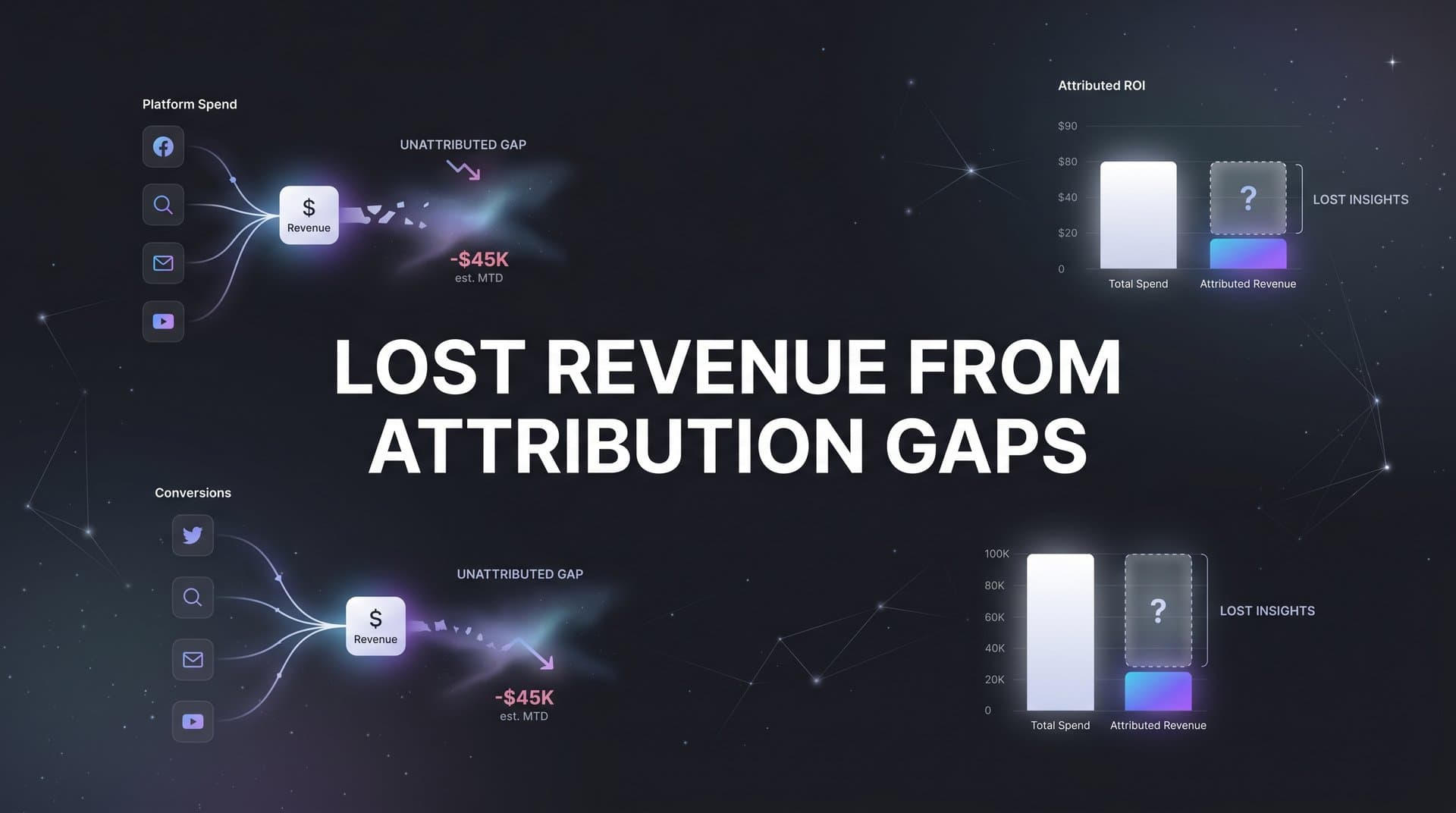
The math stops making sense quickly. Add up all the conversions your platforms report, and you might see 500 conversions this month. Check your actual customer database? You acquired 300 new customers. The 200-conversion gap represents overlapping attribution where multiple platforms claimed the same customer, or phantom conversions that never actually completed.
The Real Cost of Flying Blind on Attribution
Attribution gaps don't just create reporting headaches. They actively destroy marketing efficiency by making bad campaigns look good and good campaigns look mediocre.
Budget misallocation becomes systematic when your data lies to you. Imagine you're running campaigns across Meta, Google, and TikTok. Meta reports a strong return on ad spend based on last-click attribution. You increase Meta's budget. But what you can't see is that most of those "Meta conversions" actually started with TikTok awareness campaigns or Google search ads. Meta got credit for closing deals that other channels opened. This is a classic case of revenue attribution to wrong campaigns.
You just rewarded the wrong channel and starved the campaigns actually driving demand.
This pattern repeats across your entire marketing mix. Retargeting campaigns look incredibly efficient because they capture people already interested in your product. You scale retargeting spend. Meanwhile, the top-of-funnel campaigns that created that interest in the first place show weaker attribution metrics and get their budgets cut. You've optimized for the last touchpoint while killing the campaigns that made conversions possible.
Scaling failures emerge when you try to grow based on incomplete data. A campaign shows a strong cost per acquisition in your dashboard. You triple the budget expecting proportional results. Instead, performance collapses. Why? The original performance metrics were inflated by attribution gaps. The campaign was taking credit for conversions it didn't drive. When you scaled, you discovered its true, much weaker performance.
The opposite scenario hurts just as much. You have a campaign generating genuine revenue, but attribution gaps hide its contribution. The numbers look mediocre. You keep it at minimal spend or pause it entirely. You just killed a profitable growth channel because your tracking couldn't see its real impact.
Opportunity cost might be the most expensive consequence. Every dollar you spend on a channel with inflated attribution is a dollar you didn't invest in channels with verified impact. Your best campaigns remain underfunded while underperformers consume budget. The gap between your actual results and your potential results grows with every budget cycle.
Teams lose confidence in their data, and that uncertainty paralyzes decision-making. When you can't trust your metrics, every optimization becomes a guess. Should you increase bids? Expand to new audiences? Test different creative? Without reliable attribution, you're optimizing in the dark.
Common Attribution Gap Scenarios Marketers Face
Attribution gaps manifest in predictable patterns. Understanding these scenarios helps you recognize when your own data might be compromised.
The vanishing mobile user represents one of the most common gaps. A prospect scrolls Instagram on their iPhone during their commute. They see your ad, tap through, and browse your product pages. They're interested but not ready to buy on a small screen. Later that day, they open their work laptop, search for your brand on Google, and convert. Your tracking sees two completely separate sessions with no connection between them.
Google gets credit for a branded search conversion. Meta's awareness campaign that created the initial interest? It shows zero conversions. You might conclude that Instagram ads don't work and shift budget to Google branded search. In reality, you just defunded the channel creating demand and increased spend on the channel capturing existing demand.
The CRM disconnect creates gaps between marketing and sales data. Your marketing automation platform tracks a lead from first touch through multiple interactions. That lead converts to a sales opportunity. But when the lead enters your CRM, the original source attribution gets lost or overwritten. Sales closes the deal weeks later, and your revenue reports show "direct" or "unknown" as the source. This is why revenue attribution software for B2B has become critical for connecting marketing to sales outcomes.
Your best lead generation campaigns show conversions but no revenue. Your CFO questions marketing ROI because the revenue can't be connected back to marketing spend. The attribution gap makes profitable marketing look like a cost center.
The multi-touch mystery affects almost every B2B purchase and many high-consideration consumer decisions. A prospect's journey might include seeing a LinkedIn ad, clicking a Google search result, downloading a lead magnet from an email campaign, attending a webinar, and finally requesting a demo after seeing a retargeting ad.
Five touchpoints across three platforms over two weeks. Last-click attribution gives 100% credit to the retargeting ad. First-click attribution credits LinkedIn entirely. Both models ignore the middle touchpoints that nurtured the prospect toward conversion. Without multi-touch visibility, you can't see which combination of channels actually drives results.
The result? You optimize for individual channel performance metrics that don't reflect how channels work together. You might cut the LinkedIn awareness campaign because it shows weak last-click conversions, not realizing it's essential for starting journeys that other channels finish.
Identifying Attribution Gaps in Your Own Data
Attribution gaps leave fingerprints. Learning to recognize these warning signs helps you diagnose problems before they drain significant budget.
Large discrepancies between platform-reported conversions and actual revenue represent the clearest red flag. Pull your conversion totals from each ad platform. Add them up. Now compare that sum to your actual customer acquisition numbers from your CRM or payment processor. If platform-reported conversions exceed actual customers by more than 10-15%, you have significant attribution overlap or phantom conversions. Learning how to fix attribution data discrepancies should be a priority.
This gap often widens for businesses with longer sales cycles. The more touchpoints involved in a typical customer journey, the more opportunities for multiple platforms to claim credit for the same conversion.
Unexplained drops in attributed conversions following privacy updates signal tracking breakage. Many marketers saw iOS-attributed conversions plummet after iOS 14.5 launched. If your actual revenue stayed stable while platform-reported conversions dropped dramatically, you didn't lose real performance. You lost tracking visibility. The conversions still happened. Your attribution system just can't see them anymore.
Revenue per conversion discrepancies point to attribution quality issues. Calculate the average revenue per conversion according to your ad platforms. Now calculate actual average customer value from your financial data. If there's a significant gap, your attribution is counting low-quality or phantom conversions that don't represent real customers.
Audit your tracking setup systematically. Check every conversion pixel on your key pages. Are they firing correctly? Use browser developer tools or tag management preview modes to verify. A single broken pixel can create a gap affecting thousands of conversions.
Examine your UTM parameter usage. Pull a sample of recent conversions from your analytics platform. How many show "direct" or "none" as the source? If more than 20% of your conversions lack source attribution, you have a UTM implementation problem. Traffic is reaching your site without proper tracking parameters.
Test your cross-domain tracking if you use multiple domains or subdomains. Start a session on your main site with UTM parameters. Navigate to your checkout or subdomain. Check if the source attribution persists. If it doesn't, you're losing attribution every time users cross domains.
Compare attribution models within the same platform. Google Analytics and most ad platforms let you view conversions under different attribution models simultaneously. Look at last-click, first-click, and linear attribution for the same time period. Minor differences are normal. If the models show wildly different channel performance, you likely have significant tracking gaps that different models expose in different ways.
Review your CRM integration. Trace several recent customers from their first marketing touchpoint through to closed revenue. Does the source attribution remain consistent? If marketing source data gets lost or changed as leads move through your funnel, you have a CRM attribution gap that's breaking the connection between marketing spend and revenue.
Closing the Gaps: Building Complete Customer Journey Visibility
Solving attribution gaps requires moving beyond traditional browser-based tracking to systems designed for today's fragmented, privacy-focused environment.
Server-side tracking fundamentally changes how you capture conversion data. Instead of relying on browser pixels that can be blocked, restricted, or deleted, server-side tracking captures events directly from your server when conversions happen. A customer completes a purchase? Your server sends that conversion data to your analytics and ad platforms regardless of browser settings, cookie restrictions, or ad blockers. This approach directly addresses lost revenue from tracking gaps.
This approach bypasses the technical barriers creating most attribution gaps. iOS privacy settings can't block server-to-server communication. Browser cookie restrictions don't affect server-side data collection. Ad blockers can't prevent your server from reporting conversions that happened in your database.
Implementation requires technical setup, but the tracking accuracy improvement justifies the effort. You connect your server environment to your marketing platforms through APIs. When a conversion event occurs in your system, your server sends that data directly to Meta, Google, and other platforms using their Conversions API or similar server-side endpoints.
Unified data sources solve the platform silo problem by creating a single source of truth that connects all your marketing touchpoints. This means integrating your ad platforms, website analytics, CRM, and revenue data into one system that tracks the complete customer journey. Implementing proper revenue attribution tracking tools makes this integration possible.
The goal is to follow individual customers across every interaction. When someone clicks a Meta ad, that touchpoint gets recorded with a unique identifier. When they later convert through a Google search, that touchpoint connects to the same customer profile. When they close as revenue in your CRM, that outcome links back to both touchpoints.
This unified view reveals the true path to conversion. You can see that a customer had five touchpoints across three platforms before purchasing. You can calculate the actual contribution of each channel rather than relying on single-touch attribution models that oversimplify complex journeys.
Multi-touch attribution models distribute credit across all touchpoints in a customer journey rather than giving 100% credit to one interaction. Different models use different logic for credit distribution. Linear attribution divides credit equally among all touchpoints. Time-decay attribution gives more credit to recent interactions. Position-based attribution emphasizes first and last touches while still acknowledging middle interactions.
The specific model matters less than moving beyond last-click attribution. When you can see how channels work together throughout the customer journey, you make fundamentally different budget decisions. You recognize that awareness channels create demand that conversion channels capture. You understand which channel combinations drive the best results. For a deeper dive, explore multi-touch attribution models for data.
Multi-touch attribution requires the unified data foundation described above. You can't attribute credit across touchpoints if you can't track those touchpoints to the same customer. Invest in the infrastructure first, then apply the attribution models that reveal true channel performance.
Turning Accurate Attribution Into Revenue Growth
Closing attribution gaps gives you a competitive advantage, but only if you act on the insights accurate data reveals.
Confident budget reallocation becomes possible when you trust your attribution data. You can identify channels with verified revenue impact rather than inflated platform metrics. That awareness campaign that showed weak last-click conversions? With multi-touch attribution, you see it initiates 40% of your highest-value customer journeys. You increase its budget with confidence.
That retargeting campaign with impressive conversion rates? You now see it rarely converts customers who haven't already interacted with other channels. It's effective as part of a multi-channel strategy but can't drive growth independently. You right-size its budget accordingly. Understanding revenue attribution by marketing channel enables these precise adjustments.
These reallocation decisions compound over time. Every budget cycle, you shift more spend toward channels with proven impact and away from channels taking credit for others' work. Your overall marketing efficiency improves even if total spend stays constant.
Feeding better data back to ad platforms creates a virtuous cycle of improved performance. Meta's algorithm optimizes toward the conversion events you send it. Google's Smart Bidding adjusts based on the conversion data it receives. When that data is incomplete or inaccurate, these algorithms optimize toward the wrong signals.
Server-side tracking and accurate attribution let you send platforms complete, reliable conversion data. The algorithms see which ads actually drive revenue, not just which ads get last-click credit. They identify patterns in truly successful campaigns rather than patterns in attribution anomalies. Their optimization improves because their training data improves.
This feedback loop accelerates over time. Better data leads to better algorithmic optimization, which leads to better campaign performance, which generates more data to further improve optimization. Marketers who solve attribution gaps don't just see current performance more clearly. They enable their campaigns to improve faster.
Building a culture of data-driven decisions requires trust in your data. When attribution gaps create uncertainty, teams fall back on intuition, politics, or outdated assumptions. The loudest voice in the room wins budget debates. Decisions get made based on vanity metrics that don't connect to revenue.
Accurate attribution changes the conversation. You can test hypotheses and measure real outcomes. You can experiment with new channels knowing you'll see their true impact. You can scale successful campaigns confidently because your data shows verified results rather than attribution artifacts.
Moving Forward with Clarity
Attribution gaps aren't an inevitable cost of modern marketing. They're a solvable technical problem that most of your competitors haven't addressed yet.
Start by identifying where your tracking breaks down. Audit your conversion data for the warning signs discussed earlier. Look for discrepancies between platform metrics and actual revenue. Test your tracking setup for broken pixels, missing parameters, and cross-domain failures. Quantify the gap so you understand the scale of the problem.
Implement server-side tracking to bypass browser-based limitations. This single change eliminates the majority of technical barriers creating attribution gaps. Your conversion data becomes reliable regardless of privacy settings, cookie restrictions, or ad blockers.
Build unified data connections that link ad platforms, analytics, CRM, and revenue systems into a single source of truth. This infrastructure lets you track complete customer journeys rather than disconnected touchpoints. You gain the visibility needed for meaningful multi-touch attribution.
Adopt attribution models that reflect how customers actually buy. Move beyond last-click attribution to models that acknowledge the multiple touchpoints involved in most conversions. Use these insights to make smarter budget decisions that fund the full customer journey, not just the final interaction.
The marketers who solve attribution gaps gain a compounding advantage. They allocate budgets more efficiently. They feed better data to ad platform algorithms. They scale with confidence based on verified performance rather than inflated metrics. Meanwhile, competitors flying blind continue funding the wrong channels and wondering why growth stalls.
Your attribution gaps represent hidden revenue waiting to be unlocked. Every dollar currently wasted on misattributed performance is a dollar that could fund genuine growth. Every high-performing campaign starved of budget is an opportunity to scale. The question isn't whether you can afford to fix attribution. It's whether you can afford not to.
Ready to elevate your marketing game with precision and confidence? Discover how Cometly's AI-driven recommendations can transform your ad strategy. Get your free demo today and start capturing every touchpoint to maximize your conversions.