

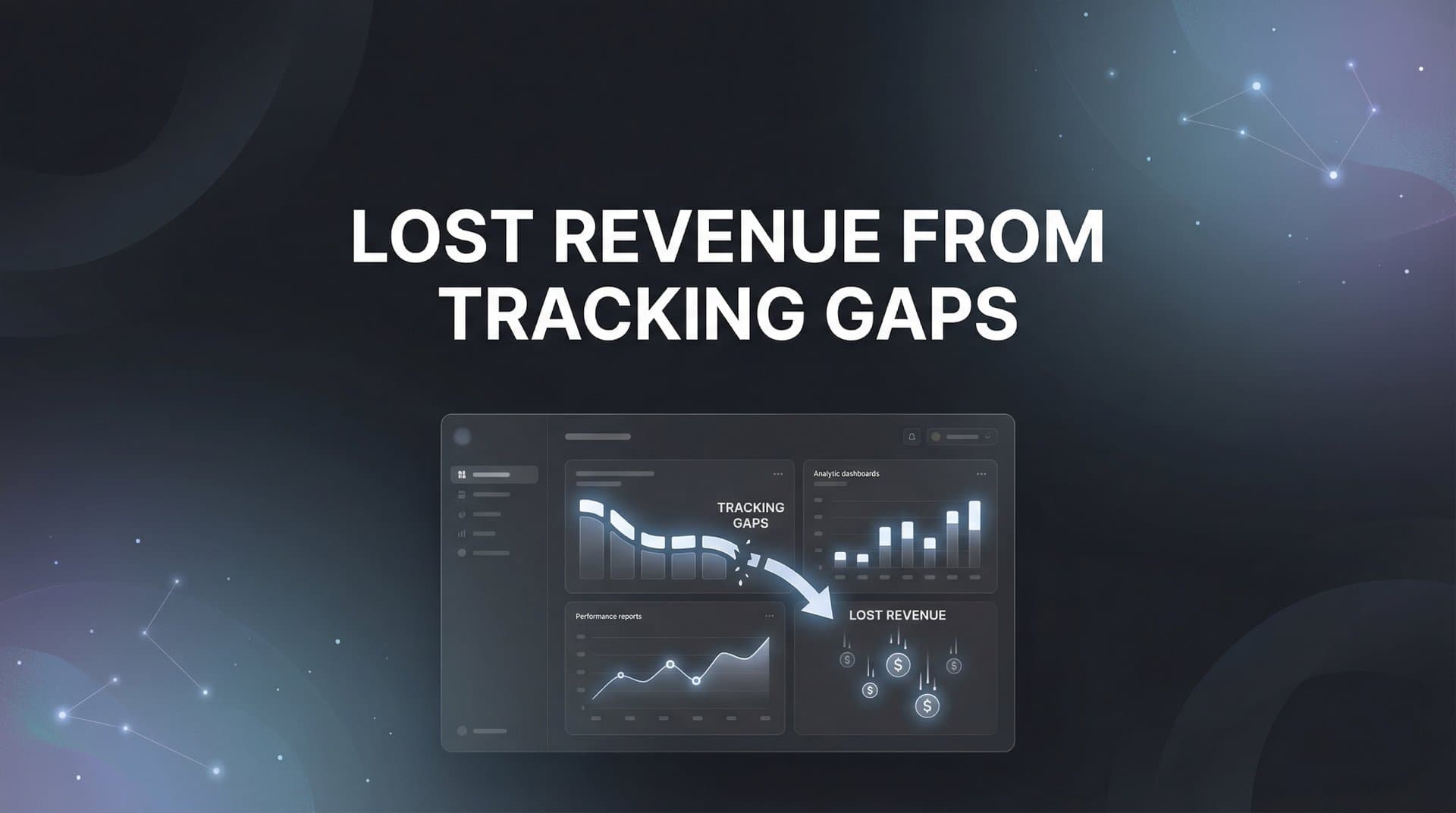
Your Facebook Ads Manager shows a 3.2x ROAS. Google Analytics reports strong conversion numbers. Your team is celebrating what looks like a winning quarter. Then you sit down with your CFO to review actual revenue, and the numbers don't match. Not even close.
This disconnect isn't a fluke or a reporting error. It's the result of tracking gaps—invisible holes in your marketing data that silently drain your budget while feeding your ad platforms incomplete information. Every missed conversion, every untracked touchpoint, and every customer journey that falls through the cracks represents not just lost attribution, but lost revenue.
The problem has grown more severe as privacy regulations tighten and customer journeys become increasingly complex. What used to be a simple click-to-purchase path now spans multiple devices, platforms, and sessions over days or weeks. Your tracking setup might have worked perfectly two years ago, but today's digital landscape demands a different approach. The stakes are higher than most marketers realize: tracking gaps don't just obscure your reporting—they actively sabotage your campaign performance by feeding ad platforms the wrong optimization signals.
The Hidden Cost of Blind Spots in Your Marketing Data
Tracking gaps represent the disconnect between what your ad platforms report and what actually drives revenue in your business. When someone clicks your Facebook ad on their phone during lunch, researches your product on their work laptop that afternoon, and finally converts three days later by typing your URL directly into their browser, most tracking setups will completely miss that attribution chain.
The immediate consequence seems manageable—you lose visibility into which campaign deserves credit. But the real damage runs deeper. Every tracking gap creates a cascade of poor decisions that compounds over time.
When your data shows incomplete conversion patterns, you make budget allocation decisions based on fiction. That high-performing campaign might be getting credit for conversions it didn't drive, while the actual revenue generators appear to underperform. You scale the wrong campaigns, pause the profitable ones, and wonder why your overall ROAS keeps declining despite "optimizing" constantly.
The feedback loop gets worse. Ad platforms like Facebook and Google rely on conversion data to train their machine learning algorithms. When you feed them incomplete information—missing conversions, delayed attribution, or events that never fire—their algorithms optimize toward the wrong audience signals. Facebook's algorithm thinks your best customers look like the subset of people whose conversions you actually tracked, not the full picture of who's really buying.
This creates a negative spiral. Poor data leads to poor targeting. Poor targeting leads to worse performance. Worse performance leads to more budget waste, which generates even more incomplete data as you scramble to test new approaches. Understanding advertising campaign tracking gaps is the first step toward breaking this cycle.
Modern privacy changes have intensified these challenges dramatically. Apple's App Tracking Transparency framework, introduced in 2021, fundamentally changed how conversion data flows from iOS devices. Cookie deprecation continues to erode browser-based tracking reliability. Cross-device journeys—already complex—now face additional barriers as users become more privacy-conscious and tracking technologies become more restricted.
The gap between platform-reported metrics and actual business outcomes has widened into a chasm. Many marketing teams now operate in a state of partial blindness, making million-dollar decisions based on data they know is incomplete but don't know how to fix.
Five Common Tracking Gaps Draining Your Ad Budget
Cross-Platform Attribution Failures: Your customer's journey rarely stays within a single platform's ecosystem. Someone discovers your brand through a Facebook ad, clicks through to read reviews on Google, watches a YouTube video about your product, and finally converts after clicking a retargeting ad on Instagram. Each platform wants to claim that conversion, but the reality is messier.
We compare the leading options in our UGC video generator roundup.
Most tracking setups use last-click attribution by default, crediting whichever platform happened to be the final touchpoint before purchase. This systematically undervalues awareness and consideration channels while over-crediting bottom-funnel retargeting. Implementing cross-platform attribution tracking helps you see the complete picture instead of isolated platform silos.
The problem intensifies when customers switch devices. That Facebook ad they clicked on their iPhone during their morning commute? The conversion that happens on their desktop computer at home won't connect back to that initial touchpoint in most tracking setups. The customer journey appears to start with direct traffic or organic search when it actually began with paid social.
For a deeper dive, see our guide to free AI UGC video generator.
Offline and CRM Disconnects: Not every conversion happens with a pixel firing in the background. Phone calls generated by your ads don't automatically report back to Google or Facebook. In-person sales triggered by digital marketing campaigns remain invisible to your ad platforms. B2B deals that close weeks or months after the initial ad interaction never get attributed back to the campaigns that started the relationship.
For a deeper dive into this space, see our AI UGC video generator guide.
Your CRM holds the truth about which leads actually convert to revenue, but that data sits in a separate system from your marketing analytics. When a lead fills out a form on your website, your pixel fires and reports a conversion. But if that lead never becomes a customer—or if they convert three months later through a sales team closing process—your ad platforms never receive that crucial feedback. Learning about tracking closed won revenue can help bridge this critical gap.
This disconnect is particularly damaging for businesses with longer sales cycles. Your ad platforms optimize for form fills or demo requests, not actual revenue. They learn to find more people who will fill out forms, which may or may not correlate with people who actually buy. Meanwhile, your highest-value customers might come from campaigns that show poor conversion rates in platform reporting because the real conversion happens offline.
Server-Side Tracking Gaps: Browser-based pixels—the foundation of most marketing tracking—are increasingly unreliable. Ad blockers prevent pixels from loading entirely. Privacy-focused browsers like Safari and Firefox restrict third-party cookies and limit tracking capabilities. Users who clear their cookies regularly break the attribution chain. Slow-loading pages might complete a conversion before the tracking pixel has time to fire.
When you rely exclusively on client-side tracking, you're building your attribution system on a foundation that's crumbling. The percentage of conversions that go completely untracked varies by audience, but privacy-conscious users and mobile Safari traffic present particularly severe blind spots. Your data doesn't just have gaps—it has systematic biases that skew toward less privacy-aware users while missing your most cautious customers.
Server-side tracking solves this by sending conversion data directly from your server to ad platforms, bypassing browser limitations entirely. Understanding the differences between server-side tracking vs pixel tracking is essential for building reliable attribution infrastructure.
How to Identify Revenue Leaks in Your Current Setup
The first step to fixing tracking gaps is recognizing they exist. Start by comparing your ad platform conversion reports against your actual revenue data. Pull your total conversions from Facebook Ads Manager and Google Ads for the last month. Now compare that number to your actual sales, leads, or revenue from your CRM or analytics platform for the same period.
If the numbers match perfectly, you either have exceptional tracking or you're not looking closely enough. Most businesses discover a significant discrepancy—sometimes platform-reported conversions exceed actual sales, sometimes they fall short. Both scenarios indicate tracking problems that need investigation.
When platforms over-report conversions, you're likely dealing with duplicate tracking, test purchases being counted, or conversion events firing for actions that don't represent real business value. When they under-report, you're experiencing the tracking gaps we've been discussing—conversions happening that your pixels and platforms never see. Implementing proper conversion tracking analytics helps you identify these discrepancies systematically.
Next, audit your customer journey for invisible touchpoints. Map out every way a customer can interact with your brand: email clicks, organic search visits, direct traffic, social media engagement, content downloads, webinar attendance, phone calls, in-person interactions. Now identify which of these touchpoints your current tracking setup actually captures and attributes back to marketing sources.
The gaps in your coverage reveal where revenue is leaking. That email campaign that drives significant traffic but shows zero conversions in your ad platform reporting? Those visitors are converting—they're just not being tracked properly. Direct traffic that spikes after you run major ad campaigns? Many of those are people who saw your ads but typed your URL directly instead of clicking, breaking the attribution chain.
Look for signs that your ad platforms are optimizing poorly due to incomplete data. Rising cost per acquisition despite steady or improving actual business metrics suggests your platforms are working with bad information. Campaigns that should logically perform well—targeting your best customer segments with proven offers—but show disappointing results in platform reporting often indicate attribution failures rather than genuine underperformance.
Pay special attention to mobile traffic, particularly from iOS devices. If your conversion rates from iOS users are dramatically lower than Android or desktop, you're likely experiencing tracking gaps from App Tracking Transparency restrictions. The customers are still converting—you're just not seeing it in your data. Addressing cross-device attribution tracking challenges becomes essential in this mobile-first environment.
Review your conversion lag time. How long does it typically take from first touch to conversion? If your business has a multi-day or multi-week consideration period, but your ad platforms are using short attribution windows (like Facebook's default seven-day click window), you're systematically missing delayed conversions. Your data shows campaigns failing when they're actually succeeding—the success just happens outside your tracking window.
The Real Math: Calculating Your Tracking Gap Losses
Understanding the financial impact of tracking gaps requires looking beyond simple conversion counts to actual revenue implications. Start with your total marketing budget and your true customer acquisition cost based on actual revenue data, not platform reporting.
Let's walk through a practical framework. Take your total ad spend for a given period and divide it by your actual number of new customers from your CRM. This gives you your real CAC. Now compare that to what your ad platforms report as your cost per conversion. The difference represents the tracking gap's impact on your understanding of campaign efficiency.
But the losses extend beyond misattribution. When you feed incomplete conversion data back to ad platforms, their algorithms optimize toward the wrong signals. This compounds your losses because you're not just misunderstanding performance—you're actively training your campaigns to find the wrong audiences. The reality of lost ad revenue from tracking issues often exceeds what most marketers initially estimate.
Consider the algorithmic impact. If your tracking only captures 60% of actual conversions, Facebook's algorithm is optimizing to find more people who look like that 60%—not the full 100% of your actual customer base. The 40% of customers you're missing might have different characteristics, behaviors, or demographics. Your campaigns increasingly target a subset of your real audience while missing opportunities to reach the full market.
The scale matters significantly. A 20% tracking gap on a $10,000 monthly budget represents different stakes than the same percentage gap on a $500,000 budget. Small percentage losses become substantial dollar amounts as your spending increases. This is why tracking gaps often go unnoticed at lower budgets but create major problems as businesses scale.
Calculate your exposure by multiplying your tracking gap percentage by your total ad spend. If you're missing 30% of conversions and spending $100,000 monthly, you're making budget allocation decisions with $30,000 worth of blind spots every month. Over a year, that's $360,000 in spending guided by incomplete information.
The opportunity cost adds another layer. When you pause or reduce budget to campaigns that are actually profitable but appear to underperform due to tracking gaps, you're not just wasting money—you're leaving revenue on the table. The customers those campaigns would have acquired represent lost growth that never shows up in any report.
Building a Complete Attribution System That Captures Every Conversion
Closing tracking gaps requires moving beyond browser-based pixels to a more robust infrastructure. Server-side tracking forms the foundation of reliable attribution in today's privacy-focused environment. Instead of relying on JavaScript pixels that load in a user's browser—where they can be blocked, deleted, or fail to fire—server-side tracking sends conversion data directly from your server to ad platforms.
This approach bypasses the technical limitations that create most tracking gaps. Ad blockers can't prevent server-to-server communication. Cookie restrictions don't apply. Cross-domain tracking challenges disappear. You capture conversions that would otherwise vanish into the void of incomplete data. Implementing first-party data tracking solutions ensures your attribution remains reliable regardless of browser restrictions.
Implementing server-side tracking requires technical setup, but the investment pays dividends in data accuracy and campaign performance. Your conversion events become reliable, consistent, and complete—giving ad platforms the clean signals they need to optimize effectively.
The next critical piece is connecting your CRM to your marketing attribution system. Your CRM knows which leads actually convert to customers and how much revenue they generate. This information needs to flow back to your ad platforms to close the loop between marketing activity and business outcomes.
CRM integration creates a single source of truth for revenue data. When a lead converts to a customer weeks after the initial ad interaction, that conversion gets attributed back to the originating campaign. When a deal closes for $50,000 instead of the $5,000 your initial conversion tracking assumed, your platforms learn to value similar opportunities appropriately. Exploring marketing attribution platforms for revenue tracking can help you find the right solution for your business.
This connection enables conversion sync—the process of sending verified, high-quality conversion events back to ad platforms to improve their machine learning algorithms. Instead of optimizing for form fills that may or may not convert, platforms can optimize for actual customers and actual revenue. The targeting gets smarter, the audiences get more precise, and your ROAS improves because the algorithms are working with complete information.
Multi-touch attribution adds the final layer by recognizing that customer journeys involve multiple touchpoints across various channels. Instead of crediting a single platform or campaign, multi-touch attribution distributes credit across the actual path to conversion. You can see which channels excel at awareness, which drive consideration, and which close the deal—then allocate budget accordingly.
A complete attribution system combines these elements: server-side tracking for reliability, CRM integration for revenue accuracy, and multi-touch attribution for journey visibility. Together, they close the gaps that drain your budget and give you the data foundation needed for confident marketing decisions.
Recovering Revenue Starts with Accurate Data
Tracking gaps aren't just a technical inconvenience or a reporting headache. They represent a direct, ongoing drain on your marketing ROI that compounds with every budget decision you make based on incomplete information. The revenue you lose comes from two sources: the immediate waste of spending on underperforming campaigns that look successful, and the opportunity cost of cutting budgets from profitable campaigns that appear to fail.
The areas where revenue typically leaks are predictable: cross-platform journeys that break attribution chains, offline conversions that never connect back to digital touchpoints, browser-based tracking failures from privacy restrictions, and delayed conversions that happen outside your attribution windows. Each gap feeds your ad platforms incomplete data, creating a negative optimization loop that makes the problem worse over time.
The solution starts with an honest audit of your current tracking setup against your actual revenue data. Compare what your platforms report to what your business actually achieves. Map your customer journey to identify invisible touchpoints. Calculate the financial impact of your tracking gaps to understand what's at stake. Then build a complete attribution system that captures every conversion through server-side tracking, CRM integration, and multi-touch attribution.
The marketing landscape will continue evolving toward greater privacy restrictions and more complex customer journeys. The tracking gaps that exist today will only widen unless you build infrastructure designed for this new reality. Your competitors who solve attribution first will gain a compounding advantage—better data leads to better optimization, which leads to better performance, which generates more revenue to reinvest in growth.
Ready to elevate your marketing game with precision and confidence? Discover how Cometly's AI-driven recommendations can transform your ad strategy—Get your free demo today and start capturing every touchpoint to maximize your conversions.


