You're running ads, posting content, and spending budget—but do you actually know what's working? For many marketers just starting out, analytics feels like staring at a dashboard full of numbers that don't connect to real business outcomes.
Picture this: You log into Facebook Ads Manager and see a 3.2% click-through rate. Then you check Google Analytics and notice 500 sessions from social media. Your email platform reports a 22% open rate. But here's the question that keeps you up at night: Which of these efforts actually drove a sale? Which ones are burning your budget?
The good news: marketing analytics doesn't have to be overwhelming.
This guide walks you through exactly how to go from analytics-confused to data-confident in your first month. You'll learn how to set up tracking properly, identify the metrics that actually matter for your goals, and start making decisions based on data instead of guesswork. By the end, you'll have a working analytics system that shows you which marketing efforts drive real results—and which ones are wasting your budget.
No complex formulas. No analytics degree required. Just a practical, step-by-step approach that transforms how you understand your marketing performance.
Step 1: Define What Success Looks Like for Your Business
Before you dive into dashboards and tracking codes, you need to answer one fundamental question: What does winning actually look like for your business?
This might sound obvious, but most beginners skip this step and jump straight to installing tracking pixels. The result? They end up drowning in data that doesn't connect to anything meaningful.
Start by identifying your primary business goal. Are you trying to generate qualified leads for your sales team? Drive direct e-commerce purchases? Get people to book consultation calls? Sign up for a free trial?
Your answer determines everything else about your analytics setup.
Once you've identified your primary goal, work backward from revenue. If you're an e-commerce business and your average order value is $80, you need to know how many orders it takes to hit your monthly revenue target. If you're a B2B service provider, trace the path from lead to closed deal—how many leads typically convert to customers, and what's the average deal value?
This reverse engineering helps you understand which marketing actions actually matter. A thousand Instagram likes might feel good, but if those likes don't translate to website visits, email sign-ups, or purchases, they're not moving your business forward.
For your first analytics sprint, set 2-3 specific, measurable goals. Make them concrete and time-bound. Instead of "increase website traffic," try "generate 50 qualified leads from paid ads this month" or "achieve $10,000 in revenue from email campaigns by month-end."
Here's the most common beginner mistake: trying to track everything at once. You don't need to monitor every possible metric on day one. In fact, tracking too many things creates paralysis. You'll spend more time building reports than actually improving your marketing.
Focus on the metrics that directly connect to your primary business goal. Everything else is noise until you've mastered the basics.
Write down your primary goal and your 2-3 supporting metrics. Keep this document handy—it becomes your North Star as you build out your analytics system. Every tracking decision you make in the following steps should tie back to measuring these specific outcomes.
Step 2: Set Up Your Core Tracking Infrastructure
Now that you know what you're measuring, it's time to build the foundation that captures this data. Think of this step as installing the sensors that will tell you what's actually happening with your marketing.
Your first priority is installing Google Analytics 4 on your website. GA4 is the current version of Google's free analytics platform, and it's essential for understanding how people interact with your site. Learning how to use GA4 for marketing attribution effectively can dramatically improve your tracking accuracy from day one.
To set up GA4, create a Google Analytics account at marketingplatform.google.com/about/analytics, then add your website as a property. You'll receive a tracking code (called a "measurement ID") that needs to be added to every page of your website. If you're using platforms like WordPress, Shopify, or Webflow, they have built-in integrations that make this process straightforward—you simply paste your measurement ID into the settings.
Next, add tracking pixels for your advertising platforms. If you're running Facebook or Instagram ads, install the Meta Pixel. For Google Ads, set up conversion tracking through your Google Ads account. These pixels allow the ad platforms to see which ads lead to valuable actions on your website.
Here's where many beginners stop—but there's a critical piece missing.
In 2026, browser-based tracking alone isn't enough. iOS privacy updates, cookie restrictions, and ad blockers mean that traditional pixel tracking misses a significant portion of your actual conversions. Some estimates suggest that browser-based tracking can undercount conversions by 30-40% or more.
This is where server-side tracking becomes essential. Instead of relying solely on browser pixels that can be blocked, server-side tracking sends conversion data directly from your server to advertising platforms. This creates a more complete, accurate picture of your marketing performance.
Setting up server-side tracking typically requires either technical expertise or a platform that handles it for you. Many modern attribution tools include server-side tracking as part of their core functionality, which is why businesses serious about accurate data often adopt these solutions early.
Once your tracking is installed, verify it's working correctly. Make a test purchase or submit a test lead form on your website. Then check your GA4 dashboard and ad platform conversion reports to confirm the action was recorded. This simple verification step catches configuration errors before they cost you weeks of missing data.
Set up conversion events in GA4 for each of your primary goals from Step 1. If your goal is lead generation, create a conversion event that fires when someone submits your contact form. If it's sales, track completed purchases. These conversion events become the foundation for everything you'll measure going forward.
Don't skip the verification step. Broken tracking is worse than no tracking—it gives you false confidence while you make decisions based on incomplete data.
Step 3: Connect Your Marketing Channels to One View
You've got tracking installed, but here's the problem most beginners face: your data is scattered across five different platforms, each telling a slightly different story about your marketing performance.
Facebook Ads Manager shows one set of numbers. Google Analytics shows another. Your email platform has its own reporting. And somehow, none of them seem to agree on how many conversions you actually got this week.
This fragmentation makes it nearly impossible to understand what's really working. You end up checking each platform separately, trying to piece together a mental picture of your overall marketing performance. It's exhausting, time-consuming, and prone to errors.
The solution starts with UTM parameters—simple tags you add to your marketing links that tell Google Analytics where your traffic is coming from. When someone clicks a link with UTM parameters, GA4 can track exactly which campaign, source, and even which specific ad drove that visitor.
A UTM-tagged link looks like this: yourwebsite.com/landing-page?utm_source=facebook&utm_medium=paid&utm_campaign=spring_sale
Use UTM parameters consistently across all your marketing channels. Tag your Facebook ads, Google ads, email campaigns, social media posts—everything. This creates a unified tracking system where all your traffic sources speak the same language in your analytics platform.
But even with UTM parameters, you're still dealing with a fundamental challenge: ad platforms use their own attribution models that tend to over-credit their performance. Facebook attributes conversions to Facebook ads. Google attributes conversions to Google ads. Both might claim credit for the same customer who actually interacted with multiple touchpoints before converting.
This is why ad platform numbers often don't match the reality in your Google Analytics or your actual sales data. Each platform is measuring from its own perspective, using its own rules about what counts as a conversion. Understanding these common attribution challenges in marketing analytics helps you interpret conflicting data more effectively.
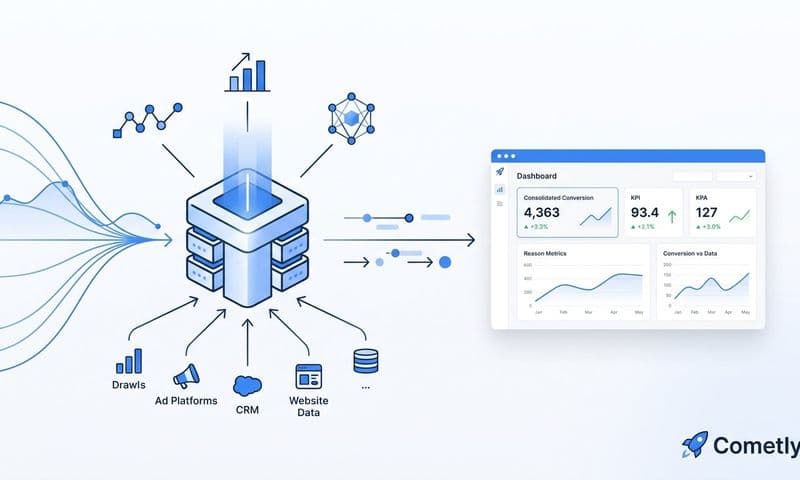
To get a true picture, you need a centralized view that tracks the complete customer journey across all channels. This is where attribution platforms come in—they connect all your marketing data sources and show you how different channels work together to drive conversions.
A centralized attribution system captures every touchpoint in the customer journey, from the first ad click to the final purchase, and shows you which marketing efforts actually contributed to the result. Instead of each platform claiming 100% of the credit, you see the real story of how your marketing channels work together.
For beginners, this means you can finally answer questions like: "Should I increase my Facebook budget or my Google budget?" or "Is my email marketing actually driving sales, or just taking credit for customers who were already going to buy?"
The goal of this step is to stop checking five different dashboards and start seeing your marketing performance in one place, with consistent measurement across all channels.
Step 4: Learn the Metrics That Actually Drive Decisions
Now that your data is flowing into a centralized view, you need to know which numbers actually matter. This is where most beginners get lost—there are hundreds of metrics you could track, but only a handful that should drive your decisions.
Let's start with the difference between vanity metrics and actionable metrics.
Vanity metrics make you feel good but don't connect to business outcomes. Impressions, reach, page views, social media followers—these numbers can grow while your business stagnates. They're not worthless, but they shouldn't be your primary focus.
Actionable metrics directly connect to revenue and business growth. These are the numbers that tell you whether your marketing is actually working or just burning budget. Understanding performance marketing analytics helps you identify which metrics truly drive results.
Cost Per Acquisition (CPA): How much you spend to acquire one customer or lead. If you spend $500 on ads and get 10 leads, your CPA is $50. This metric tells you whether your acquisition costs are sustainable for your business model.
Return on Ad Spend (ROAS): How much revenue you generate for every dollar spent on advertising. A ROAS of 3:1 means you make $3 for every $1 spent. This is your primary profitability metric for paid advertising.
Conversion Rate: The percentage of visitors who take your desired action. If 100 people visit your landing page and 5 submit the lead form, your conversion rate is 5%. This metric tells you how effective your website and offers are at turning traffic into results.
Customer Acquisition Cost (CAC): The total cost of acquiring a new customer, including all marketing and sales expenses. This is broader than CPA—it includes everything you spend to bring in a customer, not just ad costs.
Here's the critical part: these metrics mean nothing in isolation. A $50 CPA might be excellent for a business with $500 average order values and terrible for one with $30 average order values. Context is everything.
Read your metrics in context by comparing them to two things: your business economics and trends over time. First, does the metric work for your unit economics? If your CPA is $50 but your average customer lifetime value is $200, you have room to scale. If your lifetime value is $60, you're in trouble.
Second, track trends over time instead of obsessing over daily fluctuations. Marketing data is noisy—one bad day doesn't mean your campaigns are broken. Look at week-over-week and month-over-month trends to identify real patterns.
Set up a weekly reporting rhythm where you review these core metrics. Every Monday morning, spend 15 minutes looking at last week's performance. Are your costs trending up or down? Is your conversion rate improving? Are certain campaigns consistently outperforming others? A well-designed marketing analytics dashboard makes these weekly reviews significantly faster and more insightful.
This weekly check-in creates a habit of data-driven decision making without overwhelming you with constant dashboard checking. You give yourself enough data to spot meaningful patterns while staying focused on execution.
Create a simple spreadsheet or dashboard where you log these metrics each week. Over time, this historical view becomes invaluable—you'll see seasonal patterns, understand what "normal" looks like for your business, and quickly spot when something needs attention.
Step 5: Trace the Customer Journey from Click to Conversion
Here's where marketing analytics gets really interesting—and where most beginners discover their initial assumptions were completely wrong.
You've probably been looking at your marketing through a simple lens: someone sees your ad, clicks it, and either converts or doesn't. But that's rarely how customers actually behave.
Think about your own buying behavior. When was the last time you saw a single ad, clicked it, and immediately purchased? More likely, you saw an ad, visited the website, left, saw another ad a few days later, searched for reviews, came back through Google, signed up for the email list, received a few emails, and finally made a purchase two weeks later.
That's a real customer journey—and it involves multiple touchpoints across different channels and days or weeks of consideration.
This is why single-touch attribution misleads beginners. When you only look at the "last click" before conversion, you miss the entire story of how that customer found you and built trust in your brand. Facebook might get credit for the conversion because the customer clicked a retargeting ad right before purchasing—but what about the Google search ad that introduced them to your brand three weeks earlier?
Multi-touch attribution solves this problem by tracking every interaction a customer has with your marketing before they convert. It shows you the complete journey: which channels introduced them to your brand, which ones kept them engaged, and which ones closed the deal. Our comprehensive guide on multi-touch marketing attribution platforms explains how these systems work in detail.
Start by mapping your typical customer path. For most businesses, it follows a predictable pattern: awareness (how they first discover you), consideration (how they evaluate your solution), and purchase (what finally convinces them to buy).
In the awareness stage, customers might discover you through social media ads, search ads, content marketing, or word of mouth. They're learning that solutions like yours exist and starting to understand their problem.
During consideration, they're comparing options. They might visit your website multiple times, read reviews, sign up for your email list, watch demo videos, or download resources. They're building trust and evaluating whether you're the right fit.
The purchase stage is where they finally convert. This might be triggered by a promotional email, a retargeting ad, a direct website visit, or a sales conversation.
When you track the complete journey, you often discover surprising patterns. Maybe your Facebook ads rarely drive direct conversions, but they're excellent at introducing new customers who later convert through email. Or perhaps your Google search ads get credit for conversions, but those customers were actually introduced to your brand through content marketing weeks earlier.
Understanding these patterns changes how you allocate budget. Instead of cutting channels that don't show last-click conversions, you recognize their role in the broader journey and optimize accordingly.
To identify which touchpoints influence conversions most, look for common patterns in your customer journeys. Which channels appear most frequently in converting paths? Which combinations of touchpoints seem to work best together? Where do customers typically enter your funnel, and what keeps them engaged?
This journey-level view is what separates beginners from sophisticated marketers. You stop optimizing individual channels in isolation and start orchestrating them to work together throughout the customer journey.
Step 6: Make Your First Data-Driven Optimization
You've spent the last few weeks building your analytics foundation and collecting data. Now comes the exciting part: using that data to actually improve your marketing performance.
Start by identifying your underperforming campaigns. Look at your CPA, ROAS, and conversion rate data across all your active campaigns. Which ones are costing more than they're returning? Which have conversion rates significantly below your average?
Use a simple framework to decide what to do with each campaign: double down, test, or cut.
Double down on campaigns that are clearly working. If a campaign has a strong ROAS and low CPA, increase its budget. Scale what's already successful before trying to fix what's broken.
Test campaigns that show promise but aren't quite there yet. Maybe the CPA is slightly high, but the conversion rate is decent. Try adjusting the targeting, creative, or landing page to improve performance. Give yourself a specific timeframe—two weeks, for example—to see if your changes move the needle.
Cut campaigns that are clearly not working. If a campaign has been running for several weeks with consistently poor performance and you've already tried optimizations, it's time to stop the bleeding. Reallocate that budget to your winning campaigns or new tests.
For your first optimization, pick one underperforming element and run an A/B test. Maybe you've noticed that your landing page has a low conversion rate. Create a variation with a different headline, clearer call-to-action, or simplified form, and split your traffic between the two versions.
The key to successful testing is changing one thing at a time. If you change the headline, the image, and the call-to-action all at once, you won't know which change drove the improvement. Isolate variables so you can learn from each test.
Document everything. Before you make the change, write down your hypothesis: "I believe that simplifying the lead form from 8 fields to 4 fields will increase the conversion rate from 3% to 5%." Then track the actual results.
This documentation serves two purposes. First, it forces you to think through your reasoning before making changes. Second, it creates a knowledge base of what works and what doesn't for your specific business. Over time, these documented tests become incredibly valuable—you'll spot patterns in what resonates with your audience. Learning how to use data analytics in marketing effectively turns these insights into consistent performance improvements.
Give your tests enough time to reach statistical significance. Don't make decisions based on a single day of data or a handful of conversions. Depending on your traffic volume, you might need to run a test for one to two weeks to collect enough data for a confident decision.
After implementing your optimization, measure the impact. Did your change improve the metric you were targeting? By how much? What was the broader impact on your overall marketing performance?
This first optimization is just the beginning. The real power of marketing analytics comes from making it a continuous habit—constantly testing, learning, and improving based on what your data tells you.
Putting It All Together: Your Analytics Action Checklist
You've now built a complete marketing analytics system from the ground up. Let's recap the six steps that transform you from analytics-confused to data-confident:
Step 1: Define What Success Looks Like — Identify your primary business goal and 2-3 supporting metrics that directly connect to revenue. Focus on what matters, not everything you could possibly measure.
Step 2: Set Up Your Core Tracking Infrastructure — Install GA4, add platform pixels, implement server-side tracking for accuracy, and verify everything is working with test conversions.
Step 3: Connect Your Marketing Channels to One View — Use UTM parameters consistently, understand why platform numbers conflict, and centralize your data to see the complete picture of your marketing performance.
Step 4: Learn the Metrics That Actually Drive Decisions — Master CPA, ROAS, conversion rate, and CAC. Read these metrics in context by comparing them to your business economics and tracking trends over time.
Step 5: Trace the Customer Journey from Click to Conversion — Move beyond last-click attribution to understand the complete customer journey. Map your typical path from awareness to purchase and identify which touchpoints influence conversions most.
Step 6: Make Your First Data-Driven Optimization — Use your data to identify underperforming campaigns, run structured A/B tests, and document what you learn. Build the habit of continuous improvement based on evidence, not guesswork.
Here's the truth about analytics mastery: it's iterative. You don't need to be perfect on day one. Start with these fundamentals, get comfortable with the basics, and add complexity as you learn. The marketers who succeed aren't the ones who implement every advanced technique immediately—they're the ones who build solid foundations and improve consistently over time. Exploring proven marketing analytics techniques can accelerate your learning curve significantly.
Your first 30 days are about establishing the system and the habits. The real transformation happens in months two, three, and beyond as you accumulate data, spot patterns, and develop intuition about what works for your specific business and audience.
The difference between guessing and knowing what drives your results changes everything. You stop wasting budget on channels that look good but don't convert. You double down on what's actually working. You make confident decisions backed by data instead of hoping your marketing is effective.
Ready to elevate your marketing game with precision and confidence? While this guide gives you the foundation, modern attribution platforms can accelerate your progress dramatically. Instead of manually piecing together data from multiple sources, tools like Cometly provide AI-powered insights that show you exactly which marketing efforts drive revenue—capturing every touchpoint across your customer journey and feeding better data back to your ad platforms for improved optimization. Discover how Cometly's AI-driven recommendations can transform your ad strategy—Get your free demo today and start capturing every touchpoint to maximize your conversions.
Your journey from analytics beginner to data-driven marketer starts with these six steps. Take them one at a time, stay consistent with your weekly reviews, and watch as the numbers start telling you the story of what's really working in your marketing.