You're running ads on five platforms. Facebook says you got 47 conversions. Google claims 52. TikTok shows 31. Your CRM? It recorded 38 actual new customers during that same period.
None of these numbers align. And you need to decide where to allocate next month's $50,000 budget by Friday.
This isn't a hypothetical scenario—it's the daily reality for marketing teams managing multi-platform campaigns in 2025. Every advertising platform reports conversions through its own lens, using different attribution windows, tracking methodologies, and success definitions. The result? Decision paralysis when you need confidence most.
The problem isn't that your platforms are lying. It's that they're each telling a partial truth. Facebook counts every conversion that happened within 7 days of someone clicking your ad. Google uses a 30-day window and includes view-through conversions. TikTok has its own attribution logic. Your CRM just knows when someone became a customer—not which marketing touchpoint deserves credit.
This fragmentation costs more than just confusion. It leads to delayed optimization decisions, wasted ad spend on underperforming channels, and missed opportunities to scale what's actually working. When you can't trust your data, you can't move fast. And in digital marketing, speed is competitive advantage.
Marketing analytics solutions exist to solve exactly this problem. Not by adding another dashboard to your stack, but by fundamentally changing how you collect, unify, and act on marketing data across every touchpoint in the customer journey.
This guide breaks down what marketing analytics solutions actually do, why they've become essential infrastructure for modern marketing teams, and how they transform fragmented platform data into the unified insights that drive confident budget decisions. You'll understand the technical mechanics behind comprehensive attribution, the business impact of real-time optimization, and the practical steps for implementing a solution that reveals exactly which ads drive revenue.
Think of this as your GPS for navigating the marketing data maze. By the end, you'll know exactly how to move from conflicting platform reports to unified clarity—and why that shift changes everything about how you scale campaigns.
The Core Problem: Why Platform-Native Analytics Fail Multi-Channel Marketers
Platform-native analytics weren't designed for the way modern marketing actually works. Facebook Ads Manager optimizes for Facebook's success. Google Analytics champions Google's attribution model. Each platform operates as an isolated intelligence system, measuring performance through its own definitions of success.
This creates three fundamental problems that compound as your marketing sophistication increases. First, attribution conflicts make it impossible to determine which channels actually drive conversions. When Facebook, Google, and your email platform all claim credit for the same sale, you can't confidently allocate budget to the highest-performing channel.
Second, optimization delays cost you money every day. By the time you manually export data from five platforms, reconcile the numbers in spreadsheets, and identify trends, the market has already shifted. Your competitors using marketing analytics platforms are making optimization decisions in real-time while you're still building last week's report.
Third, incomplete customer journey visibility means you're optimizing for the wrong metrics. Platform analytics show you the last click before conversion, but they can't reveal that your customer actually discovered you through a TikTok ad, researched via Google search, engaged with three email sequences, and finally converted after seeing a Facebook retargeting ad. Without understanding this full journey, you might cut the TikTok budget that's actually driving your entire funnel.
The cost of this fragmentation isn't theoretical. Marketing teams waste an average of 15 hours per week manually reconciling platform data. That's 780 hours per year spent on data cleanup instead of strategy. More critically, delayed optimization decisions mean you're spending weeks testing ad variations that real-time analytics would have flagged as underperforming within days.
Consider a typical scenario: Your Facebook ROAS dropped from 4.2x to 2.8x over two weeks. Platform analytics show the decline but can't explain why. Was it creative fatigue? Audience saturation? Increased competition? Changes in customer behavior? Without unified data showing how Facebook performance correlates with your other channels, CRM data, and revenue metrics, you're guessing at solutions instead of implementing data-driven fixes.
This is where marketing analytics and reporting solutions fundamentally change the game. They don't just aggregate platform data—they create a unified source of truth that reveals the complete customer journey, accurate attribution, and actionable optimization opportunities that platform-native analytics simply cannot provide.
What Marketing Analytics Solutions Actually Do: The Technical Foundation
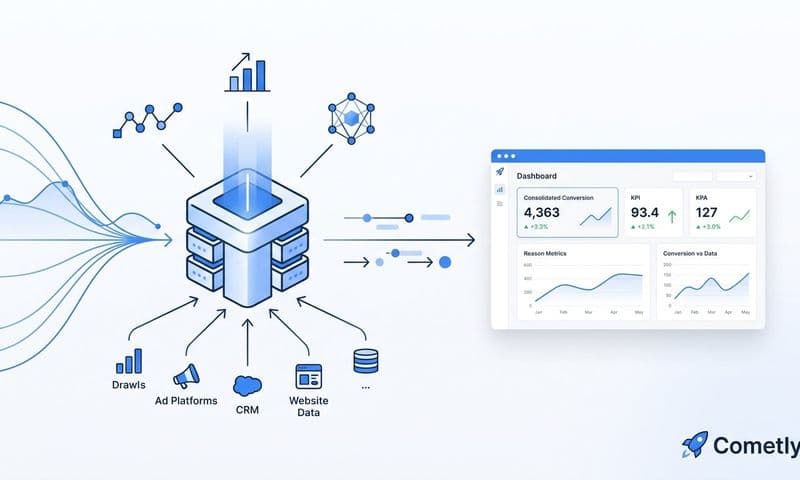
Marketing analytics solutions operate as a centralized intelligence layer that sits between your advertising platforms, CRM, and revenue data. Think of them as a universal translator that speaks every platform's language while creating a single, unified view of marketing performance.
The technical foundation starts with comprehensive data collection. Instead of relying on platform-reported conversions, these solutions implement first-party tracking that captures every customer interaction across your entire marketing ecosystem. When someone clicks your Facebook ad, visits your website, downloads a lead magnet, receives email sequences, and eventually makes a purchase, the analytics solution tracks every touchpoint with precision that individual platforms cannot match.
This tracking happens through multiple mechanisms working in concert. Server-side tracking captures conversion data directly from your backend systems, bypassing browser-based limitations like ad blockers and cookie restrictions. Client-side tracking monitors user behavior on your website and landing pages. API integrations pull advertising spend, impression data, and platform-reported metrics directly from each advertising account. CRM integrations connect marketing touchpoints to actual revenue outcomes.
The real power emerges in the unification layer. Raw data from disparate sources gets normalized into a consistent format, deduplicated to eliminate counting errors, and enriched with additional context. When Facebook reports a conversion and your CRM records a sale, the solution matches these events to the same customer journey, resolving attribution conflicts through sophisticated logic rather than accepting each platform's self-reported claims.
Attribution modeling transforms this unified data into actionable intelligence. Instead of accepting last-click attribution that gives all credit to the final touchpoint, advanced solutions apply multi-touch attribution models that distribute credit across every interaction that influenced the conversion. You can see that your TikTok ad generated initial awareness, Google search drove consideration, email nurturing built trust, and Facebook retargeting closed the sale—with each channel receiving appropriate credit for its role.
Real-time processing ensures you're never optimizing based on stale data. As conversions happen, the analytics solution immediately attributes them to the correct marketing touchpoints, updates performance metrics, and surfaces insights. This means you can identify underperforming ad sets within hours instead of weeks, shifting budget to winners while they're still hot.
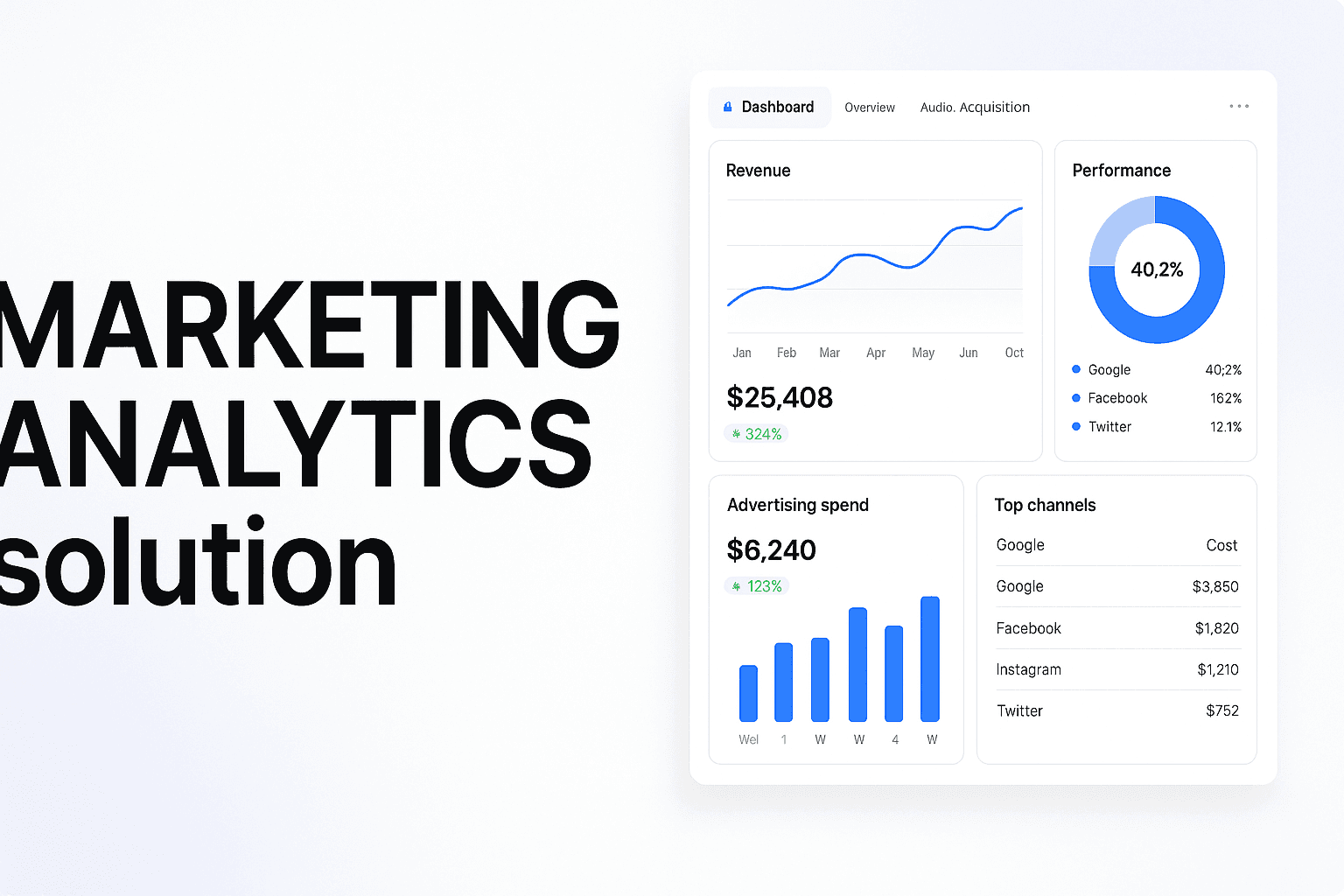
The output layer presents this intelligence through customizable dashboards, automated reports, and alert systems. Instead of logging into five platforms and manually comparing numbers, you see unified performance metrics that answer the questions that actually matter: Which campaigns drive profitable revenue? Where should you increase spend? What's your true customer acquisition cost across all channels?
For teams managing facebook marketing analytics alongside other platforms, this unified approach eliminates the guesswork that comes from trying to manually reconcile platform-specific metrics with actual business outcomes.
Key Capabilities That Separate Basic Analytics from True Solutions
Not all marketing analytics platforms deliver the same value. The difference between basic reporting tools and comprehensive solutions comes down to specific capabilities that directly impact your ability to make confident optimization decisions.
Cross-platform attribution stands as the foundational capability. Basic tools might aggregate data from multiple sources, but true solutions resolve attribution conflicts through sophisticated logic. When Facebook and Google both claim credit for the same conversion, the solution determines which touchpoint actually influenced the purchase based on timestamp analysis, user journey mapping, and configurable attribution rules. This isn't just academic—it's the difference between confidently scaling your best channels and accidentally cutting budget from the campaigns that actually drive your funnel.
Customer journey visualization reveals the complete path from first touch to conversion. Instead of seeing isolated platform metrics, you get a timeline showing every interaction: initial ad click, website visits, content downloads, email opens, retargeting impressions, and final conversion. This visibility exposes optimization opportunities that platform analytics miss entirely. You might discover that customers who engage with your educational content convert at 3x the rate of those who don't, suggesting you should increase content promotion budget.
Revenue attribution connects marketing metrics to actual business outcomes. Basic analytics show you clicks, impressions, and platform-reported conversions. Comprehensive solutions integrate with your CRM and payment systems to track which campaigns generate real revenue, calculate true customer lifetime value, and measure profit margins by channel. This transforms optimization from "which ads get clicks" to "which campaigns drive profitable growth."
Predictive analytics and AI-powered insights move beyond historical reporting to forecast future performance. Advanced solutions analyze patterns in your data to predict which campaigns will scale profitably, identify audience segments with highest conversion potential, and recommend budget allocation adjustments before performance declines. This proactive approach prevents problems rather than just reporting them after they've already cost you money.
Custom reporting and data flexibility ensure the solution adapts to your specific business model. E-commerce brands need different metrics than B2B SaaS companies. Agencies managing multiple clients require different views than in-house teams. True solutions offer customizable dashboards, flexible data exports, and API access that lets you integrate marketing analytics into your existing workflows rather than forcing you to adapt to rigid templates.
Real-time alerting and anomaly detection catch problems immediately. If your Facebook ROAS suddenly drops 30%, your cost per acquisition spikes on Google, or a high-performing campaign stops delivering conversions, the solution alerts you instantly rather than waiting for you to discover the issue during your weekly reporting review. This responsiveness can save thousands in wasted spend.
For teams exploring advanced marketing analytics capabilities, these features represent the difference between basic reporting and true competitive advantage in campaign optimization.
The Business Impact: How Unified Analytics Changes Marketing Operations
The operational transformation that comes with implementing a comprehensive marketing analytics solution extends far beyond prettier dashboards. It fundamentally changes how marketing teams make decisions, allocate resources, and scale campaigns profitably.
Decision speed increases dramatically when you eliminate manual data reconciliation. Teams that previously spent 15 hours per week building reports from multiple platforms can now access unified performance data instantly. This time savings compounds—instead of analyzing last week's performance, you're optimizing today's campaigns based on this morning's data. The competitive advantage of moving faster than competitors who are still stuck in weekly reporting cycles cannot be overstated in fast-moving digital advertising markets.
Budget allocation becomes data-driven rather than intuition-based. When you can see true cross-platform ROAS and customer acquisition costs, you stop making budget decisions based on which platform "feels" like it's working. You shift spend to channels that actually drive profitable revenue, even when those channels don't look impressive in their native analytics. This often reveals surprising insights—like discovering that your "expensive" LinkedIn ads actually have the lowest customer acquisition cost when you factor in customer lifetime value, or that your "high-performing" Facebook campaigns are just taking credit for conversions driven by other channels.
Team collaboration improves when everyone works from the same data source. Marketing, sales, and finance teams frequently conflict over performance metrics because they're looking at different numbers. Unified analytics creates a single source of truth that eliminates these disputes. When the CMO, CFO, and head of sales all see the same revenue attribution data, strategic discussions focus on optimization opportunities rather than arguing about whose numbers are correct.
Scaling becomes predictable rather than risky. Without unified analytics, increasing ad spend feels like gambling—you're not sure which campaigns will maintain performance at higher budgets. With comprehensive attribution and predictive analytics, you can identify campaigns with genuine scale potential, understand the customer acquisition cost curve, and increase spend confidently knowing you're investing in proven winners rather than hoping for the best.
Client reporting transforms for agencies managing multiple accounts. Instead of manually building custom reports for each client by exporting data from multiple platforms, agencies can deliver automated, white-labeled reports that show unified performance metrics. This professionalism builds client trust while freeing account managers to focus on strategy rather than data compilation.
The financial impact shows up in multiple ways. Direct cost savings come from eliminating wasted spend on underperforming campaigns identified through accurate attribution. Opportunity gains come from confidently scaling campaigns that unified analytics proves are driving profitable revenue. Efficiency improvements come from teams spending time on optimization rather than reporting. Companies implementing comprehensive marketing analytics software typically see 20-40% improvement in marketing efficiency within the first quarter.
Implementation Considerations: What You Need to Know Before Choosing a Solution
Selecting and implementing a marketing analytics solution requires careful evaluation of both technical requirements and business needs. The wrong choice can leave you with another underutilized tool in your martech stack, while the right solution transforms your entire marketing operation.
Integration capabilities should be your first evaluation criterion. The solution must connect seamlessly with every platform in your current stack—advertising accounts, CRM systems, email platforms, landing page builders, and payment processors. Partial integration creates the same data gaps you're trying to eliminate. Before committing to any solution, verify it offers native integrations or robust API access for every critical system in your marketing ecosystem.
Data accuracy and attribution methodology deserve deep scrutiny. Not all attribution models are created equal, and some solutions use simplified logic that doesn't actually resolve the platform conflicts you're trying to fix. Ask specific questions: How does the solution handle attribution when multiple platforms claim the same conversion? What tracking methodology ensures data accuracy despite browser restrictions and ad blockers? Can you customize attribution rules to match your specific customer journey? Solutions that can't clearly explain their attribution logic probably aren't sophisticated enough to solve your problems.
Scalability matters more than most teams initially realize. A solution that works well tracking 1,000 conversions per month might break down at 10,000. If you're planning to grow your marketing spend significantly, ensure the platform can handle increased data volume without performance degradation or cost explosions. Check whether pricing scales linearly with usage or includes expensive tier jumps that could surprise you later.
User interface and learning curve impact adoption success. The most powerful analytics solution becomes worthless if your team doesn't actually use it. During evaluation, have multiple team members test the interface. Can your media buyers quickly find the metrics they need? Can executives access high-level performance summaries without training? Does the solution require a data analyst to interpret, or can marketers extract insights independently?
Support and onboarding quality often determines implementation success. Marketing analytics solutions require proper setup to deliver accurate data—incorrect tracking implementation or misconfigured attribution rules can produce misleading insights that are worse than no data at all. Evaluate the vendor's onboarding process, documentation quality, and ongoing support availability. Solutions offering dedicated implementation specialists and responsive technical support are worth premium pricing.
Cost structure requires total cost of ownership analysis. Beyond base subscription fees, consider implementation costs, training expenses, and potential integration development. Some solutions charge based on ad spend, others on conversion volume, and some use flat monthly fees. Model your expected costs at current scale and at 2-3x growth to avoid expensive surprises. The cheapest solution often becomes the most expensive when you factor in limited capabilities that force you to maintain supplementary tools.
Data privacy and compliance capabilities are non-negotiable in 2025's regulatory environment. Ensure the solution complies with GDPR, CCPA, and other relevant privacy regulations. Verify it offers proper data handling, user consent management, and the ability to delete customer data on request. Privacy violations can cost far more than any analytics solution saves.
For teams comparing different tools for marketing analytics, these evaluation criteria help separate solutions that will actually transform your operations from those that will just add another login to your daily routine.
Common Use Cases: How Different Teams Leverage Marketing Analytics Solutions
Marketing analytics solutions deliver value across diverse business models and team structures, but the specific applications vary significantly based on your marketing sophistication, channel mix, and growth stage.
E-commerce brands running multi-platform acquisition campaigns use analytics solutions to solve the attribution chaos that comes with advertising on Facebook, Instagram, Google, TikTok, and Pinterest simultaneously. When a customer sees your TikTok ad, searches your brand on Google, clicks a Facebook retargeting ad, and finally converts after receiving an abandoned cart email, platform-native analytics can't tell you which channel deserves budget increases. Unified analytics reveals the complete journey, enabling confident budget allocation to channels that actually drive revenue rather than just taking credit for last-click conversions.
B2B companies with long sales cycles leverage analytics solutions to connect marketing touchpoints to deals that close months later. When your sales cycle spans 90-180 days and involves multiple decision makers, you need attribution that tracks the initial LinkedIn ad click through content downloads, webinar attendance, sales calls, and eventual contract signing. This visibility proves marketing's revenue contribution and identifies which campaigns generate qualified pipeline rather than just vanity metrics like clicks and impressions.
Marketing agencies managing multiple client accounts use analytics solutions to deliver professional reporting while reducing manual work. Instead of spending hours each week exporting data from multiple platforms and building custom reports for each client, agencies automate unified reporting that shows clients exactly which campaigns drive their business results. This professionalism builds trust and justifies agency fees while freeing account managers to focus on strategy rather than data compilation.
High-growth startups scaling from $100K to $1M+ in monthly ad spend need analytics solutions to maintain profitability during rapid expansion. At low spend levels, you can manually monitor performance and make intuitive optimization decisions. But as you scale across multiple platforms, audiences, and campaigns, manual tracking becomes impossible. Analytics solutions provide the real-time visibility and automated alerting that prevents expensive mistakes during aggressive scaling.
Enterprise marketing teams with complex organizational structures use analytics solutions to create alignment across departments. When paid media, content marketing, email teams, and sales all operate with different metrics and reporting systems, strategic decisions become political battles over whose numbers are correct. Unified analytics creates a single source of truth that enables data-driven collaboration rather than intuition-based arguments.
Affiliate and performance marketers running high-volume campaigns across dozens of traffic sources need granular attribution to identify profitable traffic sources. When you're buying traffic from 20+ affiliate networks and advertising platforms, platform-native analytics can't provide the cross-source visibility required to optimize profitably. Analytics solutions reveal which traffic sources drive genuine conversions versus which just generate clicks that never convert, enabling rapid budget shifts to winners.
Teams exploring various marketing analytics tools should evaluate solutions based on their specific use case rather than assuming all analytics platforms serve the same purpose.
Advanced Features That Maximize ROI from Your Analytics Investment
Beyond core attribution and reporting capabilities, advanced features separate analytics solutions that deliver basic visibility from those that become genuine competitive advantages in campaign optimization.
AI-powered optimization recommendations analyze your historical performance data to suggest specific actions that will improve results. Instead of just showing you that Campaign A outperforms Campaign B, advanced solutions tell you exactly how much to increase Campaign A's budget, which audiences to expand into, and when to pause underperforming ad sets. This proactive guidance transforms analytics from a reporting tool into an optimization co-pilot that helps you make better decisions faster.
Automated budget allocation takes AI recommendations a step further by actually implementing optimization changes automatically. You set parameters—maintain minimum ROAS of 3x, never spend more than $500 per day on untested campaigns, prioritize channels with customer LTV above $200—and the solution continuously shifts budget to maximize performance within your constraints. This automation enables 24/7 optimization that responds to performance changes in real-time rather than waiting for your next manual review.
Cohort analysis reveals how customer behavior and value change over time. Instead of just knowing your average customer lifetime value, you can see that customers acquired through Facebook in Q4 have 40% higher LTV than those from Google, or that customers who engage with your content before purchasing have 2x better retention. These insights inform not just campaign optimization but entire marketing strategies.
Incrementality testing helps you understand which marketing activities actually drive incremental revenue versus which just capture demand that would have converted anyway. By running controlled experiments that compare conversion rates with and without specific marketing touchpoints, you can identify which campaigns genuinely grow your business versus which are just expensive ways to reach customers who were already going to buy.
Custom event tracking extends beyond standard conversion tracking to measure any business outcome that matters to you. Track not just purchases but product returns, customer support tickets, referrals, upsells, and subscription cancellations. This comprehensive tracking reveals the full impact of different acquisition channels—you might discover that Facebook drives high initial conversion volume but also high return rates, while Google drives fewer conversions but much better customer quality.
Multi-currency and multi-region support becomes critical for businesses operating internationally. Advanced solutions handle currency conversion, regional performance comparison, and geo-specific attribution rules that account for different customer behaviors across markets. This prevents the common mistake of over-investing in regions with high conversion volume but low profitability due to currency exchange rates or shipping costs.
Data warehouse integration enables advanced analysis by connecting your marketing analytics to business intelligence tools. Export unified marketing data to your data warehouse where it can be combined with product analytics, customer support data, and financial metrics for comprehensive business analysis that extends far beyond marketing performance.
For teams evaluating different marketing analytics tool options, these advanced features represent the difference between basic reporting and true competitive advantage in marketing optimization.
Getting Started: Your Roadmap to Implementation Success
Implementing a marketing analytics solution successfully requires methodical planning and execution. The difference between transformative results and another underutilized tool often comes down to how you approach the implementation process.
Start with clear objectives that extend beyond "better reporting." Define specific business outcomes you want to achieve: reduce customer acquisition cost by 20%, increase marketing efficiency by 30%, enable same-day optimization decisions, or prove marketing's revenue contribution to executive leadership. These concrete goals guide solution selection and provide benchmarks for measuring implementation success.
Audit your current data infrastructure before evaluating solutions. Document every platform in your marketing stack, identify existing integration points, and map your current customer journey from first touch to conversion. This audit reveals technical requirements your analytics solution must meet and exposes data gaps that need addressing. You might discover that your CRM doesn't properly track lead sources, or that your e-commerce platform lacks the webhook capabilities needed for real-time conversion tracking.
Involve stakeholders from across your organization during solution evaluation. Marketing needs user-friendly dashboards and real-time optimization insights. Finance requires accurate revenue attribution and ROI reporting. Sales wants to understand which marketing channels generate the best leads. IT needs to verify technical feasibility and security compliance. Getting input from all stakeholders during evaluation prevents the common problem of implementing a solution that serves marketing but fails to deliver the cross-functional visibility that maximizes value.
Prioritize proper tracking implementation over rushing to launch. Inaccurate data is worse than no data because it leads to confident but wrong decisions. Work closely with your solution provider's implementation team to ensure tracking pixels are correctly placed, server-side tracking is properly configured, and attribution rules match your business model. Test thoroughly before relying on the data for optimization decisions—verify that conversions are being tracked accurately, attribution matches reality, and all platforms are properly integrated.
Plan for a phased rollout rather than trying to implement everything simultaneously. Start with your highest-volume advertising channels and most critical conversion events. Get those working perfectly before expanding to secondary platforms and advanced features. This approach builds confidence in the data while preventing the overwhelm that comes from trying to learn a complex new system while also troubleshooting integration issues across a dozen platforms.
Invest in team training to ensure adoption success. The most powerful analytics solution delivers zero value if your team doesn't know how to use it. Schedule comprehensive training sessions for different user roles—media buyers need to understand campaign-level optimization insights, managers need executive reporting capabilities, and analysts need to master advanced features. Create internal documentation that captures your specific use cases and workflows rather than relying solely on vendor documentation.
Establish regular review cadences that turn insights into action. Schedule daily optimization reviews where media buyers check real-time performance and make tactical adjustments. Hold weekly strategy sessions where the team analyzes trends and makes budget allocation decisions. Conduct monthly executive reviews that connect marketing performance to business outcomes. These structured reviews ensure your analytics investment drives continuous improvement rather than just providing data that nobody acts on.
The path from fragmented platform analytics to unified marketing intelligence requires commitment, but the operational transformation and performance improvements make it one of the highest-ROI investments in your marketing stack. When you can finally answer "which campaigns actually drive profitable revenue" with confidence rather than guesswork, every optimization decision becomes more effective and every dollar of ad spend works harder.
Ready to elevate your marketing game with precision and confidence? Discover how Cometly's AI-driven recommendations can transform your ad strategy—**Get your free demo** today and start capturing every touchpoint to maximize your conversions.