You have the dashboards. You have the data. You might even have five different analytics tools running simultaneously. And yet, when someone asks you which campaign actually drove that sale last Tuesday, you hesitate.
This is the quiet frustration living inside most marketing teams right now. Clicks live in one platform, revenue lives in the CRM, and somewhere in between, the actual customer journey disappears into a black hole. You can see that someone converted, but you cannot confidently say which ad started it, which touchpoint nudged them over the line, or which channel deserves the budget increase next month.
Data fragmentation is the real enemy here. It is not that marketers lack information. Most teams are drowning in it. Impressions, CTR, CPC, ROAS, bounce rates, session data, it all piles up. The problem is that none of it connects in a way that answers the one question that actually matters: where should I put my next dollar to drive the most revenue?
The tools delivering the most value are not the ones with the most features or the prettiest dashboards. They are the ones that close the gap between ad spend and real business outcomes. They are the ones that show you the full journey, from the first ad impression to the closed deal, without requiring you to stitch together exports from six different platforms.
This article breaks down exactly what separates high-value marketing analytics tools from the rest. You will learn which capabilities to prioritize, how to evaluate whether your current stack is actually helping you scale, and what a well-built analytics foundation looks like when it is working the way it should.
The Gap Between Data Collection and Revenue Clarity
Most marketing teams have no shortage of data. Ad platforms produce detailed reports on every impression, click, and engagement. Website analytics tools track sessions, pageviews, and behavior flows. Email platforms report opens and clicks. CRMs log every lead and deal stage. The data is everywhere.
And yet, revenue clarity remains elusive.
The reason is that collecting data and connecting data are two completely different problems. Each platform reports on what it can see within its own walls. Meta reports on conversions attributed to Meta ads. Google reports on conversions attributed to Google ads. Neither one knows what happened on the other's platform, and neither one has visibility into what the customer did after clicking through to your site, how long they took to convert, or whether they came back through a different channel before finally buying.
This creates a well-known problem in paid advertising: double-counting. When a customer clicks a Meta ad on Monday and a Google ad on Thursday before purchasing on Friday, both platforms claim credit for the conversion. Your combined platform reports show two conversions. Your CRM shows one deal. The discrepancy quietly corrupts every budget decision you make, which is why unreliable marketing analytics data is such a persistent challenge for growing teams.
Native platform metrics were not designed to give you an honest view of cross-channel performance. They were designed to show each platform in the best possible light. This is not a conspiracy. It is simply how attribution defaults work when platforms operate in silos. Last-click attribution, which is still the default in many ad platforms, hands all the credit to whichever ad the customer clicked most recently, completely ignoring every touchpoint that built awareness and intent along the way.
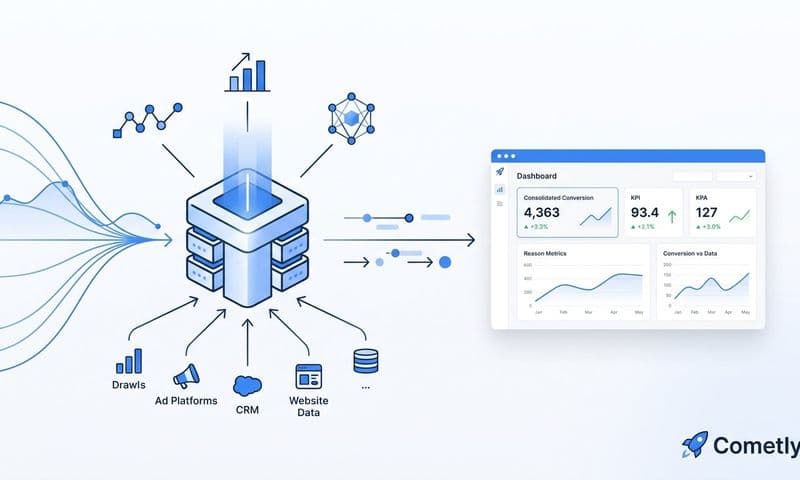
The most valuable marketing analytics tools solve this by doing something fundamentally different: they unify touchpoints across the entire customer journey into a single, coherent view. Instead of asking each platform what it thinks happened, they track the journey independently, connecting the first ad click to every subsequent interaction and ultimately to the revenue event in your CRM or payment processor. A unified marketing analytics platform makes this kind of cross-channel visibility possible.
When you have that unified view, the picture changes dramatically. Channels that looked like top performers based on platform-reported ROAS sometimes reveal themselves as last-click beneficiaries of work done earlier in the funnel. Channels that looked marginal turn out to be consistent first-touch drivers of high-value customers. Budget decisions made from this kind of data are fundamentally more reliable than those made from siloed platform reports.
The gap between data collection and revenue clarity is not a data volume problem. It is a data connection problem. And solving it is the first thing to look for in any analytics tool worth investing in.
Five Capabilities That Separate High-Value Tools from the Rest
Not all analytics tools are built with the same purpose. Some are excellent at surface-level reporting. Others are built to answer the harder questions about revenue attribution and campaign efficiency. Here are the five capabilities that consistently define the tools that deliver real value.
Multi-Touch Attribution Across the Full Journey: Last-click attribution is simple, but it is also deeply misleading for any purchase that involves more than one interaction. Multi-touch attribution models assign credit across every touchpoint in the customer journey, from the first awareness ad through consideration-stage retargeting to the final conversion click. For B2B purchases and high-consideration consumer decisions, this is not optional. Customers interact with multiple ads, channels, and content pieces before deciding. The best marketing attribution tools report on the entire journey rather than just the final click.
Server-Side Tracking for Accurate Data Capture: Traditional pixel-based tracking relies on code running in the customer's browser. That approach has become increasingly unreliable. iOS App Tracking Transparency restrictions, ad blockers, and the ongoing deprecation of third-party cookies in various browsers all degrade the accuracy of client-side tracking. Server-side tracking solves this by sending conversion data directly from your server to the analytics platform, bypassing browser-level restrictions entirely. Understanding the digital marketing strategy that tracks users across the web is essential for implementing this correctly. The result is a more complete and accurate picture of what is actually happening, rather than a picture full of gaps caused by blocked or dropped pixels.
Conversion Syncing Back to Ad Platforms: Ad platform algorithms like Meta's Advantage+ and Google's Smart Bidding are powerful, but they are only as good as the conversion signals they receive. When your tracking is incomplete or inaccurate, these algorithms optimize toward the wrong events or the wrong audiences. Conversion syncing solves this by feeding enriched, verified conversion data back to the ad platforms in real time. This gives their algorithms better signals to work with, which improves targeting, reduces wasted spend, and compounds over time as the algorithms learn from higher-quality data.
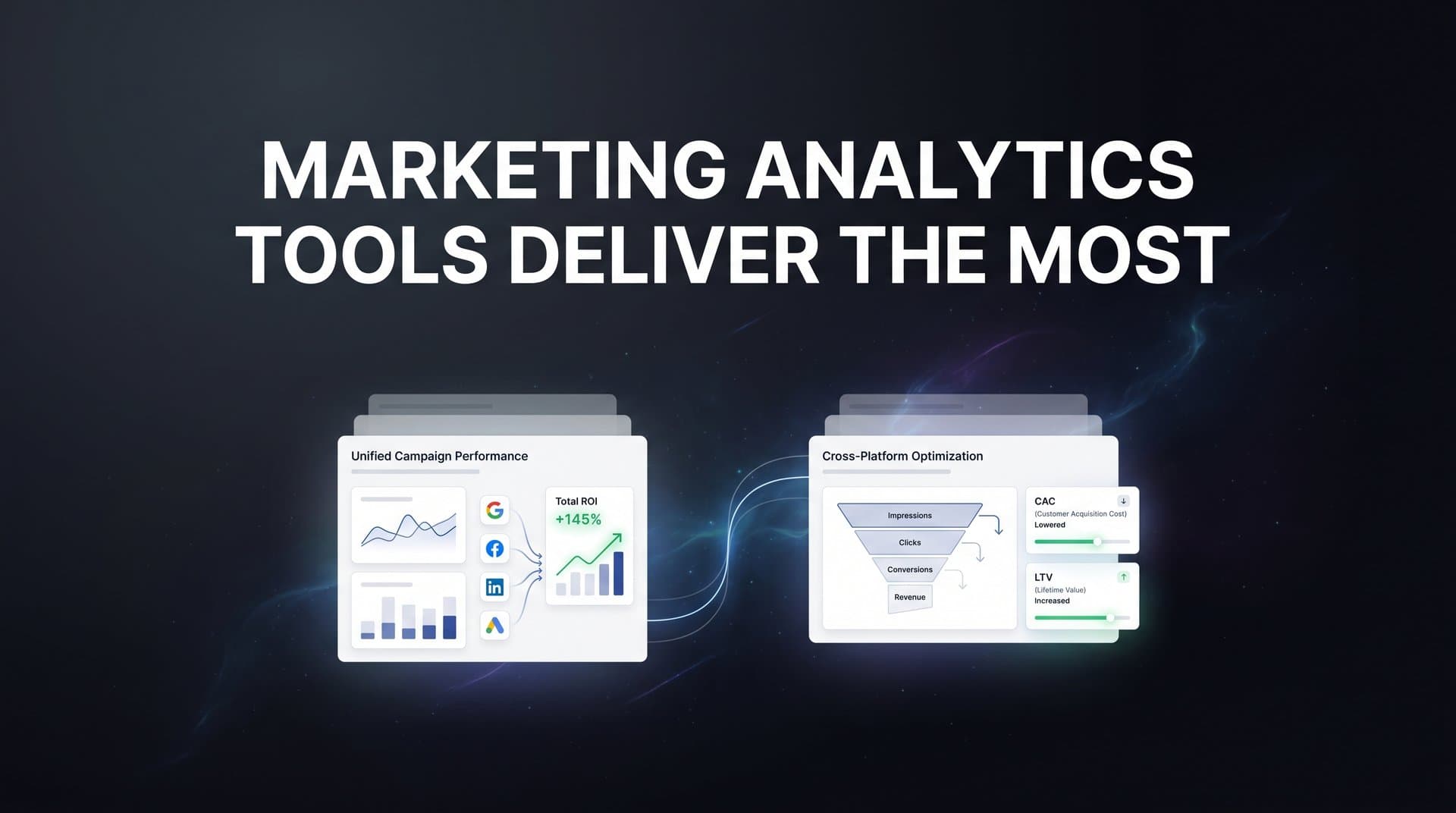
Unified Cross-Platform Reporting: A high-value analytics tool pulls data from every channel you run, including Meta, Google, TikTok, LinkedIn, email, and organic, into a single dashboard where you can compare performance on a level playing field. Without this, you are always comparing apples to oranges, each platform using its own attribution logic and conversion windows. Unified reporting eliminates that inconsistency and gives you a single source of truth for performance across your entire marketing operation.
CRM and Revenue Integration: The final capability that separates high-value tools is the depth of their integrations with the systems where revenue actually lives. Connecting ad platform data to CRM records, payment processors, and sales pipelines is what transforms a marketing analytics tool from a traffic dashboard into a revenue attribution system. When you can trace a closed deal back to the exact ad that initiated the journey, you are operating with a level of clarity that most marketing teams never reach.
How Cross-Platform Tracking Changes Budget Decisions
Here is a scenario that plays out constantly in marketing teams. The Meta dashboard shows strong ROAS. The Google Ads dashboard shows strong ROAS. But when you look at total revenue in the CRM, the numbers do not add up to what both platforms are claiming. Something is being counted twice, and you do not know which platform to trust.
So you do what most marketers do: you allocate more budget to whichever platform has the higher reported ROAS. And the cycle continues.
This is the core problem with making budget decisions from siloed platform reports. Each platform is optimizing for its own reported metrics, not for your actual business outcomes. Without cross-platform tracking that ties every touchpoint to a single revenue event, you are essentially navigating with a map where each section was drawn by a different cartographer using different coordinates.
Cross-platform tracking changes this by creating one consistent view of the customer journey. Instead of asking Meta what Meta drove and asking Google what Google drove, you track the journey from the outside, independent of any single platform's attribution logic. You can see that a customer first clicked a Meta awareness ad, then searched and clicked a Google branded search ad, then converted. You can decide how to distribute credit across those two touchpoints using an attribution model that reflects your actual business priorities, not the default model each platform prefers. Exploring the different types of marketing analytics helps you understand which model fits your business best.
The practical impact on budget decisions is significant. Channels that consistently appear early in the customer journey, driving first touches for customers who eventually convert through other channels, are often undervalued in last-click or platform-reported models. When you can see their true contribution, you can defend investment in them rather than cutting them because their platform-reported ROAS looks weak.
Real-time analytics add another dimension to this. Traditional reporting cycles mean that marketers often discover wasted spend weeks after it happened. By the time the end-of-month report reveals that a campaign was burning budget on audiences that never converted, the damage is done. A real-time marketing analytics platform allows you to catch underperformance quickly and reallocate budget before the waste compounds. Faster feedback loops mean faster optimization, which is a meaningful competitive advantage when you are running campaigns at scale.
The shift from siloed reporting to unified cross-platform tracking is one of the highest-leverage changes a marketing team can make. It does not just improve reporting accuracy. It changes the quality of every budget decision downstream.
AI-Powered Insights vs. Manual Reporting: What Actually Scales
There is a ceiling on what manual reporting can deliver, and most growing marketing teams hit it faster than they expect.
The traditional workflow looks like this: pull exports from each ad platform, import them into a spreadsheet, reconcile the numbers, build pivot tables, identify trends, and then write up findings for the weekly or monthly review. This process takes hours, and by the time the insights are ready, the data is already stale. Campaigns have continued running. Budgets have continued flowing. Decisions that should have been made on Tuesday are being made on Friday.
AI-driven analytics tools approach this differently. Instead of waiting for a human to pull and interpret data, they continuously analyze performance across every campaign, channel, and audience segment. They surface anomalies, identify high-performing ads, flag campaigns that are underperforming relative to historical benchmarks, and generate optimization recommendations without requiring anyone to build a single pivot table. The rise of AI marketing analytics has fundamentally changed what is possible for lean teams managing complex campaigns.
This is not just a convenience improvement. It is a structural advantage. When your analytics system is actively surfacing insights rather than passively storing data, your team spends less time in spreadsheets and more time acting on what the data is telling you. That shift in how time is spent compounds quickly when you are managing campaigns across multiple platforms and dozens of ad sets.
The compounding advantage extends to ad platform performance as well. When you feed better conversion data back to Meta, Google, and other platforms through conversion syncing, their own AI systems get smarter about who to target and when. This is not a one-time improvement. Every conversion signal you send back improves the algorithm's model, which improves targeting, which improves conversion rates, which generates more high-quality signals to send back. The flywheel builds on itself over time.
Manual reporting cannot create this kind of compounding effect because it is reactive by nature. You analyze what already happened and adjust. AI-powered attribution and conversion syncing create a system that is continuously learning and improving, not just documenting the past. Understanding the impact of machine learning on marketing analytics helps explain why this shift is so significant for long-term performance.
For teams running significant ad spend across multiple channels, the question is not whether AI-powered analytics delivers more value than manual reporting. The question is how much value is being left on the table by not having it in place yet.
Evaluating Your Current Stack: A Practical Framework
Before investing in new tools, it is worth honestly assessing what your current stack can and cannot do. Many teams are paying for tools that generate impressive-looking dashboards while leaving the most important questions unanswered.
Start with these questions about your current analytics setup:
Can you trace a specific sale back to the exact ad that started the journey? Not just the last click, but the first touchpoint that introduced the customer to your brand. If the answer is no, your current tools are not giving you full-journey attribution.
Can you compare attribution models side by side? The ability to switch between first-touch, last-touch, linear, and time-decay models and see how credit distribution changes is essential for understanding the true contribution of each channel. If your tools only support one attribution model, you are working with a partial view.
Does your data flow between your ad platforms, website, and CRM without manual exports? If connecting your ad data to your revenue data requires a weekly export-and-import process, you have a data latency problem. By the time the data is connected, it is no longer actionable in real time. Adopting tools for data-driven marketing strategies can eliminate these manual bottlenecks.
Are you measuring vanity metrics or revenue metrics? There is a meaningful difference between a dashboard that shows impressions, clicks, and CTR and one that shows cost per acquired customer, revenue attributed per channel, and lifetime value by acquisition source. Vanity metrics dashboards look active and data-rich but do not support the decisions that actually move the business forward.
How deep are your integrations? Integration depth is one of the most underrated differentiators in analytics tools. A tool that connects only to ad platforms gives you ad performance data. A tool that also connects to your CRM, payment processor, and email platform gives you a complete picture of the customer journey from first touch to revenue. Reviewing the top marketing analytics software options can help you benchmark your current stack against what is available today. The more integration points, the more complete the data, and the more reliable the attribution.
Running through these questions honestly will quickly reveal whether your current stack is built for revenue clarity or just data collection. The goal is not to have the most tools. It is to have the right tools that connect the dots between every marketing touchpoint and the revenue it generates.
Building an Analytics Foundation That Compounds Over Time
The right analytics setup does not just improve reporting. It creates a compounding advantage that grows as your ad spend grows.
Think about how the flywheel works. Better tracking gives your attribution system more complete data. More complete data produces more accurate insights about which channels and campaigns are genuinely driving revenue. Those insights lead to smarter budget allocation. Smarter budget allocation improves campaign performance. Improved campaign performance generates more high-quality conversion signals, which get synced back to ad platforms. Better signals improve ad platform algorithms, which improves targeting and reduces wasted spend. And the cycle continues, each rotation building on the last.
This is fundamentally different from the experience of using tools that require constant manual workarounds. When your analytics stack is held together with spreadsheet exports and manual reconciliation, it does not scale. As your campaigns grow in complexity and your ad spend increases, the manual work grows proportionally. You end up spending more time managing data and less time acting on it.
Choosing tools that are built to scale means prioritizing automation, integration depth, and AI-driven insights from the start. It means not accepting a setup where adding a new ad channel requires a new manual reporting process. It means building toward a system where every new data source feeds into a unified view automatically.
This is where platforms like Cometly are built to deliver. Cometly unifies attribution, AI-powered recommendations, and conversion syncing into a single system designed to make every dollar of ad spend more accountable. It captures every touchpoint from ad click to CRM event, connects that data to real revenue outcomes, and feeds enriched conversion signals back to Meta, Google, and other platforms so their algorithms can optimize more effectively. The result is not just better reporting. It is a continuously improving marketing engine that gets smarter as it runs.
For marketers who are serious about scaling, the analytics foundation is not a back-office concern. It is a strategic asset. Build it right, and it compounds in your favor over time.
Putting It All Together
The marketing analytics tools that deliver the most value are not the ones with the longest feature lists or the most impressive demo dashboards. They are the ones that connect every touchpoint in the customer journey to actual revenue with accuracy and clarity.
The capabilities that matter most are multi-touch attribution across the full journey, server-side tracking that captures data accurately despite browser restrictions, conversion syncing that feeds better signals back to ad platforms, unified cross-platform reporting, and deep integration with the CRM and revenue systems where business outcomes actually live.
If your current stack cannot answer the question "which ad started the journey that led to this sale," it is time to audit what you have and identify the gaps. Use the framework in this article to evaluate your tools honestly. Ask whether you are measuring revenue metrics or vanity metrics. Ask whether your data flows automatically or requires manual reconciliation. Ask whether your analytics system is helping you scale or just helping you report.
The difference between a marketing team that scales confidently and one that constantly second-guesses its budget decisions often comes down to the quality of the analytics foundation underneath everything else.
Ready to elevate your marketing game with precision and confidence? Discover how Cometly's AI-driven recommendations can transform your ad strategy. Get your free demo today and start capturing every touchpoint to maximize your conversions.