You're spending $10,000 a month on Facebook ads, another $8,000 on Google, and running email campaigns that seem to drive conversions. Your dashboard shows sales coming in, but when your CFO asks which channels are actually working, you freeze. The Facebook pixel claims credit for 60% of conversions. Google Analytics says something completely different. Your email platform is taking credit for the same sales everyone else is claiming.
This isn't a tracking error. It's the attribution problem every marketer faces.
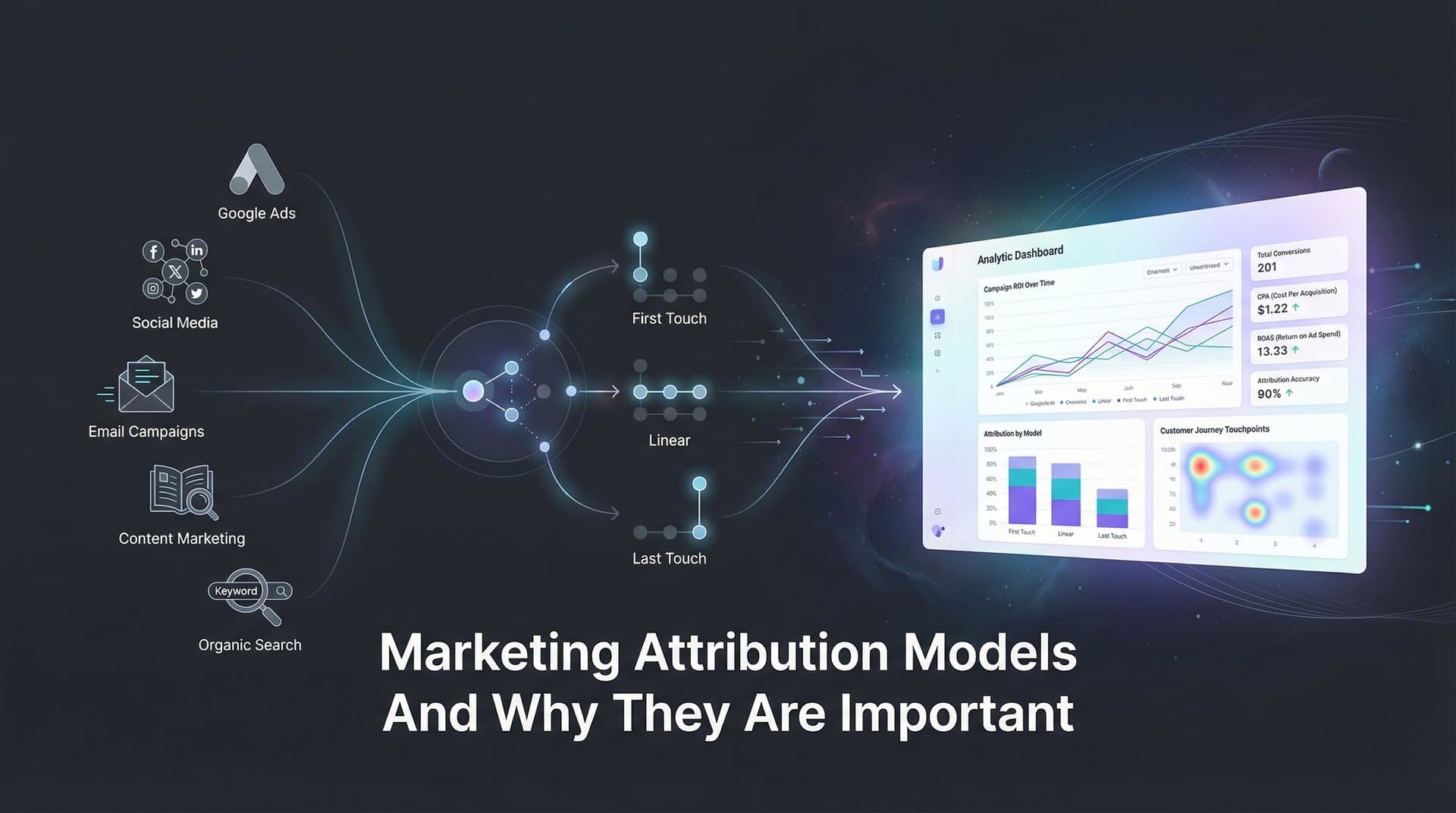
Marketing attribution models are the frameworks that determine which touchpoints get credit for driving conversions. They're not abstract concepts—they're the logic that decides whether you double down on that expensive awareness campaign or cut it entirely. Choose the wrong model, and you'll systematically starve the channels that are actually building your pipeline while pouring money into the ones that just happen to be last in line.
This guide breaks down how attribution models work, what each one reveals about your marketing, and how to choose the approach that matches your actual customer journey. Because understanding attribution isn't just about better reporting—it's about knowing where to invest your next dollar.
The Credit Assignment Problem in Multi-Channel Marketing
Marketing attribution is the process of assigning credit to the touchpoints that lead to conversions. Think of it as the referee deciding which players get points for scoring a goal. Except in marketing, there are dozens of players on the field at once, and they're all claiming they made the winning play.
Here's why this matters: customers rarely convert on first contact. They see a Facebook ad during their morning scroll. They click a Google search ad three days later while researching solutions. They download a lead magnet from an email campaign. A week after that, they return through a retargeting ad and finally purchase.
That's five touchpoints before one conversion. Which channel gets credit?
The answer determines everything. If you only credit the last touchpoint—that retargeting ad—you might conclude that retargeting is your best performer and shift more budget there. But what if that person would never have entered your funnel without the initial Facebook ad? What if the email campaign was the moment they decided you were credible enough to consider?
This is the credit assignment problem. Every marketing platform wants to claim the conversion. Facebook's attribution window says the person converted within seven days of seeing your ad, so it counts as a Facebook conversion. Google sees the click on a search ad in the journey and claims credit. Your email platform tracked the click from the newsletter and logs it as an email-driven sale.
The result? Your total attributed conversions add up to 300% of your actual sales. Everyone's taking credit, but nobody's telling you the truth about what's actually working.
Without a clear attribution model, you're making budget decisions based on whichever platform has the most aggressive attribution window or happens to be the last click. That's not strategy—it's guesswork dressed up as data. Understanding why attribution is important in digital marketing is the first step toward solving this problem.
Single-Touch Attribution Models: Simple But Limited
Single-touch attribution models solve the credit problem by giving 100% of the credit to one touchpoint. They're simple, easy to implement, and often dangerously misleading.
First-Touch Attribution: This model credits the very first interaction a customer has with your brand. If someone first discovered you through a Facebook ad, that ad gets 100% credit for the eventual conversion—even if they clicked three other ads and read five blog posts before purchasing.
First-touch attribution is useful when you need to understand what's driving awareness. It tells you which channels are good at getting new people into your funnel. If you're running brand awareness campaigns or trying to figure out which content is attracting cold traffic, first-touch gives you that answer.
But it completely ignores everything that happened after that initial touch. The nurture emails that built trust? Invisible. The retargeting campaign that brought them back when they were ready to buy? Doesn't count. First-touch attribution rewards the channels that start conversations but tells you nothing about what closes them.
Last-Touch Attribution: This is the opposite approach and the default in most advertising platforms. Last-touch gives 100% credit to the final interaction before conversion. If someone clicked a Google ad and immediately purchased, Google gets full credit—regardless of the six other touchpoints that preceded it. Many marketers rely on last-click marketing attribution software because of its simplicity, but this approach has significant blind spots.
Last-touch attribution is popular because it's straightforward and aligns with how ad platforms naturally track conversions. It also reflects a certain logic: the last touchpoint was the one that actually triggered the purchase decision.
The problem? It systematically undervalues everything that built interest and intent. Your expensive awareness campaigns that introduce your brand to thousands of people? Last-touch says they're worthless because they rarely result in immediate conversions. The educational content that convinced prospects you're credible? Ignored, because someone clicked a retargeting ad before buying.
Last-touch attribution makes performance channels look like heroes and awareness channels look like budget drains. If you're optimizing based purely on last-touch data, you're likely cutting the very campaigns that fill your funnel in the first place.
When Single-Touch Models Make Sense: Despite their limitations, single-touch models aren't always wrong. They work reasonably well for businesses with short sales cycles—think e-commerce products where people discover and buy within a few hours. If your customers typically convert on first or second touch, there isn't much of a journey to attribute.
Single-touch models also make sense when you're running a limited number of marketing channels. If you're only advertising on Google and sending occasional emails, the attribution question is simpler. You don't need sophisticated multi-touch logic when there aren't multiple touches to track.
They're also useful for quick directional insights. Want to know which channels are driving the most top-of-funnel awareness? First-touch tells you. Need to see which campaigns are associated with immediate conversions? Last-touch provides that view.
The key is recognizing what single-touch models can't tell you. They're snapshots, not the full story. And if you're investing in a complex marketing mix with multiple touchpoints, single-touch attribution will consistently mislead you about where your budget should go. For a deeper dive into the distinctions, explore the difference between single source attribution and multi-touch attribution models.
Multi-Touch Attribution Models: Seeing the Full Picture
Multi-touch attribution models acknowledge reality: most conversions involve multiple interactions across different channels. Instead of giving all the credit to one touchpoint, these models distribute credit across the entire customer journey.
Linear Attribution: The simplest multi-touch approach is linear attribution, which divides credit equally among all touchpoints. If someone interacted with five different marketing assets before converting, each touchpoint gets 20% credit.
Linear attribution is fair in a democratic sense—every interaction gets recognized. It's useful when you want to see the full scope of your marketing ecosystem and understand which channels appear consistently in converting paths, even if they're not first or last. Businesses exploring this approach often turn to linear model marketing attribution softwares for implementation.
The limitation? Linear attribution treats all touchpoints as equally influential, which often isn't true. The Facebook ad someone scrolled past three months ago probably didn't have the same impact as the demo request form they filled out last week. By distributing credit evenly, linear models can overvalue low-intent interactions and undervalue high-intent ones.
Linear attribution works best when you genuinely believe each touchpoint plays a roughly equal role—perhaps in content marketing strategies where each piece of content builds on the previous one, or in nurture sequences where every email is designed to move prospects incrementally closer to conversion.
Time-Decay Attribution: This model recognizes that touchpoints closer to conversion typically have more influence. Time-decay attribution assigns increasing credit to interactions as they get closer to the purchase decision.
The logic is intuitive: the retargeting ad someone clicked yesterday probably had more direct impact on their decision to buy than the blog post they read six weeks ago. Time-decay models weight recent interactions more heavily while still acknowledging that earlier touchpoints played a role.
Time-decay attribution is particularly useful for businesses with longer sales cycles where momentum builds over time. It rewards the channels that close deals while still giving some credit to the awareness and consideration-stage marketing that initiated the journey.
The trade-off is that time-decay can undervalue top-of-funnel efforts. If your brand awareness campaigns are what get people interested in the first place, time-decay will consistently show them as less valuable than bottom-funnel tactics—even though without that initial awareness, there wouldn't be anyone to retarget.
Position-Based (U-Shaped) Attribution: Position-based models try to balance the importance of both starting and closing the customer journey. The most common version is U-shaped attribution, which assigns 40% credit to the first touch, 40% to the last touch, and distributes the remaining 20% among all the middle touchpoints.
This approach reflects a realistic view of how marketing often works: you need channels that introduce your brand to new audiences, and you need channels that convert ready-to-buy prospects. The middle touches matter, but the endpoints often have outsized importance.
U-shaped attribution is popular among marketers running both awareness and conversion campaigns because it gives credit to both strategies. It tells you which channels are good at starting conversations and which ones are good at finishing them, while acknowledging that the nurture process in between plays a supporting role.
The challenge with position-based models is that the 40/40/20 split is arbitrary. Why not 30/30/40 if you run extensive nurture campaigns? Why not 50/50/0 if middle touches rarely influence your conversions? The fixed percentages don't adapt to your actual customer behavior—they're just a predefined formula that might or might not match reality.
Still, for many businesses, position-based attribution provides a more balanced view than single-touch models without requiring the data volume and complexity of algorithmic approaches. It's a practical middle ground that acknowledges the full customer journey while emphasizing the touchpoints that typically matter most. For a comprehensive overview of all these approaches, check out our guide on types of attribution models in digital marketing.
Data-Driven Attribution: Letting Algorithms Find Patterns
Data-driven attribution models take a fundamentally different approach. Instead of applying predefined rules about which touchpoints get credit, they analyze your actual conversion data to determine which interactions statistically contribute most to conversions.
Here's how it works: the algorithm examines thousands of customer journeys—both converting and non-converting paths. It identifies patterns in the data. Maybe people who see your Facebook ad and then click a Google search ad convert at 3x the rate of people who only do one or the other. Maybe email interactions in the middle of the journey correlate with a 40% higher conversion rate. Maybe certain blog posts appear disproportionately in converting paths.
The algorithm uses these patterns to assign credit. Touchpoints that consistently appear in converting journeys and correlate with higher conversion rates get more credit. Interactions that don't statistically influence conversion likelihood get less.
This is powerful because it removes guesswork. You're not deciding whether first-touch or last-touch is more important—the data is telling you what actually influences conversions in your specific business. Data-driven models adapt to your unique customer journey rather than forcing your data into a generic framework.
The catch? Data-driven attribution requires substantial conversion volume to work. The algorithms need enough data to identify statistically meaningful patterns. If you're only generating 50 conversions per month across multiple channels, there isn't enough data to reliably determine which touchpoints are influential versus which ones just happen to appear in some converting paths by chance.
You also need comprehensive tracking across all channels. Data-driven attribution only works if you're capturing every touchpoint—ad clicks, email opens, website visits, content downloads, everything. If your tracking has gaps, the algorithm is working with incomplete information and will draw incorrect conclusions about what drives conversions.
Clean data connections are essential. The algorithm needs to connect touchpoints to individual users across platforms. If your Facebook ad data, Google Analytics data, and CRM data aren't properly linked, the system can't build accurate customer journey maps. This is where server-side tracking and unified attribution platforms become critical—they create the data infrastructure that makes algorithmic attribution possible.
When you have the volume, tracking, and data quality required, data-driven attribution reveals insights that rule-based models simply can't provide. It might show you that certain channel combinations are exponentially more effective than others. It might reveal that a channel you thought was underperforming is actually a critical middle-touch that dramatically increases conversion probability when combined with other interactions. Implementing multi-touch marketing attribution software is often the key to unlocking these insights.
The limitation is that data-driven models are black boxes. They don't explain why certain touchpoints get the credit they do—they just show you the statistical results. You need to trust the algorithm and have enough understanding of your customer journey to validate whether the results make logical sense.
Choosing the Right Model for Your Marketing Strategy
There's no universal "best" attribution model. The right choice depends on your sales cycle, marketing mix, and what questions you're trying to answer.
Match Model to Sales Cycle Length: Short sales cycles with few touchpoints work fine with simpler models. If your customers typically discover your product and purchase within hours or a few days—common in e-commerce or impulse purchases—last-touch or first-touch attribution provides reasonably accurate insights. There simply aren't enough middle touches to warrant complex multi-touch logic.
Longer, complex sales cycles demand multi-touch approaches. B2B software purchases that involve weeks or months of research, multiple decision-makers, and numerous content interactions require models that credit the full journey. If you're using single-touch attribution for a 60-day sales cycle with 15 average touchpoints, you're getting a fundamentally distorted view of what's working. Companies in this space benefit from specialized B2B marketing attribution software designed for complex buyer journeys.
Consider Your Marketing Mix: Your channel strategy should influence model selection. If you're investing heavily in brand awareness campaigns—podcast sponsorships, display advertising, content marketing—you need attribution models that credit top-of-funnel interactions. First-touch or position-based models will show you the value of these awareness efforts. Last-touch attribution will make them look worthless.
Performance-focused strategies with heavy retargeting and bottom-funnel tactics might benefit from time-decay attribution. If your marketing is primarily about converting people who are already aware and interested, models that weight recent interactions more heavily will align with your strategy.
Businesses running balanced full-funnel strategies—awareness, consideration, and conversion campaigns all working together—need models that credit the entire journey. Position-based or data-driven attribution provides the visibility into how each stage contributes to results. Understanding marketing mix and attribution modeling helps you align your model choice with your overall strategy.
The Case for Comparing Multiple Models: Here's the reality: no single attribution model tells the complete truth. Each model is a lens that reveals certain aspects of your marketing while obscuring others. The most sophisticated approach is running multiple attribution models simultaneously.
Look at your channel performance through first-touch, last-touch, and a multi-touch model. The differences reveal important insights. If a channel performs well in first-touch but poorly in last-touch, it's good at awareness but weak at conversion. If a channel shows up consistently across all models, it's genuinely driving results throughout the journey.
Comparing models also prevents you from over-optimizing for one perspective. If you only look at last-touch data, you'll systematically underfund awareness channels until your funnel dries up. If you only look at first-touch, you might pour money into channels that generate interest but never convert. Multiple views create a more complete picture.
The practical approach? Choose one model as your primary decision-making framework based on what aligns with your sales cycle and strategy. Then use one or two other models as secondary views to validate your conclusions and catch blind spots.
Turning Attribution Insights Into Budget Decisions
Attribution models are only valuable if they change how you allocate budget. Here's how to translate attribution data into smarter spending decisions.
How to Read Attribution Data: Look for channels that consistently appear in converting paths, not just channels with high conversion counts. A channel might only get credit for 50 conversions under last-touch attribution, but if it appears in 80% of all converting journeys as a first or middle touch, it's clearly playing a critical role.
Pay attention to channels that generate clicks but no downstream value. These are the budget drains. If a channel drives traffic but rarely appears in converting paths under any attribution model, it's generating low-intent visitors who aren't moving through your funnel.
Compare cost per acquisition across different attribution models. A channel might look expensive under last-touch attribution but become cost-effective when you credit its role earlier in the journey. This is particularly common with content marketing and awareness campaigns—they look expensive if you only measure last-touch conversions, but the economics improve dramatically when you credit their top-of-funnel contribution.
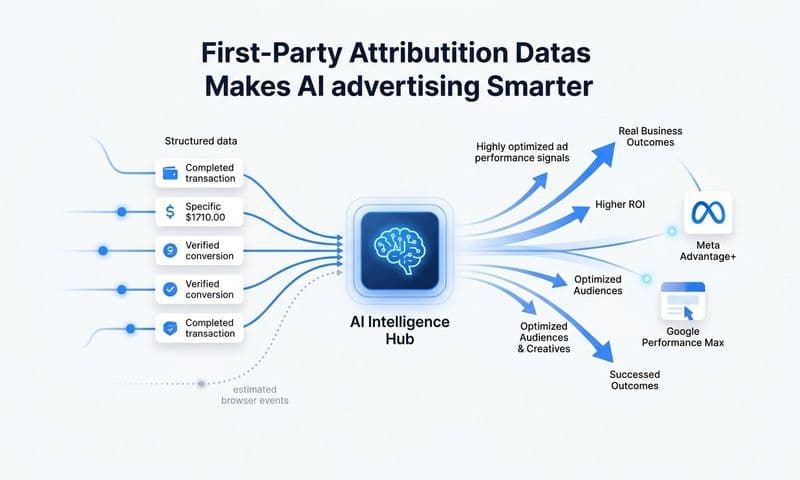
Optimizing Ad Platform Algorithms: Modern ad platforms use machine learning to optimize targeting and bidding. But these algorithms are only as good as the conversion data you feed them. If you're only sending last-click conversions back to Facebook or Google, you're teaching the algorithm to optimize for last-touch performance—which systematically biases it toward retargeting and bottom-funnel tactics.
Better attribution allows you to send more accurate conversion signals. When you credit channels appropriately for their role in the customer journey, you can feed that data back to ad platforms through conversion APIs and server-side tracking. This improves their ability to find prospects who will actually convert, not just people who will click. Connecting attribution to marketing attribution and optimization creates a powerful feedback loop for continuous improvement.
Building a Feedback Loop: Attribution insights should drive experimentation, not just reporting. Use what you learn to test budget shifts. If time-decay attribution shows that a channel performs better than last-touch data suggested, gradually increase spend there and measure results.
Track how changes in one channel affect performance in others. When you increase awareness spending, does bottom-funnel conversion efficiency improve because you're filling the pipeline with higher-quality prospects? When you cut spend on a channel that looked weak in last-touch attribution, do your other channels' performance decline because you're starving the top of the funnel?
The goal is continuous refinement. Attribution models show you where to look, but testing shows you what actually happens when you make changes. Combine attribution insights with incremental budget adjustments, measure the results, and iterate. Over time, this feedback loop compounds into significantly better channel allocation.
Don't expect attribution to give you perfect answers immediately. It's a tool for asking better questions and making more informed decisions—not a magic formula that tells you exactly how to spend every dollar.
Putting It All Together
Marketing attribution models aren't academic exercises. They're the difference between confidently scaling what works and accidentally killing the channels that fill your pipeline.
Every attribution model reveals something true about your marketing while hiding something else. Single-touch models are simple but incomplete. Multi-touch models capture the journey but rely on arbitrary rules. Data-driven models adapt to your reality but require substantial data volume and infrastructure.
The best approach? Choose an attribution model that matches your sales cycle and marketing strategy, but don't rely on it exclusively. Compare multiple models to understand the full picture. Look for channels that perform consistently across different attribution lenses—those are your genuine winners.
Remember that attribution only works if you're tracking every touchpoint accurately. Gaps in your data create gaps in your understanding. This is why comprehensive tracking across all channels—ad platforms, website analytics, CRM systems, email campaigns—is the foundation of any attribution strategy.
Use attribution insights to guide budget decisions, not dictate them. Test changes incrementally. Measure results. Build a feedback loop where attribution data informs experiments, experiments generate new data, and you continuously refine your channel mix based on what actually drives revenue.
The marketers who master attribution aren't the ones with the most sophisticated models. They're the ones who consistently ask "which channels are actually driving conversions?" and have the data infrastructure to answer that question honestly.
Ready to elevate your marketing game with precision and confidence? Discover how Cometly's AI-driven recommendations can transform your ad strategy—Get your free demo today and start capturing every touchpoint to maximize your conversions.