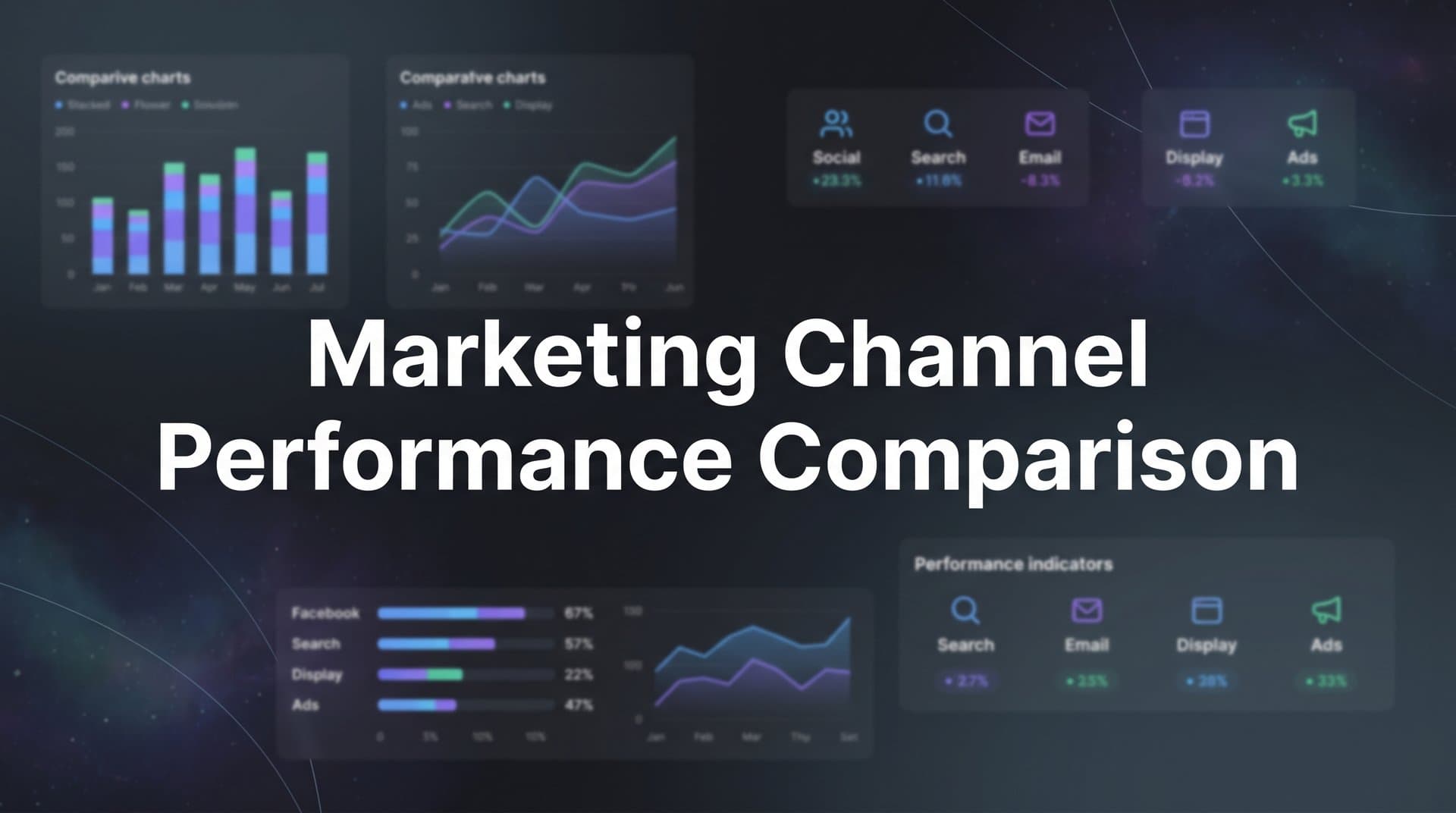
Most marketing teams struggle with a fundamental challenge: they know they need to compare channel performance, but they're drowning in disconnected data and conflicting metrics. One platform says Facebook drove the sale, another credits Google, and your CRM tells a completely different story. This fragmented view leads to misallocated budgets and missed opportunities.
Effective marketing channel performance comparison isn't about finding a single 'winner' among your channels. It's about understanding how each channel contributes to your customer journey and optimizing your entire marketing mix accordingly.
In this guide, we'll walk through seven actionable strategies that help you move beyond surface-level metrics and start making data-driven decisions about where to invest your marketing dollars. Whether you're comparing paid channels, organic efforts, or a mix of both, these approaches will give you the clarity you need to scale what's working and cut what isn't.
1. Establish Unified Tracking Before You Compare Anything
The Challenge It Solves
You can't compare channels accurately when each one is tracked differently. When your Facebook Ads use one naming convention, Google Ads uses another, and your email platform tracks conversions in a completely separate system, you're comparing apples to oranges. This tracking chaos creates blind spots where conversions get misattributed or lost entirely.
The problem gets worse when you consider how browsers and privacy updates have degraded client-side tracking. Cookie limitations mean you're likely missing a significant portion of your conversion data if you're only relying on pixels and browser-based tracking.
The Strategy Explained
Unified tracking means creating one consistent system that captures every customer touchpoint across all your marketing channels. This starts with establishing standardized UTM parameters that follow the same naming conventions across every campaign, ad set, and creative.
Think of it like creating a universal language for your marketing data. When every channel speaks the same language, you can finally see the complete picture of how customers move through your funnel.
Server-side tracking takes this foundation further by capturing conversion data directly from your server rather than relying solely on browser cookies. This approach maintains accuracy even as privacy restrictions tighten, giving you a more complete view of channel performance.
Implementation Steps
1. Create a UTM naming convention document that defines exactly how you'll tag every campaign across all platforms, including specific formats for campaign names, sources, mediums, and content parameters.
2. Implement server-side tracking alongside your existing pixel-based tracking to capture conversions that browser restrictions might otherwise block, ensuring you're not missing critical attribution data.
3. Set up a centralized tracking system that pulls data from all your marketing platforms into one unified dashboard where conversions are attributed consistently regardless of which channel drove them. Learn more about multi-channel marketing tracking best practices.
Pro Tips
Build your UTM conventions with future scalability in mind. Include fields for testing variations and campaign types you haven't launched yet. Document everything in a shared resource that your entire team can access, and conduct quarterly audits to ensure everyone is following the conventions consistently.
2. Define Channel-Appropriate KPIs Instead of One-Size-Fits-All Metrics
The Challenge It Solves
When you judge every channel by the same metric, you're setting yourself up for bad decisions. Measuring your awareness-focused display campaigns by the same cost-per-acquisition standard as your bottom-funnel search campaigns will make display look terrible, even if it's doing exactly what it should.
Different channels play different roles in your marketing funnel. Forcing them all into the same measurement framework ignores their unique contributions and leads to cutting channels that are actually valuable to your overall strategy.
The Strategy Explained
Channel-appropriate KPIs recognize that each marketing channel has a primary job to do. Top-of-funnel channels like social media and display should be measured by awareness metrics like reach and engagement quality. Mid-funnel channels like retargeting and email should focus on consideration metrics like time on site and pages per session. Bottom-funnel channels like search and shopping ads should be held to conversion and revenue standards.
This doesn't mean ignoring conversions from upper-funnel channels. It means understanding that a display campaign generating brand awareness at a higher cost per click than search is still succeeding if it's introducing new audiences to your brand who later convert through other channels.
Implementation Steps
1. Map each of your active marketing channels to a specific stage in your customer journey, identifying whether each channel primarily drives awareness, consideration, or conversion.
2. Define primary and secondary KPIs for each channel based on its funnel position, setting realistic benchmarks that reflect what success actually looks like for that channel's role. Understanding digital marketing performance metrics is essential for this process.
3. Create separate reporting views for each funnel stage so you're comparing channels against their peers rather than against channels serving completely different purposes.
Pro Tips
Set up a KPI hierarchy that includes both channel-specific metrics and overall business goals. Your awareness channels should still tie back to eventual revenue, but give them credit for the full customer lifetime value of the audiences they introduce, not just immediate conversions.
3. Use Multi-Touch Attribution to See the Full Customer Journey
The Challenge It Solves
Last-click attribution tells you which channel got the final touch before conversion, but it completely ignores all the touchpoints that happened before. When a customer sees your Facebook ad, clicks a Google search result, reads your email, and then converts through a retargeting ad, last-click gives 100% of the credit to retargeting and zero credit to everything else.
This creates a distorted view where bottom-funnel channels look incredibly effective while the channels that actually introduced customers to your brand appear worthless. Many marketers have cut valuable awareness channels based on last-click data, only to watch their overall conversion volume drop.
The Strategy Explained
Multi-touch attribution distributes conversion credit across all the touchpoints in a customer's journey. Different attribution models weight these touchpoints differently. Linear attribution gives equal credit to every touchpoint. Time-decay gives more credit to recent interactions. Position-based gives more credit to the first and last touches.
The key insight is that no single attribution model tells the complete truth. The value comes from comparing multiple models to understand how channels contribute throughout the journey. Explore multi-channel marketing attribution strategies to see how this works in practice.
Implementation Steps
1. Implement tracking that captures the complete customer journey across all touchpoints, not just the last click, ensuring you're collecting data on every interaction from first awareness to final conversion.
2. Run reports comparing at least three attribution models simultaneously, typically last-click, first-click, and linear or time-decay, to see how channel value shifts under different assumptions.
3. Analyze which channels consistently show high value across multiple attribution models versus which channels only look good under specific models, using this insight to inform budget allocation decisions.
Pro Tips
Don't get paralyzed trying to find the "perfect" attribution model. The goal is understanding patterns across models. If a channel shows strong performance across last-click, first-click, and linear attribution, that's a signal of genuine value regardless of which model is theoretically most accurate.
4. Implement Cohort Analysis for True Channel Value Assessment
The Challenge It Solves
Comparing channels based on immediate conversion metrics misses a critical question: which channels bring customers who stick around and generate long-term value? A channel might have a higher initial cost per acquisition but bring customers who make repeat purchases, while a cheaper channel brings one-time buyers who never return.
Without cohort analysis, you're making budget decisions based on incomplete information. You might be scaling channels that bring low-quality customers while cutting channels that drive your most valuable long-term relationships.
The Strategy Explained
Cohort analysis groups customers by their acquisition channel and tracks their behavior over time. Instead of just measuring how much it cost to acquire a customer, you measure how much revenue that customer generates in the first 30 days, 90 days, six months, and beyond.
This reveals patterns that immediate metrics can't show. You might discover that customers from organic search have lower immediate conversion rates but higher lifetime value because they're genuinely interested in your solution. Meanwhile, customers from aggressive retargeting might convert quickly but rarely make a second purchase. Understanding which marketing channel drives revenue over time is crucial for accurate assessment.
Implementation Steps
1. Set up cohort tracking in your analytics platform that groups customers by acquisition channel and tracks their revenue contribution over defined time windows like 30, 60, 90, and 180 days.
2. Calculate customer lifetime value by channel for each cohort, comparing not just acquisition cost but total revenue generated per customer to determine true channel efficiency.
3. Build retention curves for each channel showing what percentage of customers make repeat purchases at different time intervals, identifying which channels bring customers who stick around versus those who churn quickly.
Pro Tips
Give your cohorts enough time to mature before making major decisions. A channel might look expensive in the first 30 days but prove highly valuable when you measure 90-day or 180-day customer lifetime value. Set calendar reminders to review cohort performance quarterly as more data becomes available.
5. Run Controlled Incrementality Tests to Prove Channel Impact
The Challenge It Solves
Attribution models show correlation, but they can't prove causation. Just because a customer clicked your ad before converting doesn't mean the ad caused the conversion. They might have converted anyway through organic search or direct traffic. Without incrementality testing, you might be spending heavily on channels that are simply claiming credit for conversions that would have happened regardless.
This is especially problematic for retargeting and branded search campaigns, which often show excellent attribution metrics while potentially capturing demand that already existed rather than creating new demand.
The Strategy Explained
Incrementality testing measures what happens when you turn a channel off or reduce spend in specific markets. The gold standard is a holdout experiment where you stop advertising to a randomly selected group of users and compare their conversion rate to a control group that continues seeing ads.
Geographic experiments work similarly by pausing campaigns in specific markets while continuing them in others. If conversions drop significantly in the test markets compared to control markets, you've proven incremental impact. Learn how to measure incremental revenue from marketing channels to validate your spend.
Implementation Steps
1. Design a holdout test for your highest-spend channels by randomly splitting your audience into test and control groups, pausing ads to the test group for a defined period while maintaining normal activity for the control group.
2. Run geographic experiments by selecting matched pairs of similar markets, pausing campaigns in half while continuing in the other half, then measuring the conversion rate difference to calculate true incremental lift.
3. Calculate incremental cost per acquisition by dividing the additional spend in control markets by the incremental conversions generated, comparing this to your attributed cost per acquisition to see if the channel is as efficient as it appears.
Pro Tips
Start with shorter test periods of two to four weeks to minimize risk, then extend if you need more statistical confidence. Focus incrementality tests on your biggest budget items first since that's where you have the most to gain or lose. Document your methodology carefully so you can run consistent tests over time.
6. Create a Standardized Reporting Cadence and Dashboard
The Challenge It Solves
Ad hoc reporting leads to inconsistent decisions. When different team members pull reports at different times using different metrics and attribution windows, you end up with conflicting conclusions about which channels are working. One person says Facebook is your best channel while another insists it's Google, and both are technically correct based on the specific way they ran their analysis.
Without a standardized reporting system, channel comparison becomes a subjective exercise rather than an objective process. Budget decisions get made based on whoever makes the most compelling argument rather than consistent data.
The Strategy Explained
A standardized reporting cadence means everyone looks at the same metrics, using the same attribution models, over the same time periods, at the same intervals. You build automated dashboards that update daily or weekly, ensuring every stakeholder sees identical data when discussing channel performance.
This creates a single source of truth for channel comparison. Instead of debating which report is correct, your team can focus on interpreting the data and making strategic decisions based on shared information. A multi-channel marketing analytics dashboard centralizes this visibility.
Implementation Steps
1. Build a primary channel comparison dashboard that shows all active channels side by side with your key metrics, attribution model comparisons, and trend lines over consistent time periods.
2. Establish weekly and monthly reporting schedules where this dashboard gets reviewed by your marketing team, creating a rhythm where channel performance discussions happen at predictable intervals with fresh data.
3. Create role-specific dashboard views that show the same underlying data but emphasize the metrics most relevant to different stakeholders, ensuring executives see ROI summaries while channel managers see detailed performance breakdowns.
Pro Tips
Include both short-term and long-term views in your dashboard. Show week-over-week changes for tactical optimization but also include month-over-month and quarter-over-quarter trends to identify bigger patterns. Set up automated alerts when any channel shows significant performance changes outside normal ranges.
7. Feed Better Data Back to Ad Platforms for Smarter Optimization
The Challenge It Solves
Ad platforms like Meta and Google use conversion data to optimize your campaigns, but they're only as smart as the data you send them. When you only send basic conversion events without value data or customer quality indicators, their algorithms optimize for volume rather than value. You end up with campaigns that drive lots of cheap conversions from low-quality customers.
The platforms have powerful machine learning capabilities, but they need rich data to make good decisions. If you're not sending back information about customer lifetime value, revenue per conversion, or which conversions came from high-value customer segments, you're leaving optimization potential on the table.
The Strategy Explained
Conversion sync means sending enriched event data back to your ad platforms that includes not just that a conversion happened, but how valuable that conversion was. This includes actual revenue amounts, customer lifetime value predictions, and signals about customer quality like whether they're a repeat purchaser or high-value segment member.
When platforms receive this enriched data, their algorithms can optimize for valuable conversions rather than just any conversion. Your campaigns start finding more customers who look like your best customers rather than simply finding anyone who will convert at the lowest cost. Discover how to attribute revenue to marketing channels for better platform optimization.
Implementation Steps
1. Implement server-side conversion tracking that captures the full value of each conversion including order value, predicted lifetime value, and customer segment information that can be sent back to ad platforms.
2. Set up conversion value optimization in your ad platforms by sending actual revenue data with each conversion event, allowing the algorithms to optimize for return on ad spend rather than just cost per conversion.
3. Create custom conversion events for high-value actions beyond purchases, such as repeat purchases, subscription upgrades, or high-margin product category purchases, then optimize specific campaigns toward these valuable outcomes.
Pro Tips
Start with your highest-spend platforms first since that's where better data will have the biggest impact. Give the algorithms time to learn from the enriched data before judging performance. Most platforms need at least 50 conversions per week in a campaign to optimize effectively, so consolidate budget if you're spread too thin.
Putting Your Channel Comparison Strategy Into Action
Start by establishing unified tracking across all your marketing touchpoints. Without clean, connected data, every comparison you make will be built on a shaky foundation. From there, define appropriate KPIs for each channel based on its role in your funnel, then implement multi-touch attribution to see how channels work together rather than in isolation.
The most successful marketing teams treat channel comparison as an ongoing practice, not a one-time analysis. Build your reporting cadence, run incrementality tests on your biggest investments, and continuously feed better data back to your ad platforms.
When you can see exactly which channels drive real revenue, not just clicks or impressions, you can scale your campaigns with confidence and allocate every dollar where it will have the greatest impact.
Cometly captures every touchpoint across your customer journey, from ad clicks to CRM events, providing complete visibility into how your channels work together. With AI-powered recommendations, you can identify which campaigns are truly driving revenue and get specific guidance on where to scale your budget. The platform's server-side tracking ensures you're not losing attribution data to privacy restrictions, while conversion sync feeds enriched data back to Meta, Google, and other platforms to improve their optimization algorithms.
Ready to elevate your marketing game with precision and confidence? Discover how Cometly's AI-driven recommendations can transform your ad strategy. Get your free demo today and start capturing every touchpoint to maximize your conversions.