You're running Meta ads, Google campaigns, LinkedIn outreach, and email sequences. Conversions are coming in. Revenue is growing. But when you open your reporting dashboards, something doesn't add up.
Meta claims 150 conversions. Google says 120. LinkedIn reports 80. Add them all up and you've got 350 conversions—but your CRM only shows 200 actual customers. Each platform is taking full credit for the same conversions, and you're left staring at inflated numbers with no idea which channels actually drove those deals.
So where do you invest next month's budget? Which campaigns deserve more spend? Which channels are just riding coattails? Without clear answers, you're essentially gambling with your marketing dollars—scaling what looks good in isolation while potentially starving the channels that truly move the needle.
This is where multi channel marketing attribution changes everything. Instead of relying on fragmented platform reports that each tell their own version of the story, attribution connects the dots across your entire customer journey. It shows you which touchpoints actually influence conversions, how different channels work together, and where your budget delivers real returns versus vanity metrics.
This guide walks you through everything you need to know about multi channel marketing attribution—from understanding why single-touch tracking fails, to choosing the right attribution model, to building a system that turns data into confident marketing decisions. Let's get into it.
Why Single-Touch Tracking Leaves You Flying Blind
Picture this: A potential customer sees your LinkedIn ad about a new feature. Intrigued, they don't click—but they remember your brand. Two days later, they search for solutions to their problem and click your Google ad. They browse your site, read a few blog posts, then leave. A week passes. Your email nurture sequence hits their inbox with a case study. They click through, explore your pricing page, but still don't convert.
Three days later, a Facebook retargeting ad catches them during their morning scroll. This time, they're ready. They click through and complete the purchase.
Now here's the problem: Facebook's pixel sees that final click and reports a conversion. Google sees the earlier search click and reports a conversion. Your email platform sees the case study click and reports a conversion. LinkedIn might even claim an assisted conversion for that initial impression.
Each platform is technically correct from its own narrow perspective—but they're all claiming credit for the same customer. This is the fundamental flaw of single-touch attribution: it ignores the reality that modern customer journeys involve multiple interactions across multiple channels before a buying decision happens.
The cost of this misattribution isn't just messy reporting—it's real money. When you can't see which channels actually contribute to conversions, you make budget decisions based on incomplete data. You might pour more money into Facebook because it claims the most conversions, not realizing that Google search and email nurture are doing the heavy lifting earlier in the journey. Or you might cut LinkedIn spend because it shows few direct conversions, missing that it's your primary channel for generating initial awareness among high-value prospects.
Platform-native reporting inflates results because each system uses last-click attribution by default—whoever touched the customer last gets full credit. This creates a systematic bias toward bottom-of-funnel channels while undervaluing the awareness and consideration touchpoints that make those final conversions possible.
The result? Budgets allocated to channels that look good in isolation but might be capturing demand created elsewhere. Underinvestment in channels that assist conversions without getting credit. And a constant nagging feeling that you're flying blind, making decisions based on data you can't quite trust.
How Multi Channel Attribution Maps the Full Customer Journey
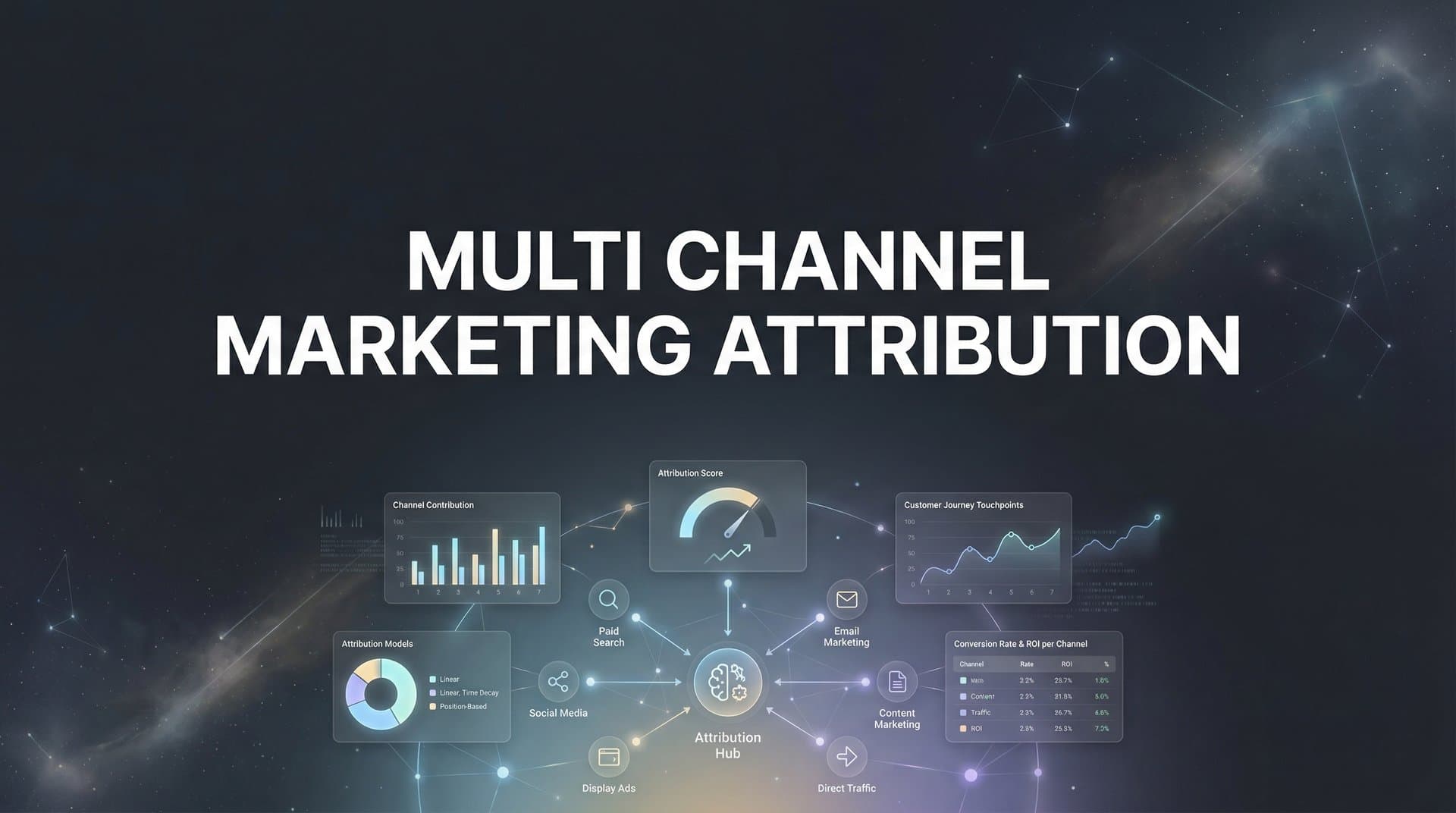
Multi channel marketing attribution solves this problem by tracking every touchpoint a customer interacts with across all your marketing channels, then assigning appropriate credit to each based on its actual contribution to the conversion. Instead of each platform reporting in isolation, attribution creates a unified view of the complete customer journey.
Think of it like connecting the dots. Each marketing interaction—an ad impression, a website visit, an email click, a form submission—is a dot. Single-touch attribution only sees individual dots. Multi channel attribution in digital marketing draws lines between them, revealing the full path customers take from first awareness to final purchase.
The mechanics work through several integrated components. First, you need unified tracking that captures interactions across all your channels. This means connecting your ad platforms, website analytics, email system, and CRM into a single attribution platform. When someone clicks a Facebook ad, visits your site, downloads a resource, receives nurture emails, and eventually converts, the attribution system logs each event and links them to the same person.
Identity resolution is the technical challenge here. The same customer might use different devices, clear cookies, switch browsers, or interact across sessions separated by days or weeks. Advanced attribution platforms use techniques like probabilistic matching, device graphs, and first-party data from your CRM to stitch these fragmented interactions into coherent customer journeys.
Server-side tracking has become essential for accurate attribution, especially after iOS privacy changes limited the effectiveness of browser-based tracking. Instead of relying solely on pixels and cookies that users can block, server-side tracking captures conversion events directly from your backend systems and sends them to your attribution platform. This maintains data accuracy even when client-side tracking fails.
Once you have complete journey data, attribution models determine how to distribute credit across touchpoints. A customer who saw a LinkedIn ad, clicked a Google search ad, visited via organic search, and converted from an email might have credit split across all four touchpoints—with the specific distribution depending on which attribution model you choose.
The real power comes from integrating this with revenue data. Attribution isn't just about counting conversions—it's about connecting marketing touchpoints to actual business outcomes. When your attribution platform integrates with your CRM, you can see not just which channels drove conversions, but which channels drove high-value customers, which influenced deals that closed quickly, and which touchpoints appear most often in your most profitable customer journeys.
This complete view transforms how you understand your marketing. Instead of asking "which channel got the last click?" you can ask much more valuable questions: Which channels initiate relationships with your best customers? Which touchpoints accelerate deal velocity? Where do customers drop off, and which channels bring them back? What combination of touchpoints produces the highest conversion rates?
Attribution Models Explained: Choosing the Right Lens for Your Data
Attribution models are the frameworks that determine how credit gets distributed across the touchpoints in a customer journey. Think of them as different lenses for viewing the same data—each reveals different insights and serves different strategic purposes.
First-touch attribution gives 100% credit to the first interaction a customer has with your brand. If someone discovered you through a LinkedIn ad, then later converted via Google search and email, LinkedIn gets all the credit. This model is valuable when you're focused on understanding which channels generate initial awareness and bring new prospects into your ecosystem. It helps answer questions like "where do our best customers first hear about us?" and "which top-of-funnel channels deserve more investment?"
The limitation? It completely ignores everything that happens after that first touch. The nurture emails, the retargeting campaigns, the search ads that brought them back—none of that gets recognized, even though those touchpoints likely played crucial roles in moving the prospect toward conversion.
Last-touch attribution takes the opposite approach, giving 100% credit to the final interaction before conversion. This is what most advertising platforms use by default. If that same customer journey ended with a click from a retargeting ad, the retargeting campaign gets full credit. This model makes sense when you're optimizing for immediate conversions and want to understand which channels are best at closing deals.
But here's the trap: last-touch systematically overvalues bottom-of-funnel channels while undervaluing the awareness and consideration touchpoints that made the final conversion possible. Your retargeting campaign looks like a hero, but it's only converting people who were already warmed up by other channels.
Linear attribution distributes credit equally across all touchpoints. In a journey with five interactions, each gets 20% credit. This model is useful when you believe every touchpoint contributes roughly equally to the conversion, or when you're just starting with attribution and want a balanced view before getting more sophisticated. The downside is that it treats all touchpoints the same, even though some clearly have more influence than others.
Time-decay attribution gives more credit to touchpoints closer to the conversion, based on the assumption that recent interactions have more influence on the buying decision. The LinkedIn ad from three weeks ago gets less credit than the email from three days ago, which gets less than the search ad from yesterday. This model works well for businesses with defined sales cycles where momentum builds as prospects move through the funnel.
Position-based attribution (sometimes called U-shaped) assigns 40% credit to the first touch, 40% to the last touch, and splits the remaining 20% among all the middle touchpoints. This recognizes that initiating the relationship and closing the deal are both critical, while still acknowledging the nurture that happens in between. Many marketers find this model reflects their intuitive understanding of how marketing actually works.
Data-driven attribution uses machine learning to analyze actual conversion patterns across all your customer journeys, then assigns credit based on which touchpoints statistically correlate with higher conversion rates. Instead of using a predetermined rule, it learns from your specific data which touchpoints actually influence outcomes. If customers who interact with your webinar channel convert at significantly higher rates, that touchpoint gets weighted more heavily. If certain ad campaigns appear in successful journeys far more often than unsuccessful ones, they receive more credit.
This is the most sophisticated approach, but it requires substantial data volume to work effectively—typically thousands of conversions across multiple channels. The advantage is that it adapts to your specific business rather than applying generic assumptions about how customer journeys work. For a deeper comparison of approaches, explore the differences between multi touch attribution vs marketing mix modeling.
From Data to Decisions: Turning Attribution Insights Into Action
Attribution data is only valuable if it changes what you do. The goal isn't to achieve perfect measurement—it's to make better marketing decisions. Here's how to translate attribution insights into concrete actions that improve your results.
Start by identifying channel roles. Not every channel needs to drive direct conversions to be valuable. When you analyze attributed journeys, you'll often discover that different channels excel at different stages. LinkedIn might be your strongest channel for generating initial awareness among your target accounts, even if it rarely gets last-touch credit. Email nurture might be essential for moving prospects from consideration to decision, even if it doesn't initiate many relationships. Retargeting campaigns might be highly effective at converting people who've already engaged, but create little new demand.
Understanding these roles prevents you from making the classic mistake of cutting channels that look weak in last-touch reporting but actually play crucial supporting roles. A channel that appears in 60% of successful customer journeys but rarely gets last-touch credit is probably more valuable than a channel with high last-touch conversions but low overall journey participation. Implementing channel attribution for revenue tracking helps you see these patterns clearly.
Use this insight to reallocate budget based on true contribution rather than inflated platform reporting. If attribution reveals that organic search and email consistently appear early in high-value customer journeys, but your budget is heavily weighted toward retargeting because it shows the most direct conversions, you've found an optimization opportunity. Shifting budget upstream to channels that generate qualified demand often produces better returns than pouring more money into bottom-funnel conversion channels.
Attribution data also helps you optimize ad platform algorithms by feeding back accurate conversion data. When platforms like Meta and Google only see conversions they can directly track, their algorithms optimize for an incomplete picture. By using conversion sync to send back properly attributed conversion events—including conversions influenced by other channels—you give these platforms better training data. Their algorithms learn which audiences and creative approaches actually drive business outcomes, not just last-click conversions.
Look for patterns in your highest-value customer journeys. Which combination of touchpoints appears most often in deals that close quickly? Which channels are common in journeys that produce high lifetime value customers? These patterns reveal your most effective marketing sequences. You might discover that customers who engage with both your blog content and attend a webinar convert at 3x the rate of those who only interact with one. That insight suggests investing more in promoting webinars to blog readers.
Identify drop-off points and friction in your customer journeys. If attribution shows that many prospects engage with your top-of-funnel content but few make it to mid-funnel consideration, you've found a gap that needs addressing—perhaps stronger calls-to-action, better content progression, or more effective nurture sequences. If prospects who visit your pricing page rarely convert without additional touchpoints, you know that pricing page visits should trigger specific retargeting or sales outreach.
The key is moving from passive reporting to active optimization. Attribution shouldn't just tell you what happened—it should tell you what to do next.
Common Attribution Pitfalls and How to Avoid Them
Multi channel attribution solves many problems, but it creates new challenges if not implemented thoughtfully. Here are the most common pitfalls and how to navigate them.
iOS privacy changes and tracking limitations have fundamentally altered the attribution landscape. When Apple introduced App Tracking Transparency, it gave users the ability to opt out of cross-app tracking, and most did. This created massive blind spots in customer journeys, particularly for mobile traffic from iOS devices. Relying solely on client-side tracking through pixels and cookies means accepting significant data loss.
The solution is server-side tracking, which captures conversion events directly from your backend systems rather than relying on browser-based tracking that users can block. When someone converts on your site, your server sends that conversion data to your attribution platform and ad platforms, maintaining accuracy even when client-side tracking fails. This approach has become essential for maintaining reliable attribution in a privacy-first world. Learn more about attribution marketing tracking to implement this effectively.
Attribution windows matter more than most marketers realize. If you're using a 7-day attribution window but your average B2B sales cycle is 45 days, you're systematically missing the early touchpoints that initiated those customer relationships. You'll overvalue bottom-funnel channels and undervalue the awareness campaigns that started the journey weeks earlier.
Match your attribution window to your actual buying cycle. B2B companies with longer sales processes often need 30, 60, or even 90-day windows to capture the full journey. E-commerce businesses with faster purchase decisions might find 7 or 14 days sufficient. The right window depends on your specific business—look at the time between first touch and conversion in your CRM data to set it appropriately.
Analysis paralysis is a real danger with attribution data. You can spend endless hours comparing different attribution models, analyzing every possible customer journey, and debating which channels deserve credit. Meanwhile, your competitors are running campaigns and capturing market share.
The goal is better decisions, not perfect attribution. Start with a reasonable model—position-based or data-driven if you have the volume—and focus on actionable insights. Which channels should get more budget? Which campaigns should you scale? Which customer segments respond best to which messaging? These questions matter more than achieving perfectly precise credit distribution.
Don't ignore qualitative factors that attribution data can't capture. Brand building, thought leadership, community engagement, and customer experience all influence conversions, but they're difficult to track through traditional attribution. A prospect might attend your founder's conference talk, follow your content for months, and eventually convert—but if they never clicked a trackable link until the conversion event, attribution misses most of that journey. Understanding common attribution challenges in marketing analytics helps you account for these limitations.
Combine attribution data with customer interviews, sales team feedback, and brand awareness surveys to build a complete picture. Attribution tells you which tracked touchpoints correlate with conversions, but it doesn't capture everything that influences buying decisions.
Building Your Multi Channel Attribution Stack
Implementing effective multi channel attribution requires the right technology foundation. Here's what to look for and how to get started.
Essential capabilities start with real-time tracking across all your marketing channels. Your attribution platform needs to integrate with your ad accounts (Meta, Google, LinkedIn, etc.), your website analytics, your email marketing system, and your CRM. The goal is capturing every touchpoint in a unified system rather than stitching together exports from different tools.
CRM integration is particularly critical because it connects marketing touchpoints to revenue outcomes. Attribution platforms that sync with your CRM can show not just which channels drive conversions, but which channels influence deals that close, which touchpoints appear in high-value customer journeys, and how marketing touches correlate with sales velocity. This transforms attribution from a marketing-only tool into a revenue intelligence system.
Cross-platform unification means the ability to track customers across devices, sessions, and channels—connecting the LinkedIn ad they saw on mobile, the Google search they did on desktop, the email they opened on tablet, and the conversion that happened on their laptop into a single coherent journey. Look for platforms that use both deterministic matching (based on logged-in user data) and probabilistic matching (based on behavioral patterns) to maintain identity resolution. A robust multi channel attribution platform handles this complexity automatically.
AI-powered pattern recognition has become increasingly valuable in attribution platforms. Machine learning can identify which combinations of touchpoints produce the highest conversion rates, which channels work best together, which audiences respond to which messaging sequences, and where optimization opportunities exist in your customer journeys. Instead of manually analyzing thousands of customer paths, AI surfaces the patterns that matter most.
Platforms like Cometly take this further by providing AI-driven recommendations based on attribution data. The system doesn't just show you which channels drove conversions—it analyzes patterns across all your campaigns and suggests specific optimizations: which campaigns to scale, where to reallocate budget, which audiences to prioritize, and which creative approaches work best for different customer segments.
Getting started with multi channel attribution follows a logical sequence. First, connect your ad accounts and marketing platforms to your attribution system. This establishes the data pipeline that will capture future touchpoints. Second, implement tracking on your website and key conversion points. This typically involves adding tracking scripts and configuring conversion events that matter to your business—not just purchases, but also lead form submissions, demo requests, free trial signups, and other meaningful actions.
Third, integrate your CRM so attribution can connect marketing touchpoints to closed deals and revenue. This is where attribution becomes truly powerful—when you can see which marketing activities influence actual business outcomes, not just lead generation metrics. Understanding how to measure ROI from multiple marketing channels becomes straightforward with this integration.
Fourth, establish baseline measurements before making major changes. Run your attribution system for at least one full buying cycle to understand your current state. Which channels are driving awareness? Which are closing deals? What does your typical customer journey look like? This baseline gives you a reference point for measuring improvement.
Finally, start making data-driven optimizations based on attribution insights. Begin with the most obvious opportunities—channels that are clearly undervalued in platform reporting but show strong contribution in attributed journeys, or channels that are overvalued because they capture last-touch credit without contributing earlier in the journey. Make changes incrementally so you can measure their impact. Following multi channel attribution best practices ensures you avoid common implementation mistakes.
The key is starting simple and building sophistication over time. You don't need perfect attribution on day one—you need better visibility than you have today, and a system that improves your marketing decisions.
Putting It All Together
Multi channel marketing attribution transforms how you understand and optimize your marketing. Instead of relying on fragmented platform reports that each claim credit for the same conversions, attribution reveals the complete customer journey—showing which touchpoints actually influence buying decisions and how different channels work together to drive revenue.
The goal isn't achieving perfect measurement. It's making better decisions. When you can see which channels initiate relationships with your best customers, which touchpoints accelerate deal velocity, and where your budget delivers real returns versus vanity metrics, you stop guessing and start investing with confidence.
Attribution shifts marketing from a cost center optimizing for clicks and impressions to a revenue driver optimizing for business outcomes. You stop asking "how many conversions did this campaign generate?" and start asking "which marketing activities influence the deals that actually close?" That change in perspective—from isolated channel performance to connected customer journeys—is what separates sophisticated marketers from those still flying blind.
The modern marketing landscape demands this level of visibility. Customers interact with multiple touchpoints across multiple channels before making buying decisions. Privacy changes have made tracking more complex. Ad platforms compete for credit using self-serving attribution models. Without a unified view of the full customer journey, you're making budget decisions based on incomplete data and inflated metrics.
Start with the fundamentals: implement tracking that captures touchpoints across all your channels, choose an attribution model that reflects your business reality, and focus on actionable insights rather than perfect precision. Look for patterns in your highest-value customer journeys. Identify which channels excel at awareness versus conversion. Reallocate budget based on true contribution, not last-touch reporting.
As you build sophistication, leverage AI to surface optimization opportunities you might miss in manual analysis. Use attribution insights to feed better conversion data back to ad platforms, improving their targeting and optimization. Connect attribution to revenue outcomes through CRM integration, transforming marketing measurement into revenue intelligence.
The marketers winning today aren't the ones with the biggest budgets—they're the ones with the clearest understanding of what actually drives results. Multi channel attribution gives you that clarity.
Ready to elevate your marketing game with precision and confidence? Discover how Cometly's AI-driven recommendations can transform your ad strategy—Get your free demo today and start capturing every touchpoint to maximize your conversions.