You're staring at your marketing dashboard at 11 PM on a Tuesday, and nothing makes sense. Google Analytics shows 500 conversions this month. Facebook Ads claims 320. Your CRM says 275. And somehow, your CFO is asking which campaigns actually drove revenue—and you can't give a straight answer.
This isn't a technology problem. It's a marketing data definition problem.
Most marketing teams are drowning in numbers but starving for answers. You've got fifteen different dashboards, fifty metrics to track, and three platforms all telling different stories about the same customers. The data exists—mountains of it—but it doesn't translate into the one thing you actually need: confidence in your marketing decisions.
Here's the uncomfortable truth: having more data doesn't make you smarter. Without understanding what marketing data actually means, how it connects across platforms, and which numbers truly matter, you're just collecting digital clutter. Meanwhile, your competitors who've mastered marketing data definition are making faster decisions, scaling winning campaigns with confidence, and proving ROI to leadership without breaking a sweat.
The gap between data collection and marketing intelligence is costing businesses real money. Wasted ad spend on underperforming channels. Missed opportunities to scale what's working. Strategic decisions based on incomplete or misleading information. And worst of all—that nagging feeling that you're flying blind despite having access to more data than ever before.
But here's the good news: understanding marketing data definition transforms everything. When you know what data you're actually collecting, how it connects to business outcomes, and which metrics drive real decisions, chaos becomes clarity. Confusion becomes confidence. And those fifteen dashboards start telling one coherent story about what's working and what's not.
This guide breaks down everything you need to know about marketing data definition—from the foundational concepts that most teams get wrong to the practical frameworks that turn raw numbers into revenue-driving insights. You'll discover what marketing data actually encompasses in 2025, why it matters more than ever for competitive advantage, and how to build a data foundation that scales with your business.
Whether you're a marketing manager trying to prove ROI, an agency owner managing multiple clients, or a founder who needs to understand what's really driving growth, this is your roadmap from data confusion to marketing intelligence. Let's cut through the noise and get clear on what marketing data really means.
The Marketing Data Maze
You're staring at your marketing dashboard at 11 PM on a Tuesday, and nothing makes sense. Google Analytics shows 500 conversions this month. Facebook Ads claims 320. Your CRM says 275. And somehow, your CFO is asking which campaigns actually drove revenue—and you can't give a straight answer.
This isn't a technology problem. It's a marketing data definition problem.
Most marketing teams are drowning in numbers but starving for answers. You've got fifteen different dashboards, fifty metrics to track, and three platforms all telling different stories about the same customers. The data exists—mountains of it—but it doesn't translate into the one thing you actually need: confidence in your marketing decisions.
Here's the uncomfortable truth: having more data doesn't make you smarter. Without understanding what marketing data actually means, how it connects across platforms, and which numbers truly matter, you're just collecting digital clutter. Meanwhile, your competitors who've mastered marketing data definition are making faster decisions, scaling winning campaigns with confidence, and proving ROI to leadership without breaking a sweat.
The gap between data collection and marketing intelligence is costing businesses real money. Wasted ad spend on underperforming channels. Missed opportunities to scale what's working. Strategic decisions based on incomplete or misleading information. And worst of all—that nagging feeling that you're flying blind despite having access to more data than ever before.
But here's the good news: understanding marketing data definition transforms everything. When you know what data you're actually collecting, how it connects to business outcomes, and which metrics drive real decisions, chaos becomes clarity. Confusion becomes confidence. And those fifteen dashboards start telling one coherent story about what's working and what's not.
This guide breaks down everything you need to know about marketing data definition—from the foundational concepts that most teams get wrong to the practical frameworks that turn raw numbers into revenue-driving insights. You'll discover what marketing data actually encompasses in 2025, why it matters more than ever for competitive advantage, and how to build a data foundation that scales with your business.
Whether you're a marketing manager trying to prove ROI, an agency owner managing multiple clients, or a founder who needs to understand what's really driving growth, this is your roadmap from data confusion to marketing intelligence. Let's cut through the noise and get clear on what marketing data really means.
Picture this: You're in your weekly marketing meeting, laptop open to a spreadsheet with 47 different metrics. Your team is debating whether to scale the Facebook campaign or double down on Google Ads. Someone mentions conversion rates. Another person brings up ROAS. Your CMO asks a simple question: "Which campaign actually brought in our best customers?"
Silence.
You've got the data. Fifteen dashboards across Google Analytics, Facebook Ads Manager, your CRM, email platform, and three other tools you signed up for last quarter. Each one shows different numbers. Each one tells a different story. And none of them can answer the one question that actually matters.
This is the modern marketing paradox. We're collecting more data than ever before—tracking every click, scroll, form fill, and purchase across dozens of touchpoints. Yet most marketing teams can't confidently explain what's working and what's not. The problem isn't lack of information. It's lack of clarity about what that information actually means.
Here's what's really happening: Your Facebook dashboard shows 320 conversions this month. Google Analytics claims 500. Your CRM says 275 customers came from marketing. These aren't just different numbers—they're measuring completely different things. But without understanding what "marketing data" actually encompasses, how it's collected, and what each metric represents, you're stuck guessing which number to trust.
The cost of this confusion is real. Marketing teams waste hours in meetings debating metrics instead of optimizing campaigns. Budgets get allocated to channels that look good on paper but don't drive actual revenue. Winning strategies get killed because the data tells an incomplete story. And leadership loses confidence in marketing's ability to prove ROI.
Meanwhile, your competitors who've mastered marketing data definition are making faster decisions, scaling what works with confidence, and proving their value to the C-suite without breaking a sweat. They're not smarter or luckier—they just understand what their data actually means and how to use it strategically.
The gap between having data and having marketing intelligence is where businesses either thrive or struggle. When you understand marketing data definition—what you're actually measuring, how different data types connect, and which numbers drive real decisions—everything changes. Chaos becomes clarity. Confusion becomes confidence. And those fifteen dashboards start telling one coherent story about what's driving growth.
The Promise of Clarity
Understanding marketing data definition isn't just about organizing spreadsheets or cleaning up dashboards. It's about transforming how your entire marketing operation functions—from reactive guesswork to proactive strategy.
Think of it this way: raw marketing data is like having a kitchen full of ingredients but no recipe. You've got flour, eggs, butter, and sugar sitting on the counter. But without understanding what each ingredient does, how they work together, and which combinations create specific outcomes, you're just staring at a pile of groceries hoping dinner magically appears.
Marketing intelligence is the recipe. It's knowing that those ingredients, combined in the right proportions and sequence, create something valuable. When you truly understand marketing data definition—what each data point represents, how it connects to business outcomes, and which combinations reveal strategic insights—those fifteen confusing dashboards suddenly tell one coherent story.
The transformation happens faster than most teams expect. Companies that master marketing data fundamentals shift from asking "What happened last month?" to predicting "What should we do next quarter?" They stop debating which metrics matter and start making confident decisions based on clear attribution. They replace gut feelings with data-backed strategies that scale.
This isn't about becoming a data scientist or learning complex statistical models. It's about establishing a clear framework for understanding what your marketing data actually means. When your team speaks the same data language, when everyone understands how customer touchpoints connect to revenue, and when you can confidently answer "Which campaigns drove our best customers?"—that's when marketing data becomes your competitive advantage.
The businesses winning in 2025 aren't necessarily collecting more data than their competitors. They're the ones who understand their data better, move faster on insights, and make smarter decisions because they've mastered the fundamentals of marketing data definition. That clarity compounds over time, creating momentum that's difficult for competitors to match.
Here's what changes when you get this right: Budget allocation becomes strategic instead of political. Campaign optimization happens in real-time instead of weeks later. Attribution disputes disappear because everyone's working from the same source of truth. And most importantly, you can prove ROI to leadership with confidence instead of hoping your numbers hold up under scrutiny.
The path from data chaos to marketing intelligence starts with understanding what marketing data actually encompasses in your business. Let's break down exactly what that means and why it matters more than ever.
Decoding Marketing Data: Beyond Basic Definitions
Ask most marketers to define "marketing data" and you'll get a vague answer about numbers from campaigns. But that surface-level understanding is exactly why teams struggle to turn data into decisions.
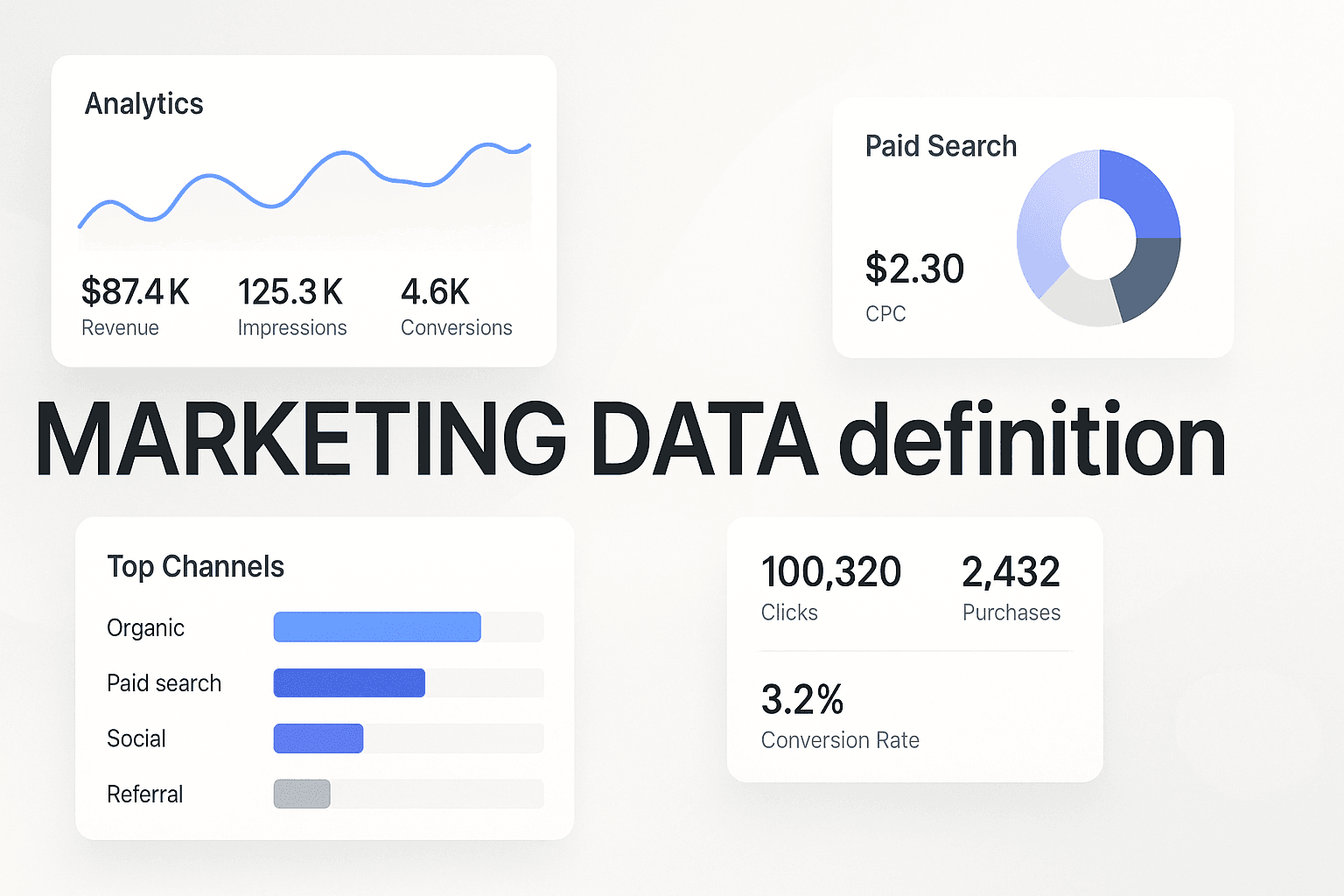
Marketing data is every piece of quantitative and qualitative information collected from your marketing activities across all customer touchpoints. It's the raw material that tells you who your customers are, what they do, how they found you, and whether your marketing investments are paying off.
But here's where it gets interesting: marketing data isn't just numbers in a spreadsheet. It's behavioral patterns from website visits. Demographic insights from form submissions. Transactional records from your CRM. Social media engagement signals. Email response rates. Ad platform performance metrics. Customer service interactions. Product usage data. Every digital footprint your prospects and customers leave behind.
The Strategic Reality: Data Hierarchy That Drives Decisions
Understanding marketing data means recognizing that not all information carries equal strategic weight. There's a hierarchy that transforms raw numbers into competitive advantage.
At the foundation, you have raw data—individual events and interactions. A website visit. An ad click. A form submission. These isolated data points mean almost nothing by themselves.
The next level is processed information—when you aggregate and organize those data points into meaningful patterns. Now you can see that 500 people visited your pricing page this week, or that your Facebook ads generated 150 clicks.
But the real value emerges at the intelligence layer—when you add context that enables decisions. Those 500 pricing page visitors came from three specific ad campaigns, and the visitors from Campaign A converted at 12% while Campaign B converted at 2%. That's intelligence you can act on.
Most marketing teams get stuck collecting data and generating information, but never quite reach the intelligence layer where confident decisions happen. They know what happened, but not why it matters or what to do about it.
Modern Attribution Complexity: The 2025 Reality
The marketing landscape has evolved into something far more complex than the simple "click an ad, make a purchase" model of the past. Today's customers interact with your brand across multiple devices, platforms, and touchpoints before ever converting.
A customer might see your Instagram ad on mobile during their morning commute, research your product on desktop at work, read reviews on their tablet that evening, and finally purchase on mobile three days later after receiving a retargeting email. Understanding these data complexities becomes actionable through structured marketing analytics and reporting frameworks that transform raw information into strategic decisions.
Privacy regulations like iOS 14.5+ and GDPR have fundamentally changed what data you can collect and how you can use it. Third-party cookies are disappearing. Platform tracking has become less accurate. The old attribution models that relied on perfect tracking across every touchpoint no longer work in this privacy-first environment.
This means your marketing data definition must account for incomplete information, probabilistic modeling, and first-party data strategies. You're not just collecting numbers anymore—you're building a comprehensive intelligence system that works within modern privacy constraints while still delivering the insights you need to scale profitably.
The marketers who master this complexity don't just have better data. They have better businesses.
Decoding Marketing Data: Beyond Basic Definitions
Let's cut through the textbook definitions and talk about what marketing data actually means when you're trying to run a business in 2025.
At its core, marketing data encompasses every piece of quantitative and qualitative information you collect from your marketing activities. That's the technical definition. But here's what that really means: it's every click, every form submission, every email open, every purchase, every abandoned cart, and every social media interaction your customers have with your brand.
Think about a single customer's journey. They see your Facebook ad on their phone during their morning commute. Later that day, they search for your product on their work computer and visit your website. That evening, they read your email newsletter on their tablet. Three days later, they make a purchase on their laptop. Each of these touchpoints generates marketing data—behavioral signals that tell you something about intent, interest, and decision-making patterns.
But marketing data isn't just behavioral. It includes demographic insights like age, location, and job title. It covers transactional records—what people bought, when they bought it, and how much they spent. It encompasses both structured data that lives in neat database rows (like CRM records) and unstructured data that's messier to analyze (like social media comments and customer service chat logs).
Here's where most teams get it wrong: they think having this data is the same as having marketing intelligence. It's not.
Marketing data is raw material. It's the ingredients sitting on your counter. Marketing intelligence is the finished meal—the insights, patterns, and strategic understanding that emerge when you properly collect, integrate, and analyze that data. The difference between the two determines whether you're making confident, revenue-driving decisions or just collecting digital clutter.
Understanding this hierarchy matters because it changes how you approach everything. Data without context is just numbers. Information without interpretation is just facts. Intelligence without action is just interesting. The real value comes from moving up this chain—from raw data collection to strategic action based on deep customer understanding.
And in 2025, that understanding needs to account for complexity that didn't exist five years ago. Your customers don't follow linear paths anymore. They bounce between devices, platforms, and channels in ways that make traditional tracking methods obsolete. They interact with your brand across paid ads, organic social, email, direct traffic, and offline touchpoints—sometimes all in the same day.
Privacy regulations have fundamentally changed what data you can collect and how you can use it. iOS privacy updates, cookie deprecation, and GDPR compliance aren't just legal checkboxes—they're strategic constraints that force you to rethink your entire data foundation. The marketing data you could easily access three years ago might not be available today, which means your data strategy needs to evolve constantly.
Meanwhile, AI and automation tools are processing more data faster than ever before. But here's the catch: these tools are only as good as the data you feed them. Garbage in, garbage out isn't just a saying—it's the reality of modern marketing technology. Understanding what marketing data you're collecting, how it connects across platforms, and which signals actually matter becomes the foundation for everything else you're trying to accomplish.
This is why marketing data definition isn't just an academic exercise. It's the strategic foundation that determines whether your marketing operates on assumptions or insights. Whether you're guessing at what works or knowing with confidence. Whether you're reacting to problems or preventing them.
The Strategic Reality
Here's what most marketing teams get wrong: they think collecting more data automatically makes them smarter. It doesn't.
The real power isn't in the numbers themselves—it's in understanding the hierarchy that transforms raw data into revenue-driving decisions. Think of it like this:
Ready to elevate your marketing game with precision and confidence? Discover how Cometly's AI-driven recommendations can transform your ad strategy—**Get your free demo** today and start capturing every touchpoint to maximize your conversions.