
If you want to measure marketing ROI the right way, you have to connect every single dollar you spend directly back to revenue. That means moving past surface-level numbers like clicks and impressions.
You need a solid framework that pulls together all your customer touchpoints, accurately gives credit to the right campaigns, and delivers clear insights you can actually use to spend smarter. It's the only way to prove your impact and scale your business without just guessing.
Why Vanity Metrics No Longer Cut It
 How to Measure Marketing ROI and Prove Your Impact
Let’s be real for a second: clicks and likes don't pay the bills. For way too long, marketers got comfortable reporting on vanity metrics—impressions, traffic, engagement—as proof of success. While those numbers look great in a presentation, they often create a dangerous illusion of progress because they don't tie back to the one metric that actually matters: revenue.
In today’s market, that old approach just doesn't work anymore. SaaS startups, e-commerce brands, and agencies are all facing the same challenge: proving that the marketing budget is an investment, not an expense. When you can't confidently connect a specific ad campaign to a final sale, you're flying blind.
The Disconnect Between Clicks and Cash
The big problem here is that the analytics from ad platforms are notoriously unreliable. They all operate in their own little silos, which leads to skewed data and misattributed sales.
Think about it. A customer might see your brand for the first time in a Facebook ad, then read a blog post they found through a Google search, and finally buy after clicking a link in your email newsletter. So, which channel gets the credit? Most platforms will take 100% of the credit for the last touch, completely ignoring the crucial role every other interaction played.
This fractured view of the data leads to some really bad decisions. You might end up cutting the budget for a top-of-funnel campaign that’s actually generating priceless awareness, all because it doesn't show any direct last-click conversions. This is exactly why you need a holistic view of the entire customer journey to truly measure marketing ROI.
The core challenge isn't a lack of data; it's a lack of connection. When your ad spend, website analytics, and sales data live in separate worlds, it's impossible to see the full picture and make truly data-driven decisions.
A New Standard for Performance
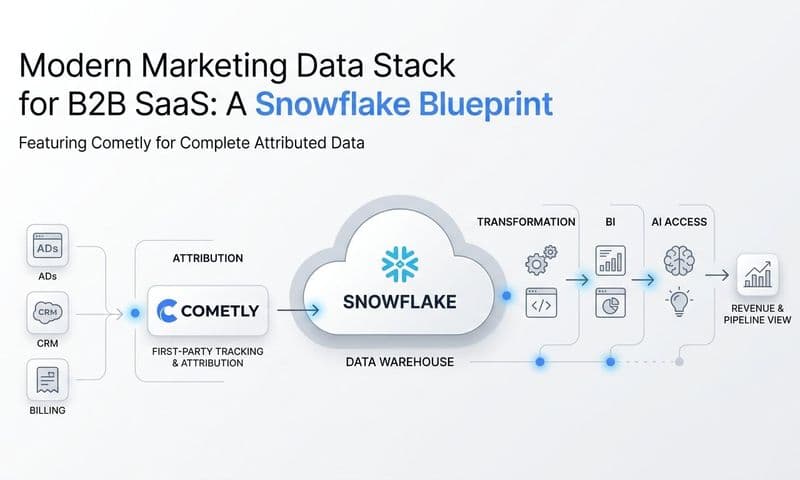
This is precisely the problem platforms like Cometly were built to solve. By unifying every touchpoint into a single source of truth, marketers can finally move past the vanity metrics and focus on what actually drives growth.
The goal is to achieve true attribution, where every dollar spent is accounted for and its return is crystal clear. For a deeper dive into what you should be tracking, check out our guide on the most essential digital marketing performance metrics.
Laying the Groundwork for ROI You Can Actually Trust
Before you can even think about measuring marketing ROI, you need a solid game plan. Trying to track performance without first defining what success looks like is like flying a plane without a flight plan—you're burning fuel, but you have no idea if you're heading in the right direction.
This is the strategic foundation. It’s about setting goals that matter to the business, not just hitting vanity metrics like traffic or likes. You need to draw a straight line from your marketing activities to the company's bottom line.
Nailing Down Your Core Business Metrics
First things first, you have to identify the key performance indicators (KPIs) that actually reflect the health of your business. While the specifics can vary, a few metrics are non-negotiable for any serious ROI calculation.
I've seen countless teams get lost in a sea of data, but these are the three that truly matter when you're trying to prove your worth.
- Customer Acquisition Cost (CAC): This is the total sales and marketing cost needed to land one new customer. You calculate it by dividing your total spend by the number of new customers you brought in over a set period. Knowing your CAC is the first step to understanding profitability.
- Lifetime Value (LTV): This metric forecasts the total revenue you can expect from a single customer over their entire relationship with your brand. A healthy LTV is a sign of customer loyalty and a sustainable business model.
- Return on Ad Spend (ROAS): Specifically for your paid campaigns, ROAS measures the gross revenue you generate for every single dollar spent on ads. It's a direct pulse-check on your ad profitability and a go-to metric for performance marketers.
These three metrics don't operate in a vacuum; they tell a story together. A high ROAS might feel like a win, but if your CAC is higher than your LTV, your business is on a fast track to failure. The real goal is a healthy LTV:CAC ratio, with the industry benchmark being 3:1 or higher. In simple terms, for every dollar you spend to get a customer, you should be getting at least three dollars back over their lifetime.
To help you keep these straight, here’s a quick-reference table.
Key Marketing ROI Metrics Explained
Getting these numbers right is what separates a good marketer from a great one. You start reporting on these, and you'll get the attention of your leadership team.
The most effective marketing teams are fluent in the language of the C-suite. They don't just report on clicks and conversions; they report on CAC, LTV, and the direct impact of their campaigns on net revenue. This is how you prove your department is a growth engine, not a cost center.
Making Sense of Marketing Attribution Models
Once you know what you're measuring, the next big question is how you'll give credit for each conversion. This is where marketing attribution enters the picture. An attribution model is just a set of rules that decides how credit for a sale gets assigned to the different touchpoints in a customer's journey.
Pick the wrong model, and you'll completely misinterpret your data. You could end up pouring money into the wrong channels while cutting the budget from the ones that are actually driving results. The model you choose has to match the reality of your sales cycle.
First-Touch attribution gives 100% of the credit to the very first interaction a customer has with your brand, making it a strong option for businesses that are focused on top-of-funnel awareness and lead generation. The downside is that it completely ignores everything that happens after that first click, which means it undervalues the middle and bottom-funnel activities that actually nurture the lead and drive the final conversion.
Last-Touch attribution gives 100% of the credit to the final touchpoint right before a customer converts, which can work well for companies with short, transactional sales cycles like impulse e-commerce purchases. The pitfall is that it fails to give any value to the channels that originally introduced the customer to your brand, which can lead to over-investing in “closing” channels while underfunding the sources that generate new demand.
Multi-Touch attribution distributes credit across multiple touchpoints throughout the customer journey, using models like Linear, U-Shaped, or W-Shaped to better reflect how people actually make decisions. This approach is ideal for most B2B and e-commerce businesses where customers take time to evaluate options before converting, but it can be more complex to set up because it requires strong tracking and clean data to accurately capture every meaningful interaction across channels.
Let's make this real. A direct-to-consumer brand selling a $20 gadget might be fine with last-touch attribution. A customer sees a TikTok ad, clicks it, and buys. The journey is short and sweet.
But for a B2B SaaS company with a six-month sales cycle, last-touch is a disaster waiting to happen. A prospect might find them through a blog post (first touch), later join a webinar, open a few email campaigns, and finally book a demo that leads to a sale. A last-touch model would give all the credit to the demo link, dangerously undervaluing the content and email marketing that made the demo possible in the first place.
Getting this right means tracking every step of that journey. A lot of teams use UTM parameters to tag their campaign URLs, which is fundamental for getting clean source data. If you're new to this concept, understanding what are UTMs and how to use them is a fantastic place to start. And if you're investing heavily in content, you also need to get serious about measuring content performance effectively.
By setting this foundation, you build a reliable system for measuring ROI and start making decisions with confidence.
Implementing Bulletproof Tracking Across Your Funnel
A great marketing strategy is one thing, but flawless execution is what really separates the winners from the rest. This is where we get into the nuts and bolts of data collection—the technical foundation you absolutely need to measure ROI accurately. Without it, even the best-laid plans will fall apart.
The traditional way of doing things, known as client-side tracking, has been the standard for years. Think of your classic Facebook Pixel or Google Analytics tag. These are just snippets of code that live on your website and send data directly from a user's browser to the ad platforms.
For a long time, this worked just fine. But the ground has shifted dramatically underneath our feet.
The Problem with Traditional Tracking
Client-side tracking is becoming a huge liability. With the rise of ad blockers, browser privacy restrictions like Intelligent Tracking Prevention (ITP), and major updates like Apple's iOS 14, a massive amount of data is simply lost before it ever reaches your analytics.
Some studies show that up to 30% of web users now use ad blockers, which can stop your tracking pixels from firing altogether. This creates enormous blind spots in your data, making it impossible to see the full customer journey.
Here's what that looks like in the real world:
- Misattributed Sales: A customer clicks a Facebook ad, but their browser blocks the pixel. They convert later, but because that first touchpoint was missed, the sale gets incorrectly credited to organic search or direct traffic. You think Facebook isn't working, but it is.
- Inaccurate ROAS: You're spending money on ads that are actually profitable, but since the conversions aren't being tracked, your ROAS looks terrible. You might end up pausing a winning campaign because of bad data.
- Poor Audience Targeting: Ad platforms rely on pixel data to build retargeting audiences and lookalikes. When that data is incomplete, your audience quality tanks, and your ad performance suffers along with it.
This visual shows how the whole ROI measurement process should be set up, starting with clear goals and metrics before you even touch a line of tracking code.
 How to Measure Marketing ROI and Prove Your Impact
As you can see, a solid ROI framework begins with strategy—defining your goals and metrics—which then tells you exactly what kind of tracking models you need to put in place.
The Shift to Server-Side Tracking
To fight back against this data loss, smart marketers are moving to server-side tracking. Instead of sending data from the user's browser, this method sends it from your website's server directly to the ad platforms.
This approach creates a much more reliable and secure data stream that bypasses many of the hurdles of browser-based tracking. You get a far more accurate view of every customer touchpoint, from the first ad click to the final purchase.
If you want to go deeper on this, our guide on what is server-side tracking breaks it all down.
Think of client-side tracking like sending a letter through the public mail—it might get lost, intercepted, or show up late. Server-side tracking is like using a secure, direct courier. The information is guaranteed to arrive intact and on time.
Unifying Your Data for a Single Source of Truth
But great tracking isn't just about collecting data; it's about connecting it. Your customer data often lives in different silos: your website analytics, your CRM, your payment processor (like Stripe), and your e-commerce platform (like Shopify).
To truly measure marketing ROI, you have to unify these separate sources into a single, cohesive view. This is how you connect an initial ad click to the final revenue figure logged in your payment system.
This used to be a super technical and expensive project, often requiring developers and complicated integrations. Luckily, modern attribution tools like Cometly were designed to solve this exact problem. With zero-code setups and pre-built integrations, you can connect all your essential tools in minutes.
This creates a "single source of truth" where every touchpoint is captured and every dollar of revenue is accurately attributed. You can finally move from guessing which campaigns are working to knowing with absolute certainty. This unified data is the bedrock of a confident, scalable marketing strategy.
Connecting Ad Spend Directly to Revenue
 How to Measure Marketing ROI and Prove Your Impact
Alright, you've put in the work to get a clean, unified stream of data flowing in. Now comes the moment of truth: connecting your ad spend directly to the revenue it generates.
This is where you stop just tracking clicks and impressions and start making confident, strategic decisions that actually grow your bottom line. It’s where you finally get a clear, undeniable answer to the question, "Is my marketing actually working?"
The pressure to prove this is intense. With budgets getting tighter, 83% of marketing leaders now say demonstrating financial returns is their absolute top priority. Yet, only 36% feel they can accurately measure their marketing ROI. That gap is exactly why a comprehensive attribution platform is no longer a nice-to-have.
This is the whole reason we've been talking about getting a single source of truth. Let's break down how to use it.
Calculating Your True Marketing ROI
The basic formula to measure marketing ROI is pretty simple. Its real power, though, comes from the quality of the data you feed it. With your unified tracking in place, you can finally trust the numbers you're plugging in.
The Simple ROI Formula:(Revenue Attributed to Marketing - Marketing Investment) / Marketing Investment x 100
Let's walk through a real-world scenario. Imagine you run an e-commerce brand selling high-performance running shoes. Over the past month, you spent $20,000 on marketing across Facebook, Google, and TikTok. Your attribution platform, like Cometly, shows these campaigns directly brought in $80,000 in sales.
Plugging this into the formula:
- ($80,000 - $20,000) / $20,000 = 3
- 3 x 100 = 300% ROI
That means for every $1 you spent, you generated $4 in revenue—a fantastic return. This high-level number is great for a quick update to your boss, but the real magic happens when you drill down into what's happening at the channel and campaign level.
High-level ROI is a vanity metric in disguise if you can't break it down. Knowing your overall return is a good start, but knowing which specific ad creative drove the most profit is what allows you to scale intelligently.
Pinpointing Your Winners and Losers
Your total ROI of 300% is an average. And averages can be deceiving. Hidden inside that number are hyper-profitable campaigns and others that are actively losing you money. Your job is to find both.
Let’s stick with the running shoe brand example. Your $20,000 total ad spend was split up like this:
- Facebook Ads: $10,000
- Google Ads: $7,000
- TikTok Ads: $3,000
But your attribution platform reveals where the $80,000 in revenue actually came from:
- Facebook Revenue: $55,000
- Google Revenue: $15,000
- TikTok Revenue: $10,000
Now we can calculate the real ROI for each channel.
ChannelAd SpendRevenue GeneratedROI CalculationChannel ROIFacebook$10,000$55,000(($55k - $10k) / $10k) x 100450%Google$7,000$15,000(($15k - $7k) / $7k) x 100114%TikTok$3,000$10,000(($10k - $3k) / $3k) x 100233%
Suddenly, the picture gets a lot clearer. Facebook is your star performer, pulling in an incredible 450% ROI. TikTok is also doing great, while Google is profitable but definitely lagging behind. This is gold. Instead of guessing, you now know exactly where to shift your budget for a bigger impact.
From Channel Data to Campaign Optimization
But we don't stop there. Within that rockstar Facebook channel, you probably have multiple campaigns, ad sets, and individual creatives running. True attribution lets you zoom in even further.
You might discover that within your $10,000 Facebook spend:
- Campaign A (Video Ads): Spent $6,000 and generated $48,000 in revenue (700% ROI).
- Campaign B (Image Ads): Spent $4,000 and generated $7,000 in revenue (75% ROI).
Boom. Now you have a powerful, data-backed insight: your video ad campaign is crushing it, while your static image ads are barely breaking even. The next move is obvious—reallocate budget from Campaign B to Campaign A and scale what's working.
We compare the leading options in our Shopify image ad generator roundup.
This level of granular insight is flat-out impossible without a robust revenue attribution model that ties every single sale back to its source. Beyond just tracking, the goal is always to maximize your return. This includes knowing how to maximize your Amazon advertising ROI if you're selling on that platform. This systematic process of analyzing and optimizing is how you build a resilient, scalable marketing machine.
Turning Your ROI Insights Into Action
Having clean, accurate data is a massive win, but it's only half the battle. Data is only useful if you act on it. This is where your analysis flips the switch, turning numbers on a dashboard into smarter marketing decisions, better budget allocations, and real, sustainable growth.
The goal here is to create a cycle of continuous improvement. You analyze your ROI, pinpoint what's working and what's not, and then shift your resources to double down on the winners. This iterative loop is what separates businesses that scale from those that stagnate.
Making Confident Budget Decisions
With channel-level and campaign-level ROI calculated, you can finally move away from guesswork and start allocating your budget with precision. You now have hard numbers showing that your Facebook video ads are crushing it, while a specific Google Ads campaign is barely breaking even.
The next move is clear:
- Scale the Winners: Gradually increase the budget for your high-performing campaigns. Just be sure to monitor performance closely to ensure the ROI holds as you scale.
- Fix or Kill the Losers: For underperforming campaigns, you need to dig deeper. Is it the creative? The audience targeting? The offer? If you can't find a clear path to profitability, don't be afraid to cut your losses and reinvest that money where it will work harder for you.
- Test and Validate: Use a small slice of your budget to test new ideas—different ad creatives, new audience segments, or even entirely new channels. Your attribution setup will tell you quickly if these experiments are worth pursuing.
This systematic approach ensures your marketing spend is always being optimized for maximum impact. To go even further, our guide on how to optimize marketing spend offers advanced strategies for making every dollar count.
Avoiding Common ROI Measurement Pitfalls
Even with a solid framework, it’s easy to fall into common traps that can skew your results and lead to poor decisions. Just being aware of these pitfalls is the first step to avoiding them.
One of the biggest hurdles is getting a clear picture of social media performance. While it remains a powerhouse, a global survey of marketers pinpointed Facebook as the top ROI deliverer at 28%, followed by Instagram (22%). However, 51% of marketers also report that internal data silos are a major barrier to accurately measuring this return—a challenge that screams for unified tracking. You can find more insights from the full research about influencer marketing ROI metrics and statistics.
Here are three of the most frequent mistakes marketers make when trying to measure marketing ROI, along with actionable solutions.
1. Relying Solely on In-Platform Ad Metrics
This is the most common mistake we see. Facebook, Google, and TikTok all want to take credit for every conversion they can. Relying on their skewed, self-reported data leads you to overvalue some channels and undervalue others, creating a completely distorted view of your performance.
- The Fix: Always use a third-party attribution tool like Cometly as your single source of truth. It de-duplicates conversions and applies a consistent attribution model across all channels, giving you an unbiased look at what's truly driving sales.
2. Ignoring Customer Lifetime Value (LTV)
Focusing only on the initial return from a customer's first purchase (ROAS) can be incredibly shortsighted. Some channels might bring in customers with a lower initial AOV but a much higher LTV, making them far more valuable in the long run.
- The Fix: Integrate your CRM and sales data with your attribution platform. This lets you track ROI not just on the first sale, but across the entire customer lifecycle. You might discover that a lower-ROAS campaign is actually your most profitable engine when you factor in repeat purchases.
A marketer who only looks at first-purchase ROAS is like a farmer who only counts the first harvest. The real value comes from nurturing the soil for years of fruitful returns. Don't sacrifice long-term customer value for short-term gains.
3. Using the Wrong Attribution Model
As we touched on earlier, using a last-touch model for a business with a long sales cycle is a recipe for disaster. It completely ignores all the critical top- and mid-funnel marketing efforts that introduced and nurtured the customer in the first place.
- The Fix: Choose an attribution model that actually matches your customer's journey. For most businesses, a multi-touch model (like linear or U-shaped) provides a more balanced and realistic view of how different touchpoints contribute to a final sale.
Where to Go From Here
We’ve covered a lot of ground, moving from the foundational principles of ROI measurement to the nitty-gritty of turning raw data into decisive action. If there's one thing to take away, it's this: truly measuring marketing ROI is about more than just reporting. It’s a strategic discipline that separates the businesses that scale from the ones that get stuck, giving you the confidence to invest in what actually works.
The good news is that with the right approach and the right tools, any team can get the data clarity they need for smart, sustainable growth. It all comes down to replacing guesswork with certainty, proving the value of your marketing, and making decisions backed by real numbers. This framework gives you a clear path to make that happen.
The Future is Tracked and Measured
The demand for precise tracking isn't just a passing trend; it's a fundamental shift in how successful businesses operate. The global market for Advertising Effectiveness & ROI Measurement is currently valued at $4.6 billion and is expected to explode to $16.4 billion by 2034.
This growth isn’t happening in a vacuum. It’s driven by an urgent need for clarity, especially as advertisers who adopt AI-powered measurement tools are reporting a stunning 76% increase in ROI compared to those using old-school methods. You can find more on the growing ROI measurement market at usdanalytics.com.
Measuring marketing ROI is no longer about justifying your budget. It’s about directing the future of your company’s growth with undeniable proof of what drives revenue—and what doesn't.
When you embrace a unified, data-first approach, you stop reacting to the market and start leading it. You finally gain the confidence to double down on winning campaigns, cut the fat from your ad spend, and rally your entire team around the metrics that actually matter.
This is how you build a resilient, high-growth marketing engine that’s ready for anything. You have the blueprint; now it’s time to put it to work.
Got Questions About Marketing ROI? We've Got Answers
Even with the best framework, a few questions always pop up once you start digging into the numbers. Let's tackle some of the most common ones we hear from marketers.
How Often Should I Actually Be Checking My ROI?
This really boils down to your business model and how long it takes for a customer to make a purchase. There's no magic number, but here are some solid guidelines based on what we see work.
If you're in e-commerce with a fast sales cycle—think hours or days—you'll want to keep a close eye on performance, maybe even daily or weekly. This lets you jump on trends, swap out ad creative that isn't hitting, and move your budget around quickly to get the best results.
But if you're in B2B or selling high-ticket items where the sales cycle stretches over months, checking daily is just going to drive you nuts. Those small, day-to-day fluctuations don't mean much. For you, a monthly or quarterly ROI analysis will give you a much clearer, more strategic picture of what’s actually driving revenue.
What’s a “Good” Marketing ROI, Anyway?
This is the million-dollar question, and the honest answer is: it depends entirely on your business. What's considered "good" ROI can be wildly different depending on your industry, profit margins, and even how established your company is. A software company with high margins might be thrilled with a 3:1 ROI, but a retail business with tighter margins might need a 10:1 ratio just to stay in the black.
That said, a widely accepted benchmark to aim for is a 5:1 ratio. This means you're generating $5 in revenue for every $1 you spend on marketing. It's a strong target for most businesses. Anything above a 3:1 is generally considered solid, while a 1:1 ratio means you’re just breaking even.
Your first move should be to figure out your own internal benchmark. From there, the goal is simple: keep improving it.
Can I Even Measure ROI for Things Like Content Marketing or SEO?
Absolutely. It just takes a bit more patience and a different way of looking at the data. You can't measure content and SEO like you would a direct-response ad campaign because they're long-term investments that build trust and attract customers over time. The secret is using a multi-touch attribution model.
This approach lets you give partial credit to the blog posts, guides, and organic search clicks that nudge a customer along early in their journey.
- Look at Assisted Conversions: How many sales were influenced by a blog post or an organic search click, even if it wasn't the very last touchpoint?
- Analyze Your Lead-to-Customer Rate: What percentage of the leads you generate from content eventually become paying customers?
- Calculate the LTV of Organic Traffic: Do customers who find you through search end up being more valuable over their lifetime compared to customers from other channels?
When you connect these top-of-funnel activities to the revenue they eventually generate, you can clearly show the massive, long-term value that both content and SEO bring to the table.
Ready to stop guessing and start knowing your true marketing ROI? Cometly provides the unified tracking and multi-touch attribution you need to connect every dollar spent directly to revenue. Eliminate wasted ad spend and scale your growth with confidence. Get started with Cometly today!