Measuring advertising effectiveness always starts with one simple question: What does success actually look like for the business? It's about tying every single ad dollar to a concrete result, like a specific Return on Ad Spend (ROAS) or Customer Acquisition Cost (CAC), instead of chasing fuzzy goals like "more traffic."
This approach builds a rock-solid, data-driven foundation that lets you see what’s really working.
1. Define Business Goals and KPIs
You can't hit a target you haven't defined. It sounds obvious, but you’d be surprised how many campaigns are launched without a clear, measurable definition of success. Before you can track anything, you have to nail down the answer to the fundamental question of defining what success truly looks like for your advertising campaigns.
This isn't about high-level ambitions; it's about creating a direct line of sight from what the business wants to achieve to the specific metrics you'll be watching every single day.
From Business Goals to Advertising KPIs
A big-picture business goal, like "increase market share," isn't an advertising KPI. It's the why. The trick is to break that ambition down into tangible metrics that your ad campaigns can directly influence.
For instance, if your goal is to grow revenue, your main KPI becomes ROAS. If you’re all about profitable growth, then CAC is your north star. This process gives every ad campaign a clear purpose that’s directly connected to real business value.
Here's how that translation works in practice:
- If the business goal is to increase overall revenue, your primary advertising KPI is Return on Ad Spend (ROAS). This tells you exactly how much money you’re making for every dollar you spend.
- If the goal is to acquire new customers profitably, your KPI is Customer Acquisition Cost (CAC). This measures the all-in cost to get one new customer through your ads.
- If you need to generate qualified leads for the sales team, you’ll focus on Cost Per Lead (CPL) and Lead-to-Close Rate. This combo tracks both the cost and the quality of the leads you're generating.
This flowchart shows the simple but powerful flow from defining your goal to tracking the actual result.
 Measuring Advertising Effectiveness for Real ROI
This process makes it clear: effective measurement starts with a strategic objective, is monitored through specific KPIs, and is ultimately proven by the financial outcome.
Mapping Goals to Metrics
To make this even more practical, here’s a quick-reference table that shows how common business goals translate into the advertising KPIs you should be tracking.
Connecting Business Goals to Advertising KPIs
Business Goal | Primary Advertising KPI | Example Metric |
|---|---|---|
Grow Revenue | Return on Ad Spend (ROAS) | A four to one ROAS means every one dollar spent generates four dollars in revenue |
Increase Profitability | Customer Acquisition Cost (CAC) | A fifty dollar CAC means it costs fifty dollars in ad spend to acquire one customer |
Generate Leads | Cost Per Lead (CPL) | A twenty five dollar CPL indicates efficient lead generation from ads |
Boost Brand Awareness | Impressions and Reach | One million unique users reached in the target demographic |
Drive Website Traffic | Click Through Rate (CTR) | A three percent CTR on a campaign driving traffic to a new landing page |
Improve Lead Quality | Conversion Rate from Lead to MQL | Fifteen percent of leads qualify as marketing qualified leads |
This table serves as a simple but effective map. Pick your destination (the business goal), and it will show you the exact coordinates (the KPI) you need to follow to get there.
Once your primary KPIs are locked in, the next step is building a system to monitor them. This is where a well-organized dashboard becomes your command center, giving you a single source of truth for all your campaign performance. Our guide on https://www.cometly.com/post/marketing-dashboard-kpis can walk you through creating a powerful overview of your most critical metrics.
Setting this foundation ensures that from day one, measuring your advertising effectiveness is a proactive, data-informed process—not just a look in the rearview mirror.
Building a Modern Tracking Infrastructure
Once you’ve figured out what to measure, the next question is how. Your ability to actually measure advertising effectiveness hinges entirely on the quality of your tracking infrastructure. Without a solid foundation, even the most brilliant campaign analysis is just guesswork built on shaky data.
 Measuring Advertising Effectiveness for Real ROI
This is exactly where so many advertisers trip up. They’re still relying on old-school, browser-based tracking methods that are losing their punch every single day. To get a true picture of performance, you need a modern setup that captures the whole customer journey, not just bits and pieces of it.
The Limits of Client-Side Tracking
For years, the go-to standard for tracking was the client-side pixel. You know the ones—the Meta Pixel, the Google Ads tag. These are little snippets of code that live on your website and fire directly from a user's browser (the "client") straight to the ad platform.
When someone loads your page, their browser runs this code, pinging data about their actions—like a page view or a purchase—back to Meta or Google. It was simple, and for a long time, it worked just fine.
But the digital world has changed. A lot. Relying only on client-side tracking today is a losing game.
The core problem is that browser-based pixels are incredibly fragile. They get blocked by ad blockers, shut down by browser privacy settings like Intelligent Tracking Prevention (ITP), and are getting hammered by the phase-out of third-party cookies. All this leads to massive data loss.
If a pixel doesn't fire, that conversion is never recorded. Your ad platforms are then flying blind, working with incomplete data, which tanks your campaign optimization and makes your reports wildly inaccurate. You could be making tons of sales, but your ad dashboards will show a dismal ROAS because they simply aren't seeing all the conversions.
The Power of Server-Side Tracking
This is where server-side tracking completely changes the game. Instead of data being sent from the user's browser, events are sent from your website's server directly to the ad platform's server. This creates a much more reliable and secure data pipeline.
Here’s the difference in a nutshell:
- Client-Side: User's Browser → Ad Platform
- Server-Side: User's Browser → Your Server → Ad Platform
That one extra step makes all the difference. Because the data comes from your server, it neatly bypasses all the browser-level roadblocks that plague client-side pixels. The result? A much more complete and accurate dataset to work with.
And you don't need to be a developer to get this running. Tools like Google Tag Manager now have server-side containers that act as a middleman, collecting data from your site and then passing it along to platforms via their Conversion APIs (like Meta's CAPI or TikTok's Events API). For a deeper dive into this, our guide on implementing server-side tracking walks you through the whole setup.
Adopting a Hybrid Tracking Model
For the most bulletproof measurement, a hybrid model is the gold standard. This approach uses both client-side and server-side tracking at the same time.
The client-side pixel keeps doing its job, capturing what it can. But the server-side connection acts as a powerful backup, filling in all the gaps left by ad blockers and browser restrictions. The ad platforms can then "de-duplicate" these events, making sure every conversion is only counted once.
Benefits of a Hybrid Approach:
- Increased Data Accuracy: You capture a way higher percentage of your actual conversion events, giving you a much more realistic view of your ROAS and CAC.
- Improved Ad Performance: When platforms like Meta and Google get more complete conversion data, their algorithms work better. They find better audiences, optimize delivery, and your campaigns perform better.
- Future-Proofing Your Measurement: As browser privacy continues to get stricter, having a server-to-server connection ensures your data pipeline stays stable and reliable for years to come.
Building this infrastructure isn't just a technical task; it's a strategic move. Accurate data fuels every decision you make, from where you put your budget to which creatives you run. By moving beyond outdated tracking, you're creating a resilient foundation that ensures every dollar is accounted for.
Choosing the Right Attribution Model
Now that you have a rock-solid tracking system in place, it’s time to tackle the next big question: how do you give credit for each conversion? This is the core of attribution modeling. Think of it less as a technical setting and more as a strategic choice that determines which touchpoints get rewarded for a sale. Get this right, and you’ll know exactly which ads to scale and which to cut.
 Measuring Advertising Effectiveness for Real ROI
Here's a classic scenario: a customer sees your Facebook ad, clicks a Google search ad a week later, and finally buys after getting an email campaign. Who gets the credit? The answer depends entirely on the attribution model you choose.
Demystifying Common Attribution Models
Different models tell different stories about the customer journey. Some are simple and to the point, while others paint a much more detailed picture. Your job is to pick the one that actually reflects how your customers behave.
Before you can pick one, it's worth taking a moment to understand what is attribution modeling at its core. It’s all about assigning value to the marketing efforts that influence someone to buy.
Here are the most common models you'll run into:
- Last-Click Attribution: This model gives 100% of the credit to the very last thing a customer interacted with before converting. It’s simple, sure, but it often overvalues bottom-of-funnel channels while completely ignoring everything that built awareness in the first place.
- First-Click Attribution: As the polar opposite of last-click, this one gives 100% of the credit to the very first touchpoint. It’s great for seeing which channels are best at introducing new people to your brand but misses all the crucial nurturing steps that come after.
- Linear Attribution: This model takes a more democratic approach, spreading credit equally across every single touchpoint in the journey. It acknowledges that multiple interactions matter, but it can also dilute the impact of the most influential moments by treating a minor touchpoint the same as the one that sealed the deal.
For a deeper dive, our guide offers a detailed comparison of attribution models for marketers that breaks down their strengths and weaknesses.
Attribution Model Comparison
Choosing an attribution model can feel overwhelming, but breaking them down by their use case makes the decision much clearer. Here's a quick comparison to help you find the right fit.
Attribution Model | Best For | Pros | Cons |
|---|---|---|---|
Last Click | Short sales cycles and impulse driven purchases such as low cost ecommerce | Simple to implement and easy to understand | Ignores top and mid funnel touchpoints and often produces misleading insights |
First Click | Brand awareness campaigns where the first interaction is most important | Highlights channels that excel at generating initial demand | Overlooks all subsequent nurturing and conversion interactions |
Linear | Long B2B sales cycles or high consideration purchases with many touchpoints | Assigns credit across the entire customer journey | Treats all interactions equally even when impact differs |
Time Decay | Nurture heavy marketing where recent interactions matter most | Weights touchpoints closer to conversion more heavily | Can still undervalue early awareness building efforts |
Position Based (U Shaped) | Businesses that prioritize both awareness and conversion moments | Balances credit between first and last interactions | Middle funnel nurturing touchpoints may receive insufficient credit |
Data Driven | Mature teams with high conversion volume and advanced analytics maturity | Uses machine learning to assign credit based on real impact | Requires large data volumes and can be opaque or difficult to interpret |
Ultimately, the best model is the one that most accurately reflects your customer's journey and gives you actionable insights, not just data for data's sake.
Selecting a Model That Fits Your Business
There's no single "best" model—the right choice depends entirely on your business. An e-commerce brand selling low-cost items with a short sales cycle might be perfectly fine with last-click attribution, as the path to purchase is fast and direct.
But a B2B SaaS company with a six-month sales cycle? A last-click model would give them a completely distorted view. For them, a linear or position-based model that credits initial discovery and nurturing is far more useful for measuring advertising effectiveness.
The goal isn’t to find a perfect model but one that is less wrong for your specific business. Start by mapping your typical customer journey. Is it a quick impulse buy or a long, considered decision? The answer will point you toward the model that best reflects reality.
Proving Your Ads Are Actually Working
Even with perfect tracking and a dialed-in attribution model, one big question always lingers: are your ads causing the sales, or are they just taking credit for conversions that were going to happen anyway?
This is the classic correlation versus causation problem. Answering it is the final boss of measuring advertising effectiveness. To get real proof, you have to go beyond just watching your dashboards and start running controlled experiments. It’s the only way to remove the guesswork and get undeniable evidence of your advertising’s true value.
Measuring True Impact with Conversion Lift Studies
The gold standard for proving causality is a Conversion Lift study. This isn’t about looking at clicks or even conversions in a report; it’s about measuring the incremental impact of your ads. In other words, how many more people converted only because they saw your advertising?
The concept is brilliantly simple. An ad platform like Meta or Google takes a small, randomized slice of your target audience and deliberately doesn't show them your ads. This is your control group. Everyone else—the test group—sees your ads like normal.
Once the study is over, the platform compares the conversion rates between the two groups.
- Test Group: Saw your ads.
- Control Group: Did not see your ads.
The difference in their behavior is the "lift"—the net new conversions that your ads alone generated. If your test group converted at 5% and the control group converted at 2%, you can be certain your ads drove a 3% incremental lift. For a deeper dive into this powerful concept, check out our guide on what incrementality is in marketing and why it’s a game-changer.
This method is so powerful because it isolates your ad's impact from everything else. It automatically accounts for seasonality, brand loyalty, and other marketing channels, giving you the cleanest possible signal of how much your campaigns are contributing to the bottom line.
A Practical Framework for A/B Testing
While lift studies prove your overall impact, good old-fashioned A/B testing (or split testing) is your best tool for optimizing the individual pieces of your campaigns.
The entire goal is to isolate one variable at a time to find a clear winner. So many marketers make the mistake of running messy tests where they change a bunch of things at once—a surefire way to get confusing, useless data.
A structured, disciplined approach is way more effective for measuring the effectiveness of your creative and copy.
How to Structure a Winning A/B Test
- Formulate a Clear Hypothesis: Always start with a simple "if-then" statement. For example: "If we change the ad headline from a question to a direct benefit, then the click-through rate will increase because it communicates value more clearly."
- Isolate a Single Variable: This is the golden rule. Only test one thing at a time. That variable could be the headline, the primary image, the call-to-action button, or the landing page design. That’s it.
- Ensure Statistical Significance: Don’t call a test after a few hours or a handful of conversions. You'll get fooled by random chance. Use a sample size calculator to figure out how much data you actually need to be confident in the results.
- Analyze and Iterate: Once you have a statistically significant winner, roll it out. Then, use what you learned to form your next hypothesis. For instance, if a benefit-driven headline won, your next test might be to pit two different benefit angles against each other.
This disciplined cycle of testing and validating turns your optimization strategy from a guessing game into a reliable system for continuous improvement. It gives you hard evidence for every creative decision, making sure your budget is always backing your best-performing assets.
Turning Data Into Actionable Dashboards
All the tracking and attribution in the world is useless if the data just sits in a spreadsheet. Raw numbers are overwhelming, but true insights are priceless. The final step in actually measuring advertising effectiveness is transforming that flood of data into a clear, intuitive dashboard that tells a story at a glance.
A great dashboard doesn't just display metrics; it surfaces trends, highlights problems, and guides your next move. It’s your command center for making fast, data-backed decisions instead of just going with your gut. The goal is to move from "what happened" to "what's next."
Designing a High-Impact Dashboard
An effective dashboard is built around smart data visualization. The type of chart you choose matters—a lot. Different visuals answer different questions, and just throwing numbers into a pie chart won't get you very far.
Your choice of visualization should directly support the KPI it represents, making the takeaway instantly obvious.
- Trend Lines are for Progress: To track metrics over time, like ROAS or CAC, a trend line is perfect. It immediately shows you if performance is improving, declining, or staying flat.
- Bar Charts are for Comparison: When you need to compare performance across different channels or campaigns, a bar chart is your best friend. It makes it easy to spot your winners and losers.
- Scorecards are for Key Totals: For your most critical, top-line numbers like total spend, total revenue, or total conversions, a simple scorecard widget keeps the most important figures front and center.
This intentional approach to visualization turns a cluttered report into a strategic tool.
Choosing Your Dashboarding Tools
You don't need a data science degree to build powerful dashboards. Several user-friendly tools can connect directly to your ad platforms and analytics sources to pull data automatically.
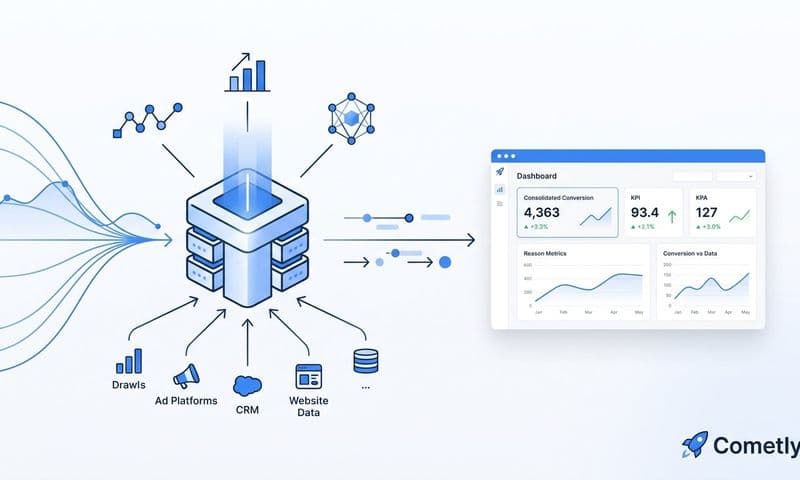
The key is to centralize your data. A dashboard's real power comes from showing metrics from Google, Meta, and your CRM all in one place. This unified view is essential for a holistic understanding of your marketing performance.
Popular choices include:
- Looker Studio (formerly Google Data Studio): It's free, integrates seamlessly with Google products, and has a massive library of connectors for other platforms like Meta Ads.
- Tableau: A more advanced option that offers incredibly deep customization and can handle massive, complex datasets. It’s a favorite among dedicated analytics teams.
- Cometly: For advertisers, a platform like Cometly is often ideal because its dashboards are purpose-built for attribution. It automatically blends ad platform data with your sales data, providing a single source of truth for ROAS and CAC without complex setup.
For a deeper look at what to include, check out our guide on creating an effective data analysis dashboard that focuses on actionable insights.
The Weekly Performance Report Template
A dashboard gives you the real-time view, but a weekly summary report is crucial for communicating performance to your team or stakeholders. It adds context to the numbers.
Keep it simple and focused. Your report should answer three core questions:
- What Worked? (The Wins): "Our new 'Testimonial' creative on Facebook drove a 25% lower CPA than the control group."
- What Didn't? (The Challenges): "The Google Search campaign for 'Product X' saw a 15% drop in conversion rate this week, likely due to a new competitor bidding on our brand terms."
- What's Next? (The Action Plan): "We will reallocate 20% of the budget from the underperforming Search campaign to scale the winning Facebook creative."
This simple framework transforms reporting from a boring data dump into a strategic conversation, empowering your entire team to understand performance and contribute to the next steps.
Common Questions About Measuring Ad Effectiveness
Even with the best framework in place, you're going to have questions. It's just part of the process. This section is all about tackling those common hurdles head-on, giving you clear, practical answers so you can turn all that data into confident decisions.
 Measuring Advertising Effectiveness for Real ROI
We'll cover everything from picking the right "North Star" metric to finally understanding the difference between analytics and attribution.
What Is the Most Important Metric for Measuring Advertising Effectiveness
I get this question all the time, and the honest answer is: there's no single "best" metric. The most important metric is the one that directly ties back to what you're trying to accomplish with your campaign. It has to reflect the business goal.
For an e-commerce store running a sales campaign, their world revolves around Return on Ad Spend (ROAS). It's their lifeline. But a B2B company trying to fill its sales pipeline? They're laser-focused on Cost Per Acquisition (CPA) or Cost Per Lead (CPL).
The key is to avoid a one-size-fits-all approach. A brand awareness campaign's success is measured by Reach and Impressions, metrics that would be irrelevant for a direct-response campaign. A strong measurement strategy always aligns one primary KPI with the campaign objective while monitoring several secondary metrics for a complete performance picture.
Ultimately, the most important metric is the one that tells you if you're making money and hitting your main objective. Simple as that.
How Often Should I Check My Advertising Performance
This really comes down to your ad spend and how fast your campaigns are moving. If you're managing high-spend, fast-paced campaigns on platforms like Meta or Google, daily check-ins are non-negotiable. You need to be able to spot a sudden CPA spike before it torches your budget.
For most businesses, though, a thorough weekly analysis is where the magic happens. This is where you identify real trends and make strategic adjustments. Performance fluctuates day-to-day—it's natural. One of the costliest mistakes I see marketers make is overreacting to a single bad day.
A healthy rhythm looks something like this:
- A quick daily health check (5-10 minutes) just to make sure nothing is on fire.
- A deeper weekly dive to analyze trends, see what creative is working, and plan your optimizations for the week ahead.
This approach keeps you from making knee-jerk decisions based on normal market volatility while ensuring you're always on top of what's happening.
How Can I Measure the Impact of Offline Ads
Measuring offline ads—think billboards, radio spots, or print—just requires a little creativity. The goal is to build a trackable bridge from the physical world to your digital one. You need to give people an easy, measurable way to respond online.
I've found these methods to be the most effective:
- Use a Vanity URL: Set up a clean, memorable URL that's exclusive to that ad (like
YourBrand.com/Radio). Any traffic hitting that page can be directly tied to your offline campaign. - Implement QR Codes: A QR code on a print ad or flyer is a direct, scannable path to a specific landing page. It's frictionless for the user and perfectly measurable for you.
- Offer a Unique Discount Code: Mention a special discount code—like "PODCAST25"—only in that specific ad. When customers use it at checkout, you get a clean count of conversions.
- Utilize a Dedicated Phone Number: With a call-tracking service, you can assign a unique phone number to your offline ad. Every call it generates is another data point.
By tracking these unique identifiers, you can directly attribute online actions and sales back to your offline efforts.
What Is the Real Difference Between Analytics and Attribution
It's easy to get these two mixed up, but they play very different—and equally important—roles in measuring your ad effectiveness.
Here’s the simplest way to think about it: analytics tells you what happened, while attribution explains why it happened.
- Analytics is the scoreboard. It gives you the results: clicks, total conversions, website traffic, bounce rate. It's the high-level summary of your campaign outcomes.
- Attribution is the post-game analysis. It’s the process of giving credit to all the different marketing touchpoints that led a customer to convert. It shows you which channels, ads, or keywords actually influenced the journey.
So, while analytics gives you the final score, attribution tells you which players made the key plays. That's the insight you need to invest your budget smarter next time.
Ready to get crystal-clear insights into your advertising effectiveness? Cometly is the all-in-one attribution platform that eliminates the guesswork. Unify your data, track every touchpoint, and see exactly which campaigns are driving real revenue. Start optimizing with confidence today.