You're running campaigns across Meta, Google, LinkedIn, and email. Your dashboard shows clicks, impressions, and conversions from each platform. But when you add up the conversions each platform claims, the total is 40% higher than what actually landed in your bank account.
Sound familiar?
This isn't a tracking error. It's the reality of siloed platform reporting, where each channel takes full credit for conversions that involved multiple touchpoints. The customer who saw your LinkedIn ad, clicked a Google search result three days later, and converted after opening your email gets counted as a win by all three platforms.
A multi channel attribution tool solves this puzzle by connecting every touchpoint across the entire customer journey. Instead of relying on conflicting reports from individual platforms, you get a unified view that shows which channels actually drive revenue—and how they work together to convert prospects into customers.
By the end of this article, you'll understand how these tools work, what features separate effective solutions from basic tracking, and how to use attribution data to make confident scaling decisions backed by real insights.
Why Single-Channel Metrics Lead Marketers Astray
Every ad platform wants to prove its value. Meta attributes conversions to users who saw your ad within a 7-day window. Google claims credit for anyone who clicked your search ad within 30 days. LinkedIn counts view-through conversions from users who simply scrolled past your sponsored content.
The problem? These attribution windows overlap, and each platform operates in a vacuum. They have no visibility into what happened before or after their touchpoint. So when a customer interacts with multiple channels before converting, every platform claims the win.
This creates a distorted picture of performance. You might see 150 conversions across your platforms when you actually closed 100 deals. Your Meta campaigns look profitable until you realize Google is claiming credit for the same customers. Your LinkedIn ads appear to generate leads, but those leads already engaged with your content through organic search first.
Here's what makes this dangerous: budget allocation decisions based on siloed metrics actively work against you. You scale the channel that looks best in isolation, not the channel that actually drives incremental revenue. You cut spend on awareness campaigns because they don't show last-click conversions, even though they're essential for warming up prospects who later convert through direct traffic or branded search.
The real customer journey doesn't fit into neat platform-specific boxes. Someone might discover your brand through a Facebook ad during their morning scroll. They research your solution on Google that afternoon. They read comparison articles over the next few days. They see a retargeting ad on LinkedIn. They finally convert after receiving a well-timed email.
Which channel "worked"? All of them. But platform reporting forces you to pick one winner, leading to misattribution that compounds over time. You overinvest in channels that get credit for conversions they didn't truly drive. You underinvest in channels that play crucial supporting roles in the journey. And you make scaling decisions based on incomplete data that tells you what happened, but not why it happened. Understanding multi channel attribution in digital marketing is the first step toward solving this problem.
How Multi Channel Attribution Tools Connect the Full Journey
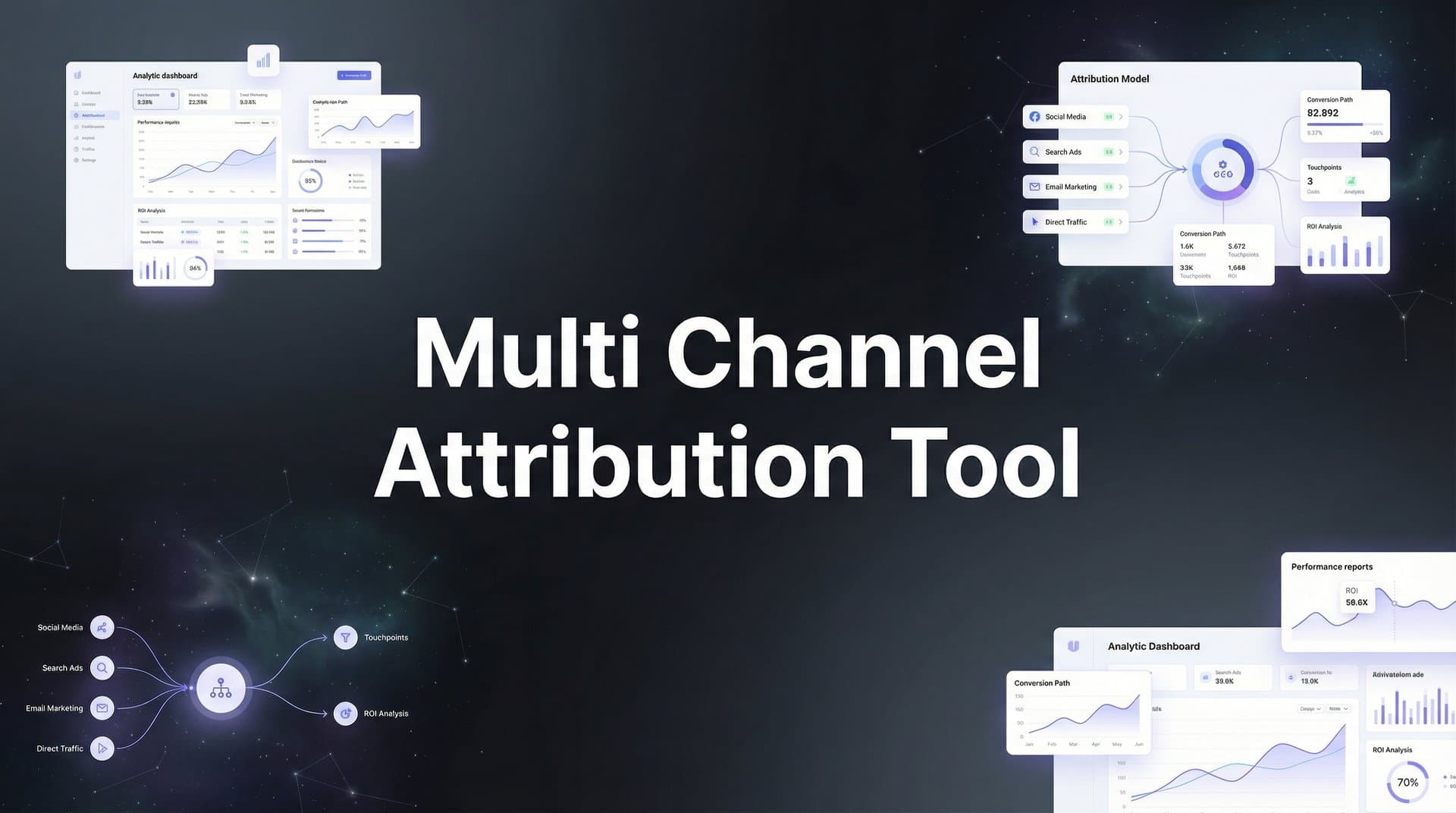
A multi channel attribution tool acts as a central nervous system for your marketing data. Instead of relying on each platform's isolated view, it captures every touchpoint a customer has with your brand and stitches them together into a complete journey.
The technical foundation starts with tracking pixels on your website that fire when visitors arrive from different sources. But modern tools go much deeper than simple pixel tracking. They implement server-side tracking that captures events directly from your web server, bypassing browser limitations and privacy restrictions that have made client-side pixels increasingly unreliable.
Here's how the data flow works: When someone clicks your Meta ad, the tracking system records that touchpoint along with campaign details, ad creative, and timestamp. When that same person later searches for your brand on Google and clicks through, the tool matches them to their previous interaction and adds this new touchpoint to their journey. When they finally convert after receiving an email, the system captures that final event and connects it back to everything that came before.
This matching happens through multiple identifiers working together. Email addresses, phone numbers, and user IDs from your CRM provide the strongest matches. Browser cookies and device fingerprinting fill in gaps for anonymous visitors. The tool constantly reconciles these signals to build accurate customer profiles even when someone switches between devices or browses in different contexts.
Integration with your CRM takes this further by connecting marketing touchpoints to actual revenue outcomes. When a lead enters your sales pipeline, the attribution tool knows which marketing interactions brought them in. When they close as a customer, it tracks the deal value back to the campaigns that influenced the sale. This closed-loop tracking reveals not just which channels generate leads, but which channels generate revenue. Implementing a robust multi channel attribution platform makes this level of visibility possible.
Real-time data unification means you're not waiting until month-end to understand performance. As conversions happen, the attribution tool processes them against the full history of touchpoints for that customer. You can see today which campaigns are driving pipeline, which creative variations are resonating, and which channel combinations are producing the highest-value customers.
The result is a single source of truth that cuts through platform reporting conflicts. Instead of Meta claiming 50 conversions and Google claiming 45 conversions for the same 60 actual customers, you see the reality: 30 customers engaged with both channels, 15 came primarily through Meta, and 15 came primarily through Google. Now you can make decisions based on actual customer behavior, not inflated platform metrics.
Attribution Models Explained: Choosing the Right Lens for Your Data
Once you have complete journey data, you need a framework for assigning credit to different touchpoints. Attribution models provide that framework, and choosing the right one dramatically affects how you interpret your results.
First-touch attribution gives all credit to the initial interaction that brought someone into your ecosystem. If a prospect discovered you through a LinkedIn ad, that campaign gets 100% credit for the eventual conversion—even if they interacted with five other channels before purchasing. This model makes sense when you're focused on top-of-funnel performance and want to understand which channels are best at generating new awareness.
Last-touch attribution does the opposite, crediting only the final touchpoint before conversion. If someone converted after clicking a Google search ad, that campaign gets full credit regardless of what came before. Many platforms default to this model because it's simple and makes their performance look strong. It works well for evaluating channels that specialize in capturing ready-to-buy intent, but it completely ignores the nurturing that happened earlier in the journey.
Linear attribution distributes credit equally across all touchpoints. If a customer engaged with four campaigns before converting, each receives 25% of the credit. This approach acknowledges that multiple channels contributed to the outcome, but it treats a fleeting impression the same as a deep engagement—which doesn't reflect reality.
Time-decay attribution weights touchpoints based on how close they occurred to the conversion. Recent interactions receive more credit than older ones, operating on the assumption that channels closer to the purchase decision had more influence. This model works well for understanding which touchpoints are most effective at closing deals, but it can undervalue the awareness-building work that happens weeks or months earlier.
Data-driven attribution uses machine learning algorithms to analyze your actual conversion patterns and determine how much credit each touchpoint truly deserves. The algorithm looks at thousands of customer journeys, identifies which combinations of touchpoints lead to conversions, and assigns credit based on statistical impact. If customers who see a Facebook ad followed by a Google search convert at 3x the rate of those who only see the Facebook ad, the model weights both touchpoints accordingly. For a deeper dive into these frameworks, explore multi channel attribution models and how they apply to different business scenarios.
The power comes from comparing models side-by-side. When first-touch and last-touch attribution tell vastly different stories about the same campaigns, that's valuable information. It means your funnel requires multiple touchpoints working together, and single-touch models are hiding important dynamics. When linear attribution spreads credit thin across many touchpoints but data-driven attribution concentrates it on specific combinations, you've identified the high-impact sequences worth replicating.
Most sophisticated marketers don't pick one model and stick with it. They use multiple models to examine their data from different angles, asking different questions. First-touch reveals which channels are best at generating awareness. Last-touch shows which channels close deals. Data-driven attribution uncovers the hidden patterns that drive actual conversions. Understanding the difference between single source attribution and multi touch attribution helps you select the right approach for your goals.
Key Features That Separate Effective Tools from Basic Tracking
Not all multi channel attribution tools are created equal. The difference between basic tracking and a truly effective solution comes down to three critical capabilities that determine whether you get accurate, actionable data or just more noise.
Server-side tracking has become non-negotiable in the post-iOS 14.5 world. When Apple introduced App Tracking Transparency, it broke the foundation of pixel-based tracking by requiring explicit user permission to track across apps and websites. Most users decline, creating massive blind spots in your data. Browser privacy features from Safari, Firefox, and soon Chrome compound the problem by blocking or deleting tracking cookies.
Server-side tracking solves this by capturing events directly from your web server rather than relying on browser pixels. When a conversion happens, your server sends that data to the attribution tool and to ad platforms through their Conversion APIs. This approach isn't affected by browser settings or iOS restrictions because the data flow never depends on client-side cookies. The result is dramatically more accurate conversion tracking and better visibility into the full customer journey.
Conversion sync capabilities take this a step further by feeding enriched data back to your ad platforms. Instead of just tracking conversions for your internal reporting, the tool sends detailed conversion events back to Meta, Google, and other platforms with additional context they wouldn't otherwise have. This might include the actual revenue value of a sale, the customer's lifetime value, or which product they purchased.
Why does this matter? Because ad platform algorithms optimize based on the conversion data they receive. When you feed them richer, more accurate data, their machine learning models make better decisions about who to target and what creative to show. A campaign that looks mediocre based on basic conversion tracking might be driving high-value customers that justify higher cost-per-acquisition. Without conversion sync, the algorithm never learns this and continues optimizing for the wrong goal. Reviewing multi touch attribution software comparison guides can help you evaluate which tools offer the strongest conversion sync features.
AI-powered recommendations represent the next evolution beyond just reporting what happened. Advanced attribution tools analyze your performance data to identify patterns and opportunities you might miss. The AI might flag that customers who engage with both video ads and carousel ads convert at twice the rate of single-touchpoint journeys. It might notice that campaigns targeting a specific audience segment are driving higher lifetime value despite higher upfront costs. It might identify that certain creative themes consistently appear in high-converting journeys across multiple channels.
These insights don't just describe your current performance—they guide your next moves. Instead of manually digging through reports to find optimization opportunities, the tool surfaces them automatically. You can confidently scale campaigns the AI identifies as high-performers, knowing the recommendation is based on complete journey data rather than siloed platform metrics. The best AI-powered marketing attribution tools combine these capabilities to deliver actionable recommendations in real time.
Putting Attribution Insights Into Action
Attribution data only creates value when it changes your decisions. The goal isn't just to understand what happened—it's to use those insights to allocate budget more effectively, improve creative strategy, and build a feedback loop that compounds over time.
Budget reallocation becomes straightforward when you can see which channels actually drive revenue. You might discover that LinkedIn generates fewer conversions than Meta, but those conversions close at 3x the rate and have 2x higher lifetime value. That insight justifies increasing LinkedIn spend even though it looks less efficient in isolation. You might find that display ads rarely get last-click credit but consistently appear early in high-value customer journeys—revealing they're worth maintaining for awareness even if they don't drive direct conversions. Following multi channel attribution best practices ensures you're making these decisions systematically.
The key is moving beyond vanity metrics to revenue impact. A channel that generates 100 leads at $50 each looks better than one generating 40 leads at $100 each—until you track those leads through your sales cycle and realize the second channel produces twice as many closed deals. Attribution tools connect marketing spend to actual revenue outcomes, letting you optimize for profit rather than just lead volume. This focus on multi channel attribution for ROI transforms how you measure marketing success.
Creative and messaging optimization gets more sophisticated when you understand what works at each funnel stage. Attribution data reveals which ad creative appears most often in first-touch interactions that lead to conversions. You can identify messaging themes that resonate during awareness versus consideration versus decision stages. You might discover that educational content works best for cold audiences while product-focused creative converts warm prospects who've already engaged with your brand.
This insight lets you build cohesive multi-channel strategies where creative evolves as customers progress through the journey. Someone who clicked your thought leadership content on LinkedIn might later see product demonstration ads on Meta. Someone who engaged with a video ad might receive carousel ads showcasing specific features. Instead of running disconnected campaigns across channels, you orchestrate a coordinated experience that guides prospects toward conversion.
The feedback loop effect amplifies these improvements over time. When you use attribution insights to feed better conversion data back to ad platforms through conversion sync, their algorithms learn what good outcomes look like. They start targeting similar audiences and optimizing toward the actions that actually drive revenue. This improved targeting brings in better prospects, which generates better attribution data, which further improves platform optimization. The cycle compounds, making your campaigns more efficient month after month.
This is where attribution transforms from a reporting tool into a growth engine. You're not just measuring what happened—you're actively improving what happens next by giving both yourself and your ad platforms the data needed to make smarter decisions. Effective attribution tracking for multiple campaigns is the foundation of this continuous improvement cycle.
Bringing Clarity to Your Marketing Data
The shift from siloed platform reporting to unified multi channel attribution represents a fundamental change in how marketing decisions get made. Instead of guessing which channels deserve more budget based on conflicting data from different platforms, you know which combinations of touchpoints drive actual revenue.
This clarity compounds over time. Every campaign you run generates more data about what works. Every conversion adds another example of a successful customer journey. The attribution tool's algorithms get better at identifying high-impact patterns. Your understanding of your customers' decision-making process deepens. What starts as basic journey visibility evolves into sophisticated insights about which creative themes, audience segments, and channel combinations produce the best outcomes.
The confidence this creates changes how you approach scaling. Instead of hesitating to increase spend because you're not sure what's really working, you can confidently invest more in campaigns the data proves are driving revenue. Instead of cutting budgets during slower periods because you can't see the full picture, you maintain investment in channels that play crucial roles in the journey even if they don't get last-click credit.
Your next step is evaluating your current tracking setup and identifying gaps. Can you see complete customer journeys across all your marketing channels? Do you know which touchpoint combinations drive the highest-value customers? Are you feeding accurate conversion data back to your ad platforms to improve their optimization? If the answer to any of these questions is no, you're making decisions with incomplete information—and leaving money on the table.
Moving Forward with Confidence
A multi channel attribution tool transforms marketing from a guessing game into a data-driven discipline. You stop relying on each platform's self-serving metrics and start seeing the complete picture of how customers actually find and choose your product. You identify which channels work together to drive conversions, which creative resonates at different funnel stages, and which campaigns justify increased investment based on real revenue impact.
The confidence that comes from seeing the complete customer journey changes everything. You make budget decisions backed by data that shows actual contribution to revenue. You build creative strategies informed by what works at each touchpoint. You create a feedback loop where better attribution data leads to better platform optimization, which drives better results, which generates even better data.
This isn't about adding another dashboard to check—it's about fundamentally improving how you understand and optimize your marketing. Every conversion becomes a learning opportunity. Every campaign contributes to a growing knowledge base about what drives results for your specific business. The compounding effect of these insights creates a sustainable competitive advantage that grows stronger over time.
Ready to elevate your marketing game with precision and confidence? Discover how Cometly's AI-driven recommendations can transform your ad strategy—Get your free demo today and start capturing every touchpoint to maximize your conversions.