

You're running ads on Meta, Google, TikTok, and LinkedIn. Each platform's dashboard shows strong performance. Meta claims 500 conversions this month. Google says it drove 450. TikTok reports 300. Add them up and you get 1,250 conversions—but your actual sales? Only 600.
This isn't a tracking error. It's the reality of multi platform advertising in 2026.
Every ad platform uses its own attribution rules, claiming credit for conversions it influenced—even if three other platforms touched the same customer first. The result? Overlapping claims, inflated metrics, and marketing teams left wondering which channels actually drive revenue. Without a unified view of how customers move across platforms before converting, you're making budget decisions based on incomplete, often contradictory data.
Multi platform ad tracking solves this puzzle by connecting fragmented data sources into a single, accurate picture of customer journeys. Instead of trusting each platform's self-reported success, you get one source of truth that shows exactly which touchpoints matter and where your budget should go.
Why Every Platform Tells a Different Story
When Meta reports a conversion, it's using a 28-day click and 1-day view attribution window by default. Google Ads uses a 30-day click window. TikTok counts conversions within 7 days of a click. Each platform defines success differently, and they all count the same customer multiple times.
Picture a customer who sees your TikTok ad on Monday, clicks a Google search ad on Wednesday, and converts through a Meta retargeting ad on Friday. All three platforms will claim that conversion. They're not lying—each genuinely influenced the journey. But when you're trying to calculate ROI and allocate budget, these overlapping claims make it impossible to know which channel deserves credit.
The problem gets worse when you factor in privacy changes. Apple's App Tracking Transparency framework has blocked tracking for millions of iOS users. Third-party cookies are disappearing across browsers. Platform-native pixels that once captured every customer action now miss significant portions of your traffic.
Meta's own reporting acknowledges this gap. When iOS users opt out of tracking, Meta can't see their full journey—so it uses statistical modeling to estimate conversions. Google faces similar limitations. The data you're seeing in each platform's dashboard isn't complete reality anymore. It's each platform's best guess, optimized to make their performance look favorable. Understanding these multiple ad platforms tracking problems is the first step toward solving them.
Without unified tracking, brands typically overspend on channels that get last-click credit while underinvesting in platforms that introduce customers to the brand. Your TikTok ads might be generating massive awareness that leads to Google searches and Meta conversions—but if you're only looking at last-click attribution, TikTok appears to underperform. You cut the budget, and suddenly your entire funnel suffers.
This fragmented view doesn't just waste budget. It prevents you from understanding what's actually working. You can't scale confidently when every platform tells a different story about the same customer.
How Unified Ad Tracking Actually Works
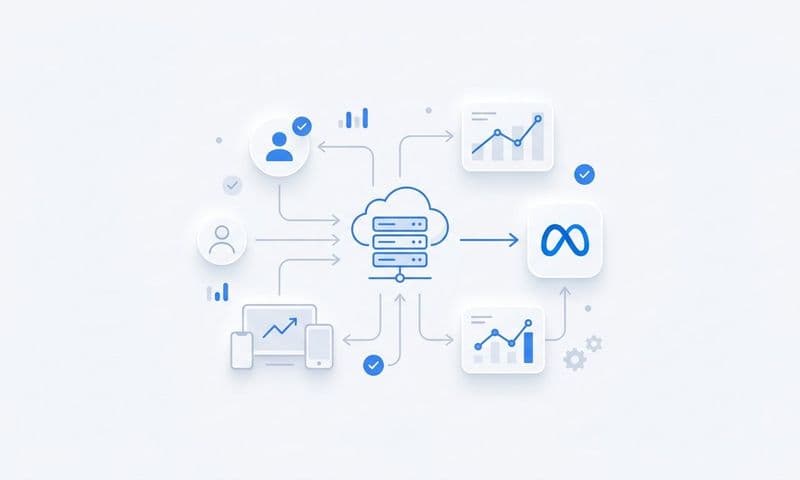
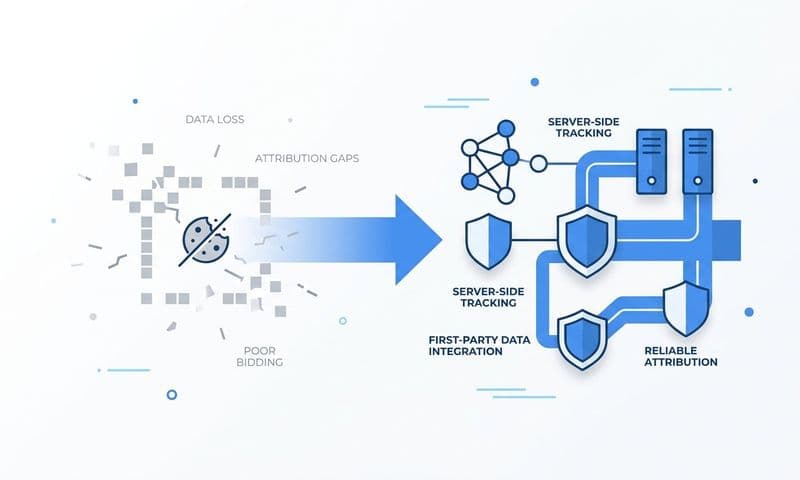
Multi platform ad tracking starts with server-side tracking, which fundamentally changes how conversion data gets captured. Instead of relying on browser-based pixels that users can block, server-side tracking sends data directly from your server to ad platforms.
Here's what happens: A customer clicks your Meta ad and lands on your website. Your server records this visit along with the Meta click ID. Later, that same customer returns through a Google search ad—your server captures the Google click ID too. When they finally convert, your server sends the complete journey data to a central attribution system that can see every touchpoint.
This approach bypasses the limitations that plague browser-based tracking. Ad blockers can't stop it. iOS privacy settings don't affect it. Cookie restrictions don't break it. You capture accurate data even when customers use multiple devices or clear their browsing history. Modern cookieless tracking platforms have made this approach increasingly reliable.
Customer journey mapping takes this raw data and connects the dots. It identifies that the person who clicked your TikTok ad on mobile Monday morning is the same person who searched on desktop Wednesday afternoon and converted through email Friday evening. Instead of treating these as three separate anonymous visitors, you see them as one customer with multiple touchpoints.
The mapping process uses various identifiers—email addresses when customers log in, phone numbers from form submissions, and probabilistic matching when direct identifiers aren't available. Advanced systems can even connect online and offline touchpoints, showing how digital ads influence in-store purchases or phone sales.
Real-time data syncing ensures this unified view stays current. When a conversion happens, your tracking system immediately sends accurate conversion data back to each platform that influenced the journey. Meta receives a conversion signal. So does Google. TikTok gets one too. But now each platform also receives context about the other touchpoints, enabling their algorithms to understand their actual role in the customer journey.
This feedback loop is crucial for campaign optimization. Ad platforms use conversion data to train their targeting algorithms. When you send complete, accurate conversion signals—including which other platforms were involved—each platform can better identify audiences likely to convert. Meta learns that users who also engage with your Google search ads convert at higher rates. Google discovers that customers who saw your TikTok content first have higher lifetime value.
The result? Better targeting, improved ad delivery, and campaigns that actually work together instead of competing for credit.
Choosing the Right Attribution Model for Your Brand
Attribution models determine how credit gets distributed across touchpoints in the customer journey. The model you choose fundamentally shapes how you understand channel performance and where you invest budget.
Last-touch attribution gives 100% credit to the final touchpoint before conversion. If a customer sees your TikTok ad, clicks a Google search ad, and converts through Meta retargeting, Meta gets all the credit. This model works well for brands with short sales cycles where the last interaction genuinely drives the decision—think impulse purchases or limited-time promotions. But for most brands, last-touch attribution severely undervalues awareness and consideration touchpoints.
First-touch attribution does the opposite, crediting the initial touchpoint that introduced the customer to your brand. In the same journey, TikTok would receive 100% credit. This model makes sense when you're focused on customer acquisition and want to understand which channels bring new audiences into your funnel. The downside? It ignores everything that happened between discovery and conversion, potentially overvaluing channels that generate awareness but don't drive actual sales.
Multi-touch attribution distributes credit across all touchpoints based on their influence. A linear model might split credit equally—TikTok gets 33%, Google gets 33%, Meta gets 33%. Time-decay models give more weight to touchpoints closer to conversion. Position-based models credit both the first and last touch more heavily while still acknowledging middle touches. Implementing cross platform attribution tracking makes these models actionable across your entire ad portfolio.
The right model depends on your business goals and sales cycle. Brands with complex B2B sales cycles spanning weeks or months need multi-touch attribution to understand how different channels work together. E-commerce brands with shorter consideration periods might find last-touch or position-based models more actionable.
Here's the critical insight: you shouldn't choose just one model. Compare multiple attribution models side-by-side to understand the full picture. When you see that a channel performs well in first-touch attribution but poorly in last-touch, you know it's strong for awareness but weak at closing. That's not a reason to cut budget—it's a signal to adjust your creative strategy for that platform.
Attribution model selection directly impacts budget allocation. If you're using last-touch attribution and Meta consistently gets credit, you might pour more budget into Meta retargeting. But switch to multi-touch attribution and you might discover that TikTok and Google are actually initiating most of those customer journeys. Without that insight, you'd scale the wrong channel.
The most sophisticated brands use different attribution models for different decisions. Last-touch for immediate optimization. First-touch for acquisition planning. Multi-touch for strategic budget allocation. This layered approach prevents any single model's biases from distorting your understanding of what's working.
Building Your Multi Platform Tracking Stack
Creating unified ad tracking requires connecting three core components: your ad platforms, your CRM or customer database, and your website analytics. Each integration serves a specific purpose in building your single source of truth.
Start with ad platform integrations. Connect Meta Ads, Google Ads, TikTok Ads, LinkedIn Ads, and any other platforms where you run campaigns. These integrations pull campaign data—impressions, clicks, spend—and match it with conversion events from your website. The goal is capturing which specific ads and audiences drove each customer touchpoint.
Your CRM integration is equally critical. When a lead fills out a form, requests a demo, or makes a purchase, that data lives in your CRM. Connecting your CRM to your attribution system allows you to track the complete journey from first ad click through closed deal. For B2B brands especially, this connection reveals which marketing touchpoints influence deals that close weeks or months later.
Website analytics integration ties everything together. Whether you're using Google Analytics or another platform, this connection provides the behavioral context—which pages customers visited, how long they stayed, what content they engaged with between ad clicks and conversion. A comprehensive cross platform tracking setup guide can walk you through each integration step.
Setting up conversion events requires thinking beyond basic website actions. Yes, track purchases and form submissions. But also define events that matter for your specific business model. SaaS brands should track free trial starts, feature activations, and upgrade events. E-commerce brands need to capture add-to-cart actions, abandoned checkout recoveries, and repeat purchases. B2B companies should monitor demo requests, proposal downloads, and sales calls booked.
The more granular your conversion events, the more precisely you can optimize. Instead of knowing that "Meta drove 100 conversions," you can see that "Meta drove 60 free trial starts, 25 upgraded to paid, and 15 became enterprise customers." That level of detail transforms how you evaluate channel performance.
Data flow back to ad platforms completes the loop. Once your tracking system identifies a conversion and attributes it across touchpoints, it sends conversion signals back to each platform. This process, often called conversion sync, feeds better data to platform algorithms.
When Meta receives accurate conversion data—including conversions that happened offline or on other devices—its algorithm learns which audiences and creative approaches actually drive results. The same applies to Google, TikTok, and other platforms. Better data in means better optimization out.
The technical implementation typically involves installing tracking pixels on your website, configuring server-side tracking endpoints, and setting up API connections between your attribution platform and each ad network. Most modern attribution platforms handle this complexity through guided setup flows, but budget time for testing and validation. You can explore conversion tracking platform implementation best practices to streamline this process.
Verification is crucial. After setup, run test conversions and confirm they appear correctly in your attribution dashboard and get synced back to ad platforms. Check that customer journeys are being mapped accurately and that attribution models are calculating as expected. A week of thorough testing prevents months of decisions based on incorrect data.
Turning Tracking Data Into Scaling Decisions
Unified tracking data only creates value when it drives better decisions. The shift from fragmented platform dashboards to complete attribution data fundamentally changes how you evaluate performance and allocate budget.
Start by identifying which campaigns and creatives actually drive revenue, not just engagement metrics. Platform dashboards emphasize clicks, impressions, and cost-per-click because those metrics make their performance look good. But unified tracking reveals the campaigns that generate customers who stick around and spend money. Effective ad performance tracking across platforms makes this revenue visibility possible.
You might discover that your highest-click-through-rate TikTok campaign drives traffic that bounces immediately, while a lower-CTR campaign brings engaged users who convert at 3x the rate. Platform data would tell you to scale the high-CTR campaign. Attribution data tells you to scale the high-conversion campaign.
Cross-platform insights reveal patterns invisible within single platforms. Maybe customers who see both your Meta and Google ads convert at twice the rate of those who only see one. That insight suggests running coordinated campaigns across both platforms instead of treating them as separate channels competing for budget.
Budget reallocation becomes strategic rather than reactive. Instead of shifting budget based on which platform reported the most conversions last week, you can analyze which channels drive the highest customer lifetime value. A platform might appear expensive on a cost-per-acquisition basis but deliver customers who spend more over time. Unified tracking reveals that relationship.
Timing insights matter too. Attribution data shows how long customers typically take to convert after first touchpoint. If your average customer journey spans two weeks with five touchpoints, you know that judging campaign performance after three days is premature. You can set realistic expectations and avoid killing campaigns before they've had time to work.
AI-powered recommendations take this analysis further by automatically identifying optimization opportunities across your entire ad portfolio. Advanced attribution platforms analyze patterns across thousands of customer journeys to surface insights you might miss manually.
The AI might notice that customers who engage with video ads on Meta and then see search ads on Google convert 40% more often than other paths. It could identify that certain creative themes consistently appear in high-value customer journeys across multiple platforms. These pattern-recognition capabilities help you spot what's working before competitors do.
Scaling decisions become more confident when backed by complete data. You're not guessing which channel deserves more budget based on each platform's self-reported success. You're allocating resources based on verified contribution to revenue across the entire customer journey.
This confidence accelerates growth. Brands with unified tracking can scale winning campaigns faster because they know which metrics actually predict success. They can test new platforms and creative approaches with clear success criteria. They can defend budget decisions with data that shows complete ROI rather than platform-specific vanity metrics.
Putting It All Together: Your Path to Unified Marketing Data
The transformation from fragmented platform dashboards to unified marketing attribution changes everything about how you run paid advertising. Instead of reconciling conflicting reports from Meta, Google, TikTok, and other platforms, you have one accurate view of customer journeys.
You move from asking "which platform reported the most conversions?" to understanding "which combination of touchpoints drives the highest-value customers?" That shift in perspective reveals optimization opportunities that remain invisible when analyzing platforms in isolation.
Brands with complete attribution data make faster, more confident scaling decisions. They identify winning campaigns earlier, reallocate budget based on actual contribution to revenue, and feed better data back to ad platforms for improved targeting. The competitive advantage compounds over time as their marketing becomes increasingly precise while competitors waste budget on channels that get credit without earning it.
Multi platform ad tracking isn't optional anymore for brands running serious advertising budgets across multiple channels. Privacy changes have made platform-native tracking unreliable. Customer journeys span more touchpoints than ever. The brands that win are those who can see the complete picture and act on it.
Start Making Decisions Based on Complete Data
Every day you run ads without unified tracking is another day of budget decisions based on incomplete information. Platform dashboards will keep showing inflated, overlapping conversion claims. Your team will keep wondering which channels actually drive results. And competitors with better attribution data will keep outmaneuvering you.
The solution is connecting your fragmented marketing data into one source of truth that shows exactly how customers move across platforms before converting. With complete attribution data, you can identify which campaigns deserve more budget, which creative approaches drive the highest-value customers, and how your channels work together to generate revenue.
Ready to elevate your marketing game with precision and confidence? Discover how Cometly's AI-driven recommendations can transform your ad strategy—Get your free demo today and start capturing every touchpoint to maximize your conversions.