

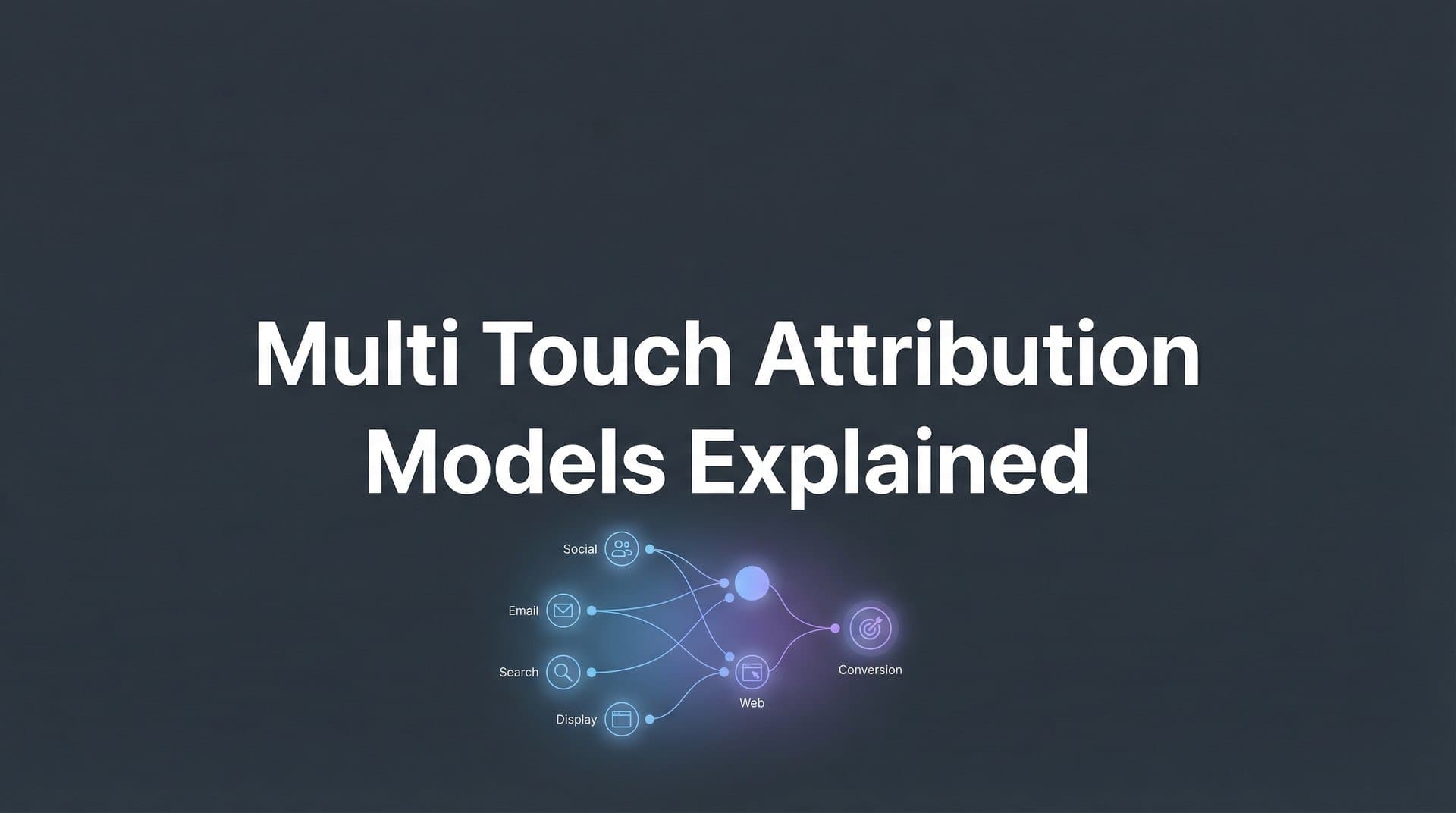
You're staring at your campaign dashboard, and something doesn't add up. Facebook claims 200 conversions this month. Google Ads says it drove 180 of the same conversions. Your email platform takes credit for 150. The math is impossible, yet every platform confidently presents its numbers as gospel truth.
This isn't a technical glitch. It's the inevitable result of single-touch attribution, where each platform only sees one moment in a customer's journey and claims full credit for the outcome. The problem? Your customers don't convert after seeing a single ad. They research, compare, revisit, and interact with multiple touchpoints before making a decision.
Multi-touch attribution solves this puzzle by distributing credit across every interaction that influenced a conversion. Instead of arguing over which channel "won" the customer, you see how your entire marketing ecosystem works together to drive revenue. This shift from single-touch to multi-touch attribution transforms marketing from a guessing game into a data-driven discipline where you can confidently allocate budgets, scale what works, and cut what doesn't.
In this guide, you'll learn how different multi-touch attribution models work, when to use each one, and how to implement them effectively so you can make smarter marketing decisions backed by complete data.
The Single-Touch Attribution Problem (And Why It Costs You Money)
Single-touch attribution models operate on a simple premise: assign 100% of the credit for a conversion to one touchpoint. First-click attribution credits whatever brought the customer into your world initially. Last-click attribution gives all the glory to the final interaction before conversion.
Both approaches ignore a fundamental truth about how people buy. Consider this typical B2B scenario: A marketing director sees your LinkedIn ad about marketing attribution software. Intrigued, she visits your site and reads a blog post explaining the basics. Two days later, she searches "best attribution tools" on Google, clicks your ad, and browses your pricing page. A week passes. She receives your email newsletter with a case study, clicks through, and finally signs up for a demo.
Under last-click attribution, your email campaign gets 100% of the credit. LinkedIn, your blog content, and your Google Ads investment? They're invisible. Under first-click attribution, LinkedIn gets all the credit, while everything else that nurtured and closed the deal disappears from view. Understanding the difference between first touch and last touch attribution reveals why both approaches fall short.
The business impact is severe. When you only see last-click data, you systematically undervalue awareness channels like social media and content marketing. You might cut LinkedIn spend because it shows zero conversions, not realizing it's introducing prospects who convert through other channels later. Conversely, you might pour money into remarketing campaigns that get last-click credit but are simply catching customers who were already convinced by earlier touchpoints.
This creates a vicious cycle: you misallocate budgets based on incomplete data, scale channels that look good in single-touch reports but don't actually drive new customers, and cut campaigns that assist conversions even though they never get credit for closing them. The result? Lower ROI, frustrated marketing teams, and executives questioning why increased ad spend isn't translating to proportional revenue growth.
Single-touch attribution also makes it nearly impossible to understand which marketing activities generate awareness versus which ones close deals. Both roles are essential, but they require different strategies and budgets. Without visibility into the full journey, you're flying blind.
How Multi-Touch Attribution Distributes Credit Across the Journey
Multi-touch attribution takes a fundamentally different approach: instead of giving 100% credit to one touchpoint, it distributes fractional credit across every interaction that influenced the conversion. Think of it as acknowledging that customer decisions are collaborative efforts involving multiple marketing channels working in sequence.
The core concept revolves around weighting touchpoints based on their role and timing in the customer journey. Each interaction receives a percentage of credit that reflects its contribution to the final outcome. The specific percentages depend on which attribution model you choose, but the principle remains constant: every touchpoint that played a part gets recognized. Learning how multi-touch attribution works is essential for any data-driven marketer.
Let's revisit that B2B scenario with a multi-touch lens. The marketing director's journey included four touchpoints: LinkedIn ad, blog post, Google ad, and email. Under a linear multi-touch model, each interaction would receive 25% of the conversion credit. Under a time-decay model, the email might get 40%, Google ad 30%, blog post 20%, and LinkedIn ad 10%, reflecting that later touchpoints had more influence on the immediate decision.
This approach reveals patterns that single-touch attribution completely misses. You might discover that prospects who engage with your content before clicking ads convert at higher rates and spend more. Or that LinkedIn consistently introduces high-value prospects even though it rarely gets last-click credit. These insights are invisible when you only track the first or last interaction.
Multi-touch attribution also accounts for the reality that different channels serve different purposes in your marketing mix. Some channels excel at generating awareness and initial interest. Others nurture consideration. Still others convert ready-to-buy prospects. By distributing credit appropriately, you can optimize each channel for its actual role rather than forcing everything to compete on last-click conversions.
The Five Core Multi-Touch Attribution Models Compared
Multi-touch attribution isn't one-size-fits-all. Different models distribute credit in different ways, each with distinct advantages depending on your marketing strategy and sales cycle. Understanding these models helps you choose the right framework for your business.
Linear Attribution: This is the most straightforward multi-touch model. Every touchpoint in the customer journey receives equal credit. If a prospect interacted with five marketing touchpoints before converting, each gets 20% of the credit. Linear attribution excels at revealing full journey participation. It's particularly valuable when you're trying to understand which channels consistently appear in conversion paths, even if they don't dominate the first or last position. The downside? It doesn't account for the reality that some touchpoints likely had more influence than others.
Time-Decay Attribution: This model assigns progressively more credit to touchpoints closer to the conversion. A touchpoint from three weeks ago might receive 5% credit, while one from yesterday gets 40%. Time-decay attribution makes intuitive sense for shorter sales cycles where recent interactions have the strongest influence on purchase decisions. It's ideal for e-commerce and direct-response marketing where customers typically convert quickly after their final research phase. The model naturally devalues early awareness touchpoints, which can be a limitation if you invest heavily in top-of-funnel marketing.
U-Shaped (Position-Based) Attribution: Also called position-based attribution, this model gives 40% credit to the first touchpoint, 40% to the last touchpoint, and distributes the remaining 20% among middle interactions. The logic? The first touchpoint created awareness and brought the prospect into your ecosystem. The last touchpoint closed the deal. Everything in between nurtured the relationship. U-shaped attribution is excellent for marketers who want to value both awareness campaigns and conversion-focused activities. For a deeper dive into all marketing attribution models explained, explore how each framework serves different strategic goals.
W-Shaped Attribution: This model builds on U-shaped by adding a third weighted touchpoint: the moment of lead creation (typically a form submission or demo request). It distributes 30% credit to the first touch, 30% to lead creation, 30% to the final conversion touch, and 10% to other interactions. W-shaped attribution is particularly suited for B2B marketing with defined funnel stages. It recognizes that moving a prospect from anonymous visitor to identified lead is a crucial milestone that deserves credit alongside initial awareness and final conversion. This model helps you optimize for both lead generation and lead conversion.
Custom and Algorithmic Attribution: These advanced models use machine learning to weight touchpoints based on actual conversion data from your campaigns. Instead of applying predetermined percentages, algorithmic models analyze thousands of conversion paths to identify which touchpoint sequences and channel combinations correlate most strongly with conversions. The algorithm then assigns credit based on each touchpoint's statistical contribution to conversion probability. Custom models offer the most accurate attribution but require substantial conversion data to train effectively. They adapt to your specific customer journey patterns rather than assuming a generic weighting formula fits your business.
Each model tells a different story about your marketing performance. The key is choosing one that aligns with your sales cycle complexity, marketing mix, and strategic priorities. Many marketers compare multiple models side-by-side to gain different perspectives on channel performance.
Choosing the Right Model for Your Marketing Strategy
Selecting an attribution model isn't about finding the "correct" one. It's about choosing the framework that best aligns with your business reality and helps you make better budget decisions. Several factors should guide your choice.
Sales cycle length is the first consideration. If your customers typically convert within a few days of first discovering your product, time-decay attribution makes sense. Recent interactions genuinely have more influence when the decision window is short. E-commerce brands, direct-response offers, and impulse purchases fit this pattern. Conversely, if you're selling enterprise software with six-month sales cycles, you need a model that values early touchpoints. U-shaped or W-shaped attribution prevents you from undervaluing the awareness campaigns that started the relationship months before conversion.
Your marketing mix composition matters significantly. If you invest heavily in brand awareness campaigns, content marketing, and top-of-funnel activities, you need an attribution model that gives these efforts proper credit. U-shaped attribution acknowledges that first-touch awareness has real value. Linear attribution ensures every touchpoint gets recognized. If you're primarily focused on conversion optimization and remarketing to warm audiences, time-decay or last-click might align better with your strategy. Our comprehensive guide on how to use multi-touch attribution models walks through these strategic decisions in detail.
Data maturity plays a crucial role in model selection. Algorithmic attribution sounds appealing, but it requires thousands of conversions across multiple touchpoints to generate reliable insights. If you're just starting to implement multi-touch tracking, begin with simpler models like linear or position-based. These provide immediate value without requiring extensive historical data. As you accumulate conversion data over months, you can graduate to more sophisticated algorithmic models that learn from your specific customer behavior patterns.
Consider your team's analytical sophistication as well. Some models are easier to explain to executives and stakeholders. Linear attribution is intuitive: every touchpoint shares credit equally. U-shaped attribution has a clear logic: first touch and last touch matter most. Algorithmic models, while potentially more accurate, can feel like black boxes to stakeholders who want to understand why certain channels receive specific credit percentages.
Think about your optimization goals too. If you're trying to identify which channels consistently participate in conversion paths, linear attribution reveals this clearly. If you want to understand which channels close deals, time-decay highlights that. If you need to optimize both awareness and conversion simultaneously, U-shaped or W-shaped models help you balance those priorities.
Many sophisticated marketers don't commit to a single model. They compare multiple attribution views side-by-side, looking for patterns that appear consistently across different frameworks. If a channel performs well under every attribution model, you can confidently increase its budget. If a channel only looks good under one specific model, dig deeper before making major budget changes.
Implementing Multi-Touch Attribution: Technical Requirements
Understanding attribution models conceptually is one thing. Actually capturing accurate multi-touch data requires robust technical infrastructure. The challenges have intensified with privacy changes and cookie limitations, making implementation more complex than simply adding tracking pixels.
Server-side tracking has become essential for accurate multi-touch attribution. Traditional browser-based tracking relies on cookies and pixels that increasingly get blocked by privacy features, browser settings, and iOS App Tracking Transparency. When tracking breaks, you lose visibility into touchpoints, creating gaps in your attribution data. Server-side tracking bypasses these limitations by capturing events directly on your server before sending them to analytics platforms. This approach ensures you capture every touchpoint regardless of browser restrictions or privacy settings.
Data unification across platforms represents another critical requirement. Your customers interact with Facebook ads, Google campaigns, email marketing, your website, and potentially your CRM before converting. Each platform tracks interactions in its own silo with different identifiers and data formats. Multi-touch attribution requires connecting these disparate data sources into a unified customer view. This means matching anonymous website visitors with identified leads, linking ad clicks to email opens, and associating CRM opportunities with the marketing touchpoints that influenced them. Effective attribution tracking for multiple campaigns depends on this unified data foundation.
The technical challenge isn't just collecting data from multiple sources. It's resolving identity across those sources. When someone clicks your Facebook ad on mobile, visits your website on desktop later, and converts after receiving an email, you need technology that recognizes these as the same person. Identity resolution typically combines deterministic matching (email addresses, user IDs) with probabilistic techniques (device fingerprinting, behavioral patterns) to construct complete customer journeys.
Real-time versus retrospective analysis creates a significant implementation decision. Some attribution platforms only update data daily or weekly, meaning you see yesterday's performance but can't react to what's happening right now. Real-time attribution lets you spot performance changes as they occur, pause underperforming campaigns immediately, and scale winners without delay. The technical infrastructure for real-time processing is more complex, requiring streaming data pipelines and continuous calculation engines rather than batch processing.
Data accuracy and consistency matter enormously. If your tracking implementation has gaps or your data unification mismatches customers, your attribution insights will be flawed. This leads to misguided budget decisions based on incomplete information. Rigorous testing of your tracking setup, regular audits of data quality, and validation that conversion numbers match across systems are essential maintenance tasks.
Integration with your existing marketing stack is the final piece. Your attribution platform needs to pull data from your ad platforms, website analytics, CRM, and email tools. It also needs to push insights back to those platforms. Feeding enriched conversion data to Facebook and Google helps their algorithms optimize better, creating a virtuous cycle where better attribution leads to better targeting, which leads to better results.
Turning Attribution Insights Into Budget Decisions
Multi-touch attribution data is only valuable if you act on it. The goal isn't perfect measurement for its own sake but actionable insights that improve ROI. Learning to read attribution reports and translate them into budget decisions is where theory meets practice.
Start by identifying channels that assist versus channels that close. Assist channels introduce prospects, generate awareness, or nurture consideration but rarely get last-click credit. Close channels capture prospects at the decision moment and convert them. Both roles are essential, but they require different evaluation criteria. A channel with high assist rates but low last-click conversions isn't underperforming. It's doing exactly what awareness channels should do: starting relationships that other channels finish.
Look for patterns in high-value customer journeys. When you analyze the attribution paths of your best customers, which channels appear most frequently? Which sequences of touchpoints correlate with higher lifetime value? This reveals your most effective channel combinations. You might discover that prospects who engage with content before clicking ads convert at higher rates, suggesting you should create more content to feed your ad funnel. Understanding multi-touch attribution for teams helps align your entire organization around these insights.
Practical budget reallocation flows from these insights. If multi-touch attribution reveals that LinkedIn consistently introduces prospects who convert through other channels, increase LinkedIn spend even if it shows weak last-click performance. If you discover that webinars have high assist rates for enterprise deals, invest more in webinar production and promotion. The key is moving budget toward channels that single-touch models systematically undervalue.
Be cautious about cutting channels that appear weak under last-click but show strong assist rates in multi-touch analysis. That blog post that never gets conversion credit might be essential for building trust that leads to conversions through other channels. That brand awareness campaign with zero direct conversions might be introducing the prospects your remarketing campaigns later convert.
Feeding better data back to ad platforms amplifies your attribution insights. When you send accurate, complete conversion data to Facebook and Google, their algorithms get smarter. They learn which audiences actually convert, which creative resonates, and which placements drive results. This creates a compounding effect: better attribution data leads to better platform optimization, which leads to better campaign performance, which generates more conversion data to further improve attribution accuracy. Marketers running Facebook multi-touch attribution see particularly strong improvements when feeding enriched data back to Meta's algorithms.
Track performance changes after implementing multi-touch attribution. Many marketers find that their budget allocation shifts significantly once they see the full customer journey. Channels they were about to cut because of weak last-click performance turn out to be crucial awareness drivers. Channels they were scaling aggressively turn out to be capturing credit for conversions that earlier touchpoints actually drove. These reallocations typically improve overall ROI by properly funding each stage of the customer journey.
Use attribution insights to inform creative and messaging strategy too. If you notice that certain ad messages consistently appear in high-converting paths, double down on those themes. If specific content topics show strong assist rates, create more content on those subjects. Attribution data reveals what resonates with prospects at each journey stage.
Your Path to Data-Driven Marketing Decisions
Multi-touch attribution transforms marketing from educated guesswork into a data-driven discipline. Instead of arguing about which channel deserves credit, you see how your entire marketing ecosystem collaborates to drive revenue. You understand which channels introduce prospects, which ones nurture consideration, and which ones close deals.
The models we've explored each offer different perspectives on channel performance. Linear attribution reveals participation across the journey. Time-decay emphasizes recent influence. U-shaped and W-shaped models balance awareness and conversion. Algorithmic approaches learn from your specific customer patterns. The right model depends on your sales cycle, marketing mix, and strategic priorities.
But understanding attribution models is only the beginning. Accurate implementation requires robust technical infrastructure: server-side tracking to capture every touchpoint despite privacy restrictions, data unification to connect interactions across platforms, and real-time processing to act on insights as they emerge.
The ultimate goal isn't perfect measurement. It's better decisions. When you see which channels assist conversions even when they don't close them, you stop undervaluing awareness campaigns. When you identify high-performing channel combinations, you can replicate what works. When you feed enriched conversion data back to ad platforms, their algorithms optimize more effectively.
Cometly handles the technical complexity of multi-touch attribution so you can focus on strategic decisions. Our platform captures every touchpoint across your customer journey, from initial ad clicks to CRM events, providing AI-driven recommendations that identify which campaigns to scale. We connect your ad platforms, website, and CRM into a unified view, then feed enriched conversion data back to Meta, Google, and other platforms to improve their targeting and optimization.
Ready to elevate your marketing game with precision and confidence? Discover how Cometly's AI-driven recommendations can transform your ad strategy. Get your free demo today and start capturing every touchpoint to maximize your conversions.


