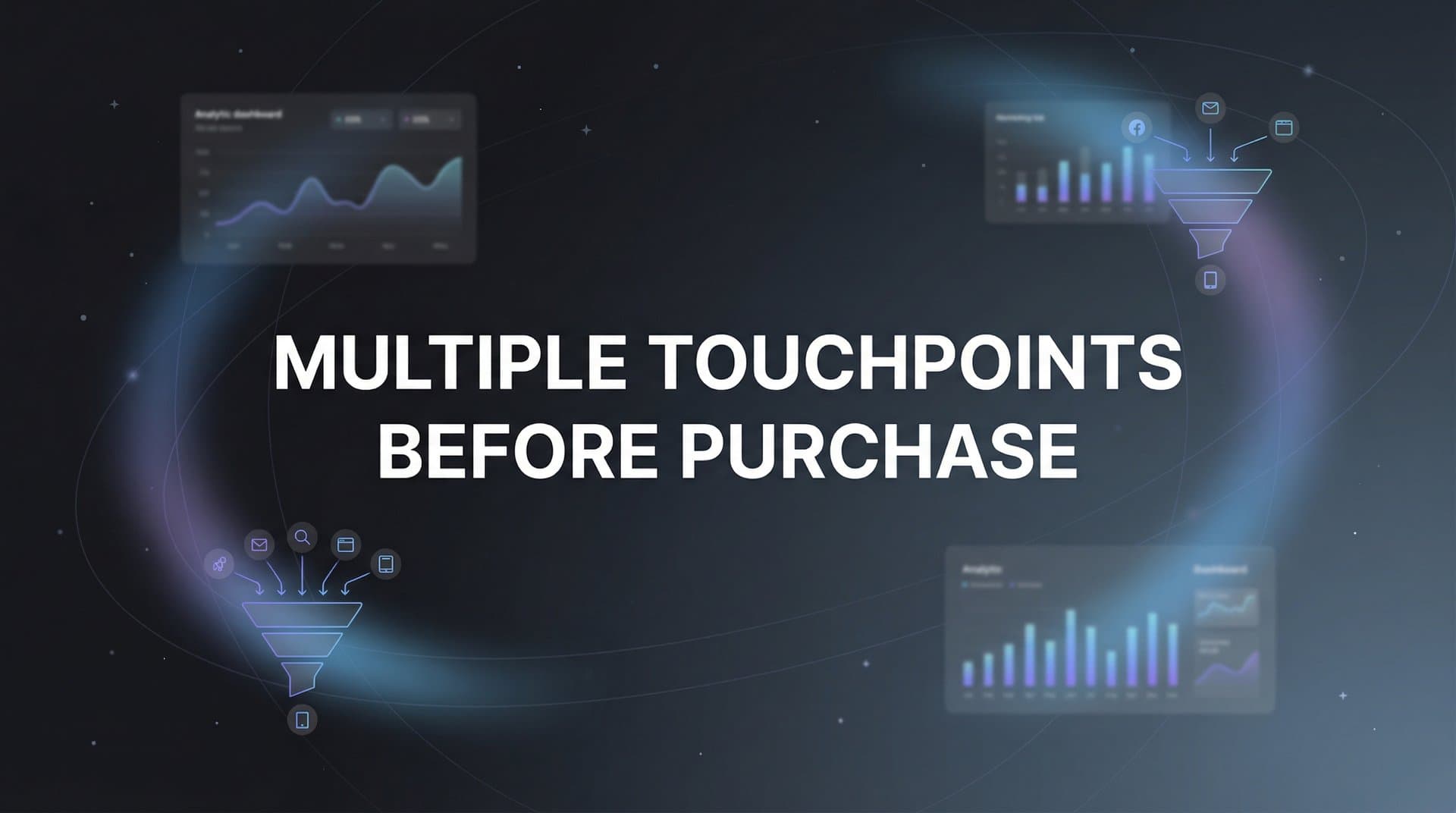
You check your dashboard and see a conversion credited to a Google ad. Simple story, right? One click, one sale, mission accomplished. But here's what actually happened: that customer first saw your brand in a LinkedIn post three weeks ago. They clicked a retargeting ad on Facebook a week later. They read two blog posts. They received three emails. They visited your pricing page twice on different devices. And then—finally—they clicked that Google ad and converted.
Your dashboard shows one touchpoint. The reality? At least eight.
This disconnect between what gets credit and what actually drove the decision is costing marketers millions in misallocated budget. When you only see the last click, you miss the entire story of how customers actually find, evaluate, and choose your product. You cut channels that are building awareness because they don't get conversion credit. You double down on bottom-funnel tactics while starving the top of your funnel. You're making budget decisions based on incomplete data—and your competitors who understand the full journey are eating your lunch.
The Modern Buyer's Journey: A Web of Interactions
Think of a touchpoint as any moment a potential customer interacts with your brand. It could be seeing your ad on Instagram, reading your blog post, receiving your email, watching your video, clicking a retargeting ad, visiting your website directly, or coming through a referral link. Each interaction is a data point in their decision-making process.
But here's where it gets complex: not all purchases require the same number of touchpoints. Someone buying a $15 impulse item might convert after one or two interactions. They see an ad, they click, they buy. Simple. But high-consideration purchases—especially in B2B or for products with significant price tags—follow a completely different pattern.
A marketing manager evaluating a $30,000 annual software contract isn't making that decision after one touchpoint. They're researching competitors. They're reading case studies. They're discussing options with their team. They're attending webinars. They're requesting demos. Each of these moments is a touchpoint, and the journey from awareness to purchase can easily span dozens of interactions over weeks or months.
The challenge? Modern customer journeys aren't linear. They don't follow a neat path from awareness to consideration to decision. Instead, buyers zigzag. They discover your brand, disappear for two weeks, return through a different channel, read content, leave again, get retargeted, come back on a different device, and finally convert through yet another channel.
This web of interactions creates a problem: which touchpoint deserves credit for the conversion? Was it the first LinkedIn post that introduced them to your brand? The blog post that educated them about the solution? The retargeting ad that brought them back? Or the Google search ad they clicked right before purchasing? Understanding the complete customer path to purchase is essential for answering these questions.
The answer is all of them—and none of them individually. Each touchpoint played a role in moving the customer closer to conversion. Understanding this reality is the first step toward making smarter marketing decisions.
Why Single-Touch Attribution Fails Marketers
Most analytics platforms default to single-touch attribution models. They assign 100% of the conversion credit to either the first touchpoint (first-touch attribution) or the last touchpoint (last-touch attribution). Both approaches are fundamentally flawed.
First-touch attribution gives all the credit to whatever channel introduced the customer to your brand. Sounds logical, right? But this model completely ignores everything that happened between awareness and conversion. That educational blog post that convinced them your solution was right? No credit. The retargeting campaign that brought them back when they were ready to buy? Invisible. You end up overvaluing top-of-funnel channels while starving the tactics that actually close deals.
We compare the leading options in our AI display ad generator roundup.
Last-touch attribution does the opposite—it credits only the final interaction before conversion. This is what most marketers see in their dashboards by default. The problem? It completely ignores the journey that brought the customer to that final click. Your brand awareness campaigns get no credit. Your nurture emails show zero ROI. Your content marketing looks worthless. You cut budgets from channels that are actually building your pipeline because they don't get last-click credit.
Here's the real danger: when you use single-touch attribution, you make budget decisions based on incomplete data. You see that Google Ads is driving conversions (last-touch credit) so you increase that budget. Meanwhile, you cut your LinkedIn spend because it's not showing conversions. What you don't realize is that LinkedIn is introducing prospects to your brand, and without those initial touchpoints, your Google Ads would have nobody to retarget.
The result? You're essentially cutting off your own pipeline while wondering why your conversion volume is declining. Implementing proper attribution tracking for multiple campaigns helps you avoid these costly mistakes.
Then there's the 'dark funnel' problem—touchpoints that happen but never get tracked. Since iOS 14.5 introduced App Tracking Transparency, millions of mobile interactions go untracked because users opt out of tracking. Third-party cookies are being deprecated across browsers, making cross-site tracking increasingly difficult. Customers switch between devices—they research on mobile, compare on desktop, and convert on tablet—creating gaps in your attribution data.
When someone sees your ad on their iPhone, clicks it, but has tracking disabled, that touchpoint vanishes. When they research your product on their work laptop but convert on their personal computer, that connection often gets lost. These invisible interactions create blind spots in your attribution, making it look like conversions are coming from fewer touchpoints than they actually are.
For a deeper dive, see our guide to AI product video ad generator.
The gap between what actually influences conversions and what your analytics show you is wider than ever. Marketers are flying blind, making million-dollar budget decisions based on data that's missing half the story.
Mapping the Complete Customer Journey
Understanding your customers' actual path to purchase requires mapping touchpoints across the entire journey. These interactions typically fall into three categories: awareness, consideration, and decision—though remember, real buyers don't move through these stages in a straight line.
Awareness touchpoints are where prospects first discover your brand. This includes social media posts, display ads, influencer mentions, podcast sponsorships, PR coverage, and organic search results. These interactions plant the seed. They introduce the problem and hint at your solution, but they rarely drive immediate conversions. That's not their job. Their job is to get your brand into the consideration set.
Consideration touchpoints happen when prospects actively evaluate whether your solution is right for them. This includes blog posts, comparison pages, case studies, webinars, email nurture sequences, retargeting ads, and review site visits. These interactions build trust and demonstrate value. They answer the question: "Is this the right solution for my specific problem?" Consideration touchpoints move prospects from awareness to serious interest.
For a deeper dive into this space, see our AI video ad generator guide.
Decision touchpoints occur when prospects are ready to convert. This includes demo requests, pricing page visits, sales calls, free trial signups, direct website visits (typing your URL directly), and bottom-funnel search ads. These interactions happen when the buying decision is nearly made—prospects just need that final push or piece of information to commit.
But here's what makes modern attribution complex: the same channel can serve different roles for different customers. LinkedIn might be an awareness touchpoint for one prospect (they see your post for the first time) and a decision touchpoint for another (they visit your company page right before converting). Google Ads might catch someone at awareness (they search "what is marketing attribution") or at decision (they search "Cometly pricing"). Learning how to measure touchpoints accurately is critical for understanding these nuances.
Identifying which touchpoints your specific audience uses most requires connecting data from multiple sources. Your ad platforms show paid interactions. Your CRM tracks email opens and sales conversations. Your website analytics reveal content consumption and page visits. The challenge is bringing all this data together into a unified view.
Without that unified view, you're looking at fragments of the journey. You see that someone converted through a Google ad, but you don't see the three blog posts they read first. You see the email click, but you miss the LinkedIn ad that brought them to your site originally. You optimize based on partial data—and partial data leads to suboptimal decisions.
The marketers who win are the ones who can connect these dots. They know which channels introduce prospects, which channels nurture them, and which channels close them. They understand that cutting awareness channels to fund decision channels is like cutting your sales team's pipeline generation to fund more sales calls—eventually, you run out of qualified prospects to close.
Multi-Touch Attribution Models Explained
Once you accept that multiple touchpoints contribute to conversions, the next question becomes: how do you distribute credit across those touchpoints? This is where multi-touch attribution models come in, and choosing the right model matters because it fundamentally changes which channels look successful.
Linear attribution takes the simplest approach—it gives equal credit to every touchpoint in the customer journey. If someone had eight interactions before converting, each interaction gets 12.5% of the credit. The advantage? It's fair and acknowledges that every touchpoint played a role. The disadvantage? It treats all interactions as equally important, which isn't realistic. The blog post that convinced someone your solution was right probably mattered more than the third retargeting ad they saw.
Time-decay attribution assumes that touchpoints closer to conversion matter more than earlier ones. It assigns increasing credit as you move toward the conversion event. An interaction that happened three weeks ago gets less credit than one that happened yesterday. This model makes sense if you believe that recent touchpoints have more influence on the final decision. The risk? You might undervalue the awareness touchpoints that started the entire journey.
Position-based attribution (also called U-shaped attribution) gives the most credit to the first and last touchpoints—typically 40% to each—and distributes the remaining 20% evenly across middle interactions. The logic? The first touchpoint introduced the prospect to your brand, and the last touchpoint closed the deal, so both deserve special recognition. This model works well if you want to value both pipeline generation and conversion tactics, but it can undervalue the nurture touchpoints that moved prospects from awareness to consideration.
Data-driven attribution uses machine learning algorithms to analyze your actual conversion patterns and assign credit based on which touchpoints statistically correlate with conversions. Instead of using predetermined rules, it learns from your data. If your data shows that prospects who read a specific case study convert at 3x the rate of those who don't, that touchpoint gets more credit. This is the most sophisticated approach, but it requires significant conversion volume to generate reliable patterns. Exploring different post purchase attribution analysis methods can help you determine which model fits your business.
So which model should you use? The answer depends on your business type and sales cycle.
For businesses with short sales cycles and straightforward customer journeys, linear attribution often provides enough insight without overcomplicating analysis. For companies with longer sales cycles where recent touchpoints strongly influence decisions—think SaaS free trials or demo-driven sales—time-decay attribution can reveal which late-stage tactics are actually closing deals.
If you're focused on both generating new pipeline and closing deals, position-based attribution helps you balance investment in top-of-funnel and bottom-of-funnel channels. And if you have the data volume and want the most accurate picture, data-driven attribution removes guesswork and lets your actual conversion patterns dictate credit distribution.
But here's the real insight: the most sophisticated marketers don't pick one model and stick with it forever. They compare multiple attribution models to understand the full story. When you look at your channel performance through linear, time-decay, and position-based lenses simultaneously, patterns emerge. You might discover that LinkedIn drives tons of first-touch credit but little last-touch credit—indicating it's great for awareness but needs support from other channels to close deals. You might find that email gets consistent credit across all models—suggesting it's valuable throughout the entire journey.
Comparing attribution models reveals which channels truly drive revenue versus which channels just assist. That distinction is everything when you're deciding where to allocate your next dollar of ad spend.
Turning Touchpoint Data Into Smarter Budget Decisions
Understanding your complete multi-touch customer journey isn't just an academic exercise—it's the foundation for making confident budget decisions that directly impact revenue. When you can see which touchpoints actually contribute to conversions, you stop making decisions based on gut feel and start optimizing based on reality.
The first shift happens when you identify undervalued channels worth scaling. Let's say your last-touch attribution shows Google Ads driving 60% of conversions while LinkedIn drives only 5%. The obvious move seems to be cutting LinkedIn and doubling down on Google. But when you look at multi-touch attribution, you discover that 80% of customers who convert through Google Ads first discovered your brand on LinkedIn. Suddenly, LinkedIn isn't underperforming—it's your primary pipeline generator. Cutting it would eventually destroy your Google Ads performance.
This kind of insight changes everything. You stop penalizing channels that introduce prospects and start valuing them for their actual contribution. You might discover that your blog content gets almost no last-click credit but appears in 90% of customer journeys. You might find that your email nurture sequences don't directly drive conversions but significantly increase conversion rates when combined with retargeting ads. Mastering how to measure ROI from multiple marketing channels unlocks these insights.
These patterns reveal optimization opportunities. If you know that prospects who engage with both blog content and retargeting ads convert at 4x the rate of those who only see retargeting, you can create audience segments that prioritize these high-intent combinations. You can increase bids for prospects who've already consumed your content. You can build lookalike audiences based on people who followed your highest-converting touchpoint sequences.
But the value of touchpoint data goes beyond just knowing which channels to fund. When you feed enriched conversion data back to ad platforms like Meta and Google, you improve their machine learning algorithms. Here's how: ad platforms use conversion data to optimize who sees your ads. The more accurate and complete your conversion data, the better they can identify patterns in converting users and find similar prospects.
When you only send last-click conversion data, the algorithm learns from an incomplete picture. It sees that someone converted after clicking your ad, but it doesn't know that person had already engaged with your brand five times before. When you send enriched data that includes the full customer journey—showing that converting users typically engage with specific content, visit certain pages, and interact with particular ad types—the algorithm can optimize for those patterns. Implementing conversion tracking across multiple ad platforms ensures you capture this complete picture.
The result? Better targeting, higher conversion rates, and lower customer acquisition costs. You're essentially teaching the ad platform what a high-intent prospect looks like across their entire journey, not just at the moment of conversion.
This is where AI-powered recommendations become game-changing. When you combine multi-touch attribution data with machine learning, you can identify high-performing ad combinations across the full customer journey. The AI might discover that prospects who see Video Ad A, then Blog Post B, then Retargeting Ad C convert at 6x your baseline rate. You'd never spot that pattern manually, but AI can surface these insights and recommend budget shifts to scale winning sequences.
The marketers who leverage this approach aren't guessing which channels work—they're operating from a position of clarity and confidence. They know which touchpoints introduce prospects, which ones nurture them, and which ones close them. They can confidently increase spend on channels that look weak in last-touch attribution but are actually critical pipeline drivers. They can cut channels that get credit but don't actually influence decisions.
Your Next Steps: From Data to Decisions
Understanding multiple touchpoints before purchase isn't just about better reporting—it's about making confident, data-driven decisions that directly impact revenue. When you can see the complete customer journey, you stop wasting budget on incomplete data and start optimizing based on what's actually driving conversions.
The marketers who track the full journey can identify which channels are building their pipeline, which are nurturing prospects, and which are closing deals. They can scale winning campaigns with confidence because they understand the role each touchpoint plays. They're not flying blind, making budget decisions based on last-click data that misses half the story. Using a marketing dashboard for multiple campaigns gives you this unified visibility.
The gap between what influences conversions and what your analytics show you is real—and it's costing you opportunities. Every untracked touchpoint is a missed insight. Every attribution blind spot is a potential budget mistake. The solution is a unified attribution platform that captures every interaction across ad platforms, CRM, and website analytics, then connects those dots into a complete picture of your customer journey.
Ready to elevate your marketing game with precision and confidence? Discover how Cometly's AI-driven recommendations can transform your ad strategy—Get your free demo today and start capturing every touchpoint to maximize your conversions.