You launch a Facebook campaign. A prospect clicks your ad, browses your site, then leaves. Three days later, they see your Google search ad and click through again. A week passes. They open your email newsletter, click a link, but still don't convert. Then finally, two weeks after that first Facebook click, they see a retargeting ad and complete the purchase.
Which channel gets credit for the sale?
Without omnichannel marketing attribution, you're flying blind. You might credit the retargeting ad because it was the last click before conversion. But what about those earlier touchpoints that built awareness and trust? What if the Facebook ad was actually the catalyst that started the entire journey?
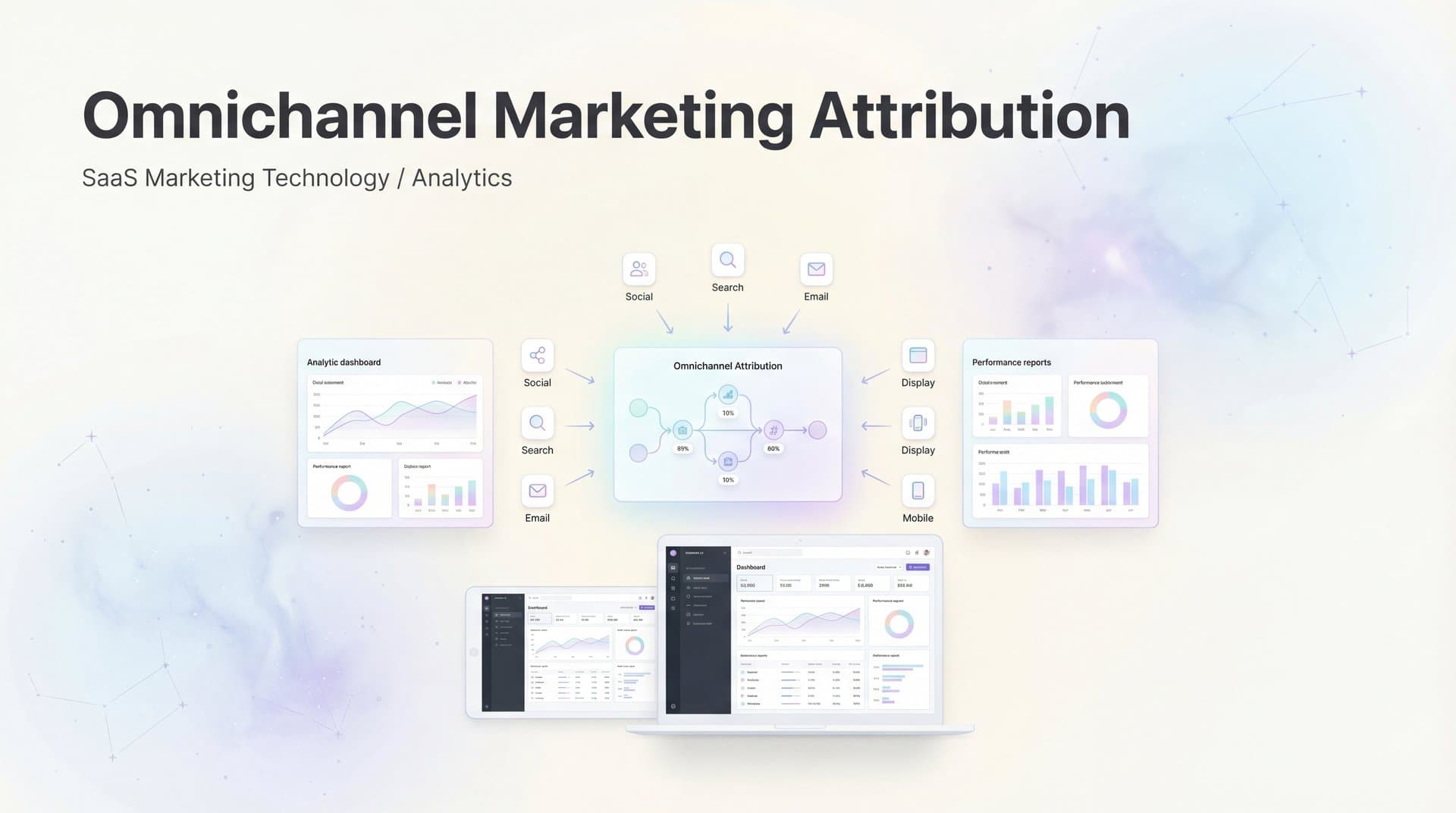
Omnichannel marketing attribution solves this puzzle. It connects every touchpoint across every channel—from social ads to email to search to website visits—into a unified view of the customer journey. Instead of guessing which campaigns drive results, you see exactly how prospects move through your marketing ecosystem and which interactions actually matter. That clarity transforms how you allocate budgets, optimize campaigns, and scale what works.
Beyond Single-Channel Tracking: Understanding the Full Customer Journey
Omnichannel marketing attribution is the practice of tracking and assigning credit to all marketing touchpoints across channels that contribute to a conversion. It answers a fundamental question: which marketing activities actually drive revenue?
Think of it as connecting the dots across your entire marketing ecosystem. Every ad click, email open, website visit, and social interaction becomes part of a complete story about how customers discover, evaluate, and ultimately choose your product.
This stands in sharp contrast to single-channel attribution, where each platform operates in isolation. Facebook Ads Manager shows you Facebook conversions. Google Ads reports Google conversions. Your email platform tracks email conversions. But when the same customer interacts with all three before buying, each platform claims 100% of the credit. Your reports show 300% attribution for a single sale.
The reality? Modern customer journeys are inherently multi-channel. Someone might discover your brand through a podcast ad, research you on Google, follow you on Instagram, read comparison articles, sign up for your email list, and finally convert after seeing a retargeting ad. That's six touchpoints across five different channels—and every single one played a role.
Omnichannel attribution recognizes this complexity. It operates on three core components that work together to create accurate tracking:
Data Collection Across Platforms: The foundation is capturing interaction data from every marketing channel you use. This means integrating your ad platforms, website analytics, email system, CRM, and any other customer touchpoint into a unified tracking system. Each interaction gets timestamped and recorded with relevant context—what they clicked, when, from which source.
Identity Resolution: This is where the magic happens. Identity resolution connects anonymous sessions to known users, stitching together touchpoints from the same person even when they switch devices or browsers. Someone might click your Facebook ad on their phone during lunch, then research your product on their laptop that evening. Identity resolution recognizes these as the same customer journey, not two separate people.
Credit Assignment Models: Once you know the complete journey, you need to decide how to distribute credit across touchpoints. Should the first interaction get more weight because it introduced your brand? Should the last click before conversion matter most? Or should every touchpoint share credit equally? The types of marketing attribution models you choose determines how you interpret your data and where you invest your budget.
The shift to omnichannel thinking isn't just about better reporting. It fundamentally changes how you make marketing decisions. Instead of optimizing each channel in isolation, you optimize the entire customer journey. You might discover that Facebook ads rarely drive direct conversions but excel at introducing prospects who later convert through search. That insight changes everything about how you evaluate Facebook's performance and allocate your budget.
Attribution Models That Actually Reflect Reality
Attribution models are the rules that determine how credit gets distributed across touchpoints. Choose the wrong model, and you'll make decisions based on a distorted view of reality. Choose the right one, and you'll see exactly which marketing activities drive results.
Let's break down the major models and when each makes sense:
First-Touch Attribution: This model gives 100% of the credit to the first touchpoint in the customer journey. If someone discovers you through a Facebook ad, then interacts with five other channels before converting, Facebook gets all the credit. This model makes sense when your primary goal is brand awareness and top-of-funnel growth. It highlights which channels excel at introducing new prospects to your brand. However, it completely ignores the nurturing and conversion activities that actually closed the sale.
Last-Touch Attribution: The opposite approach—100% of credit goes to the final touchpoint before conversion. This is what most ad platforms use by default because it makes their performance look best. Last-touch works when you have a short sales cycle where customers make quick decisions. If someone searches for your product and converts immediately, last-touch accurately reflects reality. But for longer sales cycles with multiple touchpoints, it overvalues bottom-of-funnel activities and undervalues the awareness and consideration phases that made the conversion possible.
Linear Attribution: Every touchpoint in the journey receives equal credit. If there are five interactions before conversion, each gets 20% of the credit. This model acknowledges that multiple channels contribute to conversions, which is more realistic than first or last-touch. It works well when you believe every touchpoint matters equally—though in practice, that's rarely true. The ad that introduced your brand probably had more impact than the third retargeting impression. You can explore linear model marketing attribution software to implement this approach effectively.
Time-Decay Attribution: Credit increases as touchpoints get closer to the conversion. The most recent interactions receive more weight than earlier ones. This model reflects the reality that later touchpoints often have more direct influence on the purchase decision. It's particularly useful for longer sales cycles where early touchpoints might lose relevance over time. A prospect who clicked your ad three months ago but only recently engaged with your email campaign probably made their decision based on recent interactions.
Position-Based Attribution: Also called U-shaped attribution, this model gives 40% of credit to the first touchpoint, 40% to the last touchpoint, and distributes the remaining 20% among middle interactions. It recognizes that both discovery and conversion moments are critical while still acknowledging the role of nurturing touchpoints. This model works well when you want to balance awareness and conversion metrics without completely ignoring the middle of the funnel.
Data-Driven Attribution: Instead of using predetermined rules, algorithmic attribution uses machine learning to analyze your actual conversion patterns and assign credit based on which touchpoints statistically correlate with conversions. It compares converting journeys to non-converting journeys and identifies which interactions actually move the needle. This is the most sophisticated approach because it adapts to your specific customer behavior rather than applying generic assumptions. Understanding how machine learning can be used in marketing attribution helps you leverage this powerful methodology.
Here's the thing about attribution models: there's no universally "correct" choice. The right model depends on your business context.
For businesses with short sales cycles—think impulse purchases or low-consideration products—last-touch attribution often reflects reality reasonably well. Customers discover, evaluate, and convert quickly, so the final touchpoint genuinely drives the decision.
For complex B2B sales or high-ticket purchases with long consideration periods, multi-touch models become essential. When prospects spend weeks or months evaluating options across dozens of touchpoints, you need attribution that reflects that complexity. Position-based or time-decay models often work well here.
The trend in marketing analytics is clearly toward multi-touch and algorithmic attribution. As customer journeys grow more complex and span more channels, simple first or last-touch models increasingly misrepresent reality. Data-driven attribution, when you have sufficient conversion volume to train the algorithms, provides the most accurate view because it's based on your actual data rather than generic assumptions.
But here's what matters more than choosing the "perfect" model: consistency and comparison. Pick a model that makes sense for your business, then stick with it long enough to identify patterns. Even better, compare multiple models side-by-side to understand how different perspectives change your interpretation of channel performance. The channels that perform well across multiple attribution models are your true winners. Learn more about the importance of attribution models in marketing to make informed decisions.
The Technical Foundation: How Cross-Channel Tracking Works
Understanding omnichannel attribution requires looking under the hood at how tracking actually works. The technical foundation determines whether your attribution data is accurate or fundamentally flawed.
At the heart of cross-channel tracking is identity resolution—the process of connecting anonymous touchpoints to known customers. When someone first visits your website, they're anonymous. You can track their session, but you don't know who they are. Identity resolution solves this puzzle by linking anonymous activity to identifiable information.
There are two primary approaches: deterministic matching and probabilistic matching.
Deterministic matching uses concrete identifiers to connect touchpoints. When someone fills out a form with their email address, you can definitively link that email to all their subsequent activity. If they later click an email campaign and visit your site, you know it's the same person because the email address matches. This is the gold standard—accurate, reliable, and privacy-compliant when users voluntarily provide information.
Probabilistic matching uses patterns and signals to make educated guesses about identity. It analyzes factors like device fingerprints, IP addresses, browser characteristics, and behavioral patterns to infer when two sessions likely belong to the same person. Someone who visits from the same IP address, uses similar browsing patterns, and accesses your site at consistent times is probably the same user—even without explicit identification.
The challenge? Traditional browser-based tracking is increasingly unreliable. iOS privacy changes have made cross-device tracking harder. Cookie deprecation means you can't rely on third-party cookies to follow users across the web. Ad blockers prevent tracking pixels from firing. The old playbook doesn't work anymore.
This is where server-side tracking becomes critical. Instead of relying on browser-based pixels that can be blocked or restricted, server-side tracking sends conversion data directly from your servers to ad platforms and analytics tools. When someone converts on your site, your server communicates that event to Facebook, Google, and your attribution platform—regardless of browser restrictions or privacy settings.
Server-side tracking solves multiple problems simultaneously. It bypasses ad blockers because the communication happens server-to-server, not in the user's browser. It captures more complete data because it's not subject to browser limitations. And it works even when cookies are blocked or unavailable, making it the foundation for reliable attribution in a privacy-focused world.
But server-side tracking alone isn't enough. You need robust data integration across your entire marketing stack.
Your attribution platform needs to connect with your ad platforms—Facebook, Google, TikTok, LinkedIn—to capture ad clicks and impressions. It needs to integrate with your website analytics to track on-site behavior. It must sync with your CRM to connect marketing touchpoints to actual sales and revenue. Email platforms, phone systems, offline conversion tracking—every customer touchpoint needs to feed into the unified attribution system.
This integration challenge is why many marketers struggle with attribution. It's not just about installing a tracking pixel. It's about building a data infrastructure that captures every interaction, resolves identities accurately, and maintains data quality across platforms. Many teams benefit from understanding how to setup a datalake for marketing attribution to manage this complexity.
The technical requirements include:
Unified Tracking Implementation: A single source of truth for customer interactions across all channels. This typically means implementing a tracking solution that captures data consistently regardless of where the interaction happens—website, app, email, or offline.
First-Party Data Collection: Since third-party cookies are disappearing, building a robust first-party data strategy becomes essential. This means collecting email addresses, phone numbers, and other identifiers directly from customers and using those for tracking rather than relying on browser cookies.
Conversion APIs: Modern ad platforms provide Conversion APIs that allow you to send conversion data directly from your servers. Facebook's Conversion API and Google's Enhanced Conversions are examples. These APIs ensure ad platforms receive accurate conversion signals even when browser tracking fails, which improves both attribution accuracy and ad optimization.
Data Validation and Quality Checks: Technical implementation is only valuable if the data is accurate. This means testing tracking implementation, validating that conversions are recorded correctly, and regularly auditing data quality to catch issues before they corrupt your attribution insights.
The technical foundation might seem complex, but it's what separates accurate attribution from guesswork. When done right, you get a reliable view of the customer journey. When done poorly, you make million-dollar budget decisions based on incomplete or inaccurate data.
Common Attribution Blind Spots (And How to Fix Them)
Even with solid technical implementation, most attribution systems have blind spots—gaps where customer interactions happen but don't get tracked. These gaps distort your data and lead to misguided decisions.
Let's address the most common blind spots and how to fix them:
Offline Conversions: Someone sees your ad online, then calls your sales team or visits your physical store to complete the purchase. Your attribution system sees the ad click but never sees the conversion, so it looks like the campaign failed. In reality, it drove a sale—just through an offline channel. The fix requires connecting offline conversion data back to online touchpoints. This might mean implementing call tracking that matches phone calls to ad clicks, or syncing point-of-sale data with your CRM and attribution platform. When you close this loop, channels that drive offline conversions suddenly show their true value.
Cookie Deprecation and Privacy Regulations: Browser restrictions and privacy laws have created massive tracking gaps. When someone blocks cookies or uses privacy-focused browsers, traditional tracking fails. You see incomplete journeys with missing touchpoints, which makes attribution unreliable. The solution is shifting to first-party data and server-side tracking. Instead of relying on browser cookies, collect email addresses and phone numbers directly from customers. Use those identifiers to track journeys across devices and sessions. Implement server-side tracking so conversion data reaches ad platforms even when browser tracking fails. This approach is both more accurate and more privacy-compliant.
Cross-Device Journeys: A prospect researches on their phone during their commute, continues on their tablet at home, then converts on their laptop at work. Without cross-device tracking, this looks like three different people, not one customer journey. The fix is identity resolution that connects devices to users. When someone logs into your site or provides an email address, you can link their activity across all devices where they authenticate. For anonymous sessions, probabilistic matching can infer cross-device behavior based on patterns and signals. Implementing cross-channel marketing attribution software helps solve these challenges systematically.
Dark Social and Direct Traffic: Someone shares your link in a private message, Slack channel, or text message. When the recipient clicks, it shows up as direct traffic with no attribution to the original source. Dark social represents a significant portion of sharing behavior but remains largely invisible to attribution systems. While you can't track private messages, you can use trackable short links and UTM parameters consistently in your content to capture more of this activity. When customers share links with tracking parameters intact, you maintain visibility into the source even through private channels.
Ad Platform Walled Gardens: Facebook, Google, and other platforms limit data sharing to protect their competitive advantages. You can see that someone clicked your Facebook ad and later converted, but you can't always see what they did on other platforms in between. This makes true cross-platform attribution challenging. The solution is implementing unified third-party tracking that operates independently of ad platforms. Use a tracking solution that captures all touchpoints regardless of platform, then reconciles that data with platform-reported conversions to get the complete picture.
Long Sales Cycles and Attribution Windows: For B2B companies or high-ticket purchases, sales cycles can span months. Someone might click your ad in January but not convert until June. If your attribution window is only 30 days, you miss the connection between the ad and the conversion. The fix is extending attribution windows to match your actual sales cycle. If prospects typically take 90 days to convert, use a 90-day attribution window. Yes, this makes reporting more complex, but it accurately reflects your business reality. Understanding these attribution challenges in marketing analytics helps you build more robust systems.
Addressing these blind spots requires a multi-layered approach:
Build First-Party Data Assets: The more directly you can identify customers through email, phone, or account login, the less you rely on fragile browser-based tracking. Make data collection a priority throughout the customer journey.
Implement Conversion APIs: Use Facebook Conversion API, Google Enhanced Conversions, and similar tools to send conversion data server-side. This ensures ad platforms receive accurate signals even when browser tracking fails, which improves both attribution and ad optimization.
Use Unified Tracking Pixels: Instead of managing dozens of platform-specific pixels, implement a single tracking solution that captures all interactions and distributes data to ad platforms and analytics tools. This reduces implementation complexity and improves data consistency.
Regularly Audit Data Quality: Set up automated checks to catch tracking issues. Monitor for sudden drops in conversion volume, missing touchpoints in typical customer journeys, or discrepancies between platform-reported conversions and your attribution system. Catching problems early prevents bad data from corrupting your insights.
The goal isn't perfect attribution—that's impossible in today's privacy-focused world. The goal is closing enough blind spots that your attribution data reliably guides budget decisions. Even 80% accuracy is transformative compared to pure guesswork.
Turning Attribution Data Into Budget Decisions
Attribution data is only valuable if it changes how you allocate resources. The insights you gain should directly inform where you spend money and how you optimize campaigns.
Here's how to translate attribution insights into action:
Identify High-Performing Channels: Look beyond last-click conversions to see which channels consistently appear in converting journeys. You might discover that LinkedIn ads rarely drive direct conversions but frequently appear as the first touchpoint for high-value customers. That insight suggests LinkedIn is excellent for awareness and prospecting, even if it doesn't get last-click credit. Increase LinkedIn spend for top-of-funnel campaigns while using retargeting to capture those prospects later in their journey.
Reallocate Spend Based on True Performance: When you understand which channels actually contribute to revenue, you can confidently shift budgets. If your attribution data shows that email nurture campaigns consistently assist conversions that get credited to paid search, you might reduce search spend slightly and invest more in email content and automation. The key is making incremental changes based on attribution insights rather than wholesale shifts based on hunches. Platforms focused on marketing attribution platforms revenue tracking make this process more systematic.
Optimize the Full Funnel: Attribution reveals how channels work together. You might find that Facebook ads excel at awareness, Google search captures high-intent prospects, and retargeting closes deals. Instead of trying to make Facebook drive direct conversions, optimize it for reach and new prospect acquisition. Optimize search for conversion rate since it captures bottom-funnel traffic. Structure your campaigns around the role each channel naturally plays in customer journeys.
Feed Better Data to Ad Platforms: Here's where attribution becomes a performance lever, not just a reporting tool. When you send accurate conversion data back to ad platforms through Conversion APIs, their algorithms learn faster and optimize better. Facebook's algorithm performs better when it knows which ad impressions led to actual sales, not just clicks. Google's Smart Bidding improves when it receives complete conversion data. By closing attribution loops, you improve ad platform performance, which improves your results, which improves your attribution data—a virtuous cycle.
Test Attribution-Informed Hypotheses: Use attribution insights to generate testable hypotheses. If data suggests video ads drive strong assisted conversions, test increasing video ad spend. If attribution shows that prospects who engage with three or more touchpoints convert at higher rates, test strategies to increase touchpoint frequency. Attribution gives you informed hypotheses to test rather than shooting in the dark.
Leverage AI for Pattern Recognition: As attribution data accumulates, patterns emerge that humans might miss. AI can analyze thousands of customer journeys to identify which touchpoint sequences correlate with conversion, which channels work synergistically, and where budget shifts would have the greatest impact. AI-driven recommendations surface insights like "prospects who see both Facebook and Google ads convert 40% more often than those who see only one" or "increasing email frequency for prospects who clicked three ads improves conversion rates." These insights become action items for optimization.
The most sophisticated marketers use attribution to build feedback loops. They analyze which touchpoints drive conversions, optimize campaigns based on those insights, measure the impact, then refine their approach based on results. This iterative process compounds over time, creating increasingly efficient marketing systems.
But remember: attribution informs decisions, it doesn't make them for you. The data might show that a particular channel drives strong assisted conversions, but you still need to consider strategic factors like market positioning, competitive dynamics, and long-term brand building. Attribution is a powerful input to decision-making, not a replacement for strategic thinking.
The goal is confident scaling. When you know which touchpoints actually drive revenue, you can increase spend on high-performing channels without fear. You're not guessing whether that Facebook campaign works—you see exactly how it fits into customer journeys and contributes to conversions. That confidence lets you scale aggressively where it matters and cut ruthlessly where it doesn't. Measuring cross-channel attribution marketing ROI becomes the foundation for these scaling decisions.
Building Your Omnichannel Attribution Stack
Implementing omnichannel attribution requires the right tools and a thoughtful approach to rolling out tracking across your marketing ecosystem.
When evaluating attribution platforms, look for these essential capabilities:
Real-Time Tracking: Attribution data should update continuously, not days later. Real-time tracking lets you spot problems quickly and optimize campaigns while they're running rather than discovering issues after you've burned through budget. Look for platforms that capture and process events immediately, giving you current visibility into campaign performance.
Model Comparison: The best attribution platforms let you view your data through multiple attribution models simultaneously. Compare first-touch, last-touch, linear, and data-driven attribution side-by-side to understand how different perspectives change your interpretation. Channels that perform well across multiple models are your true winners. Platforms that force you into a single model limit your ability to understand the full picture. When comparing marketing attribution software features, model flexibility should be a top priority.
Comprehensive Platform Integrations: Your attribution tool needs native integrations with every ad platform you use—Facebook, Google, TikTok, LinkedIn, and others. It should connect with your CRM to match marketing touchpoints to actual revenue. Email platform integration captures nurture touchpoints. Website analytics integration tracks on-site behavior. The more seamlessly data flows between systems, the more complete your attribution picture becomes.
Server-Side Tracking Capabilities: Given the limitations of browser-based tracking, server-side implementation is no longer optional. Look for platforms that offer robust server-side tracking to bypass browser restrictions and capture more complete data. This ensures your attribution remains accurate even as privacy regulations tighten and cookie support diminishes.
Conversion Sync Features: The ability to send enriched conversion data back to ad platforms closes the optimization loop. Look for platforms that support Facebook Conversion API, Google Enhanced Conversions, and similar features. This ensures ad platforms receive accurate conversion signals, which improves their optimization and your campaign performance.
AI-Powered Insights: As attribution data accumulates, AI can surface patterns and recommendations that humans might miss. Look for platforms that use machine learning to identify optimization opportunities, predict which touchpoint sequences drive conversions, and recommend budget allocation changes based on performance patterns.
Implementation should follow a strategic sequence rather than trying to track everything at once:
Start With High-Spend Channels: Begin attribution implementation on the channels where you spend the most money. If you're running significant budgets on Facebook and Google, get accurate tracking for those platforms first. This gives you immediate value from attribution while you expand to other channels. Don't let perfect be the enemy of good—tracking your top two channels is infinitely better than tracking nothing while you plan a comprehensive implementation.
Ensure CRM Connectivity: Marketing touchpoints only matter if they drive revenue. Connect your attribution platform to your CRM early in the implementation process so you can see which marketing activities lead to actual sales, not just form fills or demo requests. This connection transforms attribution from a marketing reporting tool into a revenue intelligence system.
Validate Data Accuracy: Before trusting attribution data for decision-making, validate that tracking works correctly. Place test orders, click test ads, and verify that conversions appear in your attribution platform with the correct touchpoint history. Check that conversion counts match between your attribution system and ad platforms. Small tracking errors compound into major misallocation of resources, so invest time in validation upfront.
Expand Channel Coverage Systematically: Once core channels are tracked and validated, expand to additional touchpoints. Add email tracking, then social organic, then referral traffic, then any other channels in your mix. Each addition makes your attribution more complete, but implementing systematically prevents overwhelming your team or creating data quality issues. Reviewing digital marketing attribution software options helps you find tools that scale with your needs.
Train Your Team on Interpretation: Attribution data is only valuable if your team knows how to interpret it. Invest in training so marketers understand what different attribution models reveal, how to identify actionable insights, and how to translate attribution data into optimization decisions. The technical implementation matters, but human interpretation determines whether insights drive action.
Measure attribution success through tangible business outcomes. The goal isn't just having attribution data—it's using that data to improve performance. Track these indicators:
Improved ROAS Visibility: Can you confidently state which channels drive the best return on ad spend? If attribution gives you clear answers about channel performance that guide budget decisions, it's working. If you're still guessing which campaigns to scale, your attribution needs improvement.
Confident Scaling Decisions: Do you feel comfortable increasing spend on high-performing channels? Attribution should give you the confidence to scale aggressively where data shows strong performance. If you're still hesitant to increase budgets despite positive attribution signals, you may not trust your data—which suggests implementation or validation issues.
Reduced Wasted Spend: Are you cutting underperforming channels based on attribution insights? If attribution reveals that certain campaigns consistently fail to contribute to conversions, you should be reallocating that budget elsewhere. Track how much spend you've shifted from poor performers to strong performers based on attribution data.
Building an effective attribution stack is an ongoing process, not a one-time project. As your marketing evolves, new channels emerge, and customer behavior shifts, your attribution system needs to adapt. But the investment pays dividends through better decision-making, more efficient budget allocation, and the confidence to scale what works.
Putting It All Together: From Data to Decisions
Omnichannel marketing attribution transforms marketing from educated guesswork into data-driven decision making. Instead of wondering which campaigns work, you see exactly how prospects move through your marketing ecosystem and which touchpoints drive revenue.
The shift is profound. Without attribution, you optimize each channel in isolation, making decisions based on incomplete data and hoping for the best. With attribution, you optimize the entire customer journey, understanding how channels work together to drive conversions.
But here's what matters most: attribution isn't about tracking for tracking's sake. It's about understanding which touchpoints actually drive revenue so you can confidently scale what works and cut what doesn't. Every attribution insight should lead to action—a budget reallocation, a campaign optimization, a strategic shift in channel mix.
The technical foundation matters. Server-side tracking, identity resolution, platform integrations, and data quality all determine whether your attribution data is reliable or fundamentally flawed. But technology alone doesn't create value. The value comes from using attribution insights to make better decisions faster.
The most successful marketers use attribution to build virtuous cycles. They track customer journeys, identify high-performing touchpoints, optimize campaigns based on those insights, feed better conversion data back to ad platforms, and measure the results. Each iteration improves performance, which generates better data, which enables better decisions, which drives better results.
As customer journeys grow more complex and span more channels, omnichannel attribution becomes not just valuable but essential. The days of crediting the last click and calling it attribution are over. Modern marketing demands a complete view of how prospects discover, evaluate, and choose your product across every touchpoint.
Ready to elevate your marketing game with precision and confidence? Discover how Cometly's AI-driven recommendations can transform your ad strategy—Get your free demo today and start capturing every touchpoint to maximize your conversions.