

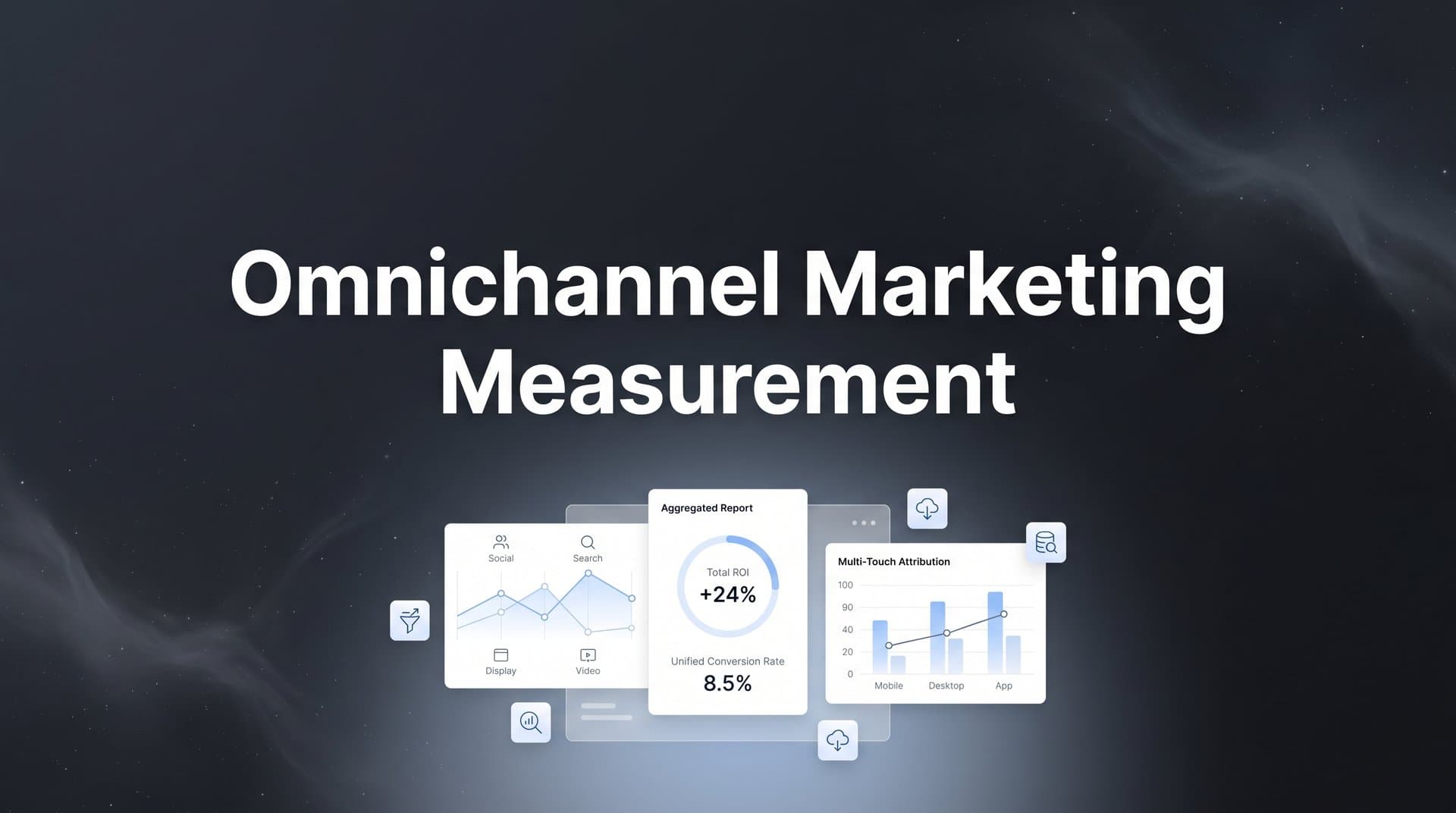
Modern marketing campaigns span multiple platforms simultaneously, from Meta and Google Ads to LinkedIn, TikTok, email, and organic channels. Yet most marketers struggle to understand how these channels work together to drive conversions.
The challenge is not a lack of data but rather fragmented data that lives in silos, making it nearly impossible to see the complete customer journey. Each platform claims credit for the same conversion, inflating your totals and obscuring which investments actually deliver results.
Effective omnichannel marketing measurement connects these dots, revealing which channel combinations actually drive revenue and where your budget delivers the highest returns. It transforms scattered data points into a coherent story of how your marketing works.
This guide covers seven actionable strategies that help you build a unified measurement framework, track cross-channel performance accurately, and make confident decisions about where to invest your marketing dollars. Each strategy builds on the previous one, creating a comprehensive system for understanding your marketing impact.
1. Unify Your Data Sources Into a Single Source of Truth
The Challenge It Solves
When you run campaigns across Meta, Google, LinkedIn, and other platforms, each system reports conversions independently. Meta might claim 150 conversions, Google Ads shows 120, and LinkedIn reports 80, yet your actual sales total only 200. The math does not add up because platforms use different attribution windows and tracking methods.
This fragmentation makes it impossible to know which platform truly drives results. You end up making budget decisions based on conflicting reports rather than actual performance.
The Strategy Explained
A single source of truth centralizes data from all your marketing channels into one authoritative system. Instead of logging into five different platforms to piece together your performance, you connect everything to a unified marketing measurement platform that reconciles the data.
This approach captures events at the source, your website and CRM, then distributes that data to your reporting system and back to ad platforms. When a conversion happens, it gets recorded once and attributed correctly across all channels based on the actual customer journey.
The result is one set of numbers you can trust. When you see 200 conversions in your unified system, you know that reflects 200 actual customers, not 350 claimed conversions that somehow turned into 200 sales.
Implementation Steps
1. Audit all current data sources including ad platforms, website analytics, CRM, email marketing tools, and any other systems that track customer interactions.
2. Choose a marketing attribution platform that can ingest data from all your sources and apply consistent attribution logic across channels.
3. Connect each data source through native integrations or APIs, ensuring that customer identifiers like email addresses or user IDs match across systems.
4. Verify data accuracy by comparing total conversions in your unified system against actual sales or leads in your CRM for a test period.
5. Train your team to reference the unified system as the authoritative source for all marketing performance discussions and decisions.
Pro Tips
Start with your highest-spend channels first to see immediate value. Focus on connecting ad platforms and CRM before adding secondary sources like email or social media. Run your old reporting and new unified reporting in parallel for two weeks to build confidence in the new system before fully switching over.
2. Implement Multi-Touch Attribution to See the Full Journey
The Challenge It Solves
Last-click attribution gives all credit to the final touchpoint before conversion, ignoring every channel that introduced the customer to your brand or kept them engaged. A customer might discover you through a LinkedIn ad, research on Google, engage with your email campaign, then convert through a Meta retargeting ad.
Last-click attribution credits Meta with the entire conversion, making LinkedIn and Google look ineffective even though they played crucial roles. This leads to underinvestment in top-of-funnel channels and overinvestment in bottom-funnel retargeting.
The Strategy Explained
Multi-touch attribution distributes conversion credit across all touchpoints that influenced the customer journey. Different models weight touchpoints differently based on their position and importance in the conversion path.
Linear attribution splits credit evenly across all touchpoints. Time decay gives more credit to recent interactions. Position-based models emphasize the first and last touchpoints while giving some credit to middle interactions. Data-driven attribution uses machine learning to assign credit based on which touchpoints statistically correlate with conversions.
The key is choosing a model that reflects how your customers actually buy. Complex B2B sales with long consideration periods benefit from models that credit early touchpoints. E-commerce with shorter paths might use time decay to emphasize recent engagement. Understanding marketing measurement and attribution fundamentals helps you select the right approach.
Implementation Steps
1. Map your typical customer journey by analyzing how long it takes from first touch to conversion and how many touchpoints customers encounter on average.
2. Select an attribution model that aligns with your business model, starting with position-based or time decay if you are unsure which fits best.
3. Configure your attribution platform to track all touchpoints including ad clicks, organic visits, email opens, social engagement, and website sessions.
4. Set appropriate attribution windows that reflect your sales cycle, such as 30 days for e-commerce or 90 days for B2B with longer consideration periods.
5. Compare results across different attribution models to understand how your perspective on channel performance changes based on the model you choose.
Pro Tips
Do not switch attribution models frequently or you will lose the ability to track performance trends over time. Choose one model and stick with it for at least a quarter. Run reports comparing your chosen model against last-click attribution monthly to quantify how much value you would miss with simpler tracking.
3. Track Offline and Online Conversions Together
The Challenge It Solves
Many businesses generate leads online but close deals offline through phone calls, demos, in-person meetings, or sales conversations. Your ad platforms show the lead generation but have no visibility into which leads actually became customers and generated revenue.
This creates a dangerous blind spot. You might optimize for lead volume without knowing that certain channels produce leads that never convert, while other channels generate fewer leads that close at much higher rates and values.
The Strategy Explained
Connecting offline conversions to online touchpoints means capturing CRM events like opportunity creation, demo completion, contract signing, and revenue, then linking those events back to the marketing activities that generated the lead.
This requires matching customer records between your CRM and marketing systems using identifiers like email addresses, phone numbers, or customer IDs. When a deal closes in your CRM, that event gets attributed back through the customer journey to show which marketing channels influenced that specific revenue.
The result is revenue-based attribution rather than lead-based attribution. You can see that LinkedIn generates leads that close at twice the rate of Facebook leads, even though Facebook delivers higher lead volume. This insight fundamentally changes budget allocation decisions, which is why attribution for B2B marketing campaigns requires this level of tracking.
Implementation Steps
1. Identify which CRM events matter most for your business, typically including qualified leads, opportunities created, demos scheduled, and closed deals with revenue amounts.
2. Set up a CRM integration that sends these events to your attribution platform whenever they occur, including all relevant data like deal value, close date, and customer information.
3. Establish a matching strategy to connect CRM records with marketing touchpoints, using email as the primary identifier and phone number or custom user IDs as backups.
4. Configure your attribution system to track the full funnel from first touch through closed revenue, creating separate conversion events for each stage.
5. Build reports that show channel performance based on revenue generated, not just leads created, and calculate metrics like cost per closed customer and return on ad spend.
Pro Tips
Account for your typical sales cycle length when evaluating channel performance. A channel might look weak in the first 30 days but strong when you measure conversions over 90 days. Create cohort reports that track how leads from specific time periods convert over subsequent months to understand true channel quality.
4. Build Cross-Channel Reporting Dashboards
The Challenge It Solves
Logging into six different platforms to compile a weekly performance report wastes hours and introduces errors. Each platform uses different metrics, date ranges, and attribution methods, making it nearly impossible to get a coherent view of overall marketing performance.
You end up with spreadsheets full of data but little insight into which channel combinations work best or where to shift budget for maximum impact. The time spent gathering data leaves no time for actual analysis.
The Strategy Explained
Cross-channel dashboards consolidate all marketing data into unified views that show how channels interact and perform together. Instead of separate reports for Meta, Google, LinkedIn, and email, you see blended metrics that reveal the complete picture.
These dashboards display metrics like total spend across all channels, blended cost per acquisition, revenue by channel combination, and customer journey visualizations that show common paths to conversion. You can see that customers who engage with both Meta ads and email convert at three times the rate of single-channel engagement. Implementing cross-channel marketing measurement makes this visibility possible.
The goal is turning data into decisions. A well-designed dashboard answers questions like which channels drive the highest-value customers, where budget increases would have the most impact, and which channel combinations produce the best results.
Implementation Steps
1. Define the key questions your dashboard needs to answer, such as which channels drive revenue most efficiently or how customer acquisition cost varies by channel.
2. Choose metrics that reflect business outcomes rather than vanity metrics, focusing on conversion rates, customer acquisition cost, return on ad spend, and revenue per channel.
3. Create visualizations that highlight channel interactions, such as Sankey diagrams showing customer journey flows or tables comparing performance of different channel combinations.
4. Set up automated reporting that refreshes daily or weekly so your team always sees current data without manual updates.
5. Build different dashboard views for different stakeholders, giving executives high-level ROI summaries while providing channel managers detailed performance breakdowns.
Pro Tips
Resist the urge to include every possible metric. A dashboard with 50 numbers tells you nothing. Focus on the five to seven metrics that actually drive decisions. Add context with benchmarks or targets so you immediately see whether performance is good or needs attention. Use color coding sparingly to highlight what requires action.
5. Feed Better Data Back to Ad Platform Algorithms
The Challenge It Solves
Ad platforms like Meta and Google use conversion data to optimize their algorithms, showing your ads to people most likely to convert. However, browser-based tracking misses many conversions due to ad blockers, cookie restrictions, and iOS privacy features.
When platforms only see 60% of your actual conversions, their algorithms optimize toward an incomplete picture. They might avoid audience segments that actually convert well but get undercounted due to tracking limitations.
The Strategy Explained
Server-side conversion tracking captures conversions on your server rather than relying on browser pixels and cookies. This method is not affected by ad blockers or privacy settings, giving you a more complete conversion count.
You then send this enriched conversion data back to ad platforms through their Conversions APIs. Meta receives information about all conversions, including those that browser tracking missed. Google gets better data about which clicks led to actual sales, even if the customer used multiple devices or cleared cookies.
The platforms use this improved data to refine their targeting and bidding algorithms. They can identify high-value audience segments more accurately and optimize delivery toward people who actually convert, not just those whose conversions happen to be trackable through browser pixels. Proper attribution marketing tracking ensures this data flows correctly.
Implementation Steps
1. Implement server-side tracking on your website or app to capture all conversion events regardless of browser settings or tracking blockers.
2. Configure Conversions API integrations for your primary ad platforms, starting with Meta and Google since they typically represent the largest share of paid spend.
3. Send enriched conversion events that include additional data like purchase value, product categories, customer lifetime value predictions, or lead quality scores.
4. Match conversion events with ad clicks using customer identifiers like email addresses, phone numbers, or platform-specific click IDs for accurate attribution.
5. Monitor event match quality scores in each platform to ensure your server-side events are matching correctly with ad interactions and making it into the optimization algorithms.
Pro Tips
Send events as quickly as possible after they occur. Platforms weight recent conversions more heavily in their optimization algorithms. Include customer value data when available so algorithms can optimize for high-value conversions rather than just conversion volume. Test campaign performance before and after implementing server-side tracking to quantify the improvement in algorithm efficiency.
6. Establish Consistent UTM and Tracking Conventions
The Challenge It Solves
Different team members tagging campaigns inconsistently creates chaos in your analytics. One person uses "facebook" as the source while another uses "meta" and a third uses "fb". Your reports show three separate channels that are actually the same platform, making performance analysis impossible.
Inconsistent tracking also breaks automated reporting and attribution models. When campaign names do not follow a standard format, you cannot easily segment performance by campaign type, product line, or audience without manual data cleanup.
The Strategy Explained
UTM conventions are standardized rules for how your team structures tracking parameters on all marketing links. This includes consistent naming for sources, mediums, campaigns, and content variations across every channel and team member.
A solid convention might specify that all Meta campaigns use "meta" as the source, "paid-social" as the medium, and campaign names that follow the format "product_audience_objective_date". Every link gets tagged the same way regardless of who creates it.
These conventions extend beyond UTM parameters to include naming standards for campaigns inside ad platforms, conversion event names, custom dimensions in analytics tools, and any other tracking identifiers your team uses. The goal is making your data instantly understandable and reportable without manual cleanup. You can even use a marketing campaign tracking spreadsheet to maintain consistency across teams.
Implementation Steps
1. Document your current tracking approach by auditing recent campaigns to see what naming patterns already exist and where inconsistencies appear.
2. Create a tracking convention guide that specifies exact formatting for sources, mediums, campaign names, and content parameters with clear examples for each channel.
3. Build a URL builder tool or spreadsheet template that enforces your conventions automatically, preventing team members from creating non-standard tags.
4. Train all team members who create marketing campaigns on the new conventions, explaining why consistency matters for reporting and attribution accuracy.
5. Audit campaign tracking monthly to catch and correct any deviations from the standard before they accumulate into major data quality issues.
Pro Tips
Keep conventions simple enough that people will actually follow them. Overly complex tagging schemes get ignored or implemented incorrectly. Use lowercase for everything to avoid case-sensitivity issues in reporting. Include the date in campaign names using YYYYMMDD format so campaigns automatically sort chronologically in reports. Create a Slack channel or shared document where team members can ask tagging questions before launching campaigns.
7. Test and Validate Your Measurement Accuracy
The Challenge It Solves
Attribution models and tracking systems provide numbers that look authoritative, but how do you know they actually reflect reality? A sophisticated multi-touch attribution model is worthless if it systematically overestimates or underestimates the true impact of your marketing.
Many marketers discover too late that their measurement system attributed conversions to channels that had minimal actual influence, leading to budget decisions that destroy ROI rather than improve it.
The Strategy Explained
Measurement validation uses controlled experiments to verify that your attribution system accurately reflects true marketing impact. Incrementality testing compares results between groups exposed to your marketing and control groups that are not, revealing whether attributed conversions would have happened anyway.
For example, you might run a test where you stop all Meta advertising to a randomly selected geographic region for two weeks while continuing everywhere else. If your attribution system is accurate, the test region should show a conversion decrease roughly equal to what your model attributed to Meta. Achieving marketing performance measurement accuracy requires this type of validation.
Regular audits also catch technical issues like broken tracking pixels, misconfigured integrations, or duplicate event counting. You verify that the number of conversions in your attribution platform matches the actual number of sales in your order system or CRM.
Implementation Steps
1. Run a baseline audit comparing total conversions in your attribution system against actual sales or leads in your source-of-truth system like your CRM or order database.
2. Design an incrementality test for your largest marketing channel by creating holdout groups that do not see your ads while maintaining normal exposure for control groups.
3. Measure the difference in conversion rates between exposed and holdout groups, then compare that difference to what your attribution model claims for that channel.
4. Test individual attribution touchpoints by verifying that clicks, impressions, and conversions recorded in your attribution platform match the numbers reported by the original ad platforms.
5. Schedule quarterly validation reviews where you re-run these tests to ensure ongoing accuracy as your marketing mix and measurement system evolve.
Pro Tips
Start with geographic holdout tests since they are easier to implement than user-level randomization. Choose test regions that are large enough to generate statistically significant results but small enough that you can afford the potential revenue impact. Document your testing methodology so you can run consistent tests over time and track whether measurement accuracy improves or degrades.
Putting It All Together
Mastering omnichannel marketing measurement requires a systematic approach that starts with data unification and builds toward sophisticated cross-channel analysis. These seven strategies work together to create a measurement framework you can actually trust.
Begin by connecting your data sources into a single system. This foundation eliminates the conflicting reports that make confident decisions impossible. From there, implement multi-touch attribution to understand how channels work together rather than competing for credit.
Expand your tracking to include offline conversions so you can optimize for revenue rather than just leads. Build dashboards that reveal the complete picture of channel interactions and performance. Feed better data back to ad platforms to improve their optimization algorithms.
Establish tracking conventions that keep your data clean and consistent over time. Finally, validate your measurement accuracy through testing to ensure your attribution system reflects reality rather than mathematical fiction.
The marketers who succeed with omnichannel measurement treat it as an ongoing practice, continuously validating their data and refining their approach. Start with strategy one, unifying your data sources, and work through each strategy sequentially.
Within a few weeks, you will have a measurement framework that gives you confidence in every budget decision you make. You will know which channels truly drive revenue, which combinations work best together, and where your next dollar should go for maximum impact.
Ready to elevate your marketing game with precision and confidence? Discover how Cometly's AI-driven recommendations can transform your ad strategy. Get your free demo today and start capturing every touchpoint to maximize your conversions.