You can't optimize what you can't measure. It's a cliché for a reason.
Before you even think about A/B testing button colors or rewriting headlines, you have to get your data house in order. Trying to run a CRO program without a solid measurement foundation is like flying blind—you're just making changes based on gut feelings and hoping for the best.
This initial setup phase is, without a doubt, the most critical part of any successful optimization strategy. It's where you stop chasing vanity metrics like traffic and start tracking the real actions that drive revenue.
 How to Improve and Optimize For Website Conversions
Setting Up Meaningful Conversion Goals
First things first: what does a "conversion" actually mean for your business? Hint: it’s almost never just the final sale.
The customer journey is made up of a series of smaller commitments, or micro-conversions, that lead up to the main goal. Tracking these is absolutely essential. You can set them up as specific goals in your analytics platform, like Google Analytics 4 (GA4).
Here are a few critical interactions you should be tracking:
- Lead Generation: Every form submission for demos, free trials, or newsletter sign-ups.
- E-commerce Actions: Clicks on "Add to Cart," checkout initiations, or even interactions with product filters.
- Key Engagements: Downloads of a whitepaper, visits to your pricing page, or watching more than 75% of a product demo video.
When you track these events, you're essentially creating a detailed map of user engagement. This map shows you exactly where people are succeeding and, more importantly, where they're dropping off before they ever pull out their credit card.
"You can't manage what you don't measure. In CRO, this means every significant user interaction should be a data point. If a click can lead to a sale, you should be tracking it."
To really nail this, you need the right tools in your corner.
Here's a quick look at the kind of toolkit you'll need to build a data-driven CRO program from the ground up.
Your Core Conversion Optimization Toolkit
Tool Category | Primary Function | Example Tools |
|---|---|---|
Web Analytics | Tracks website traffic, user behavior, and conversion goals. The foundation of all quantitative data. | Google Analytics 4, Adobe Analytics |
Attribution & Ad Tracking | Connects ad spend to revenue, showing which campaigns actually drive conversions. | Cometly |
Qualitative Analysis | Shows you the why behind the numbers through heatmaps and session recordings. | Hotjar, Crazy Egg |
A/B Testing Platform | Allows you to test variations of your pages to see which one performs better. | VWO, Optimizely, Google Optimize |
User Feedback | Gathers direct feedback from users through surveys, polls, and feedback widgets. | Qualaroo, Survicate |
Putting these tools in place gives you a 360-degree view of what's happening on your site, which is exactly what you need to form strong, data-backed hypotheses.
Seeing Your Site Through Your Visitors' Eyes
The numbers in GA4 tell you what is happening, but they rarely explain why. This is where you need to get qualitative and understand the human experience behind the clicks.
- Heatmaps: These are fantastic. They create a visual map showing exactly where users click, scroll, and move their mouse. You can instantly spot which parts of your page are getting all the attention and which are being completely ignored.
- Session Recordings: This is like looking over your user's shoulder. Watching anonymized recordings of real visitor sessions lets you see their struggles in real-time. You'll spot moments of confusion, frustrating bugs, or navigation issues that are killing your conversions.
Let's say GA4 shows a huge drop-off on your checkout page. That's the what. A few session recordings might reveal the why: a broken promo code field on mobile devices is stopping people cold.
Combining this qualitative feedback with your hard data is the key to unlocking real insights. Our guide on website visitor tracking dives deeper into how to gather this kind of user-centric data effectively. If you're looking to fast-track your results, bringing in expert landing page conversion design services can make a huge difference here.
All of this foundational data—your goals, events, heatmaps, and recordings—becomes the evidence you need to build powerful hypotheses. You'll move from guessing that a button should be green to knowing that 30% of users aren't even scrolling far enough to see it. That's the difference between random testing and strategic optimization.
Finding Where Your Funnel Is Leaking Money
 How to Improve and Optimize For Website Conversions
Let's be honest: every marketing funnel has leaks. That's a given. The real difference between a site that limps along and one that prints money is how fast you can find and plug those leaks. Guessing doesn't work. You need to get methodical and let the data show you exactly where potential customers—and your revenue—are slipping through the cracks.
The whole process kicks off with visualizing your customer’s journey from start to finish. Think of it as a map with specific stops, from the moment they land on your site to the second they complete a purchase. To get this right, you have to understand the bigger picture of a full-funnel marketing strategy.
Your job is to find the biggest cliff they’re falling off. Those drop-off points are your golden opportunities.
Building Your Funnel Visualization Report
First things first, you need to build a funnel report in a tool like Google Analytics 4 (GA4). This isn't just another report; it's a diagnostic tool that shows you, in black and white, the percentage of users who make it from one stage to the next.
For a typical e-commerce store, the funnel might look something like this:
- Viewed a product page: They've shown some initial interest.
- Added item(s) to cart: This signals real purchase intent.
- Initiated checkout: They're committed and ready to buy.
- Completed purchase: The final conversion. Money in the bank.
Once you have this set up, the leaks become painfully obvious. You might see that 80% of users who view a product add it to their cart—great! But then you see that only 30% of those people actually start the checkout. That’s a staggering 50% drop-off. You've just found a massive leak that needs your immediate attention.
Your funnel report is your treasure map. The biggest drop-off percentages aren't problems; they're giant X's marking the spot where your biggest conversion wins are buried.
Segmenting Data to Uncover Hidden Insights
A high-level view of your funnel is a good start, but the real "aha!" moments come from slicing up the data. A single, top-line number can easily mask the critical details you need. To really optimize, you have to dig deeper and figure out who is dropping off and why.
By applying filters, you can isolate specific user groups and see how their behavior stacks up. This turns a vague problem like "people are leaving" into a specific, actionable insight like "mobile users from our Instagram ads are abandoning the checkout page like crazy."
Here are a few essential segments you should be analyzing:
- By Device: Are your conversion rates tanking on mobile compared to desktop? That's a huge red flag for UX or page speed issues on smaller screens.
- By Traffic Source: Do visitors from Google Ads convert better than traffic from Facebook? This tells you which channels are bringing you qualified, ready-to-buy customers.
- By User Type: How do new visitors behave compared to returning customers? If new users bail early, your value proposition probably isn't hitting hard enough, fast enough.
For example, you might discover your checkout abandonment rate is a respectable 25% on desktop but skyrockets to a horrifying 75% on mobile. That’s not just an interesting stat; it’s a direct order to audit your entire mobile checkout experience, right now. Maybe the form fields are too tiny, a payment option is broken, or the page is just taking forever to load.
From Analysis to Actionable Opportunities
The goal of this whole exercise isn't to create a list of problems. It's to build a prioritized list of your best optimization opportunities, all backed by cold, hard data. Every significant drop-off you find becomes the foundation for a testable hypothesis.
Let's walk through a real-world scenario. Your analysis shows a huge drop between "Add to Cart" and "Initiate Checkout," but it's happening almost exclusively for users coming from your Instagram campaigns.
- The Problem: Instagram traffic isn't converting after adding a product to the cart.
- The Investigation: You start digging into the user flow. Maybe Instagram’s in-app browser has some weird compatibility issues, or the switch from a social media mindset to a transactional one is just too jarring.
- The Hypothesis: "By adding a mini-cart pop-up with a clear 'Proceed to Checkout' button immediately after a user adds an item, we can reduce friction for mobile users and increase the cart-to-checkout rate."
Suddenly, you’ve moved from guessing to knowing. You have a data-validated reason to run a very specific A/B test. For a more detailed breakdown of this process, our guide on conversion funnel analytics offers a deep dive into building and interpreting these crucial reports.
How to Craft Hypotheses That Actually Win
Your funnel analysis has given you a map of the battlefield—it shows you exactly where you're losing customers. Now it's time to turn those problems into wins. Great CRO isn't about throwing random ideas at the wall to see what sticks. It's a disciplined process of solving specific, data-validated issues with targeted experiments.
This is where a strong hypothesis comes in. It’s the bridge between the what (your data) and the how (your A/B test). Without one, you're just guessing.
The Anatomy of a Powerful Hypothesis
A weak hypothesis sounds something like this: "Let's make the button green to see if it works better." It has no context, no clear outcome, and no real reason for existing. It’s based on a hunch, not evidence.
A winning hypothesis, on the other hand, is structured, specific, and rooted in the data you've already gathered. It forces you to think through the entire experiment before you even touch your testing tool.
Here's the framework you should use for every single test idea:
Based on [a specific data insight], we believe changing [a website element] for [a specific user segment] will result in [an expected outcome], which we will measure by [a key metric].
Let's put that into a real-world scenario. Say your funnel analysis revealed that mobile users from your Instagram ads have a staggering 70% cart abandonment rate.
- Weak Hypothesis: "Our mobile checkout is probably confusing."
- Strong Hypothesis: "Based on session recordings showing mobile users repeatedly tapping the wrong section of our checkout form, we believe simplifying the form to a single-column layout for mobile users coming from Instagram will result in fewer abandoned carts, which we will measure by an increase in the checkout completion rate."
See the difference? The second one is a complete battle plan. It tells you exactly what to change, for whom, why you're changing it, and how you'll define success. Mastering this structure is a critical step in turning observations into actionable data.
Prioritizing Your Tests for Maximum Impact
Once you start building strong hypotheses, you'll quickly have a long backlog of potential tests. You can't run them all at once, so how do you decide where to start? This is where a simple prioritization framework is your best friend.
One of the most effective frameworks I’ve used is P.I.E., which stands for:
- Potential: How much improvement do you realistically expect to see? Fixing a checkout page that’s leaking 50% of your customers has way more potential than tweaking the color of a footer link.
- Importance: How valuable is the traffic to this page? An experiment on your highest-traffic product page is far more important than one on a rarely visited "About Us" page.
- Ease: How difficult will this be to implement? A simple headline change is a walk in the park compared to a complete redesign of your navigation.
Score each hypothesis on a scale of 1-10 for each category. The ideas with the highest total scores get bumped to the top of your testing roadmap. This simple process removes emotion and personal bias from the equation, ensuring you focus your resources where they’ll make the biggest difference.
The Value of a Disciplined Testing Approach
This methodical approach is the absolute cornerstone of successful conversion optimization. A/B testing, when driven by strong hypotheses, consistently delivers measurable results. We’ve seen case studies where testing landing page designs lifted conversions by up to 12%. Companies like Calendly saw a 30% boost in sign-ups just by refining their form layout. Bing even reported a 12% revenue increase from testing ad headlines.
By moving from random ideas to a structured, data-informed process, you stop wasting time on low-impact changes. You start systematically improving the metrics that actually run your business. Every test—win or lose—is a learning opportunity that makes your next hypothesis even stronger.
Running Tests That Move the Needle
You’ve done the hard work of digging through your funnel and have a solid list of data-backed hypotheses. Now it’s time to move from analysis to action. This is where the rubber meets the road—launching targeted experiments designed to fix the real problems you just uncovered.
High-impact tests aren't about reinventing the wheel. They’re about removing friction, clarifying your message, and building trust at those make-or-break moments in the user journey. The goal isn’t just to run tests, but to run the right tests. We'll walk through specific experiments for user experience (UX), copy, and social proof that consistently get results.
Streamlining the User Experience to Reduce Friction
Friction is the silent killer of conversions. Anything that makes a user's journey more difficult, confusing, or just plain slow is a leak in your funnel. Your main goal with UX testing should be to make the path to conversion as smooth and effortless as possible.
Here are a few common areas ripe for improvement:
- Simplifying Navigation: Can users find what they need in three clicks or less? Try testing a stripped-down menu with fewer top-level options against your current, more complex navigation. The idea is to reduce their cognitive load and get them to key pages faster.
- Reducing Form Fields: Every single field you ask someone to fill out is another reason for them to bail. If you're running lead gen, test a simple "Email" and "Name" form against a longer one that asks for company size and phone number. Sure, you might get fewer data points upfront, but a 20-30% lift in submissions is a common trade-off we see.
- Optimizing Page Speed: This one is non-negotiable. Slow pages frustrate people and directly hit your bottom line. Research shows that as page load time goes from one to five seconds, the chance of a user bouncing increases by a staggering 90%. A Shopify study even found that making a site just one second faster can boost conversions by 7%.
Sharpening Your Copy for Maximum Clarity
Your website's copy does all the heavy lifting when it comes to persuasion. Vague headlines, weak calls-to-action (CTAs), and feature-focused language just leave users confused about what you do and why they should even care.
Luckily, copy adjustments are often the highest-leverage, lowest-effort tests you can run.
Consider these high-impact copy tests:
- Benefit-Driven Headlines: Instead of a headline describing what your product is (e.g., "AI-Powered Project Management Software"), test one that describes what it does for them (e.g., "Finish Your Projects 2x Faster and Never Miss a Deadline"). This immediately answers their "what's in it for me?" question.
- Action-Oriented CTAs: Vague CTAs like "Submit" or "Learn More" just don't have any urgency. Test them against more specific, compelling language like "Get Your Free Demo" or "Download My Free Guide." Adding a sense of ownership ("My") can create a powerful psychological nudge.
- Clarifying Value Propositions: Your main value prop should be impossible to misunderstand. Try testing different ways of phrasing it. For example, an accounting software might test "Easy Invoicing for Small Businesses" against "Get Paid Faster with Automated Invoicing."
A winning test is one that provides clarity. Even if a variation doesn't boost conversions, if it teaches you what language actually connects with your audience, you've gained a valuable insight for the next experiment.
Building Trust with Strategic Social Proof
Let's be real—users are naturally skeptical. They need to trust you before they'll hand over their money or personal information. Social proof is your best tool for building that trust because it shows visitors that other people have already used and loved your product.
Placing social proof strategically at key decision points can have a massive impact.
- Example 1: The Checkout Page Test. Add a short, punchy customer testimonial right below the "Complete Purchase" button on your checkout page. The control version has no testimonial. The variation includes a quote like, "This was the best investment I've made in my business all year." This simple addition can ease last-minute anxiety and cut down on cart abandonment.
- Example 2: The Pricing Page Test. On your pricing page, try adding logos of well-known companies you work with just above the pricing tiers. This "borrowed credibility" can seriously increase the perceived value and trustworthiness of your offer, often leading to more sign-ups for higher-tier plans.
Each of these tactics—improving UX, sharpening copy, and adding social proof—is a powerful lever on its own. When you're ready to run multiple experiments back-to-back, exploring an accelerated testing strategy can help you gather insights and scale your wins much, much faster.
By combining these proven testing concepts with the specific drop-off points you found in your funnel, you’ll be running tests that don’t just generate data—they actually move the needle on revenue.
Analyzing Results and Scaling Your Wins
Launching a test is the easy part. The real work—and where the real money is made—starts the moment it ends. What you do next is what separates high-growth companies from everyone else just spinning their wheels. It’s time to dig into the data, connect your results back to revenue, and build a system that makes every future experiment even smarter.
First things first: you have to wait for your test to reach statistical significance. This isn’t some jargon-y term you can ignore; it's a non-negotiable threshold, usually around a 95% confidence level, that proves your results weren't just a fluke. Calling a test early because one variation is pulling ahead is one of the most common—and costly—mistakes in CRO. Be patient. Let the numbers tell the whole story.
Connecting On-Site Lifts to Real Revenue
So, your new headline boosted form submissions by 15%. That's a win, right?
Maybe. But if those new leads are all low-quality tire-kickers who never become paying customers, you've just optimized for a vanity metric, not for the business. This is a massive gap where a lot of optimization programs fall flat. A lift in on-site conversions means absolutely nothing until you can prove it drives a real lift in revenue.
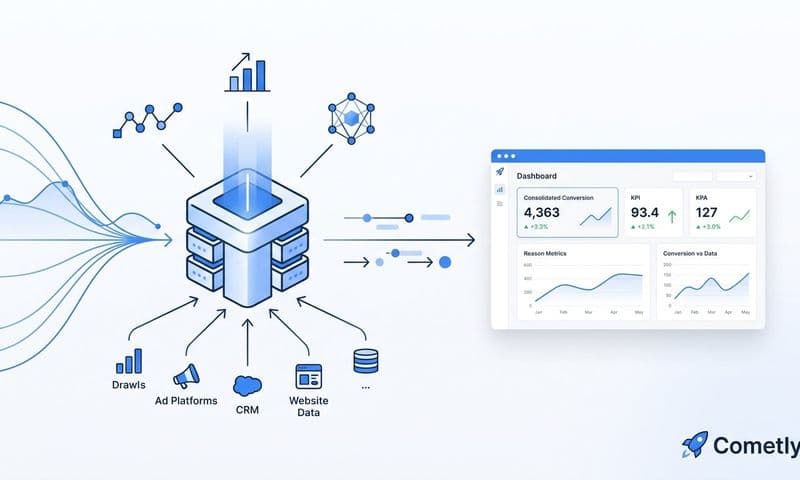
This is where marketing attribution tools are non-negotiable. Platforms like Cometly close the loop by tracking the entire customer journey, from the first ad click all the way to a purchase in your CRM.
This lets you answer the single most important question:
Did the group of users who saw the winning variation (Variation B) actually generate more revenue than the group who saw the control (Variation A)?
By syncing conversion data back to your ad platforms, you can see with certainty that your on-site win created a tangible increase in Return on Ad Spend (ROAS). Without this step, you're flying blind. For a deeper dive, check out some detailed guides on conversion analytics to see how the pros connect every action to a dollar amount.
Documenting Everything The Wins and the Losses
A successful test is great. But a well-documented test—win or lose—is invaluable. Every single experiment you run is a chance to learn something new about your audience. Failing to document those learnings is like throwing away free research. The goal is to build an internal "insights library" that becomes the brain of your entire CRO program.
For every test, you need to log:
- The Hypothesis: What was the original, data-backed reason you ran the test?
- Screenshots: Simple visuals of the control and the variation(s).
- The Results: Key metrics, statistical significance, and the final outcome.
- The Insights: This is the most critical part. Why do you think the test won or lost? What did you learn about your customers' motivations, anxieties, or preferences?
Honestly, losing tests are often more valuable than winning ones. A failed test that proves a long-held assumption wrong can save you from making far bigger strategic mistakes down the road. For instance, if a test with a "softer" CTA loses to a more direct one, it tells you your audience values clarity over cleverness—a powerful insight you can apply across all your marketing.
Scaling Your Wins and Creating a Feedback Loop
Once you've validated a win and documented the insights, it's time to scale. The obvious first step is to roll out the winning variation to 100% of your traffic. But don't stop there.
Think about the core learning from that test. How can you apply it elsewhere?
If simplifying the checkout form on desktop boosted conversions, what's the next logical move? You could hypothesize that simplifying the mobile checkout form will have an even bigger impact. This is how you create a powerful optimization loop, where each test informs the next, building momentum with every experiment.
The whole process is about creating a clear, repeatable flow that builds trust and drives action.
 How to Improve and Optimize For Website Conversions
As you can see, great copy and a smooth user experience are the two pillars that create the customer trust you need for a conversion.
By analyzing results with discipline, tying them to revenue, and building a library of insights, you turn your website from a static brochure into a dynamic, constantly evolving conversion engine. Each test becomes another step toward a smarter, more profitable optimization strategy.
Frequently Asked Questions About Website Conversions
Jumping into conversion rate optimization always brings up a ton of questions. Getting the right answers is the key to dodging common mistakes and building a strategy that actually drives results. Here are a few of the most common questions we get from marketers trying to get more out of their website.
What Is a Good Website Conversion Rate?
Honestly, there’s no magic number. Chasing some universal benchmark is usually a waste of time.
Performance swings wildly depending on your industry, business model, price point, and even where your traffic is coming from. An e-commerce store might be thrilled with a 2.5% conversion rate, while a B2B SaaS company could be aiming for 5-10% on a demo request form.
The best thing you can do is stop comparing your site to vague industry averages. Instead, figure out your own baseline conversion rate with accurate tracking. From that moment on, your only goal is to beat your own numbers. Your biggest competitor should be your performance from last month.
How Long Should You Run an A/B Test?
How long to run an A/B test really comes down to your website's traffic volume and the conversion rate of whatever goal you're tracking. The most important thing is to collect enough data to hit statistical significance—which usually means a confidence level of 95% or higher. This confirms your results are real and not just a random fluke.
A huge, costly mistake we see all the time is stopping a test early just because one variation pulls ahead. Don't do it. Random swings in the first few days can be incredibly misleading.
As a general rule, let your experiments run for at least one full business cycle. For most businesses, that means a minimum of two full weeks. This helps smooth out any weirdness from daily or weekly changes in user behavior and gives you a much more reliable picture of what’s actually working.
What Is the Difference Between CRO and SEO?
It’s easy to get these two mixed up since they work so closely together, but CRO and SEO are different disciplines with different jobs. The distinction is pretty simple when you break it down:
- SEO (Search Engine Optimization) is all about acquisition. Its job is to get more high-quality traffic to your website from organic search results.
- CRO (Conversion Rate Optimization) is all about action. Its job is to convince more of the visitors who are already on your site to do something specific, like buy a product or sign up for a newsletter.
Think of it like this: SEO is in charge of filling the top of your funnel with the right people. CRO makes sure all that valuable traffic doesn't just leave without doing anything.
A solid marketing strategy needs both to survive. One without the other is like having a beautiful, well-stocked store with the front door locked.
Ready to connect every conversion back to the ad that drove it? Cometly provides the marketing attribution you need to see what's really working, so you can stop wasting spend and start scaling your wins with confidence. Get the full picture at https://www.cometly.com.