Ask any marketing pro what ROI means, and you'll get a dozen different answers. But at its core, the roi definition marketing teams need is simple: it's the metric that tells you if your marketing is actually making money.
It answers the most important question of all: “For every dollar we spend, how many are we getting back?”
Defining Marketing ROI for Modern Growth
 ROI Definition For Marketers: Use ROI Tracking To Prove Campaign Spend
It’s time to stop thinking of your marketing budget as an expense. Instead, see it as a strategic investment portfolio. Every dollar you put into Google Ads, influencer campaigns, or even content creation is an investment—one that should be expected to generate a measurable return.
Marketing Return on Investment (ROI) is the ultimate proof of your department's value. It’s the language that connects your campaign clicks and conversions to the company's bottom line, justifying budgets and fueling smarter decisions.
Without a solid grip on ROI, marketing can feel like gambling—throwing money at different channels and just hoping something sticks.
Why ROI Is the North Star Metric
A clear understanding of ROI forces you to move beyond vanity metrics (like impressions and likes) and focus on what really moves the needle: revenue and profit. It gives you a universal yardstick to compare totally different initiatives.
For instance, you can finally determine if that $10,000 trade show booth actually delivered more value than a $10,000 TikTok ad campaign.
This kind of clarity is critical for a few big reasons:
- Budget Justification: It gives you the cold, hard data to defend your current budget and make a rock-solid case for more investment in what’s working.
- Strategic Optimization: When you know which campaigns are winners, you can confidently pull budget from the underperformers and double down on what’s driving real results.
- Performance Accountability: It creates a culture where marketing success is tied directly to financial outcomes, getting your entire team aligned with the company’s biggest goals.
The Standard Formula Explained
At its heart, Marketing ROI (often called MROI) is a straightforward performance metric. It quantifies how profitable your campaigns are by comparing the revenue they generated against how much they cost to run.
It’s no surprise that improving MROI and attribution is a top priority for marketers everywhere—it's that important. You can dig deeper into MROI in our detailed guide on the topic.
The fundamental ROI formula is: (Revenue Generated from Marketing - Cost of Marketing) / Cost of Marketing. You then multiply the result by 100 to get a percentage.
To get a better sense of how this works, we've broken down the formula's key parts in the table below.
The Core Marketing ROI Formula at a Glance
Component | Description | Example Value |
|---|---|---|
Revenue from Marketing | The total sales or revenue directly generated by a specific marketing campaign or effort. | $10,000 |
Cost of Marketing | The total spend for that marketing campaign, including ad spend, creative costs, and agency fees. | $2,000 |
The Calculation | The formula that puts the components together to measure the return. | ($10,000 - $2,000) / $2,000 |
Let’s put it all together. If you spend $2,000 on a campaign that brings in $10,000 in revenue, your ROI is a whopping 400%.
This means for every single dollar you invested, you got four dollars back after covering your initial cost. This simple calculation is the bedrock for all the more advanced ROI strategies we’ll explore.
How to Calculate Your True Marketing ROI
 ROI Definition For Marketers: Use ROI Tracking To Prove Campaign Spend
The basic ROI formula is a great starting point, but if you want to know your true return, you need to dig a little deeper. It’s about moving past surface-level revenue and getting to actual profitability. This is where the Return on Marketing Investment (ROMI) calculation comes into play.
Think of the simple ROI formula as a quick health check. It tells you part of the story, but it misses a huge variable: the cost of what you’re actually selling. ROMI brings the Cost of Goods Sold (COGS) into the equation, giving you a much sharper picture of a campaign's financial impact.
The Foundational ROMI Formula
The ROMI formula adjusts the standard calculation to account for the direct costs of producing or delivering your product. It’s a small change that makes a world of difference.
ROMI = (Revenue from Marketing - COGS - Marketing Investment) / Marketing Investment
This formula answers the most important question: after paying for the products and the marketing, how much profit did we actually make? For a closer look, you can explore how to calculate Return on Marketing Investment in our complete guide.
Let’s run the numbers on a couple of real-world scenarios to see why this matters so much.
Example 1: The DTC Brand TikTok Campaign
Picture a direct-to-consumer (DTC) brand that sells premium t-shirts. They decide to run a TikTok influencer campaign to drive sales for a new collection.
Here’s how their numbers shake out:
- Marketing Investment: $5,000 (This covers influencer fees and ad spend.)
- Total Revenue Generated: $20,000 (Tracked via unique discount codes.)
- Cost of Goods Sold (COGS): $8,000 (The cost to make and ship the shirts they sold.)
Using the simple ROI formula, the result looks incredible: ($20,000 - $5,000) / $5,000 = 300% ROI. This suggests they got $4 back for every $1 they spent. Not bad, right?
But the ROMI formula tells a more grounded story:
($20,000 - $8,000 - $5,000) / $5,000 = 140% ROMI.
This reveals that for every $1 invested, the company actually generated $1.40 in pure profit. It’s still a fantastic outcome, but it’s a far more realistic measure of the campaign's success—the kind of number you can confidently use to make budget decisions. To get a better handle on the different ways to approach this, check out this guide on how to measure Marketing ROI the right way.
Example 2: The B2B SaaS Webinar Series
Now let's switch gears to a B2B SaaS company trying to generate qualified leads for its software, which comes with an annual subscription fee. They run a webinar series promoted through LinkedIn Ads.
The math here is a bit different because the immediate "sale" isn't a purchase; it's a lead.
- Marketing Investment: $10,000 (Includes ad spend, speaker fees, and the webinar platform.)
- Leads Generated: 200 qualified leads.
- Lead-to-Customer Conversion Rate: 10% of those leads become paying customers.
- Lifetime Value (LTV) of a Customer: $5,000 (The average total revenue one customer brings in.)
First, we need to figure out the total revenue this campaign generated.
- Customers Acquired: 200 leads * 10% conversion rate = 20 new customers.
- Total Revenue: 20 customers * $5,000 LTV = $100,000.
Now, we can plug this into the ROMI formula. For most SaaS products, the marginal COGS is nearly zero, so we can use revenue as a solid proxy for gross profit here.
($100,000 - $10,000) / $10,000 = 900% ROMI.
That’s a massive $9 return in lifetime value for every $1 spent on the webinar series. This example hammers home why looking beyond immediate sales and incorporating metrics like LTV is so critical for B2B marketers who need to prove their long-term value.
Understanding Good Marketing ROI Benchmarks
So you've meticulously calculated your ROI, and now you're staring at a number. The next question is always the same: "Is this any good?"
To answer that, you have to look beyond your own data and see how you stack up against industry benchmarks. While there’s no single magic number that fits every business, understanding the context behind these benchmarks is key to setting realistic goals and knowing when to double down.
A widely accepted rule of thumb is that a 5:1 ratio—or a 400% ROI—is a strong, healthy return. This simply means for every $1 you put into marketing, you're getting $5 back in revenue. If you hit an exceptional campaign, you might even see a 10:1 ratio, which is a clear signal that you've found something incredibly profitable and should probably invest more.
But here’s the thing: treating these figures as absolute truths is a surefire way to misjudge your performance. What’s considered a "good" marketing ROI depends entirely on your business.
Why Context Is Everything
A 5:1 return might be phenomenal for a low-margin ecommerce store, but it could be a bit underwhelming for a high-margin SaaS business with massive customer lifetime value. Several factors can completely shift what you should be aiming for.
- Industry and Profit Margins: It all comes down to profitability. A business selling high-ticket items with 80% margins has a lot more breathing room for marketing spend than a retailer operating on slim 15% margins. That retailer needs a much higher revenue-to-cost ratio just to turn a real profit.
- Business Maturity: Are you a startup or an established brand? A startup laser-focused on aggressive growth might be perfectly happy with a lower ROI (or even a temporary negative one) if it means acquiring valuable customers who will pay off down the road. An established company, however, will likely prioritize profitability and aim for a consistently high ROI.
- Campaign Goals: Not every campaign is built for immediate sales. The goal of a brand awareness campaign is better measured by things like social engagement or a lift in direct traffic, not immediate ROI. A direct-response Google Ads campaign, on the other hand, absolutely should be held to a strict, positive ROI standard.
Benchmarks Across Different Marketing Channels
The channel you're using also plays a huge role in what you can realistically expect. Some channels are built for high, direct returns, while others contribute more quietly to the customer's journey.
Let's look at how different marketing channels typically perform when it comes to ROI. While a 5:1 ratio is often cited as a solid average for digital marketing, this number is a blend of wildly different results from various channels. Having a baseline helps you gauge whether your efforts in a specific area are on track, overperforming, or in need of a tune-up.
Average Marketing ROI by Channel
Marketing Channel | Average ROI (Ratio) | Average ROI (Percentage) |
|---|---|---|
Email Marketing | Up to 40:1 | Up to 3,900% |
SEO | 10:1 or more | 900%+ |
PPC Advertising | 2:1 or more | 100%+ |
Content Marketing | Variable (Long-term) | Variable (Long-term) |
As you can see, the expectations can vary dramatically. You wouldn't judge an email campaign by the same ROI stick as a brand new PPC campaign. For a deeper dive into these numbers, check out this helpful resource on what constitutes a good marketing ROI.
We compare the leading options in our PPC advertising software roundup.
Here’s a quick breakdown of what to expect from some of the most common channels:
- Email Marketing: Often hailed as the king of ROI, email can generate insane returns as high as 40:1. This is largely due to its low cost and direct line to an audience that has already opted in.
- SEO: This one is a long game. It requires a significant upfront investment of time and resources, but successful SEO can deliver an ROI well over 10:1 as it generates compounding organic traffic over time.
- PPC Advertising: Paid search campaigns are highly measurable and typically aim for a 2:1 ROAS (Return on Ad Spend) just to be considered successful at a baseline level. Many, of course, achieve much higher returns with proper optimization.
- Content Marketing: Much like SEO, content is a long-term play. Its ROI can be tricky to measure directly, but it often fuels other channels by improving their performance and building trust with your audience.
Getting a handle on these nuances is the first step toward building a smarter marketing strategy. When you track the right numbers, you get a much clearer picture of your actual performance. For more on this, check out our guide on the most important marketing dashboard KPIs to keep an eye on.
Navigating the Hidden Challenges of ROI Measurement
Knowing your marketing ROI formula is one thing. Actually measuring it is a whole different ballgame.
In a perfect world, every customer would click an ad, pull out their credit card, and buy something on the spot. But we don't live in a perfect world. Real customer journeys are messy, winding paths that can stretch across multiple channels and devices over weeks or even months.
This complexity creates some serious hurdles that can make your ROI calculations feel more like a shot in the dark than a science. One of the biggest obstacles staring down every marketer is marketing attribution.
The Problem with Giving Credit
Think of marketing attribution like trying to figure out who deserves credit for a game-winning touchdown. The quarterback who threw the pass gets the glory, but what about the offensive lineman who held off a blitz? Or the receiver who ran a decoy route to draw away the defense?
Giving all the credit to the final player who touched the ball is simple, but it completely ignores the teamwork that made the score possible.
Marketing works the same way. A customer might see a Facebook ad, read one of your blog posts they found through a Google search, get a follow-up email, and then finally convert after clicking a retargeting ad. So, which touchpoint gets the credit for the sale?
Last-click attribution, the default setting for many platforms, gives 100% of the credit to the final touchpoint before the conversion. This model is easy to track but dangerously misleading, as it systematically undervalues the channels that build initial awareness and trust.
This flawed approach can trick you into cutting the budget for a top-of-funnel campaign that’s actually filling your pipeline, all because it doesn't get that "last click" glory. To fix this, smart marketers use different attribution models.
- First-Click: Gives all the credit to the very first interaction, showing you which channels are best at getting your brand noticed.
- Linear: Splits the credit equally among every single touchpoint in the customer's journey.
- Time-Decay: Gives more credit to the touchpoints closest to the sale, working on the idea that more recent interactions had a bigger impact.
- Multi-Touch (U-Shaped or W-Shaped): These more advanced models assign credit to multiple key moments, like the first touch, the point when a lead was created, and the final conversion.
The right model really depends on your business goals and how long your sales cycle is. But even if you pick the perfect model, other major challenges are waiting for you.
Beyond Attribution: Common Hurdles
Solving the attribution puzzle is a huge step, but other factors can still muddy your ROI data. The marketing world is full of data gaps and tracking headaches that require a clear strategy to navigate.
For instance, connecting offline sales to your online campaigns is a classic problem. If a customer sees a digital ad and then walks into your physical store to make a purchase, how do you connect those dots? Without things like unique coupon codes or asking customers at checkout, that valuable conversion can easily slip through the cracks, completely untracked.
 ROI Definition For Marketers: Use ROI Tracking To Prove Campaign Spend
While aiming for a 5:1 or 10:1 return is a fantastic goal, this just reinforces that your specific industry and campaign objectives ultimately define what a "good" ROI looks like for you.
Long B2B sales cycles create another challenge. A lead you generate today might not become a paying customer for six months or more. This long delay makes it tough to tie revenue back to the original marketing spend in a timely way, forcing you to take a much longer-term view of ROI.
Finally, the rise of privacy measures—like Apple's iOS updates and the slow death of third-party cookies—has created massive data gaps. These changes make it much harder to track user behavior across different websites and apps, which directly torpedoes the accuracy of your attribution and ROI measurement.
To get a better handle on these issues, you can learn more about the common attribution challenges in marketing and how to start solving them.
How Modern Attribution Tools Solve the ROI Puzzle
 ROI Definition For Marketers: Use ROI Tracking To Prove Campaign Spend
If you've ever tried to define your marketing ROI, you know the drill. You pull a report from Google Analytics, another from Facebook Ads, and a third from your CRM, only to find the numbers don't add up. Relying on these siloed, often conflicting reports is like trying to assemble a puzzle with pieces from three different boxes. It’s never going to give you the full picture.
This is exactly where a dedicated attribution platform changes the game.
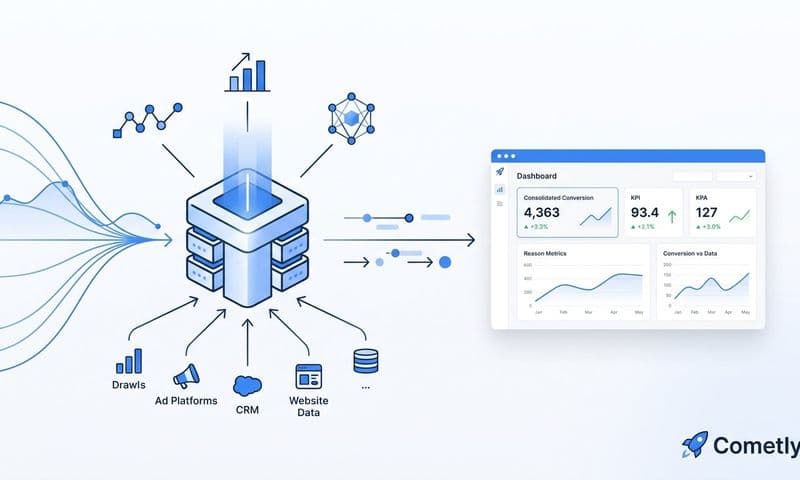
Instead of patching together mismatched reports, these tools are built from the ground up to create a single, unified source of truth for your marketing. Think of them as an impartial referee, meticulously tracking every single interaction a customer has with your brand, no matter where it happens. By capturing touchpoints across the entire customer journey—from the very first ad they saw to the final purchase click—these platforms move you far beyond simplistic last-click models.
Creating a Unified View of Performance
The real power of an attribution tool is its ability to consolidate everything. Imagine all your marketing metrics—from paid ads, organic search, email campaigns, and social media—flowing into one intuitive dashboard. This unified view puts an end to the guesswork.
You no longer have to wonder if a sale credited to a Google search was actually kickstarted by a TikTok ad they saw last week. The platform connects those dots for you, revealing how your channels are really working together. For anyone serious about understanding their roi definition marketing results, this clarity is non-negotiable.
This centralized approach lets you see what’s actually driving the needle. When you can accurately attribute success and untangle the messy customer journey, you’ve mastered cross-channel marketing attribution. Instead of making decisions with one eye closed, you can confidently shift your budget to the activities that are genuinely profitable.
From Measurement to Optimization
Ultimately, the goal of any great attribution tool isn't just to measure ROI—it's to help you improve it. Armed with a clear and accurate picture of your entire marketing funnel, you can finally make data-driven optimizations that have a real impact on your bottom line.
This means you can:
- Identify Winning Channels: Discover which platforms are consistently delivering high-value customers, not just cheap clicks.
- Optimize Ad Creative: Pinpoint the exact ads and messaging that resonate most with your audience and drive them to convert.
- Improve the Customer Journey: Understand how different channels work together and spot friction points that are causing potential customers to drop off.
This shift from reactive measurement to proactive optimization is where the true value lies. When you embrace a modern attribution solution, you're not just getting a better roi definition marketing teams can use; you're gaining the strategic insight needed to grow faster and smarter. You can explore a variety of marketing attribution tools to find the right fit for your business.
Common Questions About Marketing ROI
Even with a solid grasp of the formulas, some practical questions about marketing ROI always pop up. Let's tackle the most common ones head-on.
Think of this as your quick-reference guide for those "what-if" scenarios that come up in team meetings and budget reviews. We'll clear up any lingering confusion so you can apply these concepts with confidence.
What Is the Difference Between ROI and ROAS?
This is easily one of the most common points of confusion. While ROI (Return on Investment) and ROAS (Return on Ad Spend) sound similar, they answer two very different questions about your marketing performance.
Imagine you're a ship captain. ROAS tells you how fast your engine is running, while ROI tells you if the ship is actually making a profit on its entire voyage.
ROAS is a laser-focused metric, calculated as (Revenue from Ads / Cost of Ads). It’s perfect for a campaign manager who needs a quick read on the efficiency of a specific Google or Facebook ad set. If you spend $100 on ads and get $400 in revenue, your ROAS is 4:1. It’s all about tactical efficiency.
Marketing ROI, on the other hand, gives you the bigger picture. It zooms out to measure the overall profitability of an entire marketing initiative by including a wider range of costs beyond just the ad spend. This bucket includes expenses like software subscriptions, agency fees, creative production, and sometimes even a chunk of team salaries. ROI measures strategic business impact.
A campaign can have a fantastic ROAS but a negative ROI. For example, a 4:1 ROAS might look great on a dashboard, but if your product margins are only 20%, you’re actually losing money on every single sale after factoring in the cost of the goods you sold.
How Do I Measure the ROI of Brand Awareness Campaigns?
Trying to pin a direct, dollar-for-dollar ROI on a brand awareness campaign is like trying to measure the immediate financial return of a single workout on your long-term health. It’s nearly impossible and misses the entire point. The value is cumulative and foundational.
Instead of chasing a direct sales link, the key is to track clear proxy metrics. These are strong indicators of your campaign's success and provide tangible proof that you're building brand equity, which ultimately fuels future sales.
Focus on tracking the trends in these key areas:
- Branded Search Volume: Are more people specifically searching for your brand name on Google? This is a powerful signal that your awareness efforts are working.
- Direct Website Traffic: Are more people typing your URL directly into their browser? This shows growing brand recall.
- Social Media Mentions and Engagement: Monitor the conversation. An uptick in untagged mentions, shares, and comments shows your brand is becoming part of your audience's dialogue.
- Share of Voice: How does your brand's presence stack up against your competitors within your market? Tools can measure this to show if you're capturing more of the conversation.
By using pre- and post-campaign surveys to measure shifts in brand recognition and tracking these proxies, you can build a compelling case for your brand-building efforts, even without a direct ROI figure.
What Is the First Step to Start Tracking Marketing ROI?
The single most important first step is to define what success looks like for each campaign before you spend a single dollar. Without a clear, measurable goal, you have no benchmark to measure your return against.
Is your goal to generate 150 qualified leads for the sales team? Is it to drive $75,000 in e-commerce sales? Or is it to get 10,000 sign-ups for a webinar? Get specific.
Once you have that target, your next move is to make sure your tracking infrastructure is set up correctly. This doesn't have to be complicated at the start. It can be as straightforward as consistently using UTM parameters on every single link to track sources, mediums, and content in Google Analytics.
This simple discipline keeps your data clean from day one. From there, you can move on to more advanced solutions like a dedicated attribution tool. But it all starts with two things: a specific goal and clean tracking. This foundation lets you confidently connect your costs to real-world outcomes.
Should Marketing Team Salaries Be Included in ROI Calculations?
Great question, and the answer is: it depends entirely on the question you are trying to answer. The scope of your ROI calculation should always match the scope of the decision you're trying to make.
Think of it in two distinct scenarios:
- The CMO's Boardroom View: If you are the Chief Marketing Officer presenting to the board on the overall profitability and efficiency of the entire marketing department, then yes, absolutely. You should include salaries, overhead, and all associated operational costs. This provides a true, high-level picture of marketing's net contribution to the business.
- The Campaign Manager's Trenches View: However, if you're a performance marketer trying to figure out if your TikTok ads are outperforming your LinkedIn ads, including salaries is not only unnecessary but counterproductive. For this kind of campaign-level analysis, you should only focus on the variable costs directly tied to that specific initiative—like ad spend and creative costs. This allows for a clean, apples-to-apples comparison of channel performance.
Ready to stop guessing and start knowing your true marketing ROI? Cometly provides a single source of truth, unifying all your marketing data into one clear dashboard so you can see exactly what's driving results. Eliminate wasted spend, optimize your campaigns with confidence, and prove your marketing's value once and for all. Get started with Cometly today!