

Server Side Tracking Benefits: Why Modern Marketers Can't Afford to Ignore This Technology
You're staring at your Facebook Ads Manager at 11 PM on a Tuesday, and the numbers look fantastic. Your campaign just drove 247 conversions at a $42 cost per acquisition. You refresh Google Analytics to cross-reference the data, and your stomach drops—only 156 conversions are showing up there. You check your CRM, and it's reporting something entirely different: 189 conversions.
Which number is real? Which campaigns should you scale? Which should you pause?
This isn't a hypothetical scenario. It's the daily reality for performance marketers in 2026, where attribution has become a guessing game rather than a science. Since Apple's iOS 14.5 update fundamentally changed how tracking works on mobile devices, and with Chrome's cookie deprecation timeline accelerating, the gap between what your ad platforms report and what actually happens has grown into a chasm that's costing you real money.
The hidden cost of inaccurate attribution isn't just frustration—it's systematic budget misallocation. When you optimize campaigns based on incomplete data, you're essentially making million-dollar decisions with a broken compass. You might be scaling campaigns that barely break even while pausing your actual top performers. Your CFO sees revenue numbers that don't match your reported conversions, and suddenly your entire marketing budget is under scrutiny.
While many marketers struggle with attribution discrepancies across their platforms, server-side tracking addresses the root cause rather than treating symptoms. It represents a fundamental architectural shift in how marketing data flows from your customers to your analytics platforms. Instead of relying on browsers, cookies, and user devices that are increasingly restricted by privacy measures, server-side tracking captures conversion data directly on your servers and sends it to ad platforms through secure, direct connections.
The benefits extend far beyond simply "better tracking." Server-side tracking delivers iOS-proof attribution, immunity to ad blockers, complete customer journey visibility, improved ad platform optimization, privacy compliance, and future-proofing against the cookieless future. For marketers who implement it correctly, the competitive advantages compound over time as data quality improvements lead to better optimization decisions, which lead to higher ROI, which leads to more budget for testing and scaling.
In this guide, you'll discover exactly how server-side tracking transforms marketing performance, why it's becoming non-negotiable for serious advertisers, and how to evaluate whether your organization is ready to make the transition. We'll break down the technical concepts into accessible explanations, quantify the real-world benefits with concrete examples, and provide a practical roadmap for implementation that doesn't require you to become a developer.
By the end, you'll understand why server-side tracking isn't just a nice-to-have upgrade—it's the difference between optimizing with confidence and making expensive guesses in the dark.
Decoding Server Side Tracking for Modern Marketers
Think of traditional client-side tracking like running a restaurant where you ask customers to report their own orders. Some forget what they ordered. Others leave before telling you. A few actively refuse to share any information. Now imagine instead that your kitchen tracks every order directly—that's server-side tracking.
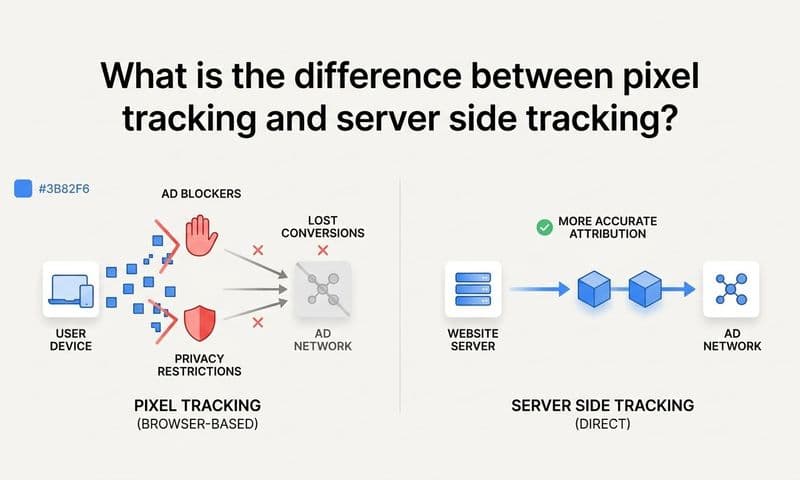
The difference isn't just technical—it's fundamental. Client-side tracking relies on browsers, cookies, and user devices to capture conversion data and send it to your analytics platforms. When someone clicks your ad, visits your site, and makes a purchase, their browser is supposed to fire tracking pixels that report this activity back to Facebook, Google, and your analytics tools. But here's the problem: browsers are increasingly blocking these tracking mechanisms, users are deleting cookies, and privacy settings are preventing data from ever reaching your platforms.
Server-side tracking eliminates this broken telephone effect entirely. Instead of depending on browsers to relay information, your server side tracking system captures conversion data directly and sends it to analytics platforms through secure, server-to-server connections. When someone completes a purchase on your site, the transaction data flows from your server straight to Facebook's Conversions API or Google's Measurement Protocol—no browser involvement required, no privacy restrictions interfering, no data lost in transit.
This architectural shift solves the core problem that's been plaguing marketers since iOS 14.5 launched. When Apple introduced App Tracking Transparency, it didn't just add a permission prompt—it fundamentally broke the client-side tracking model that the entire digital advertising industry was built on. Suddenly, the majority of iOS users were invisible to traditional tracking methods. Ad blockers, which were already popular, became even more effective. Cookie restrictions tightened across every major browser.
The result? A campaign might show 100 conversions in Facebook Ads Manager but only 60 in Google Analytics, with your CRM reporting something entirely different. These aren't small discrepancies—they're systematic data loss that makes optimization nearly impossible. Understanding the full landscape of conversion tracking tools helps marketers evaluate which solutions can overcome these browser-based limitations.
Server-side tracking captures events that client-side tracking misses entirely. When someone's phone dies mid-purchase, client-side tracking loses the conversion because the browser never fired the tracking pixel. Server-side tracking captures it because the transaction completed on the server. When an iOS user with tracking disabled converts, client-side tracking sees nothing. Server-side tracking records the full conversion because it's happening server-to-server, completely independent of the user's privacy settings.
This isn't about finding a workaround to privacy restrictions—it's about implementing a tracking architecture that respects user privacy while maintaining measurement accuracy. Your server still needs to handle data responsibly and comply with regulations, but the technical infrastructure is no longer vulnerable to the browser-level restrictions that have crippled traditional tracking methods.
The implications extend beyond just "seeing more conversions." When your ad platforms receive complete, accurate conversion data through server-side connections, their optimization algorithms work better. Facebook's AI can't optimize toward conversions it never sees. Google's Smart Bidding can't improve performance when half the conversion signals are missing. Server-side tracking feeds these platforms the complete data they need to actually optimize your campaigns effectively.
How Server-Side Tracking Actually Works
Think of traditional tracking like sending a postcard through the mail system. Your customer's browser writes down what happened, puts it in an envelope, and tries to deliver it to Facebook or Google. But along the way, that postcard might get lost, blocked by a spam filter, or returned to sender because the address is restricted. That's client-side tracking—dependent on the customer's device, browser settings, and a dozen other variables you can't control.
Server-side tracking eliminates this unreliable delivery system entirely. Instead of relying on the customer's browser to report what happened, your server captures the conversion event directly and sends it straight to ad platforms through a secure, direct connection. When someone completes a purchase on your site, the transaction data flows from your server to Facebook's Conversions API or Google's Enhanced Conversions—no browser involvement required, no privacy restrictions to navigate, no ad blockers to bypass.
This direct server-to-server communication is fundamentally different from how web tracking has worked for the past two decades. Traditional pixel-based tracking loads JavaScript code in the user's browser, which then attempts to fire tracking events back to ad platforms. Every step of that process can fail: the JavaScript might be blocked, the user might close the browser before the event fires, iOS restrictions might prevent the data from being sent, or privacy settings might strip identifying information.
Server-side tracking bypasses all of these failure points because the data never touches the user's device in a way that can be blocked or restricted. Your server already knows a conversion happened—it processed the payment, created the account, or completed the lead form submission. Instead of hoping the browser successfully reports this event, your server sends a direct API call to the ad platform with complete conversion data, enriched with additional context like customer lifetime value, product categories, or subscription tier.
The technical architecture is surprisingly straightforward. When a conversion event occurs on your website or app, your server captures the relevant data points: what was purchased, the transaction value, the customer identifier, and the original ad click information. This data gets packaged into a secure API request and sent directly to platforms like Facebook, Google, TikTok, or Pinterest through their server-side APIs. The entire process happens server-to-server, immune to browser restrictions, ad blockers, or privacy settings that plague traditional tracking methods.
What makes this approach powerful is that you control the entire data flow. You decide what information to send, when to send it, and how to format it. If a customer opts out of browser tracking but completes a purchase, you can still report that conversion to your ad platforms while respecting their privacy preferences. If someone converts on mobile but your pixel didn't fire due to iOS restrictions, your server still captured the transaction and can report it accurately.
This direct server communication ensures no conversion data gets lost in transit, no attribution gets dropped due to technical limitations, and no optimization signals fail to reach your ad platforms. The result is a complete, accurate picture of campaign performance that enables confident scaling decisions based on real data rather than incomplete fragments. For marketers looking to implement this technology, understanding how to set up server side tracking properly is essential for maximizing these benefits.
Why Traditional Tracking Is Failing Marketers
Browser-based tracking was designed for a simpler internet—one where users stayed logged into the same device, cookies persisted indefinitely, and privacy regulations didn't exist. That world is gone, and the tracking infrastructure built for it is crumbling under the weight of modern privacy restrictions.
The problem starts with iOS devices, which now represent over 50% of mobile traffic in many markets. Apple's App Tracking Transparency framework requires apps to ask permission before tracking users across other apps and websites. The opt-in rate? Roughly 25% of users globally. That means 75% of your iOS traffic is essentially invisible to traditional pixel-based tracking. Your Facebook pixel can't see what happens after someone clicks your ad if they declined tracking permission.
But iOS restrictions are just the beginning. Chrome's third-party cookie deprecation, originally scheduled for 2024 and now pushed to 2025, will eliminate another foundational element of client-side tracking. Firefox and Safari already block third-party cookies by default. Ad blockers, used by over 40% of internet users in some demographics, prevent tracking pixels from loading entirely. Privacy-focused browsers like Brave strip tracking parameters from URLs automatically.
The cumulative effect of these restrictions creates what I call "systematic data blindness"—you're not just missing a few conversions here and there, you're losing visibility into entire customer segments. Your highest-value customers might be the most privacy-conscious, meaning your data systematically underrepresents your best audience. Your optimization decisions become biased toward the minority of users who haven't blocked tracking, while the majority remains invisible.
This data loss compounds over time. When Facebook's algorithm receives incomplete conversion data, it optimizes toward the wrong audience—the trackable minority rather than your actual best customers. Your cost per acquisition appears higher than reality because you're only seeing a fraction of conversions. Your attribution models break down completely when the customer journey spans multiple devices or includes iOS users who declined tracking.
The business impact is measurable and severe. Marketers report attribution gaps of 30-50% between what ad platforms show and what actually converts. Campaign optimization becomes guesswork when half your conversion signals are missing. Budget allocation decisions are made with incomplete information, leading to systematic misallocation of marketing spend. The competitive disadvantage grows as competitors who've implemented server-side tracking gain access to complete data while you're optimizing in the dark.
Traditional tracking isn't just less accurate—it's fundamentally broken for modern marketing. The infrastructure was never designed to handle the privacy restrictions, device diversity, and cross-platform journeys that define today's digital landscape. Patching it with workarounds and probabilistic modeling is like trying to fix a rotary phone to work with 5G networks—the underlying architecture simply can't support what's required.
The Measurable Business Impact of Server-Side Tracking
The theoretical benefits of server-side tracking sound compelling, but what matters is the actual business impact. When marketers implement server-side tracking correctly, they see measurable improvements across every key performance metric—not because the tracking makes their campaigns better, but because they can finally see and optimize what was always happening.
The most immediate impact shows up in conversion reporting accuracy. Marketers typically see 20-40% more conversions appear in their ad platforms after implementing server-side tracking. These aren't new conversions—they're conversions that were always happening but never being reported due to iOS restrictions, ad blockers, or browser limitations. One e-commerce brand running $50,000 monthly on Facebook saw their reported conversion count jump from 847 to 1,183 after implementing server-side tracking—a 40% increase in visibility with zero change to actual campaign performance.
This improved visibility transforms campaign optimization. When Facebook's algorithm receives complete conversion data instead of fragmented signals, it can identify patterns and optimize more effectively. The same e-commerce brand saw their cost per acquisition drop 23% over the following month as Facebook's AI learned from the complete dataset rather than the incomplete fragment it had been working with. They weren't running better campaigns—they were finally giving the platform the data it needed to optimize properly.
Attribution accuracy improvements extend beyond just seeing more conversions. Server-side tracking captures the complete customer journey tracking data across devices, browsers, and sessions that client-side tracking loses. A SaaS company discovered that 34% of their conversions involved cross-device journeys—users who clicked ads on mobile but converted on desktop. Client-side tracking attributed these conversions to "direct" traffic, making their paid campaigns appear less effective than they actually were. Server-side tracking connected these journeys properly, revealing that their mobile campaigns were driving significantly more value than previously measured.
The iOS attribution gap closes dramatically with server-side tracking. Before implementation, one DTC brand could only track 31% of conversions from iOS users. After implementing server-side tracking, that number jumped to 89%. The remaining 11% gap came from users who never completed purchases, not from tracking limitations. This visibility shift changed their entire media buying strategy—they discovered iOS users actually had 18% higher lifetime value than Android users, completely reversing their previous optimization approach that had been based on incomplete data.
Related reading: our complete guide to media buying automation tools.
Ad platform optimization algorithms perform measurably better with complete data. A lead generation company running Google Ads saw their conversion rate improve 31% after implementing server-side tracking, despite making no changes to their ads, landing pages, or targeting. The improvement came entirely from Google's Smart Bidding algorithm receiving complete conversion signals and optimizing more effectively. Their cost per lead dropped from $47 to $34 while lead quality remained consistent.
Budget allocation decisions become dramatically more confident with accurate attribution. When you know which campaigns actually drive conversions rather than which campaigns drive trackable conversions, you can scale winners and cut losers with confidence. One agency managing $200,000 monthly across multiple clients reallocated 35% of their budget after implementing server-side tracking and discovering that several "underperforming" campaigns were actually their best performers—they just served primarily iOS users whose conversions weren't being tracked.
The competitive advantage compounds over time. While competitors optimize campaigns based on incomplete data, you're making decisions with complete visibility. Your campaigns improve faster because your optimization loop includes all conversions, not just the trackable minority. Your attribution models reflect reality rather than a biased sample. Your forecasting becomes more accurate because you're working with complete historical data.
Return on ad spend improvements of 15-30% are common after implementing server-side tracking, not because campaigns suddenly perform better, but because you can finally measure their true performance and optimize accordingly. One eight-figure e-commerce brand calculated that incomplete tracking had caused them to misallocate approximately $180,000 in ad spend over six months—scaling campaigns that appeared profitable but weren't, while underfunding campaigns that appeared marginal but were actually their best performers.
Privacy Compliance and Future-Proofing Your Tracking Infrastructure
The privacy landscape isn't just changing—it's fundamentally reshaping how digital marketing operates. GDPR, CCPA, and emerging regulations worldwide are tightening restrictions on data collection and usage. Browser manufacturers are blocking third-party cookies and limiting tracking capabilities. Users are becoming more privacy-conscious and actively blocking tracking technologies.
Server-side tracking isn't a workaround to these privacy restrictions—it's a compliant architecture that respects user privacy while maintaining measurement accuracy. The key difference is control and transparency. With client-side tracking, data flows through browsers, third-party cookies, and tracking pixels that users can't see or control. With server-side tracking, you control the data flow entirely, making it easier to implement proper consent management, data minimization, and user rights.
GDPR compliance becomes more straightforward with server-side tracking because you control exactly what data gets collected and where it goes. When a user opts out of tracking, you can immediately stop sending their data to ad platforms through your server-side connections. With client-side tracking, pixels might still fire even after a user opts out, creating compliance risks. Server-side tracking gives you a single point of control for all data flows, making it easier to implement and verify compliance measures.
The cookieless future that's rapidly approaching won't break server-side tracking the way it will devastate traditional pixel-based tracking. When Chrome finally deprecates third-party cookies, client-side tracking will lose another critical component. Server-side tracking doesn't depend on third-party cookies—it uses first-party data captured on your servers and sent directly to platforms through authenticated APIs. Your tracking infrastructure remains functional regardless of browser cookie policies.
Platform-specific privacy features like Apple's App Tracking Transparency don't affect server-side tracking the same way they cripple client-side pixels. When a user declines tracking permission, your client-side pixel stops working entirely. But your server still captures the conversion when it happens, and you can still report that conversion to ad platforms through proper server-side channels while respecting the user's privacy preferences. The technical implementation respects privacy restrictions while maintaining attribution accuracy.
Future privacy regulations are likely to tighten restrictions further, not loosen them. Browser manufacturers will continue limiting tracking capabilities. Users will become more privacy-conscious. The tracking infrastructure that works today might not work tomorrow. Server-side tracking provides a more future-proof architecture because it's built on first-party data collection and direct platform APIs rather than browser-dependent technologies that are actively being phased out.
The investment in server-side tracking infrastructure pays dividends as privacy restrictions continue tightening. While competitors scramble to adapt to each new browser update or privacy regulation, your tracking infrastructure remains stable because it's built on a foundation that respects privacy by design. You're not fighting against privacy restrictions—you're working within them using an architecture designed for the privacy-first future.
Implementation Considerations and Requirements
Server-side tracking delivers transformative benefits, but implementation requires careful planning and technical resources. This isn't a simple pixel installation—it's an infrastructure project that touches your website, servers, and data flows. Understanding the requirements upfront helps you evaluate whether your organization is ready and what resources you'll need to allocate.
The technical requirements start with server access and development resources. Unlike client-side tracking where you just paste a pixel code into your website, server-side tracking requires backend development work. Your servers need to capture conversion events, format the data properly, and send API calls to ad platforms. This typically requires a developer with backend experience, though the complexity varies significantly based on your existing infrastructure and chosen implementation approach.
Platform-specific APIs form the foundation of server-side tracking. Facebook's Conversions API, Google's Enhanced Conversions, TikTok's Events API, and similar server-side solutions from other platforms each have their own requirements, data formats, and authentication methods. Implementing server-side tracking means integrating with these APIs directly, which requires understanding their documentation, handling authentication, and managing ongoing maintenance as platforms update their APIs.
Data infrastructure becomes more important with server-side tracking. You need systems to capture conversion events on your servers, store relevant data temporarily, handle API calls reliably, and manage error handling when API calls fail. This infrastructure needs to be reliable—if your server-side tracking system goes down, you lose conversion visibility just as completely as if client-side pixels stopped firing. Many organizations underestimate the ongoing maintenance and monitoring required to keep server-side tracking running smoothly.
Identity resolution presents one of the biggest technical challenges. Client-side pixels automatically capture browser identifiers and cookie data. With server-side tracking, you need to explicitly pass these identifiers from the client to your server, then include them in your API calls to ad platforms. This requires careful implementation to ensure you're capturing the right identifiers, matching them correctly, and sending them in the format each platform expects. Poor identity resolution undermines the entire benefit of server-side tracking.
Testing and validation become more complex with server-side tracking. With client-side pixels, you can use browser developer tools to verify that pixels are firing correctly. With server-side tracking, you need server-side logging, API response monitoring, and platform-specific testing tools to verify that your implementation is working correctly. Many organizations implement server-side tracking but don't realize it's not working properly until they notice attribution gaps weeks later.
The implementation timeline varies dramatically based on your technical resources and existing infrastructure. A simple e-commerce site with a single conversion event might implement basic server-side tracking in a few days. A complex multi-step funnel with multiple conversion events, subscription tiers, and custom attribution requirements might take weeks or months to implement properly. Understanding your specific requirements and timeline expectations is critical for planning.
Cost considerations extend beyond just development time. Server-side tracking requires ongoing server resources to handle API calls, monitoring systems to ensure reliability, and maintenance as platforms update their APIs. Some organizations choose to build custom solutions, while others use third-party platforms that handle the technical complexity but charge monthly fees. The right approach depends on your technical resources, budget, and long-term maintenance capabilities.
Integration with existing marketing technology stacks requires careful planning. Your server-side tracking implementation needs to work with your CRM, analytics platforms, data warehouses, and other marketing tools. Many organizations discover integration challenges after starting implementation, leading to delays and additional development work. Mapping out your entire data flow before starting implementation helps identify potential integration issues early.
Choosing the Right Server-Side Tracking Solution
The server-side tracking landscape includes multiple implementation approaches, each with distinct tradeoffs. Understanding your options helps you choose the solution that matches your technical resources, budget, and long-term requirements.
Custom implementation gives you complete control but requires significant technical resources. You build the entire server-side tracking infrastructure yourself, integrating directly with platform APIs, managing data flows, and handling all ongoing maintenance. This approach works well for organizations with strong development teams and unique requirements that off-the-shelf solutions can't accommodate. The upfront development cost is high, but you avoid ongoing platform fees and maintain complete flexibility.
Platform-native solutions like Google Tag Manager Server-Side or Facebook's Conversions API Gateway provide middle-ground options. These platforms handle some technical complexity while still requiring configuration and integration work. They're typically more affordable than custom development but less flexible. You're working within the constraints of what the platform provides, which works well for standard implementations but can be limiting for complex requirements.
Third-party attribution platforms offer the fastest implementation path but come with ongoing costs. Platforms like Cometly, Hyros, or Northbeam handle the entire server-side tracking infrastructure, providing pre-built integrations with major ad platforms, user-friendly interfaces, and ongoing maintenance. You trade monthly platform fees for dramatically reduced implementation complexity and faster time to value. For organizations without strong technical resources, this approach often provides the best balance of capability and feasibility.
The right solution depends on your specific situation. Organizations with strong technical teams, unique requirements, and long-term commitment to maintaining custom infrastructure might benefit from custom implementation. Organizations wanting to implement server-side tracking quickly without significant technical resources typically find third-party platforms more practical. Organizations with moderate technical resources and standard requirements might find platform-native solutions like GTM Server-Side provide the right balance.
Evaluation criteria should include implementation timeline, ongoing maintenance requirements, cost structure, feature completeness, integration capabilities, and long-term scalability. A solution that works well at $50,000 monthly ad spend might not scale effectively to $500,000. A platform that handles Facebook and Google might not support the emerging platforms you'll want to test next year. Thinking beyond immediate needs helps you choose a solution that remains effective as your requirements evolve.
For organizations managing significant ad spend across multiple platforms, comprehensive purchase marketing tracking software that includes server-side tracking capabilities often provides better value than implementing separate solutions for each platform. The integrated approach ensures consistent data flows, unified reporting, and simplified management across your entire marketing technology stack.
Server-Side Tracking for Enterprise Organizations
Enterprise organizations face unique challenges with server-side tracking implementation. The scale of data flows, complexity of marketing technology stacks, compliance requirements, and organizational coordination required make enterprise implementation fundamentally different from small business deployments.
Data volume becomes a significant consideration at enterprise scale. When you're processing millions of conversion events monthly across dozens of campaigns, platforms, and customer touchpoints, your server-side tracking infrastructure needs to handle this volume reliably. API rate limits, server capacity, data processing pipelines, and error handling all become critical concerns that don't matter much at smaller scales but can break implementations at enterprise volumes.
Multi-brand and multi-region operations add complexity layers that simple implementations don't address. An enterprise might need to track conversions across multiple websites, brands, regions, and business units, each with different conversion events, attribution requirements, and compliance needs. The server-side tracking infrastructure needs to handle this complexity while maintaining data separation, proper attribution, and compliance with region-specific regulations.
Integration with enterprise marketing technology stacks requires careful planning and execution. Enterprise organizations typically use sophisticated CRM systems, data warehouses, customer data platforms, marketing automation tools, and analytics platforms that all need to work together. Server-side tracking needs to integrate with this ecosystem, ensuring data flows correctly between systems while maintaining consistency and avoiding conflicts.
Compliance and data governance requirements are more stringent at enterprise scale. Large organizations face stricter regulatory scrutiny, higher penalties for compliance violations, and more complex data governance requirements. Server-side tracking implementations need to include proper consent management, data minimization, user rights handling, and audit trails that satisfy enterprise compliance standards.
Organizational coordination becomes a major implementation challenge. Enterprise server-side tracking projects typically involve marketing teams, development teams, data teams, compliance teams, and IT infrastructure teams. Coordinating across these groups, managing competing priorities, and maintaining project momentum requires strong project management and executive sponsorship.
The business case for enterprise server-side tracking is typically stronger than for smaller organizations because the absolute impact scales with ad spend. An organization spending $1 million monthly on advertising might be losing $200,000-$400,000 in attribution visibility with client-side tracking alone. The cost of implementing server-side tracking, even with significant technical resources required, pays back quickly when the stakes are this high.
Enterprise organizations should evaluate enterprise conversion tracking tools specifically designed to handle their scale and complexity requirements. Solutions built for small businesses often lack the scalability, security, compliance features, and integration capabilities that enterprise deployments require. The right platform should handle enterprise data volumes, support complex organizational structures, provide enterprise-grade security and compliance features, and integrate with existing enterprise technology stacks.
Common Implementation Mistakes and How to Avoid Them
Server-side tracking implementations fail more often than they should, usually due to preventable mistakes. Understanding common pitfalls helps you avoid them and implement server-side tracking successfully the first time.
Incomplete identity resolution is the most common technical mistake. Organizations implement server-side tracking but fail to properly capture and pass browser identifiers, cookie data, and user identifiers from client to server. The result is server-side tracking that technically works but can't match conversions back to ad clicks, making attribution impossible. Proper identity resolution requires capturing client-side identifiers, storing them temporarily, and including them in server-side API calls with correct formatting for each platform.
Testing inadequacy leads to implementations that appear to work but actually lose data. Organizations implement server-side tracking, see some conversions appear in ad platforms, and assume everything is working correctly. But without comprehensive testing across different user scenarios, device types, and conversion paths, subtle bugs go undetected. Proper testing requires verifying that server-side tracking works for iOS users, Android users, desktop users, users with ad blockers, users who decline tracking consent, and every other scenario your real customers encounter.
Ignoring client-side tracking entirely is a mistake some organizations make after implementing server-side tracking. While server-side tracking is more reliable, client-side tracking still provides valuable data for real-time optimization, remarketing audiences, and platform features that require browser-level data. The optimal approach uses both client-side and server-side tracking together, with server-side tracking providing reliable conversion attribution while client-side tracking enables real-time features and audience building.
Underestimating ongoing maintenance requirements causes implementations to degrade over time. Platforms update their APIs, your website changes, new conversion events get added, and bugs emerge. Without ongoing monitoring and maintenance, server-side tracking implementations that worked perfectly at launch can silently break months later. Proper maintenance requires monitoring API response rates, tracking conversion volumes for anomalies, staying current with platform API updates, and having processes to quickly identify and fix issues.
Poor data quality undermines even technically correct implementations. Server-side tracking can send data to platforms reliably, but if that data is incomplete, incorrectly formatted, or missing critical fields, attribution still fails. Common data quality issues include missing transaction values, incorrect currency codes, improperly formatted product IDs, and incomplete customer information. Data validation at the point of capture prevents these issues from propagating through your entire tracking infrastructure.
Rushing implementation without proper planning leads to technical debt and suboptimal results. Organizations eager to implement server-side tracking sometimes skip proper planning, documentation, and testing in favor of getting something live quickly. The result is implementations that work partially, require extensive rework later, and never deliver the full benefits of server-side tracking. Taking time upfront to plan properly, document requirements, and test thoroughly pays dividends in long-term reliability and effectiveness.
Measuring Success and Optimizing Server-Side Tracking Performance
Implementing server-side tracking is just the beginning. Measuring its effectiveness and continuously optimizing performance ensures you're capturing the full benefits and maintaining data quality over time.
Conversion volume comparison provides the most immediate success metric. Compare conversion counts before and after implementing server-side tracking to quantify the attribution gap you were experiencing. Most organizations see 20-40% more conversions appear in ad platforms after implementation. If you're not seeing significant improvement, it suggests either your client-side tracking was working better than expected or your server-side implementation has issues that need investigation.
Attribution match rates measure how effectively your server-side tracking connects conversions back to ad clicks. A match rate below 80% suggests identity resolution issues—your server-side tracking is capturing conversions but can't attribute them to specific campaigns because browser identifiers aren't being passed correctly. High match rates (above 90%) indicate proper implementation with effective identity resolution.
Platform-specific metrics help identify implementation issues with individual ad platforms. If Facebook shows significant conversion increases after implementing server-side tracking but Google doesn't, it suggests your Facebook Conversions API integration is working correctly while your Google Enhanced Conversions implementation has issues. Monitoring each platform separately helps isolate problems and verify that all integrations are functioning properly.
Data quality monitoring catches issues before they impact optimization. Track metrics like missing transaction values, incorrect currency codes, duplicate conversions, and API error rates. Spikes in any of these metrics indicate data quality issues that need immediate attention. Automated monitoring with alerts ensures you catch problems quickly rather than discovering them weeks later when attribution has already been compromised.
Campaign performance improvements validate that better data is driving better optimization. After implementing server-side tracking, you should see cost per acquisition decrease, return on ad spend increase, and conversion rates improve as ad platforms optimize with complete data. If campaign performance doesn't improve after implementation, it suggests either your previous tracking was more accurate than expected or your server-side implementation isn't providing the data quality improvements you need.
Continuous optimization involves regularly reviewing your server-side tracking implementation, identifying improvement opportunities, and implementing enhancements. As your business evolves, new conversion events emerge, platforms update their APIs, and optimization opportunities appear. Organizations that treat server-side tracking as a one-time implementation rather than an ongoing system miss opportunities to improve data quality and capture additional value.
The Future of Marketing Attribution and Server-Side Tracking
The trajectory of digital marketing attribution is clear: privacy restrictions will continue tightening, browser-based tracking will become less effective, and server-side tracking will transition from competitive advantage to baseline requirement. Understanding where attribution
Ready to elevate your marketing game with precision and confidence? Discover how Cometly's AI-driven recommendations can transform your ad strategy—**Get your free demo** today and start capturing every touchpoint to maximize your conversions.