The stages of the customer journey describe the entire path someone takes with your company—from the moment they first hear your name to the day they become a raving fan.
But let's be real: this path is never a straight line. It’s a winding, multi-channel process with distinct phases, like awareness, consideration, and conversion.
Understanding the Modern Customer Journey
If you're still thinking in terms of a simple, top-to-bottom sales funnel, it's time for an update. Today's customer journey looks less like a funnel and more like a chaotic road trip with a dozen detours.
Customers bounce between social media ads, blog posts, review sites, and emails before they even think about making a decision. This scattered path makes it incredibly difficult for marketers to figure out what’s actually driving sales.
When you can't see the full journey, you’re basically marketing in the dark. You end up wasting ad spend on channels that don’t contribute to the bottom line and missing huge opportunities to connect with people who are ready to buy. The root of the problem? All that valuable data is trapped in different systems—your ad platforms, your CRM, your email tool—making a single, coherent view of the customer almost impossible to get.
 Mapping the Stages of the Customer Journey to Drive Growth
Why Mapping This Journey Is Non-Negotiable
Mapping the customer journey isn't just a "nice-to-have" marketing exercise anymore. It’s fundamental to growth. It forces you to step into your customer's shoes, see your business from their perspective, and pinpoint the exact friction points that are costing you money.
A great first step is learning how to craft your B2B customer journey map, which gives you a visual model of all these interactions. (If you want to go deeper on mapping types, check out our guide on https://www.cometly.com/post/experience-maps-vs-journey-maps).
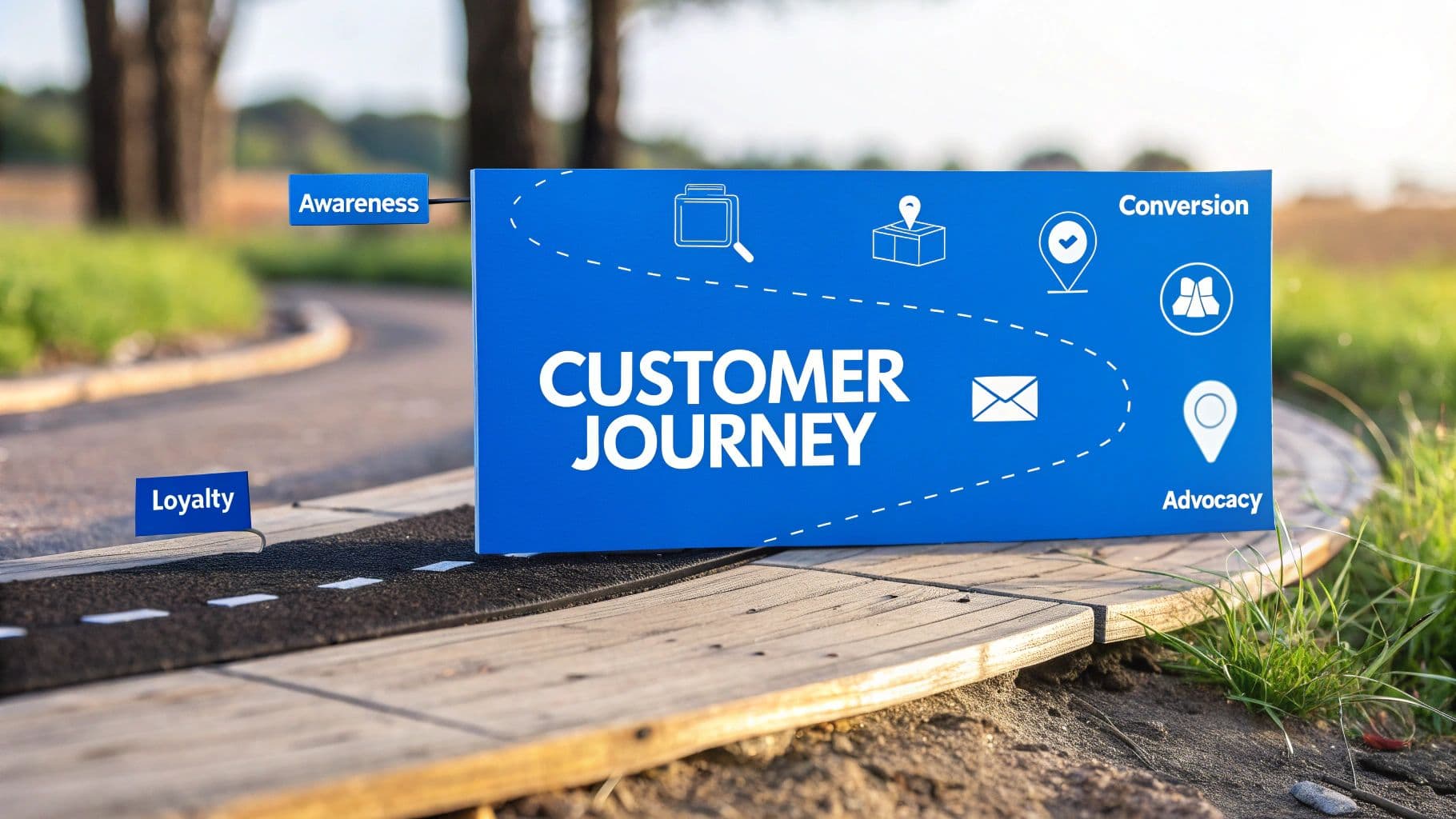
Typically, this journey unfolds across five key stages: Awareness, Consideration, Conversion, Loyalty, and Advocacy. It all starts at the Awareness stage, where a potential customer first discovers your brand, often because they’ve just realized they have a problem to solve. Think of someone Googling "better project management tool."
Grabbing their attention here is critical. Research shows 72% of customers expect immediate service from the very first time they interact with a brand.
By visualizing the stages of the customer journey, you transform abstract data into an actionable roadmap. This roadmap reveals not only what customers do, but why they do it, enabling you to optimize every interaction and maximize your marketing ROI.
A Quick Guide to the Five Customer Journey Stages
Before we dive deep into each phase, here’s a high-level look at the five stages, the main goal for each, and a metric you can use to track success. Think of this as your cheat sheet for the journey ahead.
Stage | Primary Goal | Key KPI Examples |
|---|---|---|
Awareness | Introduce your brand to potential customers and make them problem-aware. | Website Traffic, Ad Impressions, Social Media Reach |
Consideration | Position your solution as the best choice by educating and building trust. | Lead Magnet Downloads, Webinar Sign-ups, Demo Requests |
Conversion | Guide the customer to take a desired action, such as making a purchase. | Conversion Rate, Cost Per Acquisition (CPA), Sales |
Loyalty | Nurture the customer relationship to encourage repeat business and satisfaction. | Customer Lifetime Value (LTV), Repeat Purchase Rate |
Advocacy | Turn satisfied customers into brand evangelists who promote your business. | Net Promoter Score (NPS), Number of Referrals, Reviews |
Understanding these stages is the first step toward building a marketing engine that doesn't just attract visitors, but creates loyal customers who stick around. Now, let's break down what really happens at each step.
Navigating the Awareness and Consideration Stages
In the real world, the lines between discovering a brand and seriously evaluating it have completely blurred. One moment, a potential customer is scrolling through Instagram; the next, they’re on your website comparing pricing plans. It’s no longer a neat, two-step process.
This is why it's far more effective to view the Awareness and Consideration stages not as separate boxes to check, but as one fluid phase of discovery and evaluation. This is where the relationship starts. A person realizes they have a problem and immediately begins looking for solutions—often at the exact same time. Your brand’s first impression happens right here.
Imagine a marketing manager at a growing SaaS company. They might see your project management tool in a LinkedIn ad. They're intrigued and click through. That’s the Awareness touchpoint. The second they land on your page, they're already in Consideration mode—scanning features, watching a demo, and looking for social proof.
The Critical Touchpoints of Discovery and Evaluation
During this initial phase, your potential customers are like information sponges. They’re actively gathering data to build a mental shortlist of options, and your job is to give them the right information, right when they need it, on the channels they’re already using.
Key touchpoints in this phase often include:
- Paid Social Ads: Grabbing attention on platforms like Facebook, Instagram, or LinkedIn with compelling visuals and a clear message.
- Organic Search: Answering a direct question or solving a problem through a high-quality blog post or a well-optimized landing page that shows up on Google.
- Content Marketing: Offering real value upfront through downloadable guides, insightful webinars, or detailed case studies that build your authority.
- Review Sites and Forums: Prospects looking for unbiased opinions on platforms like G2, Capterra, or even Reddit.
- Website Exploration: Potential customers diving deep into your product pages, pricing, and "About Us" section to figure out who you are and what you offer.
Think about a DTC brand selling sustainable activewear. They might capture Awareness with an influencer's Instagram story. Someone sees it, clicks the link, and immediately enters the Consideration stage. They browse product collections, read on-site reviews, and maybe even search for YouTube reviews of the brand before making a choice. Both stages happened in a matter of minutes.
We cover this in more depth in our guide to AI UGC vs real UGC.
Identifying and Removing Friction
The biggest risk in this phase is friction. A confusing website, a slow-loading page, or a lack of clear social proof can kill a promising journey before it even gets started. According to Gartner, customers spend only 17% of their buying journey talking to potential vendors. The vast majority of their time is spent doing their own research. If that research process is a pain on your website, they’ll just leave.
Your goal is to make the transition from "Who is this?" to "This might be for me" as seamless as possible. Every broken link, every unanswered question, and every moment of confusion is an open door for your competitors to walk through.
For marketers, this is where understanding your top-of-funnel channels is absolutely vital. Multi-touch attribution is essential here because it helps you see which initial touchpoints—that first ad click or blog post view—are actually leading to valuable engagement down the road. Without it, you might mistakenly slash the budget for a blog that introduces hundreds of future customers, all because it doesn't get the "last click" before a sale.
Our complete guide on the marketing acquisition funnel digs deeper into how these early stages feed into eventual conversions.
By treating Awareness and Consideration as a single, combined stage, you get a much more realistic picture of the modern customer journey. It’s a fast, non-linear process where brands have to educate, build trust, and prove their value almost instantly. Successfully navigating this phase means providing clear, accessible, and persuasive information that guides a prospect from initial curiosity to genuine interest—without any roadblocks getting in their way.
Optimizing the Path to Conversion
After a prospect discovers your brand and weighs their options, they land at the most crucial stage of the customer journey: Conversion. This is the moment of truth, where all that hard work building interest needs to turn into decisive action. But don't make the mistake of thinking conversion is just the final sale—that’s a narrow view.
A "conversion" is really any high-value action that pulls a lead deeper into your world. For a SaaS company, that might be booking a demo or kicking off a free trial. For a DTC brand, it could be adding an item to their cart or signing up for a newsletter to snag a discount. Each of these is a strong signal of intent.
The name of the game here is creating a frictionless experience. Any hiccup, no matter how tiny, can be enough to make someone bail. Even a few seconds of extra loading time can kill your momentum; studies show a 1-second delay in page load time can torpedo conversions by 7%.
 Mapping the Stages of the Customer Journey to Drive Growth
Identifying and Removing Conversion Roadblocks
A smooth path to conversion is part technical, part psychological. You have to build trust while making the whole process feel completely effortless. Unfortunately, many businesses accidentally put up roadblocks that stop customers dead in their tracks.
Common conversion killers include:
- A Complicated Checkout Process: Too many fields, surprise shipping costs, or forcing account creation will send potential buyers running for the hills.
- Slow Page Speeds: If your checkout page or demo form feels like it's loading on dial-up, you're losing money with every tick of the clock.
- Lack of Trust Signals: Not showing off security badges, customer reviews, or clear return policies creates hesitation right when you need confidence.
- Poor Mobile Experience: With more than half of all web traffic coming from mobile, a clunky interface on a phone is a surefire way to lose sales.
Optimizing this stage means going through every single step a user takes and asking, "How can we make this simpler?" For a deeper look at specific tactics, check out these proven conversion optimization strategies to help clear the path for your customers.
The Critical Role of Accurate Attribution
This is where so many marketing teams drop the ball. They manage to get a customer to convert, but they have no reliable data telling them what actually drove that conversion. Was it the first Facebook ad they saw last month? The blog post they read last week? Or the retargeting ad they clicked yesterday?
Traditional tracking methods, like client-side browser pixels, are notoriously unreliable. They get zapped by ad blockers or wiped out by browser privacy updates (like iOS 14+), leaving you with a messy, incomplete picture. This means the conversion data you're feeding back to ad platforms is fundamentally flawed.
When ad platforms get incomplete data, their algorithms can't effectively find more people like your best customers. You end up wasting money targeting the wrong audiences, all because of poor tracking at the most important stage of the journey.
This is exactly why server-side tracking is so essential. Instead of depending on the user's browser, server-side tracking sends conversion data directly from your server to the ad platform. It's a far more robust method that captures nearly 100% of conversion events with precision.
When you have a complete and accurate picture of what drives conversions, you can feed ad platform algorithms the high-quality data they need to perform at their peak. This leads to smarter targeting, a lower cost per acquisition, and a much higher return on your ad spend—turning the conversion stage into a predictable growth engine.
If you're evaluating vendors, our UGC ads breakdown can help.
Building Lasting Loyalty and Advocacy
So many marketers make the mistake of treating the conversion as the finish line. In reality, the purchase is just the beginning of what should be the most profitable part of the entire customer journey. All the hard work you put into awareness and consideration leads to this moment, but the real value gets unlocked in the Loyalty and Advocacy stages.
Think of it like this: acquiring a new customer is like convincing a stranger to go on a first date. Getting them to stick around and become a true partner requires a completely different skillset—it's about nurturing, listening, and consistently delivering on your promises. This is where you turn one-time buyers into repeat customers and, eventually, into your most vocal brand evangelists.
From First Purchase to Lasting Loyalty
The journey from a new customer to a loyal one kicks off the second they convert. That first post-purchase experience, often called onboarding, is absolutely critical. It’s your chance to validate their decision and show them exactly how to get the most out of your product or service, as fast as possible.
Poor onboarding is a loyalty killer. For SaaS companies, it can cause 40-60% of users to churn within the first 90 days. On the flip side, effective onboarding programs can boost retention by a staggering 82%—a powerful testament to starting the relationship off on the right foot.
Proven strategies for building loyalty include:
- Personalized Email Campaigns: Go beyond the generic "thank you." Send targeted emails with tips, advanced feature showcases, or content that’s actually relevant to how they're using your product.
- Exclusive Rewards Programs: Offer points, discounts, or early access to new products. This incentivizes repeat purchases and makes customers feel like they're part of an exclusive club.
- Proactive Customer Support: Don’t just wait for problems. Use your data to spot customers who might be struggling and reach out with helpful resources or a quick support check-in.
If you want to explore new frontiers in customer engagement, you can also dig into practical strategies for mastering Web3 loyalty programs, which are completely redefining what it means to build a loyal community.
Turning Happy Customers into Powerful Advocates
Once you’ve built a solid foundation of loyalty, you reach the final stage: Advocacy. This is where your best customers become an extension of your marketing team, promoting your brand voluntarily simply because they believe in what you do. An advocate is infinitely more credible than any ad because their recommendation is built on a genuine, positive experience.
Advocacy is the ultimate ROI of a great customer experience. It’s the organic, high-trust marketing that you can’t buy, but you can absolutely earn. A single recommendation from a trusted peer can be more persuasive than an entire marketing campaign.
So how do you activate this powerful final stage? The key is to make it easy and rewarding for customers to share their love for your brand.
Key tactics to encourage advocacy include:
- Referral Programs: Create a simple, compelling program that rewards both the referrer and the new customer. Dropbox famously grew 3900% in 15 months with a simple two-sided referral system that did just that.
- User-Generated Content (UGC) Campaigns: Encourage customers to share photos or videos of them using your product on social media. Feature their content on your official channels to build community and powerful social proof.
- Requesting Reviews and Testimonials: After a positive interaction or a repeat purchase, automate a request for a review on a relevant platform. Make it as frictionless as possible by giving them a direct link.
Tying It All Back to Attribution
These post-purchase activities aren't just about creating good vibes; they have a direct, measurable impact on your bottom line. Every repeat purchase, referral, and positive review increases a customer's Lifetime Value (LTV).
This is where attribution comes full circle. By tracking LTV and connecting it back to the original acquisition channels, you can finally see which ads or campaigns are bringing in your most valuable, long-term customers—not just the ones who make a single purchase. This data is pure gold. It allows you to refine your future ad spend, focusing on acquiring more customers who look just like your best ones.
For a deeper dive into this space, see our guide to AI UGC ads.
If you want to master this, we have a complete guide that breaks down the process of customer lifetime value analysis and how to apply it to your marketing. Ultimately, a successful journey doesn't just end with a sale; it creates a profitable, self-sustaining loop of loyalty and advocacy.
How to Measure and Improve Your Customer Journey
Understanding the customer journey is a great first step, but the real growth happens when you start measuring and improving it. This is your playbook for building a data-driven strategy that ties every click, interaction, and conversion back to your bottom line. It’s time to move beyond guesswork and start making decisions with confidence.
It all begins with a solid tracking foundation. This means getting your tracking pixels and, more importantly, server-side tags in place to capture every interaction. From there, you can connect your ad platform data directly with your CRM, creating a single source of truth that follows a customer from their very first ad click to their most recent purchase.
Setting Up Your Tracking Foundation
The first order of business is making sure you’re capturing data accurately. Traditional client-side pixels, which run in a user's browser, are getting less and less reliable thanks to ad blockers and privacy updates from companies like Apple. This is where server-side tracking becomes a non-negotiable.
By sending data directly from your server to platforms like Facebook or Google, you neatly sidestep browser-based interruptions. This helps ensure that nearly 100% of your conversion data is actually captured, giving ad platform algorithms the high-quality fuel they need to find more of your ideal customers.
Once your tracking is rock-solid, the next move is to sync your ad platform data with your CRM. This connection is crucial because it allows you to see the full story—not just who converted, but which campaigns brought in the customers with the highest lifetime value.
Demystifying Attribution Models
With your data flowing in, you have to decide how to give credit for each conversion. This is where attribution models come into play, and the right one really depends on your business goals. Each model offers a different lens through which to view the touchpoints that influenced a customer's decision.
There are three common models to consider:
- First-Touch Attribution: This model gives 100% of the credit to the very first interaction a customer had with your brand. It’s incredibly useful for figuring out which top-of-funnel channels are champs at generating initial awareness.
- Last-Touch Attribution: Here, the final touchpoint right before the conversion gets all the glory. It’s simple to set up but often overvalues bottom-of-funnel channels like branded search or retargeting ads, ignoring everything that came before.
- Multi-Touch Attribution: This approach is much more balanced, spreading credit across multiple touchpoints in the journey. Models like linear, time-decay, or U-shaped provide a more holistic view of how different channels work together to land a conversion.
Modern customer journey mapping has moved far beyond these simple, linear funnels. Today’s strategies have to account for customer emotions, pain points, and critical KPIs along the entire path. And it's not just a "nice-to-have"—with 73% of customers saying that customer experience directly influences their purchasing decisions, mapping and accurately attributing every stage is essential.
Visualizing the Complete Customer Journey
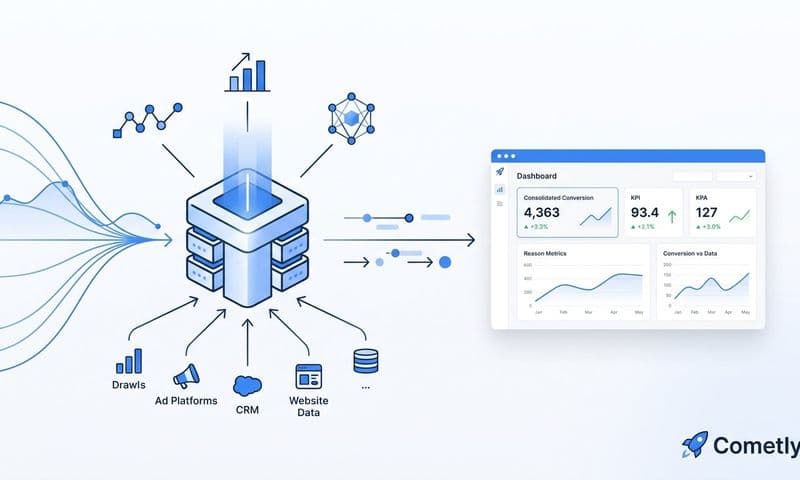
Bringing all this data together can feel like trying to drink from a firehose. That’s why a centralized dashboard is such a game-changer. It transforms all those complex data streams into clear, actionable insights, letting you see the entire path to purchase at a glance.
By consolidating key metrics like ad spend, conversions, and ROAS in one place, you can instantly spot your most profitable customer paths and make smarter decisions about where to put your budget.
A unified dashboard is your command center. It helps you stop wasting money on underperforming channels and double down on the campaigns that are actually driving profitable growth, giving you a true picture of your marketing ROI.
Platforms like Cometly are designed to make this entire process painless. They provide the tools to not only track every stage with precision but also to analyze and act on the data you collect. For a complete overview of the tools and techniques involved, you can learn more about customer journey analytics and how to put them to work.
This is how a customer moves from their first purchase to becoming a true brand advocate:
 Mapping the Stages of the Customer Journey to Drive Growth
The journey doesn't just stop at the sale. It moves through a structured onboarding process, is nurtured into loyalty, and finally blossoms into active advocacy. By taking a data-driven approach, you can optimize each of these stages, turning measurement into a powerful engine for improvement and sustainable growth.
Got Questions? We’ve Got Answers.
When you start digging into the customer journey, a lot of questions pop up. It’s a complex topic, and frankly, the old marketing playbooks don’t always apply anymore. Here are some of the most common questions we hear from marketers trying to map, measure, and make sense of the modern path to purchase.
What’s the Difference Between a Customer Journey and a Sales Funnel?
Great question. Think of a sales funnel as a one-way street. It’s a simple, linear model where you expect everyone to start at the top and move straight to the bottom. But we all know customers don't behave that way.
The customer journey is more like a dynamic city map. People take detours. They make U-turns, stop for coffee, and visit multiple places before reaching their final destination. The journey accounts for this messy, non-linear reality.
While a funnel is laser-focused on getting the sale, the journey considers the entire experience—including what happens after the purchase, like loyalty and telling their friends about you. It’s a much more realistic, customer-first way of looking at things.
Why Is Multi-Touch Attribution So Important?
Relying on last-touch attribution is like giving all the credit for a Super Bowl win to the player who scored the final touchdown. You're completely ignoring the quarterback's perfect pass, the offensive line's blocking, and every other play that got them down the field.
Multi-touch attribution gives you the full story. It assigns value to the different touchpoints that influenced a customer along their path, from the very first blog post they read to the final retargeting ad they clicked.
This holistic view stops you from making costly mistakes, like cutting the budget for your top-of-funnel campaigns because they don't look like they're closing deals. In reality, they're the ones bringing new people to the game in the first place.
How Do I Start Mapping My Customer Journey?
This doesn't have to be some massive, overwhelming project. The key is to start small. Pick a single customer segment or persona and focus on their experience first.
- Dig for Data: Start by gathering what you already have. Look at your analytics, send out a few customer surveys, and—this is a big one—talk to your sales and support teams. They’re on the front lines and know the common paths and pain points better than anyone.
- Outline the Core Stages: Sketch out the main phases for your business. Most companies use something like Awareness, Consideration, Conversion, Loyalty, and Advocacy.
- List the Touchpoints: For each stage, brainstorm all the ways a customer might interact with you. In the Awareness stage, this could be anything from a social media ad or a podcast mention to finding you through a Google search.
- Draw it Out: Create a simple visual of the journey. A flowchart works great. Map out the customer's actions, but also try to capture their thoughts and feelings at each step.
This map isn’t just a document to file away; it becomes your strategic guide for spotting friction and finding opportunities to make the journey smoother.
How Do Different Journey Stages Impact ROI?
Every single stage is a chance to either make or lose money. The data is pretty clear on this. Unifying your touchpoints can lead to 20-40% efficiency gains right off the bat. But drop the ball at any stage, and the whole thing can fall apart.
For example, 72% of customers in the Awareness stage expect an instant response. But since only 40% of brands actually deliver, a whopping 55% of potential customers just leave. During Consideration, if your content isn’t personalized, you can lose 67% of your audience right there. On the flip side, getting multi-channel attribution right can boost progression to the next stage by 28%.
And when it comes to the final conversion, things get even more dramatic. The global e-commerce conversion rate hovers at a tiny 2-5%. But brands that use smart tech like one-click syncs and real-time tracking can see those numbers jump to 10-15%. Find out more about customer experience statistics.
Optimizing each stage has a compounding effect. A small win in moving people from awareness to consideration, plus another small win moving them from consideration to purchase, adds up to massive overall growth. If you ignore one stage, you undermine all the hard work you did in the others.
By understanding the unique challenges at each phase, you can put your resources where they’ll make the biggest impact and build a growth engine that actually lasts.
Stop guessing which ads are driving sales and start knowing. Cometly provides a single source of truth for your marketing attribution, helping you eliminate wasted ad spend and scale your most profitable campaigns with confidence. Get started with Cometly today.