TikTok has become one of the most powerful advertising platforms for reaching engaged audiences, but many marketers struggle to understand which TikTok ads actually drive revenue. The native TikTok Ads Manager provides surface-level metrics like impressions, clicks, and video views, yet these numbers often tell an incomplete story.
Without proper tracking in place, you might scale a campaign that looks great on paper but fails to generate real conversions. Or you might pause an ad that is quietly driving high-value customers through a longer buying journey, simply because last-click attribution gave the credit to another channel.
Here is the reality: TikTok frequently acts as a top-of-funnel or mid-funnel touchpoint. A user sees your ad, gets curious, and converts three days later after a Google search. If your tracking setup does not account for that journey, you are flying blind on one of the most important channels in your media mix.
This guide walks you through the complete process of setting up accurate TikTok ad performance tracking. You will learn how to configure your TikTok pixel, define meaningful conversion events, structure campaigns for clean data, connect your ad spend to real revenue in your CRM, apply multi-touch attribution to see the full picture, and feed better conversion signals back to TikTok so its algorithm can optimize more effectively.
By the end, you will have a tracking system that shows you exactly which TikTok ads produce revenue, not just engagement, so you can allocate budget with confidence and scale what actually works.
Step 1: Install and Configure the TikTok Pixel on Your Website
The TikTok pixel is the foundation of everything. Without it, TikTok cannot connect ad interactions to on-site behavior, and you cannot measure what your campaigns are actually producing. Getting this right from the start saves you from chasing bad data later.
To begin, log in to your TikTok Ads Manager and navigate to the Events section under the Assets menu. From there, select Web Events and create a new pixel. TikTok will generate a unique pixel code snippet that you will deploy on your website.
You have three main options for installation:
Manual code placement: Paste the pixel code directly into the <head> section of your website's HTML. This works well if you have developer access and want full control over when and how the pixel fires.
Google Tag Manager: Use the TikTok Pixel tag template available in GTM to deploy without touching your site's code directly. This is often the fastest route for marketers who already use GTM for other tracking.
Partner integrations: If you are running on Shopify, WooCommerce, or a similar platform, TikTok offers native integrations that simplify the setup considerably.
Once installed, use the TikTok Pixel Helper browser extension to verify that the pixel is firing correctly. Open the extension on your website and confirm it detects the pixel on every key page, including your homepage, product pages, and thank-you confirmation pages. A pixel that only fires on certain pages will produce gaps in your data. To understand more about how pixels work, read our guide on what a tracking pixel is and how it captures user interactions.
Watch out for a few common pitfalls. Duplicate pixel installations can inflate your event counts and skew reporting. Cookie consent banners that block scripts before user acceptance can cause your pixel to miss a significant portion of visitors. And if your site uses a single-page application framework, you may need custom event listeners to ensure the pixel fires on each virtual page view.
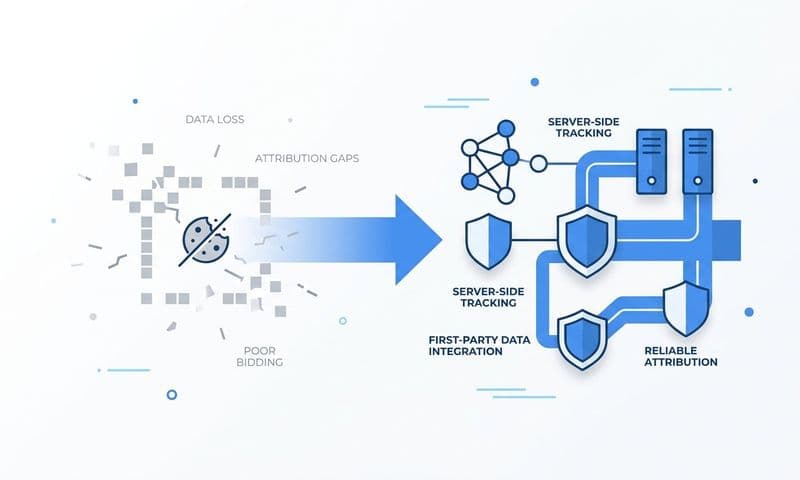
This is also the right moment to consider server-side tracking. Browser-based pixels are increasingly limited by iOS privacy restrictions, ad blockers, and browser-level cookie controls. Server-side tracking sends conversion data directly from your server to TikTok, bypassing these limitations and providing a more complete and reliable data set. Platforms like Cometly support server-side tracking specifically to address these gaps, giving TikTok's algorithm more accurate signals to work with.
Step 2: Define and Map Your Conversion Events
Installing the pixel gets you in the door. Defining the right conversion events is what makes your tracking actually useful. This step is where many marketers underinvest, and it costs them clarity when it is time to optimize.
TikTok supports a set of standard events that cover most common actions: ViewContent, AddToCart, InitiateCheckout, CompletePayment, and others. These are pre-built event types that TikTok's algorithm recognizes and can optimize toward. For most e-commerce and lead generation setups, standard events will cover your core needs.
Custom events let you go further. If you run a SaaS product, you might want to track free trial starts, feature activations, or subscription upgrades. If you run a service business, you might track form submissions, quote requests, or booked calls. Define events that reflect real business value, not just website activity.
When setting up events, always include value and currency parameters for any transaction-related events. Tracking that 50 users completed a purchase is useful. Knowing that those 50 purchases generated a specific total revenue is far more useful, especially when you are comparing campaign efficiency and calculating return on ad spend.
Before launching any campaign, test every event to confirm it fires correctly. TikTok's Events Manager includes a test tool that shows you real-time event data as you navigate your site. Walk through your entire conversion flow, from landing page to confirmation page, and verify that each event triggers at the right moment with the right parameters. If your numbers still seem off, explore common reasons why conversion tracking numbers are wrong.
Think of your events as a map of your full funnel. When you can see where users enter, where they drop off, and where they convert, you gain the ability to identify friction points and prioritize improvements. A well-mapped funnel also helps you understand which TikTok campaigns are moving users through the journey even if they are not generating the final conversion directly.
One practical tip: avoid creating too many custom events early on. Start with the events that matter most to your business goals, get clean data flowing, and expand from there. Cluttered event setups make reporting harder and can confuse TikTok's optimization signals.
Step 3: Structure Your Campaigns for Clean Performance Data
Even with perfect pixel setup and event mapping, messy campaign structure will muddy your data and make optimization guesswork. How you build and name your campaigns directly affects your ability to read performance clearly and act on it.
Start with UTM parameters on every ad URL. UTMs are the tags you append to your landing page URLs that tell your analytics tools exactly where traffic came from. A well-structured UTM for a TikTok campaign might look like this: utm_source=tiktok, utm_medium=paid-social, utm_campaign=spring-sale-2026, utm_content=video-ad-version-a. For a deeper dive into tagging best practices, see our guide on UTM parameter tracking best practices.
Naming conventions matter more than most marketers realize. When you are managing multiple campaigns across audiences, creatives, and objectives, clear naming is what separates a reporting system you can trust from one that requires constant manual interpretation. Build a naming structure that includes the campaign objective, target audience, and creative type. Apply it consistently from day one.
Test one variable at a time. If you change the audience, the creative, and the bid strategy simultaneously, you will not know which change drove the performance shift. Isolate your variables so that when results change, you understand why. This discipline makes your data actionable rather than just interesting.
Pay close attention to your attribution window settings in TikTok Ads Manager. TikTok allows you to configure click-through attribution windows and view-through attribution windows separately. A seven-day click window means TikTok will credit conversions that happen within seven days of someone clicking your ad. A view-through window credits conversions that happen after someone sees but does not click your ad. Understanding what each window captures helps you interpret TikTok's reported numbers accurately and compare them against your own TikTok ads attribution tracking data.
Step 4: Connect TikTok Data to Your CRM and Revenue Sources
Here is where most TikTok tracking setups hit their ceiling. TikTok Ads Manager can tell you how many people clicked your ad and how many completed a tracked event on your website. What it cannot tell you is whether those people became paying customers, how much revenue they generated over time, or how their value compares to customers acquired through other channels.
To answer those questions, you need to connect your TikTok ad data to your CRM and revenue systems. This connection is what transforms ad reporting from a traffic and conversion count into a true revenue attribution model.
If you use a CRM like HubSpot or Salesforce, the goal is to link each contact back to the ad interaction that first brought them in. This means passing UTM parameters and ad identifiers through your landing page forms and into your CRM records. When a lead eventually closes as a customer, you can trace that revenue back to the specific TikTok campaign, ad group, and creative that influenced them. Dedicated lead tracking software can streamline this entire process.
This is where platforms like Cometly provide significant value. Cometly connects your TikTok ad interactions to downstream CRM events and purchases in real time, giving you a complete view of the customer journey from first ad click to closed deal. Instead of seeing a conversion count in TikTok Ads Manager, you see the actual revenue tied to each campaign, broken down by the creative and audience that generated it.
The practical impact of this visibility is substantial. You might discover that one TikTok audience segment generates a high volume of leads but a low close rate, while another segment generates fewer leads but a much higher average deal value. Without CRM integration, both segments look similar in TikTok's native reporting. With it, the difference becomes clear and your budget decisions become sharper.
Connecting ad data to revenue also gives you the ability to calculate true customer acquisition cost and lifetime value by channel. These are the metrics that drive confident scaling decisions, not impressions or click-through rates.
Step 5: Analyze Performance Using Multi-Touch Attribution
If you rely on last-click attribution to evaluate TikTok, you will almost certainly undervalue it. TikTok's strength as a platform is its ability to reach users in a discovery mindset, which means it often introduces people to your brand before they are ready to buy. When they eventually convert through a Google search or a direct visit, last-click attribution gives all the credit to that final touchpoint and TikTok gets nothing.
Multi-touch attribution solves this by distributing credit across every touchpoint in the customer journey, giving you a more accurate picture of how each channel contributes to revenue.
It helps to understand the main attribution models and what each one tells you:
First-touch attribution: Gives all credit to the first interaction a user had with your brand. This highlights TikTok's role in driving awareness and initial discovery.
Last-touch attribution: Gives all credit to the final touchpoint before conversion. This tends to favor direct traffic, branded search, and retargeting channels while undervaluing upper-funnel channels like TikTok.
Linear attribution: Distributes credit equally across all touchpoints in the journey. This is a balanced starting point that prevents any single channel from being over or undervalued.
Data-driven attribution: Uses algorithmic modeling to assign credit based on the actual influence each touchpoint had on the conversion outcome. This is the most sophisticated model but requires sufficient conversion volume to produce reliable results.
Comparing attribution models side by side is one of the most revealing exercises you can do as a marketer. When you see how TikTok's attributed revenue changes across models, you start to understand its true role in your buyer journey rather than the role a single model assigns it. Learning to track ad performance across channels is essential for this kind of cross-platform analysis.
Cometly's multi-touch attribution shows you how TikTok ads interact with Google, Meta, and other channels within the same customer journey. You can see which TikTok campaigns consistently appear as early touchpoints for customers who eventually convert through other channels. These assisted conversions represent real value that would be invisible in TikTok's native reporting or in a last-click model.
This perspective changes how you make budget decisions. Instead of cutting TikTok because it does not show strong last-click conversions, you can see its contribution to the full funnel and allocate accordingly.
Step 6: Optimize Campaigns by Feeding Better Data Back to TikTok
Tracking performance is only half the equation. The other half is using what you learn to improve TikTok's ability to find and convert the right people. This is where conversion syncing comes in, and it is one of the most underutilized levers available to TikTok advertisers.
TikTok's algorithm optimizes based on the conversion signals it receives. If it only receives website pixel events, it is working with incomplete information. It knows someone clicked an ad and visited your site, but it may not know whether that person became a paying customer, what they spent, or how valuable they turned out to be over time.
Conversion syncing addresses this by sending enriched, verified conversion events from your CRM or attribution platform back to TikTok. Instead of TikTok seeing a generic "CompletePayment" event, it receives a confirmed purchase with revenue data attached, matched to the specific user who converted. This gives TikTok's optimization engine a much clearer signal about what a valuable customer looks like. Improving TikTok ads tracking accuracy at this stage directly impacts how well the algorithm performs.
The practical effect is that TikTok can find more people who resemble your actual paying customers, rather than optimizing toward users who complete surface-level pixel events but never convert to revenue. Over time, this typically results in better audience targeting, more efficient spend, and lower cost per acquisition.
Cometly's Conversion Sync feeds real revenue data back to TikTok automatically. When a lead closes in your CRM or a purchase is confirmed in your revenue system, that event flows back to TikTok with the enriched data TikTok needs to optimize more effectively. You are essentially teaching TikTok's algorithm what your best customers look like, using real outcomes rather than proxy metrics.
To keep your optimization loop running effectively, review performance on a weekly cadence. Look at true return on ad spend based on actual revenue, not platform-reported conversions. Identify which campaigns are producing the highest quality customers and shift budget toward them. Flag campaigns where the cost per acquisition looks acceptable in TikTok Ads Manager but does not hold up when you check against CRM revenue data. This gap between platform-reported metrics and actual revenue is where budget leaks happen, and understanding tracking ROI for performance marketing helps you catch it early and make a meaningful difference in your overall marketing efficiency.
Your TikTok Tracking Checklist and Next Steps
Setting up accurate TikTok ad performance tracking is not a one-time task. It is a system you build, verify, and refine over time. Here is a quick-reference summary of everything covered in this guide:
Pixel installed and verified: Your TikTok pixel is live on all key pages, confirmed with the Pixel Helper extension, and ideally supplemented with server-side tracking for more reliable data capture.
Conversion events mapped and tested: You have defined events that reflect real business value, configured revenue parameters where applicable, and tested each event fires correctly through your full conversion flow.
Campaigns structured with clean UTMs and naming conventions: Every ad URL includes consistent UTM parameters, your campaigns follow a clear naming structure, and you are testing one variable at a time to generate actionable insights.
CRM connected for revenue tracking: TikTok ad interactions are linked to your CRM so you can trace leads to closed revenue and calculate true customer acquisition cost by campaign.
Multi-touch attribution enabled: You are using a multi-touch attribution model to see TikTok's full contribution across the customer journey, including assisted conversions that last-click reporting would miss.
Conversion data synced back to TikTok: Enriched revenue events are flowing back to TikTok so its algorithm can optimize toward your actual best customers rather than surface-level pixel signals.
Audit this checklist monthly. Tracking setups drift over time as websites change, campaigns evolve, and new channels are added. Regular audits catch gaps before they distort your data and your decisions.
If you are ready to bring all of this together in one place, Cometly connects your TikTok data with every other ad channel you run, giving you a single source of truth for attribution, revenue tracking, and optimization. Get your free demo today and start capturing every touchpoint to maximize your conversions.