

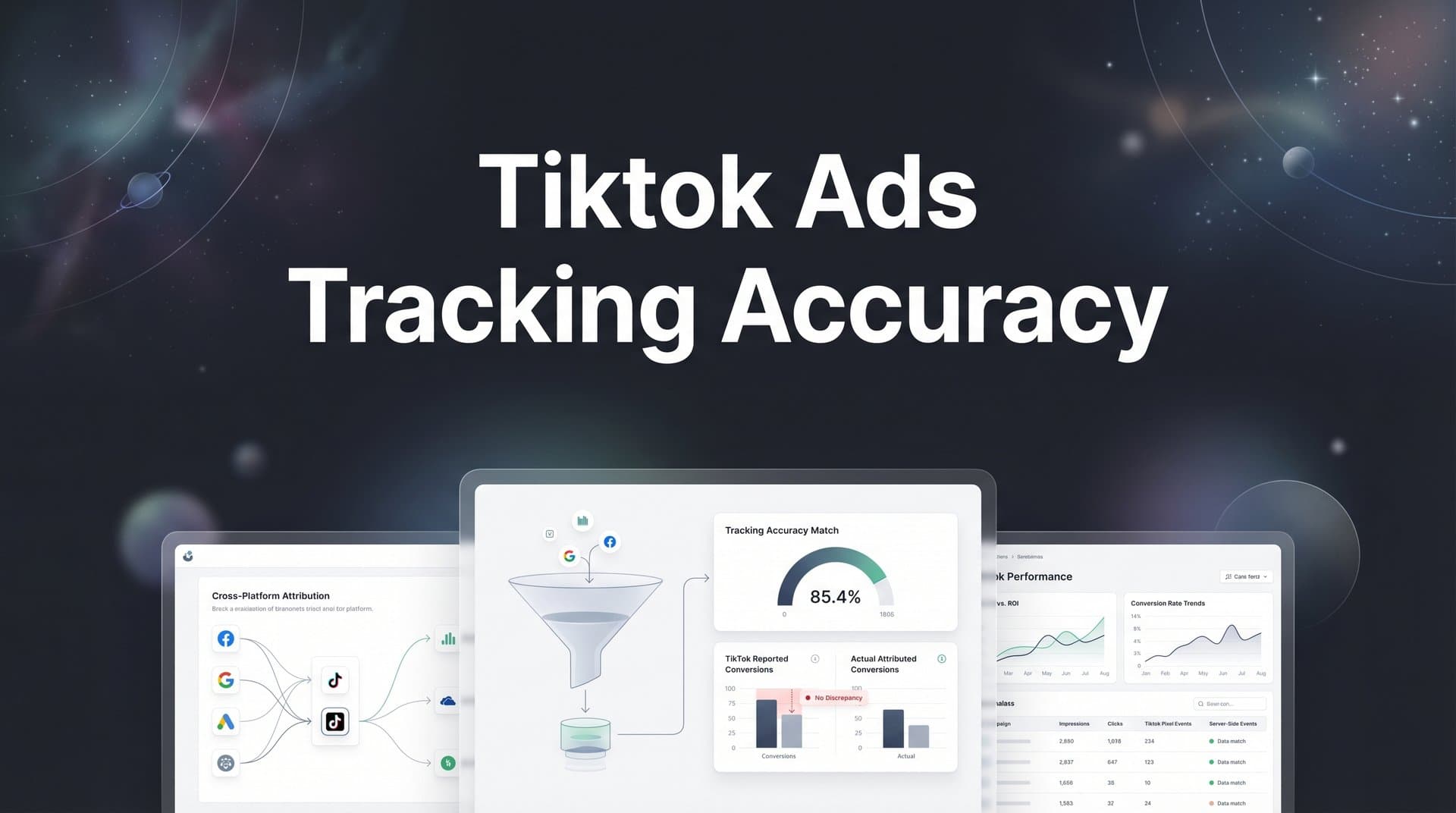
You check your TikTok Ads Manager and see 50 conversions from yesterday's campaign. Feeling confident, you pull up your CRM to review the new leads. Twenty. Twenty actual leads. Your stomach sinks as you realize the numbers don't match—again.
This isn't a rare glitch. It's the daily reality for marketers running TikTok campaigns. The platform reports one set of numbers while your actual business results tell a completely different story. You're making budget decisions based on inflated data, scaling campaigns that might not actually perform, and struggling to prove ROI to stakeholders who only care about real revenue.
The tracking accuracy gap on TikTok isn't just frustrating. It's actively costing you money and credibility. When you can't trust your data, every optimization decision becomes a guess. Every budget increase feels risky. Every campaign report comes with an asterisk.
This guide breaks down exactly why TikTok's tracking falls short, what's happening behind the scenes with your conversion data, and most importantly, how to fix it. You'll learn the technical realities of TikTok attribution, the infrastructure changes that dramatically improve accuracy, and the systems that let you finally trust your marketing data.
The Hidden Gap Between TikTok Reports and Real Results
TikTok's native attribution model operates like most advertising platforms: it uses a pixel-based tracking system that fires when users take actions on your website. When someone clicks your ad and converts, TikTok's pixel sends a signal back to the platform claiming credit for that conversion.
Sounds straightforward. But here's where it breaks down.
TikTok's pixel lives in the browser—the same browser that's increasingly hostile to tracking technologies. Every time a user blocks cookies, uses a privacy-focused browser, or has tracking prevention enabled, that pixel loses its ability to see what's happening. The conversion still occurs in your business, but TikTok's tracking infrastructure never receives the signal. Understanding pixel tracking accuracy issues is essential for diagnosing these problems.
The iOS privacy changes that started with iOS 14.5 fundamentally altered how tracking works on mobile devices. Users now actively choose whether to allow apps to track their activity. Most choose not to. When TikTok users browse your website through Safari or any iOS browser with default privacy settings enabled, the pixel tracking becomes unreliable at best, completely blind at worst.
Then there's the attribution model itself. TikTok defaults to a 7-day click and 1-day view attribution window. This means if someone saw your ad in the past day without clicking, then converted, TikTok takes credit. If they clicked your ad anytime in the past week and eventually converted, TikTok takes credit.
This creates a massive inflation problem. Picture this scenario: A user sees your TikTok ad on Monday morning during their commute. They don't click. Tuesday evening, they search for your product on Google, click a search ad, and purchase. TikTok claims that conversion because the user saw the ad within the 1-day view window. Google Ads also claims it because they clicked the search ad. Your analytics show one sale. Your ad platforms show two conversions.
Multiply this across hundreds of conversions and multiple marketing channels, and you end up with conversion counts that bear little resemblance to reality. The view-through attribution model is particularly problematic because it counts passive ad exposure as a meaningful touchpoint, even when users had no intention of engaging with your brand at that moment.
Many businesses discover their TikTok conversion counts are 40-60% higher than actual sales. Some see even wider gaps. The platform isn't lying—it's using an attribution methodology that overcounts conversions based on loose correlation rather than clear causation.
Three Core Reasons Your TikTok Tracking Fails
The first culprit is signal loss, and it's more severe than most marketers realize. Ad blockers now run on roughly 30% of desktop browsers and a growing percentage of mobile devices. When an ad blocker is active, TikTok's pixel never loads. The user could complete a purchase, become a paying customer, and TikTok would have zero visibility into that conversion.
Cookie restrictions compound the problem. Safari's Intelligent Tracking Prevention and Firefox's Enhanced Tracking Protection actively delete third-party cookies and limit first-party cookie lifespans. Chrome is moving in the same direction. When cookies get deleted or restricted, the tracking chain breaks. TikTok can't connect the ad click to the conversion event because the cookie that would have maintained that connection no longer exists. This is why first-party data tracking for ads has become increasingly important.
Cross-device journeys create another blind spot. Users scroll TikTok on their phones during downtime but often convert on desktop when they're ready to make a serious purchase. Without sophisticated cross-device tracking infrastructure, TikTok sees the mobile ad interaction but misses the desktop conversion entirely. The sale happens, but the attribution never connects back to the original touchpoint.
The second major issue is attribution window mismatches. TikTok's default 7-day click window works fine for impulse purchases and low-consideration products. It completely fails for longer sales cycles.
If you're selling enterprise software, high-ticket coaching, or complex services, your sales cycle might span weeks or months. A potential customer sees your TikTok ad, visits your website to learn more, joins your email list, consumes your content over several weeks, and finally books a sales call. By the time they convert, the 7-day attribution window has long expired. TikTok played a role in that sale, but the platform's tracking shows zero conversions.
You can extend TikTok's attribution window to 28 days, but that creates a different problem. Longer windows increase the likelihood of false attribution—crediting TikTok for conversions that would have happened anyway through other channels. There's no perfect window length because every business has different customer journeys.
The third reason is TikTok's increasing reliance on data modeling and estimation. When deterministic tracking fails—when the platform can't directly observe the conversion—it uses probabilistic models to estimate what probably happened. These models analyze patterns, user behaviors, and aggregate data to make educated guesses about conversion counts.
Modeling isn't inherently bad. It's necessary given privacy restrictions. But it introduces uncertainty into your data. The conversions TikTok reports might be statistically accurate in aggregate, but they're not precise at the individual campaign or ad set level where you're making optimization decisions.
Server-Side Tracking: The Foundation of Accurate Data
Server-side tracking fundamentally changes how conversion data reaches TikTok. Instead of relying on browser pixels that can be blocked, deleted, or restricted, you send conversion events directly from your server to TikTok's servers. No browser involvement. No cookie dependencies. No signal loss from ad blockers.
Here's how it works in practice. When a user converts on your website, your backend system records that conversion in your database. Your server then sends an event notification to TikTok's Events API, including details like the conversion value, timestamp, and user identifiers. This happens server-to-server, completely independent of what's happening in the user's browser. Learn more about implementing server-side tracking for ads to overcome browser limitations.
The accuracy improvement is dramatic. Server-side tracking captures conversions that browser pixels miss entirely. Users with ad blockers? Tracked. Users who cleared their cookies? Tracked. Users who converted days later on a different device? Tracked, as long as you can match them through email, phone number, or customer ID.
Setting up TikTok's Events API requires technical implementation, but the core concept is straightforward. You need to generate an access token from TikTok's Events Manager, set up your server to send properly formatted event data, and ensure you're passing the right user identifiers to maintain attribution connections.
The events you send should mirror your most valuable business outcomes. For e-commerce, that means purchase events with actual revenue values. For lead generation, that means form submissions and qualified lead events. For SaaS, that means trial starts, demo bookings, and paid conversions. Send the events that matter to your business, not just the events that are easy to track.
User matching is critical for server-side tracking accuracy. TikTok needs to connect the server-side conversion event back to the original ad interaction. You do this by passing hashed user identifiers—email addresses, phone numbers, or TikTok click IDs—with your conversion events. The more identifiers you include, the higher your match rate and attribution accuracy.
The real power emerges when you connect your CRM and backend systems into this tracking loop. When a lead converts in your CRM weeks after the initial TikTok interaction, your system can still send that conversion event back to TikTok with the proper attribution. This solves the attribution window problem by allowing you to track conversions across your entire sales cycle, not just TikTok's arbitrary time limits.
Building a Multi-Touch Attribution System for TikTok
Single-touch attribution treats every marketing channel as if it operates in isolation. Last-click attribution gives all credit to the final touchpoint before conversion. First-click attribution credits the initial discovery moment. Both approaches distort reality because customer journeys involve multiple touchpoints across different channels.
A user might discover your brand through a TikTok ad, research your competitors through Google searches, see your retargeting ads on Facebook, read your email nurture sequence, and finally convert after clicking a promotional email. Which channel deserves credit for that sale? All of them played a role. Single-touch models either overstate or understate TikTok's actual contribution. This is why understanding attribution marketing tracking is crucial for accurate measurement.
TikTok often serves as a top-of-funnel awareness channel. Users see your ads while scrolling for entertainment, not actively shopping. They might not convert immediately, but the exposure plants a seed. When they later search for solutions to their problem, they remember your brand. TikTok initiated the journey, but a single-touch model would credit the search click or email that closed the deal.
Multi-touch attribution distributes credit across all touchpoints in the customer journey. Different models weight touchpoints differently—linear attribution splits credit equally, time-decay gives more weight to recent interactions, position-based emphasizes first and last touch. The specific model matters less than acknowledging that multiple channels contribute to conversions.
Implementing multi-touch attribution requires connecting TikTok data with your other marketing channels. You need a system that tracks users across touchpoints, maintains their journey history, and applies attribution logic to assign fractional credit. This can't happen inside TikTok's platform alone because TikTok only sees its own touchpoints.
Attribution platforms aggregate data from all your marketing channels, website analytics, and CRM systems. They build complete customer journey maps showing every touchpoint from initial awareness through final conversion. When you view TikTok's performance through this lens, you see its true contribution rather than the inflated numbers from platform-reported conversions. Explore attribution tracking for multiple campaigns to understand how this works across your marketing mix.
This approach reveals insights that transform how you optimize campaigns. You might discover that TikTok ads don't drive many last-click conversions, but they significantly increase conversion rates on your other channels. Users who see TikTok ads convert at higher rates from email, search, and retargeting. That influence wouldn't show up in TikTok's native reporting, but it's valuable and worth investing in.
Reconciling TikTok reports with actual revenue becomes straightforward when you have independent attribution. You trust your attribution platform's revenue numbers because they're based on real sales data from your CRM and payment systems. TikTok's reported conversions become a directional metric rather than the source of truth. You use them to spot trends and compare relative performance between campaigns, while relying on your attribution system for accurate ROI calculations.
Feeding Better Data Back to TikTok's Algorithm
TikTok's optimization algorithm makes decisions based on the conversion data it receives. When you feed it accurate, enriched conversion events, the algorithm learns faster and targets more effectively. When you feed it incomplete or inflated data, it optimizes toward the wrong signals.
Think about what happens with basic pixel tracking. TikTok sees conversion events but knows little about conversion quality. It can't distinguish between a $50 purchase and a $5,000 purchase unless you send revenue values. It doesn't know which leads are qualified versus which bounced immediately. The algorithm treats all conversions as equally valuable and optimizes accordingly.
Enriched conversion data changes this dynamic entirely. When you send actual revenue values with purchase events, TikTok can optimize for high-value customers rather than just conversion volume. When you send qualified lead events from your CRM instead of raw form submissions, TikTok learns to find users who are more likely to become real opportunities. Discover the best tools for tracking TikTok ads to implement this effectively.
Setting up conversion sync means sending your most valuable conversion events back to TikTok through the Events API. If you're running lead generation campaigns, don't just send form submission events. Send qualified lead events when your sales team validates the lead. Send opportunity created events when leads enter your sales pipeline. Send closed-won events when they become paying customers.
This creates a feedback loop that compounds over time. In the first few days, TikTok's algorithm is learning from basic conversion signals. As you feed it richer data about which users actually drive revenue, the targeting improves. The algorithm identifies patterns in high-value converters and finds more users who match those patterns. Your cost per qualified lead drops. Your conversion rates improve. Your ROAS increases.
The timing of this feedback matters. If you wait weeks to send conversion data back to TikTok, the algorithm can't connect those outcomes to the specific ads and audiences that drove them. Send conversion events as soon as they occur in your business systems. Real-time or near-real-time event transmission keeps the feedback loop tight and the learning cycle fast.
Revenue-based optimization becomes possible when you consistently send accurate value data. Instead of optimizing for conversions at any cost, you can optimize for return on ad spend. TikTok's algorithm will prioritize showing ads to users likely to generate higher revenue, even if they convert at slightly lower rates. This shift from volume to value fundamentally changes campaign performance.
Putting It All Together: Your TikTok Tracking Action Plan
Start by auditing your current tracking setup. Check whether TikTok's pixel is firing correctly on your conversion pages. Verify that you're sending the right events and that conversion values are passing through accurately. Compare your TikTok-reported conversions against your actual sales data for the past 30 days. Calculate the discrepancy percentage to establish your baseline accuracy problem.
Implement server-side tracking as your next priority. Set up TikTok's Events API and configure your backend systems to send conversion events directly. Start with your highest-value conversion events—purchases, qualified leads, or demo bookings. Ensure you're passing hashed user identifiers to maintain attribution connections. Test thoroughly to confirm events are reaching TikTok and matching back to ad interactions. Our guide on how to improve ad tracking accuracy provides detailed implementation steps.
Connect your CRM to your tracking infrastructure. Map out which CRM events should trigger conversion signals back to TikTok. Set up automated workflows that send qualified lead events, opportunity events, and closed-won events as they occur in your sales process. This extends your attribution beyond TikTok's default windows and captures the full value of your campaigns.
Implement a multi-touch attribution system that aggregates data across all your marketing channels. Connect TikTok alongside your other platforms to build complete customer journey visibility. Choose an attribution model that makes sense for your business—linear for awareness campaigns, time-decay for longer sales cycles, or custom models based on your specific funnel dynamics.
Monitor these key metrics to assess tracking health. Match rate shows what percentage of your server-side events TikTok successfully attributes back to ad interactions—aim for 70% or higher. Conversion discrepancy tracks the gap between platform-reported conversions and your actual sales—work to narrow this to within 10-15%. Event delivery rate confirms your server-side events are reaching TikTok without errors—target 95%+ successful delivery.
Know when to trust TikTok data versus when to rely on independent attribution. Use TikTok's reporting for campaign comparisons, creative testing, and audience insights. The platform excels at showing relative performance between different ads and targeting approaches. Rely on your attribution system for absolute performance metrics, ROI calculations, and budget allocation decisions across channels. Understanding tracking paid ads performance helps you make these distinctions effectively.
Review and refine your setup monthly. Attribution isn't a set-it-and-forget-it system. As your campaigns evolve, your tracking needs change. As TikTok updates its platform, your implementation may need adjustments. Regular audits catch issues before they compound into major data problems.
Moving Forward with Confidence
Accurate TikTok tracking isn't a luxury reserved for enterprise advertisers with massive tech teams. It's an achievable goal for any marketer willing to invest in proper infrastructure. The gap between reported conversions and real results doesn't have to be a permanent frustration. With server-side tracking, multi-touch attribution, and enriched conversion data, you can close that gap and finally trust your marketing data.
The marketers who solve the tracking accuracy problem gain a significant competitive advantage. They make smarter optimization decisions because they're working with reliable data. They allocate budgets more effectively because they understand true channel contribution. They scale campaigns confidently because they know which ads actually drive revenue.
Your competitors are likely still relying on inflated platform metrics and making decisions based on incomplete data. That's your opportunity. Build the tracking foundation that gives you clarity while others operate in uncertainty. Connect your marketing touchpoints to actual business outcomes. Feed TikTok's algorithm the quality data it needs to find your best customers.
The infrastructure you build for TikTok tracking accuracy pays dividends across your entire marketing operation. The same server-side tracking, attribution systems, and conversion sync capabilities that fix your TikTok data improve accuracy across every advertising platform. You're not just solving a TikTok problem—you're building a data foundation that transforms how you understand and optimize all your marketing efforts.
Ready to elevate your marketing game with precision and confidence? Discover how Cometly's AI-driven recommendations can transform your ad strategy—Get your free demo today and start capturing every touchpoint to maximize your conversions.


