

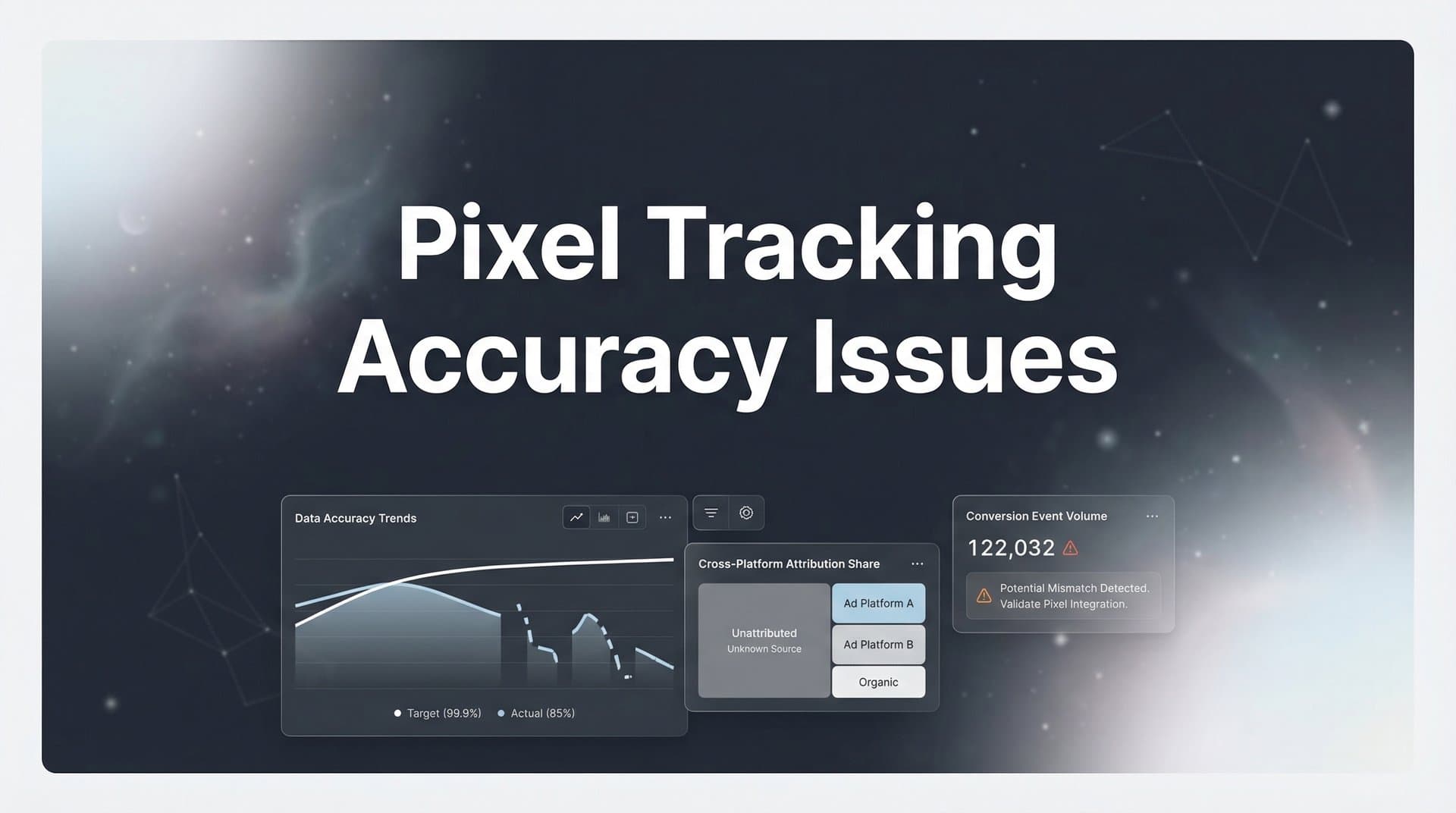
You check your Meta Ads dashboard and see 147 conversions this month. You check your Shopify store and count 98 actual sales. The numbers don't match. Again.
This isn't a minor discrepancy. It's a fundamental breakdown in how you understand your marketing performance. When your pixel tracking data diverges from reality, every decision you make—from budget allocation to campaign optimization—is built on a foundation of inaccurate information.
Pixel tracking accuracy issues have evolved from a technical nuisance into a critical business problem. Browser restrictions, privacy updates, and ad blockers have systematically dismantled the tracking infrastructure that marketers relied on for over a decade. The result? Ad platforms report conversions that never happened, miss conversions that did, and leave you guessing which campaigns actually drive revenue.
This guide breaks down exactly why pixel tracking fails, what it's costing you, and how modern server-side approaches restore the data accuracy you need to scale with confidence.
The Mechanics Behind Pixel Tracking Failures
Browser-based pixels operate through a deceptively simple process. When someone visits your website, a small piece of JavaScript code loads in their browser, sets a cookie to identify them, and sends data back to the ad platform. This happens in milliseconds, assuming everything works perfectly.
But here's the problem: that assumption rarely holds true anymore.
The entire pixel tracking system depends on a chain of events executing flawlessly. The JavaScript must load completely. The browser must allow cookie storage. The network request to the ad platform must complete successfully. If any single link in this chain breaks, the conversion data disappears into the void.
The Cookie Dependency Problem: Pixels rely on cookies to connect a user's ad click to their later conversion. Without that cookie, the ad platform has no way to attribute the sale back to your campaign. When browsers restrict cookie lifespans or block them entirely, this connection breaks. Understanding pixel tracking cookie limitations is essential for diagnosing these failures.
The JavaScript Execution Gap: Pixels need JavaScript to run. Users with JavaScript disabled, browsers with strict security settings, or pages that load slowly can prevent pixel code from executing. No execution means no data captured.
The Network Request Vulnerability: Even when the pixel code runs, it must successfully send data to the ad platform's servers. Network interruptions, server timeouts, or browser extensions that block tracking requests can prevent this final step.
The cascade effect makes this worse. Imagine a customer journey: Sarah clicks your Facebook ad, visits your site but doesn't buy. Three days later, she returns directly and makes a purchase. Your pixel needs to connect both visits to attribute the conversion correctly. But if Safari deleted the cookie after 24 hours, that connection is lost. Facebook never sees the conversion, your data shows the ad failed, and you might pause a campaign that's actually working.
This isn't hypothetical. Many businesses discover their pixel is capturing only 60-70% of actual conversions, and that percentage continues declining as privacy protections expand.
Privacy Changes That Broke Traditional Tracking
The tracking landscape fundamentally changed on April 26, 2021, when Apple released iOS 14.5 with App Tracking Transparency. This update required apps to ask users for permission before tracking them across other apps and websites. The result? Approximately 75-80% of iOS users opted out of tracking.
For marketers running Facebook and Instagram ads, this created immediate data blindness. The Meta pixel could no longer track iOS users who opted out, which meant conversions from a massive segment of mobile users simply vanished from reporting. Campaigns that appeared profitable suddenly looked like failures because the data supporting their performance disappeared overnight. If you're struggling with this, learn how to fix iOS tracking issues affecting your campaigns.
But iOS changes were just the beginning of a broader privacy shift.
Safari's Intelligent Tracking Prevention (ITP): Apple's desktop browser implements aggressive cookie restrictions that limit first-party cookies to just seven days of storage. If a user doesn't return within that window, the tracking connection is lost. For products with longer consideration cycles, this effectively makes attribution impossible through browser pixels alone.
Firefox Enhanced Tracking Protection: Mozilla blocks known tracking scripts and third-party cookies by default. Users don't need to configure anything. The browser simply prevents many pixels from functioning at all. For marketers, this means Firefox users are largely invisible in pixel-based attribution.
Chrome's Cookie Evolution: While Google has delayed the complete deprecation of third-party cookies multiple times, the direction is clear. Chrome continues implementing privacy-focused features that restrict tracking capabilities. The browser that once provided the most permissive tracking environment is steadily closing that door.
Ad blockers compound these browser-level restrictions. Extensions like uBlock Origin, Privacy Badger, and Ghostery prevent pixel scripts from loading entirely. The user visits your site, converts, and your pixel never fires because the ad blocker killed it before execution. These tracking pixel limitations from privacy updates continue expanding each year.
The adoption rate of ad blockers has grown consistently. Desktop users employ them more frequently than mobile users, but mobile ad blocking is increasing as well through browser-level features and VPN services with built-in blocking.
The combined impact of these privacy changes creates a tracking environment where your pixel might capture less than half of actual conversions, depending on your audience demographics and device mix. If your customers skew toward iOS users, privacy-conscious demographics, or tech-savvy audiences likely to use ad blockers, your data accuracy is even worse.
Hidden Costs of Inaccurate Pixel Data
Inaccurate tracking doesn't just create reporting discrepancies. It actively damages your marketing effectiveness in ways that compound over time.
When your pixel shows 100 conversions but you actually had 180 sales, you're not just missing data. You're making budget decisions based on incomplete information. That campaign you paused because it looked unprofitable? It might have been your best performer, but the pixel only captured 40% of its conversions. Meanwhile, the campaign you scaled up could be underperforming, appearing successful only because it happens to target users whose conversions the pixel catches more reliably.
This budget misallocation creates a vicious cycle. You starve effective campaigns of resources while pouring money into underperformers. Your overall marketing efficiency declines, but you can't identify why because your data points you in the wrong direction. Many businesses experience significant lost ad revenue from tracking issues before they even realize the problem exists.
Algorithm Degradation: Modern ad platforms use machine learning to optimize campaign delivery. Facebook's algorithm, Google's Smart Bidding, TikTok's automated targeting—they all learn from the conversion data you send them. When that data is incomplete, the algorithms cannot accurately identify which users are most likely to convert.
Think about how this plays out in practice. Your pixel misses 50% of conversions from iOS users. The algorithm sees that iOS users rarely convert (because it's not receiving the conversion data). It starts showing your ads less frequently to iOS users, assuming they're not valuable. In reality, iOS users might be your highest-value customers, but the algorithm will never know because it's optimizing based on broken data.
The algorithm's performance degrades further over time. Each optimization cycle is based on incomplete information, leading to progressively worse targeting decisions. You might blame the ad platform for poor performance when the real issue is that you're feeding it corrupted data.
Strategic Misalignment: Bad data corrupts long-term planning. When you calculate customer acquisition costs, lifetime value, or channel performance using inaccurate conversion data, every strategic decision built on those calculations is flawed. You might exit channels that are actually profitable, double down on tactics that don't work, or set unrealistic performance expectations based on numbers that don't reflect reality.
The compounding effect is the most dangerous part. Month after month of decisions based on inaccurate data pushes your entire marketing strategy further from optimal performance. By the time you realize the data was wrong, you've potentially wasted months of budget and opportunity.
Server-Side Tracking as the Modern Solution
Server-side tracking fundamentally changes where and how conversion data is captured. Instead of relying on JavaScript code running in a user's browser, server-side tracking sends conversion events directly from your server to the ad platform's servers via API.
Here's the technical difference that matters: when a conversion happens on your website, your server already knows about it. Your e-commerce platform processes the order, your CRM logs the lead, your database records the signup. All of this happens on your server, completely independent of what's happening in the user's browser.
Server-side tracking captures that server-level data and sends it to ad platforms through their conversion APIs. Meta has the Conversions API, Google offers server-side tagging through Google Tag Manager, TikTok provides the Events API. Understanding the differences between conversion API vs pixel tracking helps you choose the right approach for your business.
Why This Solves Pixel Accuracy Issues: Browser restrictions don't matter when you're not using the browser to send data. Safari's cookie limitations can't block a server-to-server API call. Ad blockers can't prevent your server from communicating with Meta's servers. iOS privacy settings have no jurisdiction over backend data transmission.
The conversion still happened on your server. You know it's real because it's in your database. Server-side tracking ensures the ad platform knows about it too, regardless of what happened in the user's browser.
Capturing Conversions Pixels Miss: Server-side approaches catch conversions that browser-based pixels lose entirely. That iOS user who opted out of tracking? Your pixel can't see their conversion, but your server knows they purchased. That Firefox user with Enhanced Tracking Protection? The pixel was blocked, but the server captured the sale. The customer whose cookie expired before they converted? The pixel lost the connection, but server-side tracking can still send the conversion event. For a deeper comparison, explore server-side tracking vs pixel tracking to understand the full benefits.
The technical implementation varies by platform, but the principle remains consistent: move data collection from the unreliable browser environment to the controlled server environment where you have complete visibility into what's actually happening.
Server-side tracking also enables data enrichment. You can send additional information that your pixel never captured: customer lifetime value, subscription tier, product categories, or CRM status. This enriched data helps ad platforms optimize more effectively because they understand not just that a conversion happened, but what kind of conversion and how valuable it was.
Building a Complete Attribution System
Server-side tracking solves pixel accuracy issues, but complete marketing clarity requires connecting all your data sources into a unified attribution system. Your ad platforms, CRM, website analytics, and sales data all hold pieces of the customer journey puzzle. Attribution platforms bring those pieces together.
The modern customer journey rarely follows a straight line. Someone might see your Facebook ad on mobile, research on desktop, click a Google ad, visit your site directly, and finally convert after receiving an email. Traditional pixel tracking only sees fragments of this journey, and last-click attribution gives all the credit to whichever touchpoint happened to fire a pixel right before conversion. Solving cross-device conversion tracking issues is essential for seeing the complete picture.
A complete attribution system tracks every touchpoint across all channels and devices. When you connect your ad platforms, website, and CRM, you can see the entire path from first interaction to final conversion. This reveals which marketing activities actually contribute to revenue, not just which ones happened to be last.
Multi-Touch Attribution Models: Different attribution models distribute conversion credit differently across the customer journey. First-touch gives credit to the initial interaction. Last-touch credits the final touchpoint. Linear attribution spreads credit evenly across all touchpoints. Time-decay gives more weight to recent interactions.
The right model depends on your business, but having the option to compare models reveals insights that single-touch attribution hides. You might discover that while Google Ads gets last-click credit, Facebook campaigns are consistently the first touchpoint that introduces high-value customers to your brand. Without multi-touch visibility, you'd undervalue Facebook's role in your marketing ecosystem. Addressing attribution modeling accuracy issues ensures your data reflects reality.
Feeding Better Data to Ad Platforms: When your attribution system captures the complete customer journey, you can send enriched conversion data back to ad platforms through their conversion APIs. This creates a feedback loop that improves algorithmic optimization.
Instead of just telling Facebook "a conversion happened," you can specify that this conversion came from a customer with high lifetime value, who purchased multiple products, and who engaged with three different touchpoints before converting. The algorithm uses this richer data to find similar high-value audiences and optimize delivery accordingly.
This approach transforms ad platform algorithms from working with incomplete pixel data to operating with comprehensive conversion intelligence. The result is better targeting, more efficient budget allocation, and improved campaign performance across all channels.
Your Path to Accurate Marketing Data
Restoring tracking accuracy starts with understanding where your current system is failing. Run a simple audit: compare your pixel-reported conversions to your actual sales or leads over the past 30 days. The gap between these numbers reveals how much data you're losing.
Check your traffic sources and device breakdown. If you have significant iOS traffic, Safari users, or visitors from privacy-focused browsers, expect larger tracking gaps. These audiences are precisely where pixel tracking fails most dramatically. Our guide on how to improve ad tracking accuracy provides actionable steps to close these gaps.
Evaluate Your Tracking Infrastructure: Look at what you're currently measuring and what you're missing. Are you capturing conversions across all devices? Can you connect a user's mobile ad click to their desktop conversion? Do you track post-purchase behavior and customer lifetime value? Can you attribute conversions that happen days or weeks after the initial ad interaction?
Most businesses discover significant blind spots. You might track website conversions but miss phone calls generated by ads. You might capture email signups but lose visibility when those leads convert to customers weeks later. You might see initial purchases but lack data on repeat buying behavior that indicates true campaign profitability.
The Shift from Hoping to Knowing: The difference between pixel-based tracking and complete attribution is the difference between hoping your data is accurate and knowing exactly what drives conversions. When you can see the full customer journey, connect all touchpoints, and capture conversions regardless of browser restrictions, you make decisions based on reality rather than incomplete fragments.
This shift changes how you approach marketing entirely. Instead of treating attribution as a technical detail, it becomes a strategic advantage. You identify which channels deserve more investment, which campaigns actually drive revenue, and which audiences convert most profitably. You feed better data to ad platform algorithms, improving their optimization over time. You allocate budgets based on actual performance rather than the limited view that surviving pixels provide.
The transition from browser-dependent pixels to server-side tracking and complete attribution isn't optional anymore. Privacy protections will continue expanding, browser restrictions will keep tightening, and pixel accuracy will keep declining. The question isn't whether to upgrade your tracking infrastructure, but how quickly you can implement solutions that restore data accuracy before more marketing budget is wasted on decisions based on broken data.
Moving Forward with Confidence
Pixel tracking accuracy issues represent more than a technical inconvenience. They're a fundamental threat to marketing effectiveness that grows worse every quarter as privacy protections expand and browser restrictions tighten. When your data is wrong, every decision built on that data compounds the error.
The solution requires moving beyond browser-dependent tracking to server-side approaches that capture the complete customer journey regardless of cookies, JavaScript, or privacy settings. It means connecting all your marketing data sources into a unified attribution system that shows which touchpoints actually drive revenue, not just which ones managed to fire a pixel before conversion.
This isn't about recovering the tracking capabilities you had five years ago. It's about building a more sophisticated attribution infrastructure that provides clearer insights than pixel tracking ever could. When you capture every touchpoint, enrich conversion data with business context, and feed that intelligence back to ad platform algorithms, you create a competitive advantage that goes far beyond fixing broken pixels.
The marketers who adapt to this new reality will make better decisions, allocate budgets more efficiently, and scale campaigns with confidence. Those who continue relying on increasingly unreliable pixel data will keep wondering why their numbers don't match reality.
Ready to elevate your marketing game with precision and confidence? Discover how Cometly's AI-driven recommendations can transform your ad strategy. Get your free demo today and start capturing every touchpoint to maximize your conversions.


