
Your analytics dashboard shows a 300% ROAS. Your ad platforms are celebrating wins. But when you check your bank account, the numbers don't add up. Sound familiar?
You're not alone. The gap between what your tracking systems report and what actually drives revenue has become the silent profit killer in digital advertising. While your campaigns appear profitable on screen, attribution blind spots are bleeding budget into campaigns that don't convert and starving the channels that actually drive sales.
The problem isn't your marketing strategy—it's that modern tracking systems are fundamentally broken. iOS privacy updates have made client-side tracking unreliable. Browser restrictions block traditional cookies. Multi-device customer journeys create gaps your analytics can't bridge. The result? Marketing decisions based on incomplete data that costs you real money every single day.
Here's what most marketers miss: tracking accuracy isn't just a technical problem—it's a competitive advantage. Companies with bulletproof attribution can confidently outbid competitors because they know their true ROI down to the dollar. They scale winners aggressively and kill losers fast. Meanwhile, marketers with attribution gaps are flying blind, making budget decisions based on guesswork dressed up as data.
The stakes are higher than ever. In 2026, the average marketing team manages campaigns across five or more platforms simultaneously. Each platform reports different conversion numbers. Each uses different attribution windows. Each captures only part of the customer journey. Without a systematic approach to tracking accuracy, you're essentially gambling with your ad budget.
This guide walks you through the complete framework for building tracking accuracy that captures every conversion, every touchpoint, and every dollar of revenue. You'll learn how to diagnose exactly where your attribution breaks down, implement server-side tracking that bypasses privacy restrictions, master multi-touch attribution modeling, and leverage AI to optimize based on true performance data.
By the end, you'll have a step-by-step action plan for transforming your tracking from unreliable estimates into precision measurement. No more guessing which campaigns actually work. No more budget waste on phantom performance. Just clear, accurate data that powers confident scaling decisions.
Let's walk through how to build tracking accuracy that captures every dollar of revenue, step by step.
Step 1: Audit Your Current Tracking Setup to Identify Attribution Gaps
Before you can fix tracking accuracy, you need to know exactly where it's broken. Most marketers skip this diagnostic step and jump straight to implementing new tools—which is like prescribing medicine without running tests first. The result? You waste time fixing problems that don't exist while the real attribution gaps continue bleeding budget.
Start with a conversion discrepancy analysis. Pull conversion data from every platform you're running ads on—Facebook, Google, TikTok, LinkedIn, whatever you're using. Then compare those numbers to what your website analytics shows and, most importantly, what your actual sales records confirm. The gaps between these numbers reveal exactly where your tracking breaks down.
Here's what to look for: If Facebook reports 100 conversions but your CRM only shows 75 new customers from Facebook traffic, you've got a 25% attribution gap. That's not a rounding error—that's a fundamental measurement problem that's distorting every optimization decision you make. Understanding how to improve data-driven decision making starts with identifying these discrepancies and understanding their root causes.
The most common culprits? Cookie blocking is the big one. Safari's Intelligent Tracking Prevention and Firefox's Enhanced Tracking Protection block third-party cookies by default, which means traditional pixel-based tracking misses a huge chunk of your traffic. iOS 14.5+ privacy changes have made this even worse—users who opt out of tracking become invisible to your Facebook pixel, creating massive blind spots in your attribution data.
Run a technical tracking audit next. Check if your pixels are firing correctly on every conversion page. Use browser developer tools or a tag management debugger to verify that conversion events are actually sending data to your ad platforms. You'd be surprised how often tracking breaks because someone updated the website and accidentally removed a pixel, or because a form submission doesn't trigger the conversion event properly.
Test cross-device tracking capabilities. Have someone click an ad on their phone, then convert on their desktop. Does your tracking system connect those dots? Most don't. Cross-device journeys are increasingly common—research shows that 65% of conversions involve multiple devices—but most tracking setups can't follow users across devices, creating massive attribution gaps.
Document your attribution windows. Facebook might be using a 7-day click, 1-day view window. Google might use last-click attribution with a 30-day window. Your analytics might use a different model entirely. When your platforms use different attribution windows, they're literally measuring different things, which explains why the numbers never match. Choosing the right conversion tracking tools that standardize these windows across platforms is critical for accurate measurement.
Check for duplicate conversion counting. If you're running multiple pixels on the same page, you might be counting the same conversion multiple times. Or if someone converts, then comes back and triggers the thank-you page again, does your tracking count that as two conversions? These technical quirks inflate your conversion numbers and destroy ROI accuracy.
Analyze your funnel drop-off points. Where do people abandon the conversion process? If 1,000 people click your ad but only 100 make it to the checkout page, and only 30 complete the purchase, you need to know exactly where the other 970 people dropped off. Most tracking setups only measure the final conversion, missing all the micro-conversions that reveal why people don't convert.
By the end of this audit, you should have a clear map of every point where your tracking fails to capture accurate data. That diagnostic clarity is what makes the next steps actually work—because you're fixing real problems, not imaginary ones.
Step 2: Implement Server-Side Tracking to Bypass Browser Restrictions
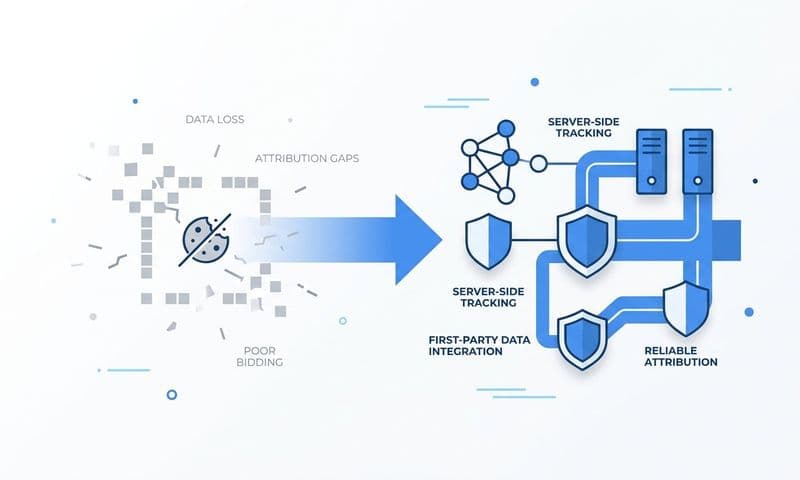
Client-side tracking is dying. Browser privacy restrictions have made pixel-based tracking so unreliable that if you're still depending on it exclusively, you're making decisions based on incomplete data. Server-side tracking is the solution—and it's not optional anymore if you want accurate attribution.
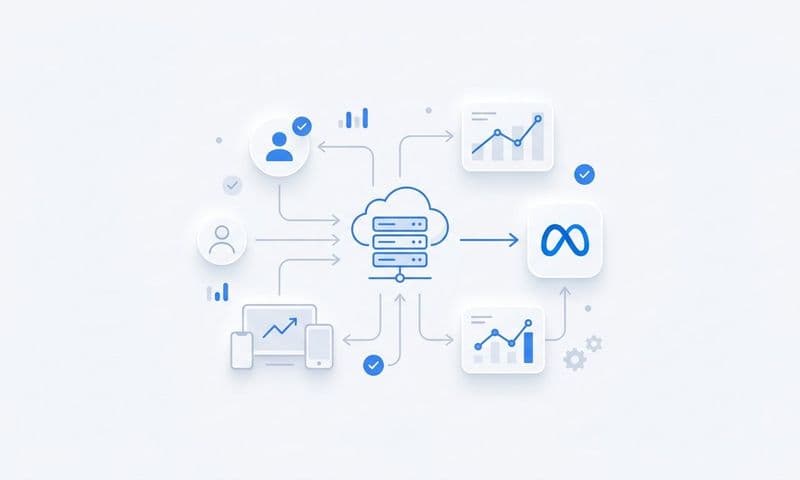
Here's why server-side tracking matters: Traditional pixels run in the user's browser, which means browser privacy settings can block them. Server-side tracking runs on your server, sending conversion data directly to ad platforms through their APIs. No browser can block it. No privacy setting can interfere with it. It captures conversions that client-side tracking misses entirely.
The implementation starts with setting up a server-side container. If you're using Google Tag Manager, you'll deploy a server-side GTM container on your own server or a cloud platform. This container receives conversion data from your website, then forwards it to ad platforms through secure server-to-server connections. Proper customer journey tracking requires this server-side infrastructure to capture the complete path from first click to final conversion.
Configure your conversion API connections next. Facebook's Conversion API (CAPI), Google's Enhanced Conversions, TikTok's Events API—these are the server-side equivalents of traditional pixels. You'll send the same conversion data, but instead of relying on browser pixels, your server sends it directly to the platform's API. This captures conversions even when users have tracking blocked.
The key is sending high-quality customer data. Server-side tracking works best when you send multiple customer identifiers—email address, phone number, IP address, user agent. The more data points you send, the better the platform can match conversions to the right users. Hash this data before sending it to protect user privacy while maintaining matching accuracy.
Implement event deduplication carefully. You'll probably run server-side tracking alongside your existing pixels during the transition, which means you need to prevent counting the same conversion twice. Use event IDs to deduplicate—send the same unique event ID from both your pixel and your server-side tracking, and the platform will only count it once.
Test your server-side implementation thoroughly. Send test conversions and verify they're showing up in your ad platform's events manager. Check that the conversion values are correct, that the attribution is working, and that you're not seeing duplicate events. A robust marketing tracking system requires this dual-layer approach to ensure no conversions slip through the cracks.
Monitor data quality metrics. Server-side tracking should increase your match rates—the percentage of conversions the platform can attribute to specific users. If your match rates aren't improving, you're probably not sending enough customer identifiers or the data quality is poor. Aim for match rates above 80% for optimal attribution accuracy.
The performance difference is dramatic. Companies that implement server-side tracking typically see 20-40% more conversions attributed compared to pixel-only tracking. That's not because they're getting more conversions—it's because they're finally seeing the conversions that were always there but invisible to browser-based tracking.
Step 3: Configure Multi-Touch Attribution Models That Reflect Reality
Last-click attribution is a lie. It gives 100% credit to the final touchpoint before conversion, completely ignoring every other interaction that influenced the decision. If someone sees your Facebook ad, clicks a Google search ad, reads three blog posts, and then converts from an email, last-click attribution gives all the credit to the email—and tells you to kill your Facebook and Google campaigns that actually started the journey.
Multi-touch attribution fixes this by distributing credit across all the touchpoints that contributed to a conversion. But here's the catch: not all multi-touch models are created equal. Choose the wrong model and you'll just replace one type of attribution error with another.
Start with linear attribution if you're new to multi-touch modeling. This gives equal credit to every touchpoint in the customer journey. If someone had five interactions before converting, each interaction gets 20% credit. It's simple, it's fair, and it immediately gives you better visibility into your full funnel than last-click ever could.
Time-decay attribution is better for longer sales cycles. It gives more credit to touchpoints closer to the conversion, based on the logic that recent interactions had more influence on the decision. If you're in B2B or selling high-ticket products where the consideration period spans weeks or months, time-decay attribution reflects reality better than linear.
Position-based attribution (also called U-shaped) gives 40% credit to the first interaction, 40% to the last interaction, and splits the remaining 20% among middle touchpoints. This model recognizes that the first touchpoint (awareness) and last touchpoint (conversion) are typically more influential than middle interactions. It works well for e-commerce and lead generation funnels. For platform-specific tracking, facebook tracking software can help implement these models within your Facebook campaigns.
Data-driven attribution is the gold standard—if you have enough conversion volume to support it. This uses machine learning to analyze your actual conversion paths and assign credit based on which touchpoints statistically increase conversion probability. Google Analytics 4 and some advanced attribution platforms offer data-driven models, but you need at least 400 conversions per month for the model to be statistically reliable.
Configure your attribution windows strategically. A 7-day click window might make sense for e-commerce impulse purchases, but B2B sales might need 30-day or even 90-day windows. Match your attribution window to your actual sales cycle—too short and you miss early-funnel touchpoints, too long and you attribute conversions to irrelevant interactions.
Implement view-through attribution for awareness campaigns. If someone sees your display ad but doesn't click, then converts later, should that ad get any credit? View-through attribution says yes—with a shorter window (usually 1 day) to avoid over-attributing. This is crucial for measuring the impact of awareness campaigns that don't drive immediate clicks. Understanding facebook attribution tracking helps you properly credit both click and view interactions in your Facebook campaigns.
The real power comes from comparing models. Don't just pick one model and call it done. Run multiple attribution models simultaneously and compare the results. If Facebook gets 30% credit in last-click but 45% credit in multi-touch, that tells you Facebook is driving more early-funnel awareness than last-click attribution revealed. That's actionable intelligence that changes how you allocate budget.
Remember: no attribution model is perfect. They're all simplified representations of complex human decision-making. The goal isn't to find the "true" attribution—it's to use models that give you better directional guidance than last-click attribution's oversimplified view.
Step 4: Leverage AI-Powered Analytics for Continuous Optimization
You've fixed your tracking infrastructure. You're capturing accurate data. Now comes the hard part: actually using that data to make better decisions. This is where most marketers fail—they have great data but lack the analytical capacity to turn it into action. AI-powered analytics solves this by automating the analysis and surfacing insights you'd never find manually.
Start with anomaly detection. AI can monitor your conversion data in real-time and alert you the moment something breaks. If your conversion rate suddenly drops 30%, you need to know immediately—not three days later when you check your dashboard. AI-powered monitoring catches tracking failures, technical issues, and performance problems before they cost you serious money. Learning how to use marketing analytics effectively means setting up these automated monitoring systems to catch issues before they impact your bottom line.
Implement predictive conversion modeling. AI can analyze patterns in your conversion data to predict which leads are most likely to convert, which customer segments have the highest lifetime value, and which campaigns will drive the best long-term ROI. This shifts you from reactive optimization (what happened) to proactive optimization (what will happen).
Use AI for attribution modeling improvements. Machine learning algorithms can analyze millions of conversion paths to identify patterns human analysts would never spot. They can weight touchpoints based on actual conversion probability increases, not arbitrary rules. The result is attribution that reflects reality more accurately than any manual model.
Deploy automated budget optimization. AI can continuously analyze performance across campaigns and automatically shift budget toward the highest-performing segments. Instead of manually checking performance and adjusting budgets weekly, AI does it hourly—capturing opportunities and cutting losses faster than any human could. Modern server side tracking tools integrate with AI optimization engines to ensure your budget flows to campaigns with the most accurate performance data.
Leverage natural language insights. The best AI analytics platforms don't just show you charts—they tell you what the data means in plain English. "Your Facebook campaign performance dropped 15% this week because iOS users are converting 40% less than last week" is infinitely more actionable than a line graph you have to interpret yourself.
Implement incrementality testing with AI. True incrementality—measuring what wouldn't have happened without your ads—is the holy grail of attribution. AI can run continuous geo-based experiments, comparing conversion rates in markets where you're running ads versus control markets where you're not. This reveals your true incremental impact, not just correlated conversions.
Use AI for creative performance analysis. Advanced AI can analyze your ad creative—images, copy, video—and identify which elements drive the highest conversion rates. It can spot patterns like "ads with customer testimonials convert 23% better" or "videos under 15 seconds have 2x higher completion rates." This turns creative optimization from guesswork into data-driven iteration.
The competitive advantage is speed. AI can analyze data, identify opportunities, and implement optimizations in minutes. Manual analysis takes days or weeks. In fast-moving ad auctions, that speed difference is the gap between capturing opportunities and watching competitors take them.
Step 5: Establish Cross-Platform Tracking for Unified Customer Journeys
Your customers don't live in platform silos. They see your Instagram ad, search for you on Google, visit your website three times, click a retargeting ad on Facebook, and finally convert from an email. But your tracking systems treat each platform as a separate universe, creating a fragmented view of the customer journey that makes optimization impossible.
Cross-platform tracking solves this by connecting touchpoints across all your marketing channels into unified customer journeys. Instead of seeing "50 conversions from Facebook" and "30 conversions from Google" as separate events, you see the complete path: Facebook introduced them, Google brought them back, email closed the deal.
Start by implementing a unified customer ID system. This is the foundation of cross-platform tracking. When someone visits your website, assign them a unique ID that persists across sessions and devices. Store this ID in a first-party cookie (which browsers don't block) and in your database. Every conversion event should include this customer ID so you can connect it to their complete journey.
Integrate your CRM with your ad platforms. When someone converts, send their customer ID and conversion data to your CRM. Then use your CRM as the source of truth for attribution. Your CRM knows the complete customer journey—every email they opened, every page they visited, every ad they clicked. Ad platforms only know their own touchpoints. CRM-based attribution gives you the full picture.
Implement UTM parameter tracking consistently. Every ad, every email, every social post should have UTM parameters that identify the source, medium, campaign, and content. This creates a data trail you can follow across platforms. But here's the key: use consistent naming conventions. If Facebook is "facebook" in one campaign and "fb" in another, your analytics can't connect them.
Use a customer data platform (CDP) if you're running complex multi-channel campaigns. CDPs collect data from every customer touchpoint—website, mobile app, email, ads, CRM—and unify it into single customer profiles. This gives you a complete view of every customer's journey across all channels, not just the fragments each platform sees.
Configure cross-domain tracking for multi-site journeys. If your customer journey spans multiple domains—like clicking an ad that goes to a landing page on landingpage.com, then converting on yourstore.com—you need cross-domain tracking to connect those sessions. Without it, the conversion looks like direct traffic instead of being attributed to the ad that started the journey.
Implement offline conversion tracking for businesses with offline sales. If people see your ads online but convert in-store or over the phone, you need to close that loop. Upload offline conversion data back to your ad platforms using their offline conversion APIs. Match conversions to ad clicks using email addresses, phone numbers, or customer IDs. This is crucial for retail, automotive, healthcare, and any business where the final conversion happens offline.
The result is attribution that reflects reality. Instead of each platform claiming credit for the same conversion (leading to 200% attributed ROAS when you add them up), you see the true contribution of each channel. You discover that Facebook drives awareness, Google captures intent, and email closes deals—and you optimize each channel for its actual role in the journey, not for last-click conversions it doesn't deserve credit for.
Step 6: Monitor and Maintain Tracking Accuracy Over Time
Tracking accuracy isn't a one-time fix—it's an ongoing maintenance requirement. Websites get updated. Platforms change their APIs. Privacy regulations evolve. What works perfectly today can break tomorrow, and if you're not actively monitoring, you won't know until you've already lost weeks of accurate data.
Set up automated tracking validation. Build daily checks that verify your tracking is working correctly. Test that pixels are firing on key pages. Confirm that conversion events are reaching your ad platforms. Check that the conversion values match what your database shows. Automated validation catches breaks immediately instead of discovering them weeks later when you notice the numbers look weird.
Create a tracking changelog. Every time someone updates the website, changes a form, modifies the checkout process, or touches anything that could affect tracking, document it. When conversion tracking breaks, this changelog is your first diagnostic tool—you can immediately see what changed and when, which points you straight to the problem.
Run weekly data quality audits. Compare conversion numbers across platforms and your source of truth (usually your CRM or database). If the discrepancies are growing, something's broken. Small gaps are normal—different attribution windows, different counting methodologies. But if Facebook suddenly shows 50% more conversions than your database, that's a red flag that demands immediate investigation.
Monitor match rates and data quality metrics. Server-side tracking platforms show you what percentage of conversions they can match to users. If your match rate drops from 85% to 60%, your data quality has degraded—maybe you stopped collecting email addresses, or your hashing implementation broke. Track these metrics weekly and investigate any significant drops.
Stay current with platform changes. Facebook, Google, and other ad platforms regularly update their tracking requirements, API versions, and privacy policies. Subscribe to their developer newsletters. Join their beta programs. When they announce changes, test them immediately in a staging environment before they go live and potentially break your production tracking.
Test major website changes in staging first. Before you launch a new checkout flow, a redesigned landing page, or any significant website update, deploy it to a staging environment and verify that all tracking still works. Test the complete conversion funnel. Confirm that events fire correctly. Check that data reaches your ad platforms. Catching tracking breaks in staging is free. Discovering them in production costs you real money.
Conduct quarterly tracking audits. Every three months, run a comprehensive audit of your entire tracking infrastructure. Verify that all pixels are still firing. Check that attribution models are still appropriate for your business. Review your UTM naming conventions. Test cross-device and cross-platform tracking. Update any deprecated code. This quarterly deep-dive catches issues that daily monitoring might miss.
The companies with the most accurate tracking aren't the ones with the best initial implementation—they're the ones with the best ongoing maintenance. Tracking accuracy is a discipline, not a destination. Treat it like infrastructure that requires constant monitoring, regular updates, and immediate attention when something breaks.
Common Tracking Accuracy Mistakes to Avoid
Even with the best intentions, most marketers make predictable mistakes that destroy tracking accuracy. Knowing these pitfalls helps you avoid them before they cost you money.
Mistake #1: Trusting platform-reported conversions as truth. Facebook says you got 100 conversions. Google says you got 80. Your CRM shows 60 actual customers. Which number is real? Your CRM is the source of truth—it's the only system that knows who actually became a customer. Platform-reported conversions are estimates, often inflated by attribution overlap, view-through conversions that didn't actually influence the decision, and technical counting errors. Always validate platform numbers against your actual customer database.
Mistake #2: Using different attribution windows across platforms. Facebook uses 7-day click, 1-day view. Google uses 30-day click. Your analytics uses last-click with a 90-day window. When every platform measures differently, the numbers will never match—and you can't make coherent optimization decisions. Standardize your attribution windows across all platforms so you're comparing apples to apples.
Mistake #3: Ignoring view-through conversions entirely. Some marketers see that view-through attribution can inflate numbers and decide to ignore it completely. But that throws out valuable signal. Someone who sees your ad five times, doesn't click, but converts later was clearly influenced by your ads. The solution isn't to ignore view-through conversions—it's to use shorter view-through windows (1 day instead of 7) and weight them appropriately in your attribution model.
Mistake #4: Not deduplicating conversions across pixels. If you're running both client-side pixels and server-side tracking, or if you have multiple pixels on the same page, you might be counting the same conversion multiple times. Always implement event deduplication using unique event IDs. Otherwise, your conversion numbers are inflated and your ROI calculations are wrong.
Mistake #5: Failing to account for offline conversions. If your business has any offline conversion component—phone calls, in-store purchases, sales team closes—and you're not feeding that data back to your ad platforms, your attribution is fundamentally incomplete. You're optimizing for online conversions while ignoring potentially higher-value offline conversions, which leads to misallocated budgets and missed opportunities.
Mistake #6: Using last-click attribution for multi-touch journeys. If your average customer has 5+ touchpoints before converting, last-click attribution is lying to you. It's telling you to kill top-of-funnel campaigns that drive awareness because they don't get last-click credit, even though they're essential to starting the customer journey. Switch to multi-touch attribution that reflects the reality of your customer journey.
Mistake #7: Not testing tracking after website updates. Your developer updates the checkout page. Your conversion tracking breaks. You don't notice for two weeks. You just lost two weeks of accurate attribution data and made optimization decisions based on incomplete information. Always test tracking after any website change, no matter how minor it seems.
Mistake #8: Relying solely on client-side tracking in 2025. Browser privacy restrictions have made client-side tracking so unreliable that if you're not using server-side tracking, you're missing 20-40% of your conversions. This isn't optional anymore—it's table stakes for accurate attribution in the privacy-first era.
Avoiding these mistakes doesn't require advanced technical skills—it just requires awareness and discipline. Most tracking accuracy problems aren't caused by complex technical issues. They're caused by simple oversights that compound over time.
Conclusion: Your Action Plan for Bulletproof Tracking Accuracy
Tracking accuracy isn't a technical nice-to-have—it's the foundation of profitable advertising. Every optimization decision you make, every budget allocation, every campaign you scale or kill, depends on accurate attribution data. Get the tracking wrong and everything built on top of it is wrong too.
The framework we've covered gives you a systematic approach to building tracking that captures every conversion, every touchpoint, and every dollar of revenue. Start with the diagnostic audit to identify exactly where your attribution breaks down. Implement server-side tracking to bypass browser restrictions and capture conversions that client-side pixels miss. Configure multi-touch attribution models that reflect the reality of your customer journey instead of oversimplifying it to last-click.
Leverage AI-powered analytics to turn accurate data into faster, smarter optimization decisions. Establish cross-platform tracking to see unified customer journeys instead of fragmented platform silos. And build ongoing monitoring and maintenance into your workflow so tracking accuracy doesn't degrade over time.
The competitive advantage is real. While your competitors make decisions based on incomplete data and attribution gaps, you'll have clear visibility into what actually drives revenue. You'll confidently scale winners because you know the true ROI. You'll kill losers fast because you're not fooled by phantom performance. You'll outbid competitors in auctions because you know your numbers are accurate while theirs are guesses.
Start with the audit. That's your foundation. You can't fix what you can't measure, and you can't measure what you haven't diagnosed. Spend a day running through the audit process in Step 1. Document every attribution gap, every tracking failure, every discrepancy between platform reports and reality. That diagnostic clarity will guide everything else.
Then prioritize based on impact. If you're losing 40% of conversions to browser blocking, server-side tracking is your highest-impact fix. If you're running multi-touch journeys but using last-click attribution, fixing your attribution model will immediately improve budget allocation. If you have accurate data but slow manual analysis, AI-powered analytics will accelerate your optimization cycle.
The tracking landscape will keep evolving. Privacy regulations will get stricter. Browsers will block more tracking. Platforms will change their APIs. But the fundamental principle remains constant: accurate attribution is the competitive advantage that separates profitable advertisers from those flying blind. Build it right, maintain it consistently, and you'll have the foundation for sustainable, scalable advertising growth.
Ready to elevate your marketing game with precision and confidence? Discover how Cometly's AI-driven recommendations can transform your ad strategy—**Get your free demo** today and start capturing every touchpoint to maximize your conversions.