Marketing analytics has become the difference between companies that guess and companies that grow. While your competitors are making decisions based on gut feelings and last quarter's results, you could be using real-time data to predict customer behavior, optimize campaigns mid-flight, and allocate budgets with surgical precision.
But here's the problem: most marketing teams are drowning in data while starving for insights. They have Google Analytics, CRM dashboards, ad platform reports, and email metrics—yet they still can't answer basic questions like "Which marketing channel actually drives our most profitable customers?" or "Why did our conversion rate drop last Tuesday?"
This guide will show you exactly how to use marketing analytics to make better decisions, starting today. You'll learn the frameworks that separate analytics beginners from experts, the specific metrics that actually matter for your business model, and the practical workflows that turn data into revenue. No fluff, no theory—just the systems that work.
Understanding Marketing Analytics Fundamentals
Marketing analytics is the practice of measuring, managing, and analyzing marketing performance to maximize effectiveness and optimize return on investment. But that textbook definition misses the point entirely.
In practice, marketing analytics is your competitive advantage. It's the system that tells you which Facebook ad creative will outperform before you spend your entire budget testing it. It's the dashboard that shows you exactly when your email subscribers are most likely to convert. It's the attribution model that proves your podcast sponsorships are actually driving 23% of your enterprise deals, even though they never get credit in last-click attribution.
The companies winning with analytics aren't necessarily the ones with the biggest budgets or the fanciest tools. They're the ones who understand three fundamental truths that most marketers miss. You can use marketing analytics software or you can follow this guide to help you understand how to use your marketing analytics.
The Data-to-Decision Pipeline
Marketing analytics isn't a destination—it's a continuous cycle that transforms raw data into strategic actions, then feeds the results back into your next decision. Think of it like a manufacturing assembly line, except instead of producing widgets, you're producing insights that drive revenue.
The pipeline has four distinct stages, and most teams fail because they skip straight to analysis without building the earlier stages properly.
Stage 1: Collect. This is where you capture data from every customer touchpoint—ad clicks, website visits, email opens, CRM interactions, purchase events. The key here isn't collecting everything possible; it's collecting the right data consistently. A small business tracking five metrics accurately beats an enterprise drowning in 500 metrics they don't trust.
Stage 2: Analyze. Raw data means nothing until you process it. This stage involves cleaning your data, identifying patterns, and running calculations that reveal what's actually happening in your marketing. You're looking for trends, anomalies, and relationships between different metrics. For example, analyzing how organic traffic converts compared to paid traffic, or which email sequences generate the highest customer lifetime value.
Stage 3: Interpret. Here's where human judgment becomes critical. The numbers might show that Instagram ads have a lower cost per click than Google Ads, but interpretation asks why. Maybe Instagram reaches a younger audience that takes longer to convert. Maybe Google captures high-intent searches that close faster. Interpretation connects data patterns to business context.
Stage 4: Act. This is where analytics earns its keep. Based on your interpretation, you make decisions: reallocate budget, pause underperforming campaigns, scale winners, test new audiences. Without this stage, you're just creating reports that nobody uses.
Descriptive vs. Predictive vs. Prescriptive Analytics
Not all analytics are created equal. There are three levels, and most marketing teams never graduate past the first one.
Descriptive analytics tells you what happened. Your Google Analytics dashboard showing 10,000 visitors last month? That's descriptive. Your email platform reporting a 22% open rate? Descriptive. This is where 90% of marketing teams live, and it's the least valuable level because it only looks backward.
Predictive analytics tells you what's likely to happen next. This is where machine learning models analyze historical patterns to forecast future outcomes. For example, predicting which leads are most likely to convert based on their behavior patterns, or forecasting next quarter's revenue based on current pipeline velocity and conversion trends.
Prescriptive analytics tells you what you should do about it. This is the holy grail—analytics that doesn't just predict outcomes but recommends specific actions to achieve your goals. For instance, a prescriptive system might tell you: "Reallocate 30% of your Facebook budget to Google Ads targeting these three keywords, and you'll increase conversions by 18% while reducing cost per acquisition by $12."
The progression from descriptive to prescriptive isn't just about better tools—it's about better questions. Descriptive analytics answers "what happened?" Predictive answers "what will happen?" Prescriptive answers "what should we do?"
The Attribution Problem Nobody Talks About
Here's a scenario that plays out in marketing meetings every single day: Your Facebook ads show a 3x ROAS in the ads manager. Your Google Analytics shows organic search as your top conversion source. Your sales team insists that most deals come from referrals. Who's right?
Everyone and no one. This is the attribution problem, and it's the reason most marketing analytics initiatives fail before they start.
Attribution is the process of assigning credit to marketing touchpoints along the customer journey. The problem is that modern customers don't follow linear paths. They might see your Facebook ad on Monday, Google your brand on Tuesday, read three blog posts on Wednesday, get a retargeting ad on Thursday, and finally convert on Friday after clicking an email link.
Which channel "caused" the conversion? The answer depends entirely on your attribution model, and different models will give you radically different answers—which means they'll lead you to make radically different budget decisions.
Most platforms default to last-click attribution, which gives 100% credit to the final touchpoint before conversion. This systematically undervalues awareness and consideration channels while overvaluing bottom-funnel tactics. It's like giving the closer on a sales team credit for the entire deal while ignoring the SDR who booked the meeting and the account executive who ran the demo.
Understanding attribution isn't optional anymore. It's the foundation of accurate marketing analytics and reporting, and getting it wrong means you'll optimize for the wrong metrics, scale the wrong channels, and wonder why your marketing efficiency keeps declining even as you follow the data.
Setting Up Your Marketing Analytics Infrastructure
You can't analyze data you don't have, and you can't trust insights from data that's incomplete, inconsistent, or inaccurate. Before you start building dashboards or running reports, you need to build the infrastructure that makes reliable analytics possible.
 How To Use Marketing Analytics: The Marketer's Guide To Better Decisions
This isn't the sexy part of analytics. There are no insights here, no "aha" moments, no charts to show your CEO. But this is where most analytics initiatives succeed or fail. Skip these steps, and you'll spend months chasing phantom patterns in unreliable data. Get them right, and everything else becomes dramatically easier.
Choosing Your Analytics Stack
Your analytics stack is the collection of tools that collect, store, process, and visualize your marketing data. The right stack depends on your business model, team size, technical capabilities, and budget—but there are some universal principles.
Start with the foundation: web analytics. Google Analytics is the default choice for most businesses, and for good reason—it's free, powerful, and integrates with everything. But "free" doesn't mean "easy." GA4 (the current version) has a learning curve that trips up even experienced marketers. If you're just starting out, make sure someone on your team actually understands how to configure it properly. A misconfigured GA4 property is worse than no analytics at all because it gives you false confidence in bad data.
Alternatives like Adobe Analytics or Matomo offer more control and better privacy compliance, but they come with higher costs and steeper learning curves. For most businesses under $10M in revenue, Google Analytics is the right choice.
Add attribution tracking. This is where most analytics stacks have a critical gap. Standard web analytics tools use last-click attribution by default, which means they're systematically lying to you about which marketing channels actually drive results. You need a dedicated attribution software that tracks the full customer journey across multiple touchpoints and channels.
Solutions like Cometly, HockeyStack, or Ruler Analytics specialize in multi-touch attribution and can show you which marketing touchpoints actually contribute to conversions, not just which ones happen to be last. For B2B companies with longer sales cycles, this isn't optional—it's the difference between knowing and guessing.
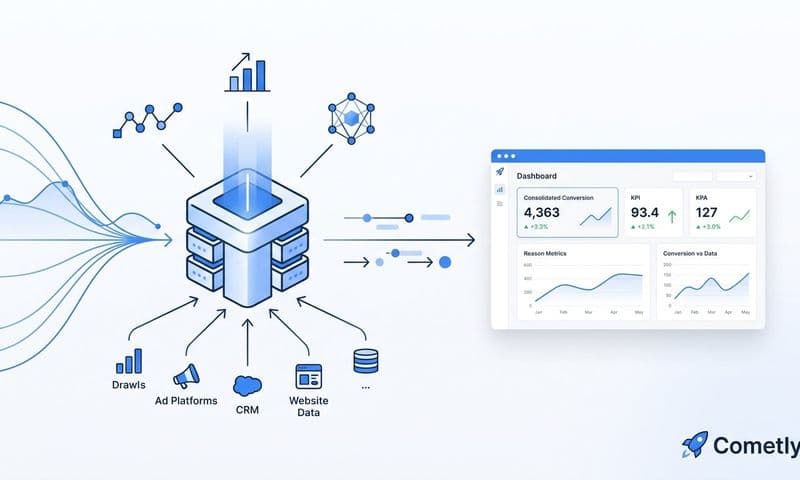
Connect your advertising platforms. Every ad platform (Facebook, Google, LinkedIn, TikTok) has its own analytics dashboard, and they all report different numbers because they all use different attribution windows and methodologies. You need a way to normalize this data and see it in one place.
Tools like Supermetrics, Windsor.ai, or Funnel.io specialize in pulling data from multiple ad platforms into a centralized dashboard or data warehouse. This lets you compare apples to apples and see your true cost per acquisition across channels.
Integrate your CRM and sales data. Marketing analytics that stops at lead generation is incomplete. You need to connect marketing data to revenue data to understand which campaigns drive not just leads, but profitable customers. This means integrating your CRM (Salesforce, HubSpot, Pipedrive) with your marketing analytics stack.
For B2B companies, this integration is non-negotiable. You need to track which marketing touchpoints influenced which deals, what the average deal size is by source, and how long it takes leads from different channels to close. Without this, you're optimizing for vanity metrics instead of revenue.
Implementing Proper Tracking
Even the best analytics tools are useless if they're not tracking the right events in the right way. Proper tracking implementation is tedious, technical work that most marketers try to skip—and then spend months dealing with the consequences.
Start with a tracking plan. Before you implement anything, document exactly what you need to track and why. This should include:
- Every conversion event that matters to your business (purchases, signups, demo requests, etc.)
- Key engagement events that indicate interest (video views, content downloads, feature usage)
- Traffic sources and campaign parameters you need to track
- Custom dimensions or properties that provide business context (user type, product category, deal size)
A good tracking plan prevents the two most common tracking mistakes: tracking too much (which creates noise) and tracking too little (which creates blind spots).
Implement UTM parameters consistently. UTM parameters are the tags you add to URLs to track where traffic comes from. They look like this: ?utmsource=facebook&utmmedium=cpc&utmcampaign=springsale. Every marketing link you create should have UTM parameters, and you need to use them consistently.
Create a naming convention and stick to it religiously. If one campaign uses utm_source=facebook and another uses utm_source=Facebook and another uses utm_source=fb, your analytics will treat them as three different sources and your reports will be garbage.
Set up conversion tracking on every platform. Each advertising platform needs its own conversion tracking pixel or API integration. This means installing the Facebook Pixel, Google Ads conversion tracking, LinkedIn Insight Tag, and any other platform-specific tracking codes. Yes, it's annoying to manage multiple pixels. No, you can't skip this step.
Use a tag management system like Google Tag Manager to make this easier. GTM lets you manage all your tracking codes from one interface instead of editing your website code every time you need to add a new pixel.
Test everything before you launch. Broken tracking is worse than no tracking because it gives you false confidence. Before you start spending money on campaigns, verify that every conversion event is firing correctly, every UTM parameter is being captured, and every integration is passing data accurately.
Use browser extensions like Google Tag Assistant or Facebook Pixel Helper to verify that your tracking codes are installed correctly. Send test conversions through your funnel and verify they show up in all your analytics platforms with the correct attribution.
Creating a Single Source of Truth
Here's a scenario that happens in every marketing team: You're in a meeting discussing campaign performance. Someone pulls up Google Analytics and says the conversion rate is 3.2%. Someone else pulls up the CRM and says it's 2.8%. The CFO pulls up the revenue report and says it's 2.1%. Now you're spending 30 minutes arguing about which number is "right" instead of making decisions.
This is why you need a single source of truth—one place where all your marketing data lives, properly cleaned and reconciled, with clear definitions that everyone agrees on.
For small teams, this might be a well-organized spreadsheet or a dashboard in your analytics platform. For larger teams, it's usually a data warehouse (like Snowflake, BigQuery, or Redshift) that pulls data from all your sources, cleans it, and makes it available for analysis.
The specific technology matters less than the principle: everyone in your organization should be looking at the same numbers, calculated the same way, with the same definitions. When someone says "conversion rate," everyone should know exactly what that means—which events count as conversions, what time period we're measuring, and how we're handling edge cases.
Document your metric definitions. Create a data dictionary that explains exactly how each metric is calculated, what data sources it uses, and what business question it answers. This sounds bureaucratic, but it's the difference between a team that trusts their data and a team that argues about it.
Key Marketing Metrics That Actually Matter
Most marketing dashboards are cluttered with metrics that don't matter. Pageviews, impressions, reach, engagement rate—these vanity metrics make you feel productive while telling you nothing about whether your marketing is actually working.
The metrics that matter are the ones that connect directly to business outcomes. They're the numbers that, if they improve, your revenue improves. Everything else is noise.
Acquisition Metrics
Acquisition metrics tell you how effectively you're bringing new potential customers into your ecosystem. These are top-of-funnel metrics that measure the efficiency of your awareness and consideration efforts.
Cost Per Acquisition (CPA): How much you spend to acquire one customer. This is your most fundamental efficiency metric. If your CPA is $100 and your average customer lifetime value is $500, you have a healthy business model. If your CPA is $400 and your LTV is $300, you're burning money.
Calculate CPA by dividing your total marketing spend by the number of customers acquired in the same period. But be careful with the time window—if your sales cycle is 90 days, you can't fairly judge a campaign's CPA after 30 days.
Cost Per Lead (CPL): How much you spend to acquire one qualified lead. This matters more for B2B businesses or high-consideration purchases where leads don't convert immediately. Your CPL should be a fraction of your CPA—if they're close to equal, it means your lead-to-customer conversion rate is terrible.
Traffic-to-Lead Conversion Rate: What percentage of your website visitors become leads. This metric tells you how effective your website is at capturing interest. A low conversion rate (under 2% for most industries) means you have a website problem, not a traffic problem. More ads won't fix it.
Channel-Specific Acquisition Costs: Your overall CPA is useful, but channel-specific CPAs are actionable. You need to know that Google Ads costs you $80 per customer while Facebook marketing analytics shows $120 per customer, because that tells you where to allocate budget.
But don't optimize for the lowest CPA in isolation. A channel with a higher CPA might deliver customers with higher lifetime value, better retention, or faster payback periods. Always look at acquisition costs in context with customer quality metrics.
Engagement Metrics
Engagement metrics measure how actively your audience interacts with your content and brand. These are middle-of-funnel metrics that indicate interest and intent.
Time on Page: How long visitors spend reading your content. This matters for content marketing and SEO. If your average time on page is 15 seconds, people aren't actually reading your content—they're bouncing. If it's 4 minutes on a blog post, you're providing value.
Pages Per Session: How many pages visitors view in a single visit. Higher is generally better because it indicates engagement and interest. If someone visits your pricing page, then your features page, then your case studies, they're seriously considering a purchase.
Email Engagement Rate: The percentage of your email list that opens and clicks your emails. This tells you whether your email content is relevant and valuable. A declining engagement rate means your list is getting stale or your content is getting boring.
Content Consumption Metrics: For content marketing, track which pieces drive the most engagement, which topics resonate, and which formats perform best. This tells you what to create more of and what to stop wasting time on.
The key with engagement metrics is to connect them to outcomes. High engagement is only valuable if it leads to conversions. If your blog posts get tons of traffic and long read times but never convert readers into leads, you have an engagement problem, not an engagement success.
Conversion Metrics
Conversion metrics measure how effectively you move people through your funnel from one stage to the next. These are your bottom-of-funnel metrics that directly connect to revenue.
Conversion Rate: The percentage of visitors who complete your desired action (purchase, signup, demo request, etc.). This is your fundamental effectiveness metric. A 2% conversion rate means 98% of your traffic is wasted. A 5% conversion rate means you're doing something right.
But "conversion rate" is too vague to be useful. You need specific conversion rates for each stage of your funnel: visitor-to-lead, lead-to-opportunity, opportunity-to-customer. This lets you identify exactly where your funnel is leaking.
Lead-to-Customer Conversion Rate: What percentage of your leads eventually become paying customers. This metric reveals the quality of your lead generation. If you're generating 1,000 leads per month but only 10 become customers (1% conversion rate), you have a lead quality problem. You're either attracting the wrong people or failing to nurture them properly.
Average Order Value (AOV): How much customers spend per transaction. Increasing AOV is often easier than increasing conversion rate. If you can get customers to spend $120 instead of $100, you just increased revenue by 20% without acquiring a single additional customer.
Revenue Per Visitor: How much revenue you generate per website visitor. This is the ultimate efficiency metric because it combines traffic, conversion rate, and order value into one number. If your RPV is $2 and your cost per visitor is $1, you're profitable. If it's $0.50, you're not.
Retention and Lifetime Value Metrics
Acquisition metrics tell you how much customers cost. Retention metrics tell you how much they're worth. This is where most marketing analytics falls short—teams obsess over acquisition while ignoring the fact that retaining existing customers is 5-25x more cost-effective than acquiring new ones.
Customer Lifetime Value (LTV): The total revenue you expect to generate from a customer over their entire relationship with your business. This is your most important metric because it determines how much you can afford to spend on acquisition.
Calculate LTV by multiplying average purchase value × purchase frequency × customer lifespan. For subscription businesses, it's monthly recurring revenue × average customer lifetime in months. If your LTV is $500 and your CPA is $100, you have a 5x return on your acquisition investment.
Retention Rate: What percentage of customers continue buying from you over time. Measure this monthly, quarterly, and annually depending on your business model. A 90% monthly retention rate means you lose 10% of customers every month—which means you need to acquire 10% more customers just to stay flat.
Churn Rate: The inverse of retention rate—what percentage of customers stop buying from you. For subscription businesses, churn is existential. A 5% monthly churn rate means you lose half your customers every year. No amount of acquisition can overcome that.
Repeat Purchase Rate: What percentage of customers make a second purchase. This metric reveals whether you're building a sustainable business or just churning through one-time buyers. If only 10% of customers ever buy again, you don't have a retention problem—you have a product-market fit problem.
Time to Payback: How long it takes to recover your customer acquisition cost through revenue. If your CPA is $100 and customers generate $25 per month, your payback period is 4 months. Shorter payback periods mean you can reinvest profits into growth faster.
Analyzing Marketing Performance Across Channels
Every marketing channel has its own dashboard, its own metrics, and its own version of the truth. Facebook Ads Manager tells you one story. Google Analytics tells you another. Your CRM tells you a third. Your job is to synthesize these competing narratives into actionable insights.
This is where how to use analytics to drive business growth becomes practical. You're not just collecting data—you're using it to make better decisions about where to invest your time and budget.
Paid Advertising Analysis
Paid advertising generates the most immediate, measurable results of any marketing channel. It's also the easiest place to waste money if you're not analyzing performance correctly.
Platform-Level Analysis: Start by comparing performance across advertising platforms. Which platforms deliver the lowest CPA? The highest conversion rate? The best customer quality? This tells you where to allocate budget at the highest level.
But don't just look at cost metrics. A platform with a higher CPA might deliver customers with 2x higher lifetime value, making it more profitable in the long run. Always analyze acquisition costs alongside customer quality metrics.
Campaign-Level Analysis: Within each platform, compare campaigns against each other. Which campaign structures perform best? Which targeting strategies work? Which ad objectives drive the most efficient results?
Look for patterns. If your retargeting campaigns consistently outperform cold prospecting campaigns (they should), that tells you to invest more in building your retargeting audiences. If campaigns targeting specific job titles outperform broad demographic targeting, that tells you to get more granular with your targeting.
Ad-Level Analysis: This is where most advertisers spend their time, and it's often the least valuable level of analysis. Yes, you should test different ad creatives and copy. But ad-level performance is noisy and changes quickly. A winning ad today might be fatigued next week.
Focus on patterns rather than individual ad performance. What types of creative consistently work? What messaging angles resonate? What calls-to-action drive clicks? These patterns are more valuable than knowing that Ad #247 outperformed Ad #248 last Tuesday.
Audience Analysis: Who's responding to your ads? Break down performance by demographics, interests, behaviors, and custom audiences. You might discover that 60% of your conversions come from 20% of your audience segments—which means you should reallocate budget accordingly.
Use advanced marketing analytics to build lookalike audiences based on your best customers, not just your most recent customers. There's a difference between people who convert and people who become valuable long-term customers.
Organic Channel Analysis
Organic channels (SEO, content marketing, social media) are harder to measure than paid advertising because the attribution is murkier and the results take longer to materialize. But they're often more valuable in the long run because they compound over time.
SEO Performance Analysis: Track organic traffic, keyword rankings, and organic conversion rates. But don't obsess over rankings—obsess over traffic and conversions. Ranking #1 for a keyword that drives zero conversions is worthless.
Analyze which pages drive the most organic traffic and conversions. These are your SEO winners, and you should create more content like them. Identify pages that rank well but don't convert—these need conversion optimization, not more traffic.
Content Marketing Analysis: Which content pieces drive the most traffic? Which ones generate the most leads? Which topics resonate with your audience? Use this data to inform your content strategy.
But also track assisted conversions—content that doesn't directly convert but influences conversions later. A blog post that doesn't generate leads might still be valuable if people who read it are more likely to convert when they see your ads later.
Email Marketing Analysis: Track open rates, click rates, and conversion rates for every email campaign. But also track email's contribution to overall revenue. Email might not get credit in last-click attribution, but it often plays a crucial role in nurturing leads and driving repeat purchases.
Segment your email performance by list source, subscriber behavior, and customer lifecycle stage. New subscribers behave differently than long-term customers. Tailor your analysis and strategy accordingly.
Cross-Channel Attribution
The most important analysis happens when you stop looking at channels in isolation and start understanding how they work together. This is cross-channel attribution, and it's where most marketing analytics initiatives either succeed or fail.
Multi-Touch Attribution Models: Instead of giving all credit to the last click, multi-touch attribution distributes credit across all touchpoints in the customer journey. Common models include:
- Linear attribution: Every touchpoint gets equal credit
- Time-decay attribution: Recent touchpoints get more credit than earlier ones
- Position-based attribution: First and last touchpoints get more credit than middle ones
- Data-driven attribution: Machine learning determines credit based on actual conversion patterns
No model is perfect, but any multi-touch model is better than last-click. Use marketing analytics software that supports multiple attribution models so you can compare results and understand how different perspectives change your conclusions.
Customer Journey Analysis: Map out the typical paths customers take from first touch to conversion. You might discover that most customers see a Facebook ad, then Google your brand, then read three blog posts, then convert from an email. This tells you that Facebook is driving awareness, organic search is driving consideration, content is building trust, and email is closing the deal.
Understanding these patterns lets you optimize the entire journey instead of just individual touchpoints. Maybe you should invest more in Facebook to drive more awareness, knowing that the conversion will happen later through other channels.
Turning Analytics Into Action
Data without decisions is just expensive storage. The entire point of marketing analytics is to make better decisions that drive better results. This is where most teams fail—they build beautiful dashboards, run sophisticated analyses, and then... do nothing with the insights.
Turning analytics into action requires three things: a decision-making framework, a testing culture, and the discipline to act on what the data tells you even when it contradicts your intuition.
Building a Data-Driven Decision Framework
You can't act on every insight. You need a framework for deciding which insights matter and what to do about them.
The ICE Framework: Prioritize potential actions based on three factors:
- Impact: How much will this improve your key metrics?
- Confidence: How certain are you that this will work?
- Ease: How difficult is this to implement?
Score each factor from 1-10, then multiply them together. Focus on the highest-scoring opportunities first. This prevents you from wasting time on low-impact optimizations or high-risk experiments that might not work.
The 80/20 Analysis: Look for the 20% of efforts that drive 80% of results. Which campaigns drive most of your conversions? Which content pieces generate most of your leads? Which customer segments generate most of your revenue?
Once you identify these high-leverage areas, double down on them. If 70% of your revenue comes from 30% of your marketing channels, reallocate budget accordingly. If three blog posts drive 60% of your organic leads, create more content like them.
The Hypothesis-Driven Approach: Don't just react to data—form hypotheses about what might improve performance, then test them systematically. This turns analytics from a reporting exercise into a learning system.
For example: "Hypothesis: Adding customer testimonials to our landing page will increase conversion rate by 15% because social proof reduces purchase anxiety." Then test it, measure the results, and update your understanding based on what you learn.
Implementing a Testing Culture
The best marketing teams don't just analyze data—they generate new data through systematic testing. This is how you move from descriptive analytics (what happened) to prescriptive analytics (what should we do).
A/B Testing Fundamentals: Test one variable at a time so you know what caused any performance change. Run tests long enough to reach statistical significance (usually 2-4 weeks depending on traffic volume). Document every test so you build institutional knowledge over time.
Common things to test: headlines, calls-to-action, page layouts, pricing, ad creative, email subject lines, targeting parameters, landing page copy. But don't test randomly—test based on hypotheses informed by your analytics.
Multivariate Testing: Once you've exhausted simple A/B tests, move to multivariate testing where you test multiple variables simultaneously. This is more complex but can reveal interaction effects—where combining two changes produces better results than either change alone.
Sequential Testing: Use insights from one test to inform the next test. If testing a new headline improves conversion rate by 20%, your next test might explore different variations of that winning headline. This creates a compounding effect where each test builds on previous learnings.
Creating Automated Alerts and Triggers
You can't watch your dashboards 24/7. Set up automated alerts that notify you when important metrics move outside normal ranges or when opportunities emerge.
Performance Alerts: Get notified when conversion rates drop below threshold, when cost per acquisition spikes above target, or when traffic from a key source declines significantly. This lets you respond to problems quickly instead of discovering them in next week's report.
Opportunity Alerts: Get notified when campaigns are performing exceptionally well so you can scale them immediately. If a new ad is generating conversions at 50
Ready to elevate your marketing game with precision and confidence? Discover how Cometly's AI-driven recommendations can transform your ad strategy—**Get your free demo** today and start capturing every touchpoint to maximize your conversions.