

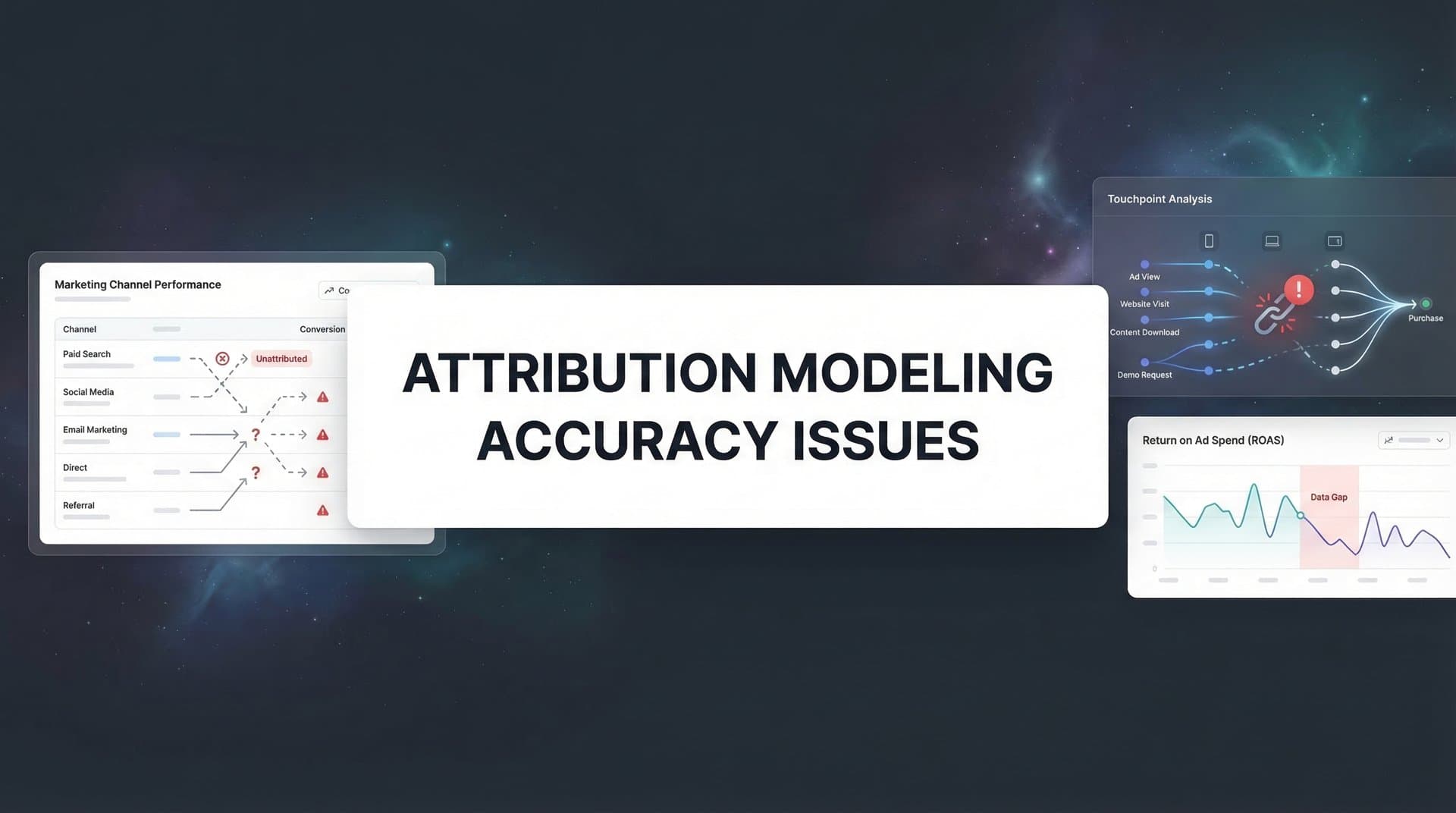
You just increased your Facebook ad budget by 40%. The attribution dashboard showed clear results: Facebook was driving 60% of your conversions. Three weeks later, your finance team asks why revenue hasn't moved. You check again. The numbers still look good in the platform. But when you trace actual customers back through your CRM, the story changes completely. Half of those "Facebook conversions" touched three other channels first. Some clicked a Google ad, read a blog post, then saw your Facebook retargeting. Your attribution model gave Facebook all the credit.
This isn't a hypothetical problem. It's happening right now across marketing teams of every size. Attribution modeling accuracy issues have become one of the most expensive silent killers in digital marketing. You're making budget decisions based on data that looks precise but tells an incomplete story. The result? Money flows to channels that appear to convert while the touchpoints that actually drive awareness get starved of investment.
The challenge has intensified dramatically since 2021. Privacy changes, cookie restrictions, and platform reporting limitations have created blind spots in nearly every marketing measurement system. But here's what most marketers miss: the problem isn't just about tracking technology. It's about understanding where attribution models break down, why they produce misleading results, and what you can actually do to build a more accurate foundation for your marketing decisions.
The Hidden Cracks in Your Attribution Data
Think of attribution modeling like trying to reconstruct a conversation you weren't part of. You're gathering fragments—a text message here, an overheard comment there—and trying to piece together what really happened. That's essentially what your attribution system does with customer journeys.
At its core, an attribution model assigns credit to marketing touchpoints that occur before a conversion. Someone clicks your Instagram ad, visits your website, leaves, sees a Google search ad two days later, clicks through, and converts. Which touchpoint "caused" the conversion? Your attribution model makes that call. But here's the fundamental issue: models don't capture causation. They capture correlation and apply rules to distribute credit.
Last-click attribution gives 100% credit to the final touchpoint before conversion. First-click credits the initial interaction. Multi-touch models spread credit across multiple touchpoints using various weighting schemes. Each approach tells a different story about which channels are "working." But none of them can truly prove that a specific touchpoint caused someone to convert rather than simply occurring along the path.
The gap between correlation and causation creates the first major crack in attribution accuracy. When your model shows that Facebook drives 60% of conversions, it might mean Facebook ads genuinely persuade people to buy. Or it might mean Facebook's retargeting catches people who were already planning to purchase after seeing your Google ads first. The attribution model can't distinguish between these scenarios.
This becomes particularly problematic when you realize that sophisticated models can actually produce more misleading results than simple ones. A complex algorithmic attribution model might look scientific and data-driven, but if it's built on incomplete data—missing touchpoints, fragmented user identities, or platform-biased reporting—its sophisticated calculations just amplify inaccuracy. You end up with precise-looking numbers that confidently point you in the wrong direction.
Five Root Causes Behind Inaccurate Attribution
Cross-Device Identity Fragmentation: Your customer journey rarely happens on a single device. Someone discovers your brand on their phone during a commute, researches on their work laptop during lunch, and converts on their home computer that evening. To your attribution system, these look like three different people unless you have a way to connect those identities. Most attribution setups can't reliably link these touchpoints, so the mobile ad that started the journey gets zero credit while the final desktop session gets everything.
The identity problem extends beyond devices. People use multiple browsers, switch between apps and web, and clear cookies regularly. Each disconnection creates a new "user" in your tracking system. What looks like three separate customer journeys might actually be one person taking three steps toward a purchase. Your attribution model treats them as unrelated events, fragmenting the true path to conversion.
Privacy Changes and Data Collection Restrictions: Apple's App Tracking Transparency framework, introduced in 2021, fundamentally changed mobile attribution. Users can now opt out of cross-app tracking, and most do. When someone opts out, you lose visibility into which ads they saw before converting. You might spend thousands on iOS campaigns that genuinely drive results, but your attribution system shows minimal impact because the tracking connection broke.
Browser restrictions compound the problem. Safari's Intelligent Tracking Prevention and Firefox's Enhanced Tracking Protection limit cookie lifespans and block third-party tracking scripts. Chrome's ongoing third-party cookie deprecation will eliminate another major tracking mechanism. Each restriction creates blind spots where customer touchpoints simply disappear from your attribution data. Understanding these conversion tracking accuracy issues is essential for modern marketers.
Platform Self-Reporting Bias: Here's where attribution accuracy gets messy. Meta reports conversions in Ads Manager. Google reports conversions in Google Ads. TikTok reports in its own dashboard. Each platform uses its own attribution window, methodology, and definitions. When you add up what each platform claims credit for, the total often exceeds your actual conversions by 30-50% or more.
This isn't necessarily intentional deception. Each platform legitimately touched these customers. But they're all using last-click logic within their own ecosystems. If someone clicks a Facebook ad, then a Google ad, then converts, both platforms claim the conversion. Neither knows about the other's involvement. You're left trying to reconcile conflicting reports where everyone claims to be your top performer.
Offline Conversion Blind Spots: Attribution systems excel at tracking digital touchpoints. They struggle with everything else. Phone calls, in-store visits, sales team conversations, trade show connections—these critical conversion drivers often live in your CRM with no connection to the ad campaigns that generated them. Someone might click your LinkedIn ad, call your sales team, and close a deal three weeks later. Your attribution system shows the ad generated zero revenue because it can't see what happened after the click.
The CRM disconnection creates a particularly expensive problem for B2B and high-ticket purchases. Your attribution model optimizes for visible conversions—form fills, demo requests, trial signups. But the real revenue comes from deals that close weeks or months later. Without connecting CRM data back to original touchpoints, you're optimizing for early-stage actions while remaining blind to which campaigns actually drive closed revenue. This is why attribution modeling for B2B requires specialized approaches.
Model Selection Mismatch: Not all attribution models fit all business types. A last-click model might work reasonably well for impulse purchases with short consideration cycles. It fails spectacularly for complex B2B sales where customers interact with 8-12 touchpoints over several months. Using a simple model for a complex journey, or vice versa, guarantees inaccurate results. Yet many marketers stick with whatever attribution model their platform defaults to without considering whether it matches their actual customer behavior.
How Accuracy Issues Distort Your Budget Decisions
When one touchpoint in your attribution data is inaccurate, it doesn't just affect that channel. It creates a ripple effect that distorts your entire marketing analysis. Picture your attribution system as a set of scales trying to weigh the contribution of each channel. If one side has a hidden weight throwing off the balance, every other measurement becomes unreliable.
Consider what happens when Facebook's retargeting campaigns receive inflated credit due to last-click attribution. You see strong conversion numbers and increase budget. That additional spend goes to retargeting people who already engaged with your brand through other channels. You're essentially paying to show ads to people who were likely to convert anyway. Meanwhile, the top-of-funnel Google campaigns that originally introduced these customers to your brand show weak direct conversion numbers. You cut their budget. Over time, your retargeting pool shrinks because fewer new customers are entering the funnel. Conversions drop. You blame market conditions when the real problem was attribution-driven budget misallocation. Learning to fix ad attribution issues can prevent these costly mistakes.
The over-investment pattern appears across industries. Channels that appear to convert—bottom-funnel search ads, retargeting, email to existing customers—look like your best performers in most attribution systems. They genuinely do convert at higher rates. But they're often converting people who were already aware, interested, and close to purchasing. If you hadn't shown that retargeting ad, many of those people would have converted anyway through direct traffic or organic search.
Attribution systems rarely capture this counterfactual. They can't tell you what would have happened without a specific touchpoint. So you optimize toward channels that take credit for conversions they influenced but didn't necessarily cause. Your budget shifts away from awareness and consideration efforts that build the pipeline these bottom-funnel tactics depend on.
The inverse problem—under-crediting top-of-funnel efforts—may be even more damaging. Brand awareness campaigns, educational content, podcast sponsorships, and broad-targeting prospecting ads often show minimal direct conversions. Someone sees your podcast ad, doesn't click anything, but remembers your brand name. Two weeks later they Google your company, click an ad, and convert. Your attribution system gives Google all the credit. The podcast that planted the seed shows zero return.
This creates a dangerous long-term pattern. You systematically defund the channels that build awareness and generate demand because they don't show immediate, directly attributable conversions. Your marketing becomes increasingly dependent on capturing existing demand through high-intent keywords and retargeting. When competition increases or market conditions shift, you have no awareness foundation to fall back on. You've optimized yourself into a fragile position based on incomplete attribution data.
Diagnosing Attribution Problems in Your Own Data
How do you know if your attribution data is lying to you? Start by looking for inconsistencies between what your attribution system reports and what your business actually experiences. If your attribution dashboard shows steady or growing conversion volume but revenue isn't moving proportionally, something is broken in the measurement system.
One of the clearest red flags is when platform-reported conversions significantly exceed what your CRM or analytics system shows. Add up what Meta, Google, LinkedIn, and your other platforms claim in their respective dashboards. Compare that total to actual conversions in your source of truth—usually Google Analytics, your CRM, or your e-commerce platform. A gap of 10-20% might be normal due to attribution window differences. If platforms collectively claim 40-50% more conversions than you actually received, you're dealing with serious over-attribution. Many marketers encounter Google Analytics attribution issues when trying to reconcile these numbers.
Another diagnostic: track the ratio between assisted conversions and last-click conversions in Google Analytics. If most channels show a high assist-to-last-click ratio—meaning they frequently appear earlier in conversion paths but rarely get last-click credit—your customer journeys involve multiple touchpoints. Using last-click attribution in this scenario guarantees inaccuracy. The channels driving awareness and consideration are being systematically undervalued.
Pay attention to sudden changes in attribution patterns that don't align with actual campaign changes. If Facebook conversions drop 30% overnight but you didn't change targeting, budget, or creative, you're probably seeing a data collection issue rather than real performance decline. iOS updates, browser changes, or tracking script problems often manifest as attribution changes that look like performance problems. Understanding Facebook ads attribution issues helps you distinguish between real performance shifts and measurement artifacts.
Test the connection between your ad platforms and downstream revenue. Pick a cohort of customers who converted in a specific week. Trace them back through your CRM to see which marketing touchpoints they actually engaged with before converting. Compare this reality to what your attribution system reported for that same week. If there's significant divergence—customers your CRM shows came from Google but your attribution system credited to Facebook, or vice versa—you've found a measurement gap.
Ask yourself these questions: Can you see the complete customer journey from first touch to closed revenue? Do you know which campaigns drive customers who become high-value, long-term buyers versus one-time purchasers? Can you connect offline conversions like phone calls and in-person sales back to the original marketing touchpoint? If the answer to any of these is no, your attribution foundation has gaps that are likely distorting your optimization decisions.
Building a More Accurate Attribution Foundation
Fixing attribution accuracy requires addressing the root causes systematically. Start with the data collection layer. Browser-based tracking—the foundation most marketing attribution is built on—has become fundamentally unreliable due to privacy restrictions and cookie limitations. Server-side tracking offers a solution by capturing conversion events on your server rather than relying on browser cookies and client-side scripts.
When someone converts on your website, server-side tracking sends that conversion data directly from your server to ad platforms and analytics tools. This bypasses browser restrictions, ad blockers, and cookie limitations. You maintain visibility into conversions even when browser-based tracking fails. More importantly, you control the data being sent, which means you can enrich it with information from your CRM, add customer lifetime value, or include offline conversion data that browser pixels can never capture.
The next critical piece is connecting your ad platforms directly to your CRM. This closes the loop between marketing touchpoints and actual business outcomes. When someone clicks an ad, fills out a form, and becomes a lead in your CRM, you want that lead record connected back to the original ad campaign. When that lead converts to a customer weeks or months later, you want that revenue attributed to the marketing touchpoint that started the relationship. Proper attribution modeling setup makes this connection possible.
This connection transforms attribution from tracking form fills to tracking revenue. You stop optimizing for leads and start optimizing for customers who actually close and generate business value. For B2B companies and high-ticket purchases, this shift is fundamental. The campaigns that generate the most form fills often aren't the same campaigns that generate the highest-quality customers. Without CRM integration, you can't see this distinction.
Multi-channel attribution modeling provides a more complete picture than single-touch models, but only if you're capturing the full customer path. This means tracking across devices, connecting online and offline touchpoints, and maintaining identity across your marketing ecosystem. The technical challenge is significant, but the alternative—making budget decisions based on incomplete last-click data—is more expensive.
Consider implementing multiple attribution models simultaneously rather than relying on a single view. Compare last-click, first-click, and multi-touch results. When they tell dramatically different stories, you've identified channels where attribution methodology matters. This comparative approach helps you understand which channels drive awareness, which assist conversions, and which close deals. No single model captures the complete truth, but comparing multiple perspectives gets you closer.
Perhaps most importantly, feed enriched conversion data back to your ad platforms. Meta, Google, and other networks use conversion data to optimize their algorithms—deciding who to show ads to and how much to bid. When you send them incomplete conversion data due to tracking limitations, their algorithms optimize based on partial information. Server-side tracking lets you send complete, enriched conversion events including customer value, conversion type, and offline results. This improves platform optimization, which in turn improves your actual campaign performance beyond just measurement accuracy.
Putting It All Together: From Broken Data to Confident Decisions
Attribution modeling accuracy issues aren't just a technical inconvenience. They directly determine whether your marketing budget flows to channels that genuinely drive growth or gets misallocated based on misleading data. Every budget decision, every optimization choice, every strategic pivot depends on understanding which marketing efforts actually work.
The root causes—identity fragmentation, privacy restrictions, platform self-reporting bias, CRM disconnection, and model mismatches—create compounding problems that distort your entire marketing analysis. A single inaccurate touchpoint throws off the balance, leading to over-investment in bottom-funnel tactics and systematic under-funding of the awareness efforts that build your pipeline.
Diagnosing these problems requires looking beyond platform dashboards to compare reported conversions against actual business outcomes. When the numbers don't align, when conversion volume moves independently of revenue, when platforms collectively claim more credit than you received conversions, you're seeing attribution accuracy issues in action.
Building a more accurate foundation means moving beyond browser-based tracking to server-side solutions that bypass privacy restrictions. It means connecting ad platforms to your CRM so you can track complete journeys from first touch to closed revenue. It means implementing multi-touch attribution that captures the full customer path rather than arbitrarily crediting a single touchpoint. And it means feeding enriched, complete conversion data back to ad platforms so their optimization algorithms work with accurate information.
The business impact of getting this right extends far beyond cleaner dashboards. Accurate attribution lets you confidently scale campaigns that genuinely drive growth. It helps you identify which channels build awareness, which nurture consideration, and which close conversions. It connects marketing spend to actual revenue rather than proxy metrics. Most critically, it transforms marketing from a cost center you're trying to optimize down to a growth driver you can confidently invest in.
For marketing teams ready to move beyond broken attribution, the path forward involves capturing every touchpoint across the customer journey, connecting data sources that typically operate in isolation, and using tools built for modern privacy constraints rather than fighting against them. The alternative—continuing to make million-dollar budget decisions based on incomplete, misleading attribution data—is simply too expensive.
Your Next Step Toward Attribution Clarity
Attribution accuracy isn't a problem you solve once and forget. It's an ongoing foundation that determines whether your marketing decisions are based on reality or illusion. The gap between what your attribution system reports and what actually drives revenue represents wasted budget, missed opportunities, and strategic decisions based on incomplete information.
Modern attribution requires capturing touchpoints that browser-based tracking misses, connecting ad platforms to CRM outcomes, and feeding enriched data back to improve platform optimization. It means moving beyond platform self-reporting to a unified view of the complete customer journey. Most importantly, it means having confidence that when you scale a campaign or shift budget between channels, you're making decisions based on accurate data about what actually drives results.
Cometly provides this foundation by tracking every touchpoint from initial ad click through CRM conversion, using server-side tracking to capture data that browser restrictions hide, and connecting the complete customer journey in real time. The platform's AI analyzes this complete data set to identify which campaigns genuinely drive revenue, not just which ones happened to be the last click before conversion.
Ready to elevate your marketing game with precision and confidence? Discover how Cometly's AI-driven recommendations can transform your ad strategy—Get your free demo today and start capturing every touchpoint to maximize your conversions.



