

Your potential customer sees your Facebook ad while scrolling through their phone during lunch break. Intrigued, they click through to learn more. Later that afternoon, sitting at their work laptop, they Google your brand name and spend twenty minutes exploring your website, reading case studies, and comparing pricing plans. That evening, relaxed on the couch with their tablet, they finally pull the trigger and convert.
Here's the problem: without cross-device tracking, your attribution platform sees three completely different people. Your Facebook ad that started the entire journey? It gets zero credit. Your brand search campaign that captured existing demand? It looks like a conversion hero. And you're left making budget decisions based on fundamentally broken data.
This isn't a hypothetical scenario. It's happening right now with your campaigns. Every fragmented customer journey creates blind spots that distort your understanding of what's actually driving revenue. The stakes are simple: marketers who can't track users across multiple devices are flying blind, misallocating budgets, and leaving money on the table. Let's fix that.
The Multi-Device Reality Breaking Your Attribution
The average consumer now uses three to four different devices every single day. They discover brands on mobile, research on desktop, and convert on tablet. They start journeys on their work computer and finish them on their personal phone. This fragmented behavior has completely shattered traditional single-device tracking models that assume one person equals one device.
Without cross-device visibility, every device switch looks like a brand new user entering your funnel. Your analytics platform counts one actual customer as three separate visitors. Your attribution model credits the wrong channels. And your understanding of the customer journey tracking across devices becomes fiction.
The business impact hits hard. Marketers systematically misattribute conversions to bottom-funnel channels that simply captured existing demand created elsewhere. That retargeting campaign showing a 5X ROAS? It might just be harvesting conversions initiated by your awareness campaigns running on different devices. Your Google Search ads converting like crazy? They could be capturing branded searches from people who first discovered you through a Facebook video they watched on their phone three days ago.
This misattribution creates a vicious cycle. You over-invest in channels that appear to convert but actually just intercept customers already moving toward purchase. Meanwhile, you starve the awareness campaigns that initiate journeys because they rarely get credit for the final conversion that happens two devices later. Your budget allocation becomes increasingly disconnected from reality.
The result? Wasted ad spend flows toward channels that look effective in single-device tracking but don't actually create new demand. Your true revenue drivers get underfunded. And your competitors who've figured out cross-device tracking start outmaneuvering you with smarter budget allocation.
The Technology Behind Cross-Device Connection
Cross-device tracking solves this problem by connecting the dots between different devices used by the same person. But the "how" matters enormously. Not all cross-device tracking methods deliver the same accuracy, and understanding the difference helps you build a system you can trust.
Deterministic matching represents the gold standard. This approach uses authenticated user data to definitively link devices. When someone logs into your website or app using their email address, you create an ironclad connection between that login and every device they use. If they check their account on their phone during lunch and then log in again from their laptop at work, you know with certainty that both sessions belong to the same person.
Email addresses serve as the primary identifier in deterministic matching, but CRM data extends this further. When a customer provides their phone number, creates an account, or completes a purchase, you're building a first-party data tracking foundation that follows them across every touchpoint. This authenticated data creates reliable user identifiers that persist regardless of browser settings, cookie policies, or device type.
Probabilistic matching fills in the gaps when deterministic data isn't available. This approach analyzes patterns like IP addresses, location signals, device characteristics, and browsing behavior to infer which devices likely belong to the same person. If someone browses your site from an iPhone on a specific IP address during weekday mornings, then visits from a MacBook on the same IP during weekday afternoons, probabilistic matching assigns a confidence score to the likelihood these devices belong to the same user.
The sophistication of probabilistic matching varies widely. Basic approaches might simply match IP addresses, which creates false positives when multiple people share the same network. Advanced systems incorporate behavioral signals, timing patterns, and machine learning models that evaluate dozens of variables to calculate connection probability. The key is understanding that probabilistic matching provides educated guesses with varying confidence levels, not definitive proof.
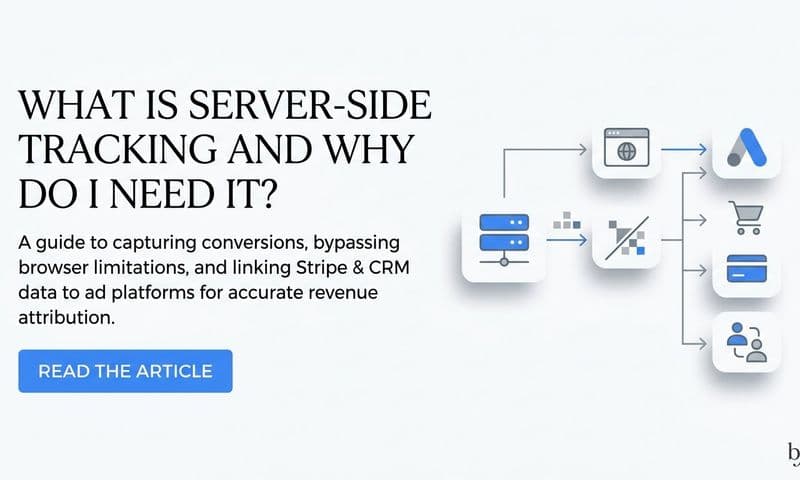
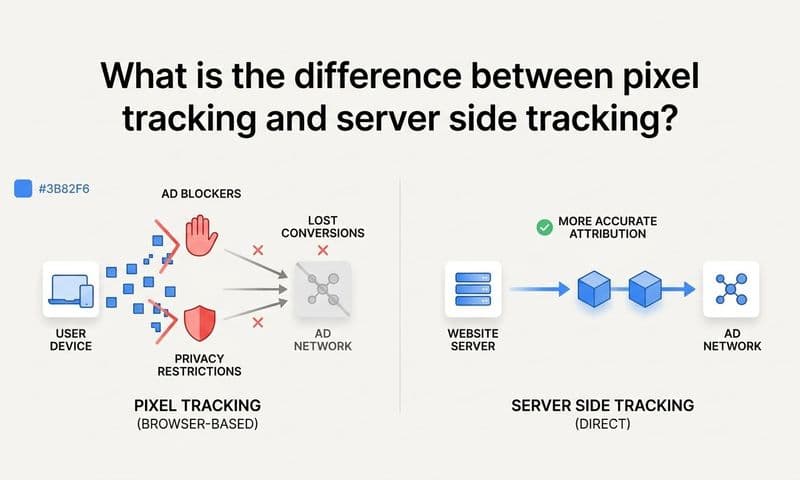
Server-side tracking forms the foundation that makes both approaches work reliably. Unlike browser-based pixels that get blocked by ad blockers, disabled by cookie restrictions, and limited by Intelligent Tracking Prevention, server-side tracking operates at the infrastructure level. Your server captures events directly, creating first-party data that bypasses browser limitations entirely.
This architectural shift matters enormously for cross-device tracking. Server-side tracking ensures you capture every touchpoint, even when browser-based tracking fails. It creates consistent user identifiers that persist across sessions and devices. And it gives you complete control over your data collection, independent of third-party cookie policies or browser privacy features.
Setting Up Your Cross-Device Infrastructure
Building effective cross-device tracking starts with connecting your marketing ecosystem into a unified data layer. Your ad platforms, website analytics, and CRM need to speak the same language and share user identifiers. This integration creates the foundation for following customers regardless of which device they're using.
Start by implementing server-side tracking across your digital properties. This means moving beyond simple pixel-based tracking to a robust infrastructure that captures events at the server level. When someone visits your website, interacts with your content, or completes a conversion action, your server logs these events with consistent user identifiers before sending them to your analytics platforms and ad channels.
The technical implementation requires coordination between your website, tracking platform, and ad accounts. You'll need to set up server-side tag management, configure event forwarding to your ad platforms, and ensure your CRM data flows into your attribution system. This infrastructure investment pays dividends by creating tracking that works regardless of browser settings or device type.
Creating consistent user identifiers becomes your next priority. Email capture strategies should exist at multiple points in the customer journey. Encourage account creation early by offering value in exchange for authentication. Use progressive profiling to gradually collect identifying information without creating friction. The goal is building a database of authenticated users whose devices you can definitively link.
First-party cookie strategies complement your authenticated tracking. Set cookies from your own domain rather than relying on third-party cookies that browsers increasingly block. These first-party cookies persist longer and face fewer restrictions, giving you reliable identifiers for users who haven't yet authenticated. Combined with server-side tracking, they create a robust tracking foundation that survives privacy updates. Learn more about tracking users without third-party cookies effectively.
Connect your CRM to your attribution platform so customer data enriches your tracking. When someone converts and enters your CRM, that authenticated data should flow back to your attribution system to definitively link all their previous anonymous touchpoints. This retroactive stitching reveals the complete journey from first anonymous visit through final authenticated conversion.
Your ad platform integrations need bidirectional data flow. Not only should your attribution system receive data from Meta, Google, and other channels, but it should also send enriched conversion data back. This feedback loop ensures ad platforms receive accurate, cross-device conversion signals that improve their optimization algorithms. When Meta knows that a mobile ad view contributed to a desktop conversion three days later, its AI can optimize more effectively.
Transforming Data Into Attribution Intelligence
Raw cross-device data becomes valuable only when you transform it into actionable attribution insights. This means moving beyond simplistic last-click models to multi-touch attribution that appropriately credits every touchpoint across every device in the customer journey.
Last-click attribution fails spectacularly in a multi-device world. It gives 100% credit to whichever touchpoint happened to occur immediately before conversion, completely ignoring the awareness campaigns, research sessions, and consideration touchpoints that happened on other devices. A customer might interact with your brand seven times across three devices, but last-click attribution credits only the final interaction and renders the rest invisible.
Multi-touch attribution models distribute credit across the entire journey. Linear models give equal credit to every touchpoint. Time-decay models give more credit to recent interactions while still acknowledging earlier ones. Position-based models emphasize the first touchpoint that introduced your brand and the last touchpoint that drove conversion, while giving partial credit to everything in between. Understanding attribution marketing tracking is essential for making this work.
The right attribution model depends on your business. Companies with long sales cycles benefit from models that credit early awareness touchpoints. Businesses with short consideration periods might emphasize recent interactions more heavily. The key is choosing a model that reflects how customers actually move through your funnel, then using cross-device data to apply that model accurately.
Analyzing complete customer journeys reveals patterns invisible in single-device tracking. You'll discover which channels consistently initiate journeys that convert days or weeks later on different devices. You'll identify which touchpoints move customers from awareness to consideration, even when the final conversion happens elsewhere. And you'll understand the true role of each channel in your marketing mix.
This journey analysis transforms budget allocation. Instead of pouring money into channels that simply capture existing demand, you can invest strategically in the touchpoints that create demand. Your awareness campaigns get proper credit for initiating valuable journeys. Your retargeting campaigns get right-sized budgets based on their actual role in closing sales rather than appearing to generate conversions they merely intercepted.
Use cross-device insights to identify your most valuable customer paths. Which combination of touchpoints across which devices produces the highest-value customers? Do mobile-first journeys convert differently than desktop-initiated paths? Understanding these patterns lets you optimize campaigns to encourage high-value journey patterns while reducing spend on paths that rarely convert.
Navigating Privacy and Technical Obstacles
Cross-device tracking faces significant challenges in the current privacy landscape. iOS updates, cookie deprecation, and browser tracking prevention have fundamentally changed what's possible with client-side tracking. Understanding these obstacles helps you build systems that maintain accuracy despite increasing restrictions.
iOS privacy changes starting with iOS 14.5 introduced App Tracking Transparency, requiring explicit user permission for cross-app tracking. Many users decline, creating gaps in traditional mobile tracking. The impact extends beyond apps to mobile web browsing, where Intelligent Tracking Prevention limits cookie lifespans and blocks many tracking mechanisms. Single-device tracking already struggles on iOS; cross-device tracking faces even steeper challenges. If you're losing tracking data from iOS users, you're not alone.
Server-side tracking provides the most reliable solution to these privacy restrictions. Because it operates at the infrastructure level rather than in the browser, server-side tracking bypasses many limitations that cripple pixel-based approaches. You capture events directly on your server before sending them to ad platforms, maintaining tracking accuracy even when browser-based methods fail.
Cookie deprecation across browsers creates another obstacle. Third-party cookies that historically enabled cross-site tracking face extinction. Chrome's planned deprecation, following Safari and Firefox, will eliminate a tracking mechanism many marketers relied on. First-party cookies persist longer but still face restrictions on lifespan and cross-domain usage.
The solution lies in authenticated, first-party data strategies. Focus on collecting email addresses, encouraging account creation, and building direct relationships with customers. When users authenticate, you create deterministic cross-device connections that don't depend on cookies or browser tracking. This first-party data foundation becomes increasingly valuable as third-party tracking mechanisms disappear.
Handling gaps in deterministic data requires combining authenticated touchpoints with probabilistic signals intelligently. You won't capture authenticated data for every user or every session. Probabilistic matching fills these gaps, but you need to understand its limitations. Use confidence scores to weight probabilistic connections appropriately in your attribution models. Validate probabilistic matches against known outcomes to calibrate accuracy.
Data accuracy validation should be continuous. Compare your cross-device attribution against actual conversion outcomes. Do customers you've identified as the same person across devices actually behave like a single user? Do your probabilistic matches correlate with eventual authenticated conversions? Regular validation helps you refine matching algorithms and maintain attribution accuracy as tracking environments evolve.
Implementing Cross-Device Tracking That Drives Results
Theory becomes valuable only when you put it into practice. Start your cross-device tracking implementation by focusing on your highest-value conversion actions and working backward to map the typical multi-device journey. What does the path to purchase actually look like for your best customers?
Analyze your existing data, even if it's incomplete. Look for patterns suggesting multi-device behavior: customers who research extensively before converting, time gaps between first visit and purchase, branded searches following paid social campaigns. These signals indicate cross-device journeys happening beneath the surface of single-device tracking.
Implement server-side tracking as your foundation. This technical infrastructure enables everything else. Work with your development team or tracking platform to set up server-side event collection, configure proper user identification, and establish data flows to your ad platforms and analytics tools. The upfront investment pays ongoing dividends in tracking accuracy.
Feed enriched, cross-device conversion data back to your ad platforms. When Meta, Google, and other channels receive accurate signals about which ads contributed to conversions across devices, their optimization algorithms improve dramatically. An ad platform that only sees final-click conversions optimizes toward bottom-funnel capture. An ad platform receiving full cross-device attribution data optimizes toward actual revenue generation. Explore how to handle tracking conversions across multiple ad platforms effectively.
This feedback loop creates compounding returns. Better data leads to better optimization, which drives better results, which generates more data to further improve optimization. Your campaigns become smarter over time as machine learning algorithms work with complete information rather than fragmented single-device signals.
Continuously refine your attribution model as you gather more cross-device journey data. Your initial model will be based on assumptions and limited data. As you collect more complete journey information, you'll discover actual patterns in how customers move across devices. Adjust your attribution weights to reflect these real behaviors rather than theoretical models.
Test different attribution approaches against business outcomes. Does linear attribution correlate better with customer lifetime value than time-decay? Do position-based models help you identify more profitable customer acquisition channels? Let actual results guide your attribution methodology rather than defaulting to industry standards that might not fit your specific business.
The Path Forward in Multi-Device Marketing
Tracking users across multiple devices has shifted from competitive advantage to fundamental requirement. Single-device attribution creates blind spots that lead directly to misallocated budgets and missed opportunities. The customer journey spans devices, and your tracking must follow.
The components are clear: server-side tracking provides the foundation that bypasses browser limitations and maintains accuracy despite privacy restrictions. Unified data infrastructure connects your ad platforms, website, and CRM into a cohesive system that follows users regardless of device. Multi-touch attribution analysis transforms raw cross-device data into actionable insights about what actually drives revenue.
Implementation requires technical investment and strategic commitment. You need infrastructure that captures events at the server level. You need authentication strategies that build first-party data. You need attribution models that credit the complete journey rather than just the final click. But the payoff is substantial: marketing decisions based on accurate data rather than fragmented guesses.
The marketers who master cross-device tracking will consistently outperform competitors still operating with single-device blind spots. They'll allocate budgets toward channels that create demand rather than merely capture it. They'll feed better data to ad platform algorithms, improving optimization and ROI. And they'll understand the true customer journey in a way that transforms campaign strategy.
Ready to elevate your marketing game with precision and confidence? Discover how Cometly's AI-driven recommendations can transform your ad strategy. Get your free demo today and start capturing every touchpoint to maximize your conversions.