

You've spent years building campaigns around third-party cookies. You've optimized audiences, retargeted visitors, and tracked conversions across dozens of sites. Now Safari blocks them by default. Firefox follows suit. And Chrome—the browser that powers over 60% of web traffic—has announced it's phasing them out entirely.
This isn't a hypothetical future problem. It's happening now.
But here's the thing: this shift isn't the end of accurate marketing measurement. It's the beginning of something better. Cookieless tracking solutions represent a fundamental evolution in how we collect and use data, moving away from surveillance-style tracking toward methods that respect privacy while delivering more accurate attribution.
If you're running paid campaigns across Meta, Google, TikTok, or any other platform, understanding cookieless tracking isn't optional anymore. It's how you'll maintain visibility into what's working, which channels drive real revenue, and where to allocate budget when the old tracking methods stop functioning.
This guide will walk you through exactly what cookieless tracking means, why the industry is moving this direction, and how to implement solutions that give you better data than you had before.
The Browser Wars Against Third-Party Cookies
Third-party cookies have been the backbone of digital advertising since the late 1990s. They allowed advertisers to follow users across the web, build audience profiles, and measure which ads led to conversions on completely different websites. For marketers, this cross-site tracking made attribution possible at scale.
Then the browsers started pushing back.
Safari introduced Intelligent Tracking Prevention in 2017, aggressively blocking third-party cookies and limiting first-party cookie lifespans to seven days. Firefox deployed Enhanced Tracking Protection in 2019, blocking known trackers by default for all users. These weren't minor updates—they fundamentally broke cross-site tracking for hundreds of millions of users.
Google Chrome held out longer, representing the last major holdout where third-party cookies still functioned normally. But in 2024, Google announced its plan to phase out third-party cookie support entirely. While the timeline has shifted multiple times, the direction is clear: third-party cookies are going away across all major browsers.
This creates an immediate problem for marketers who built their entire measurement stack around cookie-based tracking. When someone clicks your Facebook ad, visits your site, leaves without converting, then returns three days later through a Google search and makes a purchase, how do you connect those dots without cross-site cookies?
The answer isn't to panic. It's to understand why this change is happening and adopt cookieless tracking alternatives designed for this new reality.
Privacy regulations like GDPR and CCPA accelerated this shift by requiring explicit consent for tracking and giving users more control over their data. Consumers increasingly expect transparency about how their information is collected and used. Browser makers responded by building privacy protections directly into their products, making third-party cookie blocking the default rather than an opt-in feature.
For marketers, this means the cross-site tracking that powered retargeting campaigns and multi-touch attribution is becoming unreliable. You can't optimize what you can't measure, and you can't measure what browsers actively block.
How Cookieless Tracking Actually Works
Cookieless tracking isn't about finding sneaky workarounds to continue surveillance-style data collection. It's about fundamentally changing where and how you collect data, using methods that browsers don't block and that give you more control over data quality.
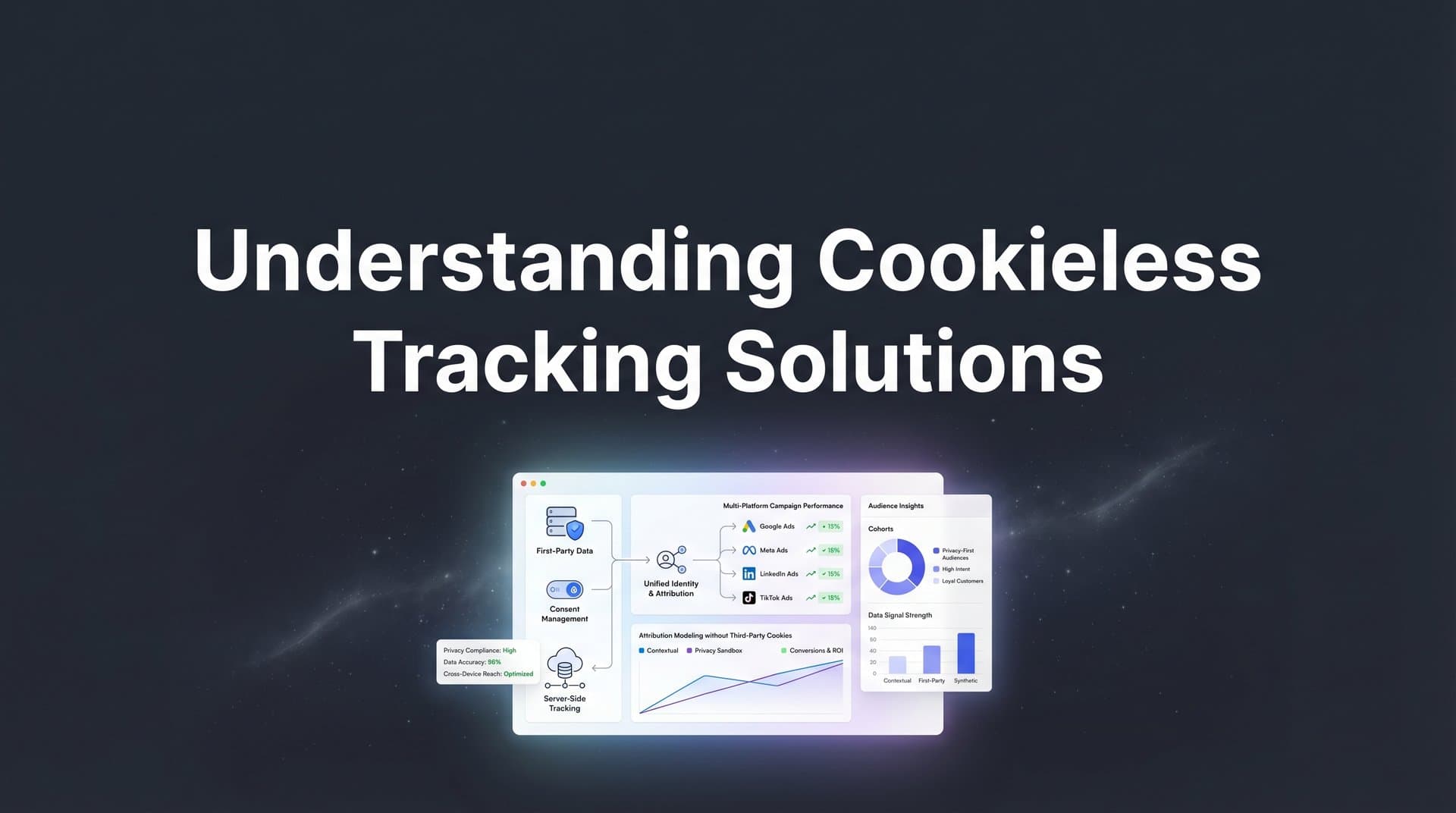
The foundation is first-party data collection. Instead of relying on third-party cookies that track users across multiple websites, you collect data directly from interactions on properties you own: your website, your app, your email campaigns. When someone fills out a form, makes a purchase, or signs up for your newsletter, that's first-party data. Browsers don't block it because users are intentionally interacting with your brand.
This seems obvious, but here's where it gets powerful: when you collect first-party data properly, you can build a complete picture of each customer's journey through your owned touchpoints. You know when they visited your site, which pages they viewed, what they downloaded, and when they converted. You're not tracking them across the entire internet—you're tracking their relationship with your brand.
Server-side tracking takes this further by moving data collection from the browser to your server. Traditional cookie-based tracking relies on JavaScript running in the user's browser, which is exactly what browser privacy features target and block. Server-side tracking bypasses this entirely by sending data directly from your server to your analytics platforms.
Think of it this way: instead of the user's browser telling Google Analytics about a conversion, your server tells Google Analytics. The browser never gets involved in the tracking process, so browser-based blocking doesn't affect it. This makes your data more accurate, more complete, and immune to ad blockers.
Server-side tracking also gives you control over exactly what data gets sent and when. You can enrich events with additional context from your CRM before sending them to ad platforms. You can filter out bot traffic. You can ensure that every conversion is tracked, even if the user has JavaScript disabled or uses aggressive privacy extensions.
Identity resolution is the piece that connects anonymous sessions to known users. When someone visits your site for the first time, you don't know who they are. But when they fill out a form or log in, you can retroactively connect their previous anonymous sessions to their known identity. This creates a unified customer journey that spans multiple visits and devices.
The key difference from third-party cookie tracking is that you're building these connections using data you collect directly, not data gathered by following users across unrelated websites. You're answering "how did this customer find us and what did they do before converting?" not "what else does this person do on the internet?"
The Main Types of Cookieless Tracking Solutions
Understanding the concept is one thing. Implementing it requires choosing the right technical approach for your business. There are three primary methods marketers use to track without third-party cookies, and most effective setups combine all three.
Server-Side Tracking Implementations: This is the most powerful cookieless solution because it completely bypasses browser limitations. Instead of relying on client-side JavaScript to fire tracking pixels, you send events from your server directly to analytics platforms and ad networks.
When someone converts on your site, your server receives that information first. It then sends conversion data to Meta's Conversions API, Google's server-side tracking, and your attribution platform, all from your server infrastructure. The user's browser never participates in the tracking process, which means browser privacy features can't interfere.
Server-side tracking requires more technical setup than dropping a pixel on your site, but the data quality improvement is substantial. You capture conversions that browser-based tracking misses. You can include additional customer data like lifetime value or subscription tier. And you maintain full control over your tracking infrastructure rather than depending on third-party scripts.
First-Party Data Strategies: This approach focuses on maximizing the value of data you collect directly from customer interactions. Your CRM becomes the central source of truth, connecting email engagement, website behavior, purchase history, and support interactions into unified customer profiles.
The strategy involves creating more opportunities to collect first-party data and using it more effectively. This might mean offering content downloads in exchange for email addresses, implementing progressive profiling in your forms, or using authenticated experiences where users log in to access personalized features. For a deeper dive, explore understanding first-party data tracking and how it transforms your measurement capabilities.
Once you have rich first-party data, you can use it for attribution by connecting CRM events back to marketing touchpoints. When someone converts, you don't just know they came from a Facebook ad—you know their entire journey from first touch through closed deal, because you've collected that data directly across your owned properties.
First-party data strategies also enable better audience targeting without third-party cookies. You can create lookalike audiences based on your actual customer data, sync customer lists to ad platforms for precise targeting, and build segments based on behavior you've observed directly rather than inferred from third-party data.
Probabilistic and Deterministic Matching: These are the techniques that connect the dots between anonymous and known user sessions. Deterministic matching uses definitive identifiers like email addresses or user IDs to link touchpoints with certainty. When someone clicks an email link and later converts on your site while logged in, you can deterministically connect those events to the same person.
Probabilistic matching uses patterns and signals to make educated guesses about identity when you don't have a definitive identifier. This might involve analyzing device fingerprints, IP addresses, browsing patterns, and timing to determine that two sessions likely belong to the same user.
The most effective attribution platforms use both approaches. Deterministic matching provides high-confidence connections when identifiers are available. Probabilistic matching fills gaps where deterministic methods can't connect the dots, using statistical models to estimate which touchpoints influenced which conversions.
The key is understanding that probabilistic matching is less precise than deterministic, but it's still far more accurate than having no visibility at all. When combined with server-side tracking and strong first-party data collection, it creates a comprehensive view of customer journeys that doesn't depend on third-party cookies.
What This Means for Marketing Attribution
Attribution is where cookieless tracking creates the biggest shift in how marketers make decisions. Multi-touch attribution models that relied on third-party cookies to connect touchpoints across different domains need fundamental rethinking.
The old approach tracked users across the web using third-party cookies, attributing credit to every ad click, organic search, and referral visit along the journey. When cookies stop working, you lose visibility into cross-domain touchpoints unless you implement cookieless solutions.
Server-side tracking changes this by ensuring that every conversion on your site gets tracked accurately, regardless of browser restrictions. But more importantly, it allows you to send enriched conversion data back to ad platforms with context they couldn't access before.
Here's what that looks like in practice: someone clicks your Meta ad, visits your site, and converts. With traditional pixel-based tracking, Meta might see the conversion but lacks detail about what happened after the click. With server-side tracking through Meta's Conversions API, you can send the conversion event along with customer lifetime value, product category, subscription tier, or any other data from your CRM.
This enriched data helps ad platforms optimize more effectively. Meta's algorithm can learn which audiences are most likely to become high-value customers, not just which audiences click ads. Google can optimize for revenue, not just conversions. Your attribution platform can connect ad clicks to actual business outcomes tracked in your CRM.
The attribution models that work best in cookieless environments prioritize first-touch and last-touch data you can verify directly, combined with modeling to estimate the influence of mid-funnel touchpoints. You're moving from "we tracked every interaction across the web" to "we tracked every interaction with our brand and modeled the rest."
This actually produces more accurate attribution for most businesses. Instead of giving credit to every random touchpoint a cookie happened to capture, you're focusing on meaningful interactions that demonstrate real engagement with your brand. You're measuring what matters. Learn more about understanding conversion tracking methods that work in this new environment.
The connection between ad platform data and CRM conversions becomes critical. When you can tie closed deals back to their originating ad campaigns, you stop optimizing for vanity metrics and start optimizing for revenue. You know which campaigns drive customers who actually buy, not just which campaigns drive clicks.
Feeding this conversion data back to ad platforms creates a virtuous cycle. Better data leads to better optimization, which leads to better results, which generates more data to optimize against. Platforms like Meta and Google explicitly recommend server-side tracking because it helps their algorithms perform better, which benefits both advertisers and the platforms themselves.
Implementing Cookieless Tracking for Your Campaigns
Understanding the theory is valuable. Implementation is where you actually maintain tracking accuracy as third-party cookies disappear. The process starts with an honest audit of your current setup.
Map every place you currently use third-party cookies for tracking. This includes retargeting pixels, cross-domain conversion tracking, audience building mechanisms, and attribution touchpoints. For each one, ask: will this still work when Chrome blocks third-party cookies? If the answer is no or uncertain, you need a cookieless alternative.
The gaps are usually obvious once you look. Cross-domain tracking between your main site and a separate checkout domain? That relies on third-party cookies. Retargeting pixels from ad platforms? Those use third-party cookies. Attribution platforms that track users across multiple sites? Built on third-party cookies.
Prioritizing first-party data collection means creating more touchpoints where users interact directly with your brand in ways you can track. This might involve implementing authenticated experiences, building email capture mechanisms that provide value in exchange for contact information, or using first-party data tracking for ads to gradually build richer customer profiles.
Server-side tracking infrastructure should be your top technical priority. For most businesses, this means implementing server-side tracking for major ad platforms first—Meta's Conversions API and Google's server-side tracking are the highest impact starting points.
The setup process involves configuring your server to send conversion events directly to these platforms. You'll need to capture conversion data on your server, format it according to each platform's API specifications, and send it with the appropriate identifiers and parameters. Many attribution platforms handle this automatically, sending events to multiple destinations from a single server-side integration.
Testing and validation are essential before you rely entirely on your new tracking setup. Run server-side tracking in parallel with your existing pixel-based tracking while both still work. Compare the data to identify discrepancies and ensure your server-side implementation captures everything your pixels currently track.
You'll likely find that server-side tracking captures more conversions than pixel-based tracking, especially from users with ad blockers or strict privacy settings. This is expected—it's the accuracy improvement you're implementing cookieless tracking to achieve.
Create a testing timeline that validates each component before moving to the next. Start with server-side conversion tracking for one ad platform. Verify the data matches your source of truth. Expand to additional platforms. Add attribution modeling. Layer in identity resolution. Each step should be validated before adding complexity.
Building a Future-Proof Measurement Framework
The transition to cookieless tracking isn't just about replacing cookies with server-side tracking. It's about building a measurement framework that doesn't depend on any single tracking method or technology that could be deprecated next.
Your measurement framework should be built on first-party data as the foundation. Everything you measure should ultimately connect back to data you collect directly from customer interactions on properties you own. Third-party data can supplement this, but it shouldn't be the core of your measurement strategy.
This means investing in your data infrastructure. Your CRM needs to be the central repository for customer data. Your website analytics should track authenticated user sessions. Your email platform should connect to your attribution system. Every touchpoint should feed into a unified view of the customer journey.
Choosing attribution tools designed for cookieless environments is critical. Look for platforms that prioritize server-side tracking, support multiple identity resolution methods, and integrate directly with your CRM and ad platforms. The tool should be able to track conversions accurately regardless of browser restrictions. A thorough cookieless tracking platforms comparison can help you evaluate your options.
Features to prioritize include native server-side tracking implementations, Conversions API integrations for major ad platforms, CRM connectivity for enriching conversion data, and support for both deterministic and probabilistic identity resolution. The platform should make it easy to send enriched conversion data back to ad platforms to improve their optimization.
Create a transition timeline that accounts for Chrome's deprecation schedule while acknowledging that dates may shift. The goal isn't to race against a specific deadline—it's to build a measurement system that works better than what you have now and will continue working regardless of future browser changes.
Start by implementing server-side tracking for your highest-value conversion events. Expand to mid-funnel events and engagement tracking. Build out identity resolution capabilities. Layer in attribution tracking best practices. Each phase should deliver immediate value while moving you toward a fully cookieless measurement framework.
The marketers who win in this transition aren't the ones who find clever workarounds to preserve cookie-based tracking. They're the ones who recognize that cookieless tracking produces better data and adopt it proactively, gaining competitive advantage while others scramble to maintain outdated methods.
Moving Forward with Confidence
The disappearance of third-party cookies isn't a crisis that forces you to accept worse data. It's an opportunity to build better measurement using methods you control, that respect user privacy, and that produce more accurate attribution than cookie-based tracking ever did.
Server-side tracking gives you complete visibility into conversions happening on your properties, immune to browser restrictions and ad blockers. First-party data strategies create richer customer profiles based on actual interactions with your brand. Identity resolution connects the journey without relying on surveillance-style cross-site tracking.
The marketers who adapt now will have a significant advantage when third-party cookies fully disappear. You'll have accurate attribution while competitors lose visibility. You'll feed better data to ad platforms while others see optimization performance decline. You'll make confident budget decisions based on complete customer journey data while others guess.
This isn't about preserving the old way of doing things. It's about embracing a better approach that aligns with where the industry is heading. Privacy-focused tracking that delivers accurate attribution isn't a compromise—it's an upgrade.
The technical implementation requires effort, but the strategic payoff is substantial. You'll know which campaigns drive real revenue. You'll optimize based on business outcomes, not proxy metrics. You'll build marketing measurement on a foundation that won't break when the next browser update ships.
Start with an audit of your current tracking setup. Identify where cookie deprecation creates gaps. Prioritize server-side tracking for your most important conversion events. Build from there, validating each component before adding complexity.
Ready to elevate your marketing game with precision and confidence? Discover how Cometly's AI-driven recommendations can transform your ad strategy—Get your free demo today and start capturing every touchpoint to maximize your conversions.


