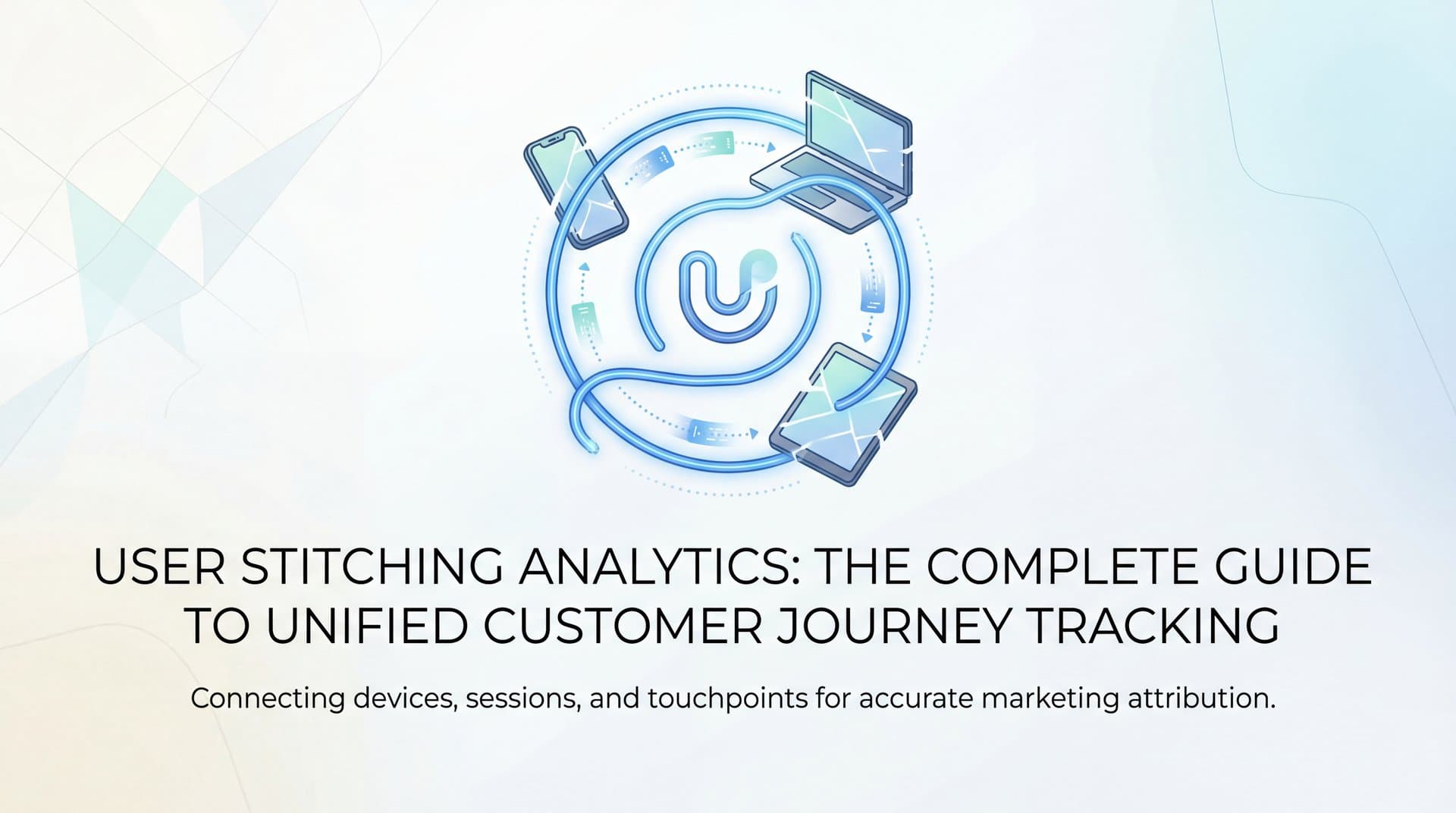
Picture this: A potential customer sees your Facebook ad during their morning commute, tapping through on their phone while waiting for coffee. Later that afternoon, they're at their desk researching your product on their laptop, comparing features and reading reviews. That evening, they finally convert on their tablet while relaxing on the couch. Your analytics dashboard? It sees three completely different people.
This isn't a hypothetical problem. It's the daily reality for marketers trying to understand which campaigns actually drive revenue. When your analytics tools can't connect these dots, you're not just dealing with messy data—you're making million-dollar decisions based on fiction.
User stitching analytics solves this identity crisis by connecting fragmented touchpoints into a single, coherent customer journey. Instead of seeing phantom users multiplying across your reports, you get the truth: one person, moving through your funnel across multiple devices and sessions. This isn't just about cleaner dashboards. It's about knowing which marketing efforts actually convert, which channels deserve more budget, and which attribution models reflect reality.
The Identity Puzzle: Why Customer Data Gets Fragmented
Your customers don't live in a single-device world, and they certainly don't limit themselves to one browser. They switch between phones, tablets, laptops, and desktops throughout their day. They use Chrome at work, Safari on their iPhone, and Firefox at home. Each switch creates a new identity in your analytics—a digital doppelganger that dilutes your understanding of the real customer journey.
Think about your own behavior. You might discover a product through an Instagram ad on your phone, research it on your work computer during lunch, and finally purchase it on your home laptop that evening. Traditional analytics tools see this as three separate users with three disconnected sessions. Your marketing team celebrates three engaged prospects when they actually only influenced one conversion.
The fragmentation runs deeper than just device switching. Privacy changes have fundamentally altered how tracking works across the digital ecosystem. Apple's App Tracking Transparency framework, introduced with iOS 14.5, gave users the power to opt out of cross-app tracking. Many did. Third-party cookies, the longtime backbone of digital tracking, are being phased out across major browsers. Chrome's ongoing deprecation of third-party cookies represents the final nail in the coffin for traditional tracking methods.
These privacy changes aren't just technical hurdles. They've created massive blind spots in customer journey data. When someone opts out of tracking or blocks cookies, traditional analytics can't follow them across touchpoints. Each interaction becomes an isolated event, disconnected from the broader journey. You lose the narrative thread that connects awareness to consideration to conversion.
The real cost of this fragmentation hits your bottom line hard. Inflated user counts make your acquisition costs look artificially low because you're counting the same person multiple times. Attribution breaks down completely when you can't connect a conversion back to the ad that started the journey. Budget allocation becomes guesswork when you don't know which channels are actually driving results. Understanding attribution challenges in marketing analytics is essential for overcoming these obstacles.
Worse, you end up retargeting people who already converted because your systems don't recognize them across devices. You waste ad spend chasing customers you've already won, while missing opportunities to re-engage people who showed genuine interest but haven't converted yet. The fragmentation creates a distorted view of reality that leads to distorted marketing decisions.
How User Stitching Actually Works
User stitching—also called identity resolution or identity stitching—is the process of connecting scattered data points into unified customer profiles. It's the technology that says "these five different sessions across three devices are actually the same person." But how does it actually accomplish this digital detective work?
The most reliable approach is deterministic stitching, which uses known identifiers to match users with certainty. When someone logs into your website or app, they provide a concrete link between their current session and their identity. Email addresses, phone numbers, customer IDs, and login credentials serve as definitive proof that two sessions belong to the same person.
Let's say a customer creates an account on your site using their work laptop, then later logs in on their phone to make a purchase. The login event on both devices provides the definitive connection. Your analytics platform can now confidently say that the research session on the laptop and the conversion on the phone belong to the same customer. No guesswork required.
The challenge with deterministic stitching is that it only works when users actually log in or provide identifying information. Many customer journeys include anonymous touchpoints—ad clicks, initial website visits, content browsing—before any login occurs. This is where probabilistic stitching comes into play.
Probabilistic stitching analyzes patterns and signals to make educated guesses about identity. It looks at device fingerprints (the unique combination of browser type, screen resolution, installed fonts, and system settings), IP addresses, browsing patterns, and behavioral signals. When multiple sessions share enough characteristics, the system assigns them a probability score for belonging to the same user. Modern cross device user tracking solutions leverage both approaches for maximum accuracy.
For example, if two sessions come from the same IP address, use similar device configurations, visit the same pages in sequence, and occur at similar times of day, there's a high probability they're the same person. The system won't be 100% certain without a deterministic identifier, but it can be confident enough to connect the dots.
The most sophisticated user stitching systems combine both approaches. They use deterministic matching wherever possible for high-confidence connections, then layer in probabilistic methods to fill the gaps. This hybrid approach maximizes coverage while maintaining accuracy.
All of this stitching work culminates in an identity graph—a unified profile that maps all the touchpoints, devices, and identifiers associated with a single customer. Think of it as a relationship database that stores every known connection between identifiers. When a new session occurs, the system checks the identity graph to see if any identifiers match existing profiles, then adds the new touchpoint to the appropriate customer journey.
The identity graph continuously evolves as new data arrives. When someone who previously browsed anonymously finally logs in, the system can retroactively connect all their previous sessions to their now-known identity. Past behavior gets stitched into the complete picture, revealing the full journey from first touch to conversion.
From Clicks to Revenue: User Stitching in Marketing Attribution
Here's where user stitching transforms from a technical capability into a marketing superpower. Without stitching, your attribution is fundamentally broken. You see ad clicks that never convert, conversions that appear from nowhere, and a massive gap in the middle where the actual customer journey happened.
Consider a typical B2B customer journey. Someone clicks your LinkedIn ad, visits your pricing page, downloads a whitepaper, attends a webinar, and finally converts two weeks later after a sales call. If each of these touchpoints appears as a different anonymous user, your attribution model has no way to connect them. The LinkedIn ad gets no credit for starting the journey. The webinar looks like it attracted a brand new prospect rather than nurturing an existing lead. The conversion appears to come from direct traffic or organic search.
User stitching fixes this by connecting the dots. When that conversion finally happens and the customer provides their email address, the system can work backwards through the identity graph. It finds the webinar registration with the same email, then connects that to the whitepaper download based on device fingerprints and behavioral patterns, which links back to the original LinkedIn ad click. Suddenly, you see the complete journey—and you can accurately attribute value to each touchpoint. This is the foundation of effective marketing attribution analytics.
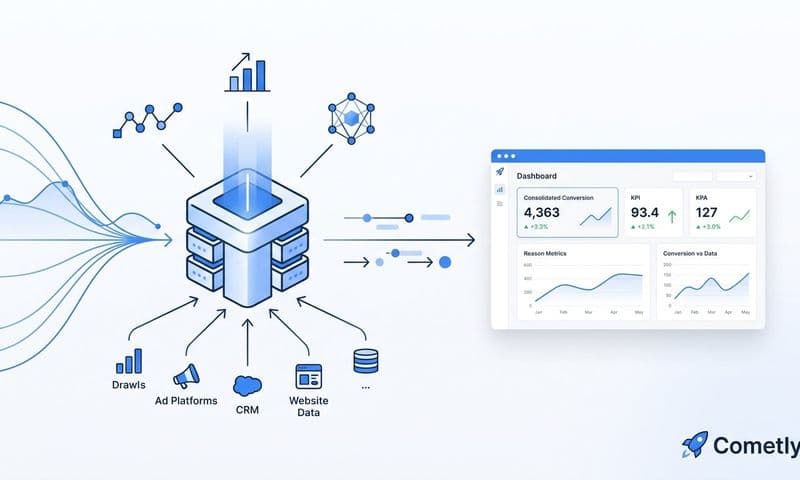
This becomes especially powerful when you connect anonymous ad clicks to CRM conversions and actual revenue. Your ad platforms know someone clicked, but they don't know if that click led to a $500 sale or a $50,000 enterprise deal. With stitched data, you can send enriched conversion events back to ad platforms that include revenue values, customer lifetime value predictions, and other business metrics.
Meta's Conversion API and Google's Enhanced Conversions were built specifically to receive this kind of enriched data. When you feed these platforms complete, accurate conversion information—including revenue values and customer identifiers—their algorithms optimize better. They learn which audiences and creative approaches actually drive valuable customers, not just clicks or form fills.
Multi-touch attribution models depend entirely on having connected customer journeys. Whether you're using first-touch, last-touch, linear, time-decay, or algorithmic attribution, the model needs to see the complete path from awareness to conversion. User stitching provides that complete path. It shows which channels work together to drive conversions, which touchpoints play supporting roles, and which interactions are truly influential versus merely present.
The impact extends beyond just understanding the past. When you know which combinations of touchpoints lead to conversions, you can design better customer journeys. You can identify where prospects typically drop off and add nurturing touchpoints. You can see which channel sequences work best for different customer segments. You can test new approaches with confidence because you're measuring the full journey, not just isolated interactions.
Building Your User Stitching Foundation
Implementing effective user stitching starts with collecting the right data at the right touchpoints. You need first-party identifiers—the known data points that enable deterministic matching. This means capturing email addresses, phone numbers, and customer IDs whenever users provide them, whether through account creation, newsletter signups, form submissions, or purchases.
Server-side tracking has become essential for reliable data collection. Unlike client-side tracking that runs in the browser and can be blocked by ad blockers or privacy settings, server-side tracking sends data directly from your servers to analytics platforms. This approach is more reliable, more privacy-compliant, and provides better data quality for identity resolution. Proper event tracking in Google Analytics forms the backbone of this data collection strategy.
Your CRM integration is equally critical. The CRM is where anonymous prospects become known customers, where you capture the definitive identifiers that enable stitching. When someone fills out a demo request form, downloads gated content, or makes a purchase, that's your opportunity to connect their previous anonymous behavior to their actual identity. Your user stitching system needs real-time access to these CRM events to build complete customer profiles. Learning how to integrate Google Analytics with Salesforce can dramatically improve your data connectivity.
Creating consistent identity keys across your marketing stack requires some strategic planning. Different platforms use different identifier formats—email addresses might be lowercase in one system and mixed case in another, phone numbers might include country codes or not. You need standardization rules that normalize these identifiers so they match reliably across systems.
The technical foundation also requires thinking about data persistence and storage. Identity graphs need to retain historical connections even as new data arrives. When someone uses a new device for the first time, the system should be able to recognize them based on login credentials and connect this new device to their existing profile. This requires robust data infrastructure that can handle the constant updating and querying that identity resolution demands.
Privacy compliance isn't optional—it's foundational. GDPR, CCPA, and other privacy regulations require explicit consent for data collection and clear policies about how identity data is used. Your user stitching implementation needs consent management that respects user choices. When someone opts out or requests data deletion, your identity graph must honor that across all connected touchpoints.
The good news is that first-party data strategies align well with privacy regulations. When customers provide their information directly to you—through account creation, purchases, or explicit consent—you have a legitimate basis for using that data. User stitching based on first-party identifiers is more privacy-compliant than third-party tracking methods that follow users across unrelated websites.
Measuring Success: KPIs That Prove Stitching Is Working
How do you know if your user stitching is actually working? Start with identity resolution rates—the percentage of sessions that successfully get matched to known user profiles. A healthy resolution rate depends on your business model, but you should see steady improvement over time as your identity graph grows and your data collection improves. Tracking the right marketing analytics metrics helps you measure this progress accurately.
Match quality scores matter just as much as match rates. Not all identity matches are equally confident. Deterministic matches based on login data have near-perfect accuracy. Probabilistic matches based on behavioral patterns have varying confidence levels. Track the distribution of match types and confidence scores to understand the reliability of your stitched data.
The real proof comes from comparing attribution before and after implementing user stitching. Look at how conversion paths change when you can see complete journeys instead of fragmented sessions. Many marketing teams find that channels they thought were underperforming were actually playing crucial early-stage roles that only become visible with proper stitching.
Your unique user counts should decrease—and that's a good thing. If you were counting the same person three times across three devices, proper stitching will collapse those into one user. This might make your traffic numbers look smaller, but your conversion rates will look more accurate. You'll finally see true user engagement rather than inflated session counts.
Ad platform performance provides another validation point. When you start sending enriched conversion data back to platforms like Meta and Google, watch for improvements in ROAS, cost per acquisition, and conversion rates. The algorithms optimize better when they receive complete, accurate signals about which users actually convert and what they're worth. Building effective data analytics dashboards helps you visualize these improvements in real time.
Customer lifetime value calculations become more accurate with stitched data. When you can see complete customer journeys—from first touch through multiple purchases—you can build better predictive models. This improved CLV understanding should inform your bidding strategies and budget allocation across channels.
Putting It All Together: Your Path to Unified Analytics
User stitching analytics isn't just a technical upgrade to your measurement stack. It's the difference between making marketing decisions based on fragmented guesses and making them based on complete customer journeys. When you can see how people actually move through your funnel—across devices, sessions, and touchpoints—you unlock a level of insight that fragmented data simply cannot provide.
The implementation priorities are clear. Start with your data collection foundation: implement server-side tracking, capture first-party identifiers at every opportunity, and integrate your CRM with your analytics platforms. Build consistent identity keys across your marketing stack so that data flows cleanly between systems. Invest in privacy compliance from the beginning, not as an afterthought. A proper attribution analytics implementation ensures all these pieces work together seamlessly.
Focus on connecting your ad platforms to your conversion data. The gap between ad clicks and revenue is where most attribution breaks down. When you can send enriched conversion events back to ad platforms—complete with revenue values and customer identifiers—you close that gap. Your campaigns optimize toward actual business outcomes instead of vanity metrics.
The competitive advantage of unified customer journey data cannot be overstated. While your competitors work with fragmented analytics that show phantom users and broken attribution, you'll see the truth. You'll know which marketing efforts actually drive revenue. You'll allocate budget based on real performance, not guesswork. You'll optimize campaigns with confidence because your data reflects reality.
This transformation doesn't happen overnight, but it doesn't require years either. Modern attribution platforms have automated much of the heavy lifting around user stitching and identity resolution. The technology exists to connect your touchpoints, build identity graphs, and deliver unified analytics. The question isn't whether it's possible—it's whether you're ready to see your marketing performance clearly.
Your Next Step Toward Marketing Clarity
User stitching analytics represents a fundamental shift in how marketers understand their customers. It's the foundation that makes accurate attribution possible, that enables AI-driven optimization, and that transforms scattered data points into actionable insights. The fragmented analytics era is ending—not because privacy regulations killed it, but because marketers demanded better.
The teams winning in today's marketing landscape aren't just running more ads or testing more creative. They're seeing complete customer journeys while others work blind. They're feeding their ad platforms enriched conversion data that drives better optimization. They're making budget decisions based on actual revenue attribution, not last-click vanity metrics.
This is where platforms built for the modern privacy landscape make all the difference. Cometly captures every touchpoint—from ad clicks to CRM events—and automatically stitches them into unified customer journeys. The AI analyzes these complete journeys to identify which ads and campaigns actually drive revenue, then provides recommendations you can act on immediately. You're not just collecting data; you're feeding ad platform algorithms the enriched conversion events they need to optimize effectively.
Ready to elevate your marketing game with precision and confidence? Discover how Cometly's AI-driven recommendations can transform your ad strategy—Get your free demo today and start capturing every touchpoint to maximize your conversions.