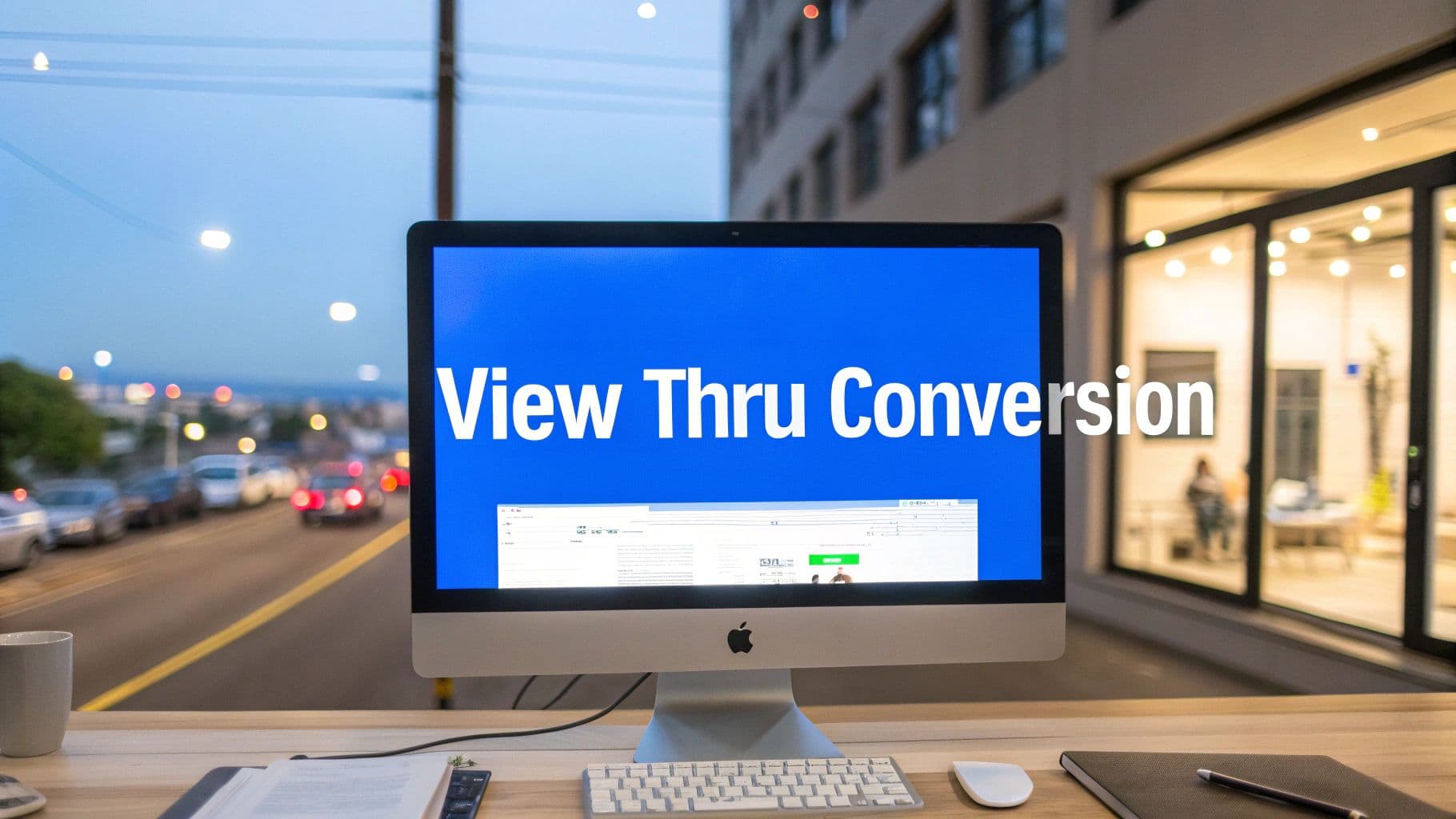
A view-thru conversion is what happens when someone sees your ad, doesn’t click on it, but later shows up on your website to buy something anyway. It’s the metric that finally measures the subtle, often subconscious, power of your display and video ads, showing you how brand visibility turns into real action, even without a click.
The Hidden Value of Ads That Aren't Clicked
 What Is a View Thru Conversion and How Does It Work?
Ever wonder if your ads are actually working when nobody seems to be clicking? A lot of marketers fall into the trap of measuring success only through direct clicks, leaving a huge piece of the performance puzzle on the table. This tunnel vision completely misses the powerful brand-building effect that visual ads have.
Clicks only tell part of the story. The other part is told by the view-thru conversion (VTC), a metric that gives credit to conversions from people who saw your ad but didn't engage with it directly.
Think of it as the digital version of brand recall. Someone is scrolling through their feed and sees your banner ad for a new pair of running shoes. They scroll right past it, but the image sticks. The next day, they open a new tab, type your brand’s name into Google, and make a purchase. That’s a VTC.
Why Impressions Matter More Than You Think
If you ignore VTCs, you risk cutting the budget on campaigns that are quietly building your brand and teeing up future customers. These conversions prove the "halo effect" of your advertising—that a simple impression can be just as valuable as a click in the long run. The key difference between an impression vs. a click is that one builds awareness while the other signals immediate intent.
This metric is especially critical for understanding the true return on investment (ROI) for certain ad types:
- Display Campaigns: Banners and other visual ads on websites often work by planting a seed that grows into a sale later.
- Video Advertising: A quick video ad can create a lasting brand impression that leads to a conversion days or even weeks down the road.
- Social Media Ads: Ads seen in a social feed can influence buying decisions without ever getting a click.
Unlike click-throughs, VTCs give credit to users who saw an ad within a specific time frame—usually up to 30 days—without clicking. In fact, benchmarks from Google Ads show that view-through tracking can account for 30-50% of total conversions in display campaigns, which is a massive chunk of performance to ignore.
Understanding View Thru vs Click Thru Conversions
To really get a handle on your ad spend's true impact, you have to know the difference between the two main ways we measure ad success: the view-thru conversion (VTC) and the click-thru conversion (CTC). While both end with a sale or a sign-up, their journeys couldn't be more different.
Think of it this way: you’re driving down the highway and see a billboard for a new coffee shop. You don’t slam on the brakes and pull over, but the image of that perfect latte sticks with you. The next day, you remember the sign, look up the shop, and go buy a coffee. That's a classic view-thru conversion—the ad planted a seed that grew into a sale later on.
Now, imagine you get a flyer for that same shop, but this time it has a QR code for a 10% discount. You scan it on the spot, place an order on their site, and go pick it up. That direct, measurable action is a click-thru conversion.
The Action Taker vs The Brand Rememberer
The core difference here boils down to user intent and interaction. A click-thru conversion is clean and simple. The user saw an ad, wanted what it offered, and clicked to get it. This is the world of direct response, measuring how effective your call-to-action is in that exact moment.
A view-thru conversion, on the other hand, measures the lingering influence of your ad. It captures the often-overlooked value of brand awareness and recall. This metric tells you your ad was memorable enough to drive someone to act later, even without a direct click. For a deeper dive, our guide on post-view conversions breaks it down even further.
A click-thru conversion proves your ad was persuasive. A view-thru conversion proves your ad was memorable. Both are critical for a complete picture of your marketing effectiveness.
To help you quickly tell them apart, here's a simple breakdown of how View Thru and Click Thru Conversions stack up against each other.
View Thru Conversion vs Click Thru Conversion at a Glance
This shows that VTCs are all about the long game—building your brand's presence in a customer's mind—while CTCs are focused on getting that immediate win.
View Thru Conversion (VTC) happens when a user sees an ad but doesn’t click it. They convert later within the attribution window, and the conversion is credited based on the impression. VTC is mainly used to measure brand awareness, ad recall, and top-of-funnel influence, making it most common for campaigns like display ads, video ads, and social media ads.
We compare the leading options in our AI banner ad generator roundup.
Click Thru Conversion (CTC) happens when a user clicks an ad and then converts shortly after. This measures how persuasive the ad is and how well it drives direct response. CTC is primarily used for immediate sales and lead generation, and it’s most common in search ads, shopping ads, and retargeting campaigns.
Why This Distinction Matters
Separating these two metrics is the key to building a more sophisticated attribution strategy. A campaign with a high CTC is fantastic for driving sales right now. But a campaign with a high VTC is a powerful brand-building machine, creating future customers who will eventually seek you out on their own.
While it's crucial to measure the impact of ad views, don't forget the other side of the coin. You can explore powerful strategies to improve click-through rate (CTR) to make your direct response campaigns even stronger. By valuing both types of conversions, you can balance your budget to support both immediate revenue and long-term brand growth, ensuring no part of your ad's influence goes unnoticed.
How Ad Platforms Actually Track Ad Views
Ever wondered how just seeing an ad can get credit for a sale days later? It feels a bit like magic, but it all comes down to two simple pieces of tech working together: tracking pixels and browser cookies.
Here’s the breakdown. When someone lands on a webpage displaying your ad, a tiny, invisible 1x1 pixel fires off. This little messenger talks to the ad platform and drops a cookie on that person’s browser. Think of this cookie as a digital breadcrumb, marking the exact moment a specific user saw your ad.
But that impression is just the first step. For a view-thru conversion to get logged, that same person has to eventually find their way back to your website and do something important, like make a purchase. When they convert, another tracking pixel on your site spots the cookie left from the ad view, connects the dots, and officially records a VTC.
This diagram shows just how different the journey is for someone who sees an ad versus someone who clicks one.
 What Is a View Thru Conversion and How Does It Work?
As you can see, the paths are fundamentally different. That’s why you absolutely need to measure both to get the full story on your ad performance.
The Lookback Window
Let's be real—an ad someone saw six months ago probably didn't influence today's purchase. This is where the lookback window comes in. It’s a set timeframe where a conversion can be fairly attributed back to an ad view.
Typically, this window is set somewhere between one and 30 days. If a user converts within that period without clicking any other ads from you, the original impression gets the credit. A shorter window gives you more conservative data, while a longer one helps capture sales for products that people take more time to decide on.
What Actually Counts as a "View"
Not every ad impression is created equal. For an impression to even be in the running for a VTC, it has to be considered "viewable."
The industry standard, used by giants like Google and Meta, defines a viewable impression as one where at least 50% of the ad's pixels are on the screen for at least one continuous second.
This standard is a big deal. It filters out all those ads that load at the bottom of a page a user never even scrolls to. The catch? Different platforms can sometimes measure viewability in slightly different ways, which can lead to conflicting VTC numbers. This makes a unified, server-side tracking approach more important than ever. You can learn more about the complexities in our guide to Facebook ad tracking and its reporting.
View-through conversions really came into the spotlight when Google started using them to fight the "viewability" crisis in display advertising. As click-through rates fell, VTCs emerged as a vital sign of an ad's silent influence. In some high-performing Google Ads campaigns, VTCs have been shown to account for up to 35% of total conversions. You can find more marketing statistics like this over at HubSpot.
We break down the leading options in our AI display ad generator guide.
Common Mistakes in Measuring View-Thru Conversions
While view-thru conversions offer a much deeper look into ad performance, the path to measuring them accurately is loaded with potential pitfalls. Just adding the VTC column to your reports isn't going to cut it. Marketers need to be aware of the common errors that can easily skew data and lead to some pretty bad strategic decisions.
One of the biggest traps is over-attribution. This is what happens when an ad gets credit for a conversion it barely influenced. Imagine a user who was already dead set on buying from you. They might see one of your display ads flash for a second right before they convert. The ad didn't cause the sale, but it still gets the credit, making your campaign look way more successful than it actually was.
This issue highlights a huge difference from click-based attribution. If you're used to the certainty of a direct click, it's worth understanding models that often hog all the credit. Our guide on last-click attribution offers more context on this traditional approach.
Under-Attribution and Data Gaps
On the flip side, under-attribution is just as dangerous. This is when an ad's true impact gets missed completely. A classic example is a cross-device conversion—someone sees your ad on their phone during their morning commute but makes the purchase later that night on their desktop. Without sophisticated tracking, those two touchpoints look like they came from separate users, and the initial ad view never gets the credit it deserves.
These attribution headaches are often made worse by other technical issues that muddy the waters.
- Ad Fraud: Bot traffic can rack up millions of fake impressions. If you’re not filtering it out, this fraudulent activity can make your view-thru conversion numbers look amazing on paper while delivering absolutely zero real-world value.
- Viewability Issues: Just because an ad loads on a page doesn't mean it was ever actually seen. If you haven't properly configured and monitored your viewability standards, you could be giving conversion credit to ads that never even appeared on a user's screen.
- Incorrect Lookback Windows: Setting a lookback window that’s too long can be a disaster. A 30-day window for a low-cost, impulse-buy product, for example, will inevitably end up crediting conversions that were likely influenced by completely different marketing channels.
The core mistake is treating a view-thru conversion as an exact science without respecting its complexities. It’s an indicator of influence, not a definitive measure of causation, and it demands careful interpretation.
Ultimately, navigating these common mistakes requires a shift in mindset. Instead of seeing VTC data as absolute proof, treat it as a powerful directional signal. When you combine it with your other metrics, it helps paint a much more complete and honest picture of your advertising impact.
How to Use VTC Data for a Smarter Ad Strategy
 What Is a View Thru Conversion and How Does It Work?
Knowing what a view-through conversion is and how it’s tracked is only half the battle. The real magic happens when you turn that data into smarter marketing decisions. By moving beyond a simple last-click mindset, you can start optimizing for the full impact of your advertising, not just the final interaction.
The first step is to sync your lookback windows with your typical sales cycle. A 30-day window might be perfect for a high-consideration product like a new car, but it’s probably way too long for an impulse buy like a T-shirt. Setting a realistic window ensures you’re attributing influence accurately, not just capturing coincidental sales.
Uncovering Hidden Campaign Winners
Once your settings are dialed in, it's time to dig into your VTC data. Don't just look at the total number; segment it by campaign, ad group, and even individual creatives. This is where you’ll find your hidden gems.
You might discover a video campaign with a low click-through rate but a massive number of VTCs. In a click-only world, this campaign looks like a dud. But with VTC data, you can see it’s a powerful brand awareness tool that’s successfully planting seeds for future sales.
A campaign with high VTCs and low clicks isn't underperforming—it's building brand equity. This insight allows you to justify budgets for top-of-funnel initiatives that create future customers instead of just capturing existing demand.
This isn't just theory. Top websites often see conversion rates of 5.31% versus the 2.35% average, partly because they're properly attributing VTCs from their display ads. For some B2B eCommerce brands, VTCs have been shown to add up to 40% more attributed revenue.
We compare the leading options in our ecommerce video ad generator roundup.
Communicating Value to Stakeholders
Using VTC data also means changing the conversation internally. Many stakeholders are conditioned to focus only on last-click metrics because they feel direct and simple. It's your job to show them the bigger picture.
Here’s how to frame the discussion:
- Highlight the Brand-Building Role: Explain that VTCs measure an ad's memorability—its power to influence a purchase decision hours, days, or even weeks later.
- Show the Connection to Clicks: Point out how campaigns with high VTCs often lead to a rise in branded search traffic and direct website visits down the line. It's the assist that leads to the goal.
- Focus on Holistic Performance: Emphasize that a healthy marketing strategy needs both brand-building campaigns (measured by VTCs) and direct-response campaigns (measured by CTCs). They work together.
This approach is central to data-driven growth marketing, which is all about turning analytics into actionable growth. Your VTC data is a rich source of insights just waiting to be turned into a strategic advantage.
To learn more about connecting your ad performance to real business outcomes, check out our complete guide on how to measure ad effectiveness.
Unifying Your Attribution with Better Tracking Tools
Trying to make sense of view-through conversions—from cross-device journeys to platform discrepancies—can feel like building a puzzle with pieces from different boxes. Every ad platform reports its own version of the truth, leaving you with data silos that make seeing the full customer journey next to impossible. This is where modern attribution platforms completely change the game.
Tools like Cometly are designed to demolish these silos and create a single, reliable source of truth. By pulling together data from every touchpoint, they solve the core challenges of VTC measurement and give you a clear, accurate picture of what’s actually driving results.
The Power of a Single Source of Truth
The biggest win you get from a dedicated attribution tool is centralized tracking. Instead of juggling fragmented, browser-based pixels from each ad network, these platforms use robust server-side tracking. This approach is far more reliable because it logs events directly from your server, bypassing browser restrictions, ad blockers, and cookiepocalypses.
What does that mean for you? You capture more data with higher accuracy, ensuring that both view-through and click-through conversions are recorded consistently across all channels. You can finally see how a view on one platform influences a conversion that happens somewhere else entirely.
A unified dashboard doesn't just combine reports; it synthesizes data to reveal the entire customer story. It shows how a view-through conversion on a display ad may have led to a branded search, which then resulted in a final purchase—a journey that would otherwise be invisible.
This dashboard from Cometly shows how you can see data from every ad platform in one place, providing a unified view of performance.
This unified view eliminates the need to reconcile conflicting reports, letting you make confident, data-driven decisions about your ad spend.
Closing the Loop with Ad Platforms
Beyond just tracking, advanced tools also feed accurate conversion data back to platforms like Google and Meta. Features like one-click conversion syncing ensure these platforms receive a clean, complete dataset—including properly attributed VTCs.
This feedback loop is critical for campaign optimization. When ad platforms have better data, their algorithms get smarter. They can more effectively target users who are likely to convert, whether through a click or a view, leading to:
- Improved Ad Targeting: Reaching audiences with higher purchase intent.
- Lower Customer Acquisition Costs: Reducing wasted ad spend on ineffective impressions.
- Better ROI: Maximizing the impact of every dollar you invest.
Ultimately, unifying your attribution empowers you to move beyond guesswork and confidently prove the full value of your advertising efforts.
Of course. Here is the rewritten section, crafted to sound like it was written by an experienced human expert.
Common Questions About View-Through Conversions
Even when you've got the basics down, the world of view-through conversions can still feel a bit murky. Let's clear up some of the most common questions that pop up when marketers start digging into this metric.
Are View-Through Conversions Even Accurate?
This is the big one, and the honest answer is: it depends entirely on your setup.
Think of it like this: if you’re just looking at the default numbers from an ad platform without any context, you're flying blind. But when you measure them correctly—using sensible lookback windows, solid viewability standards, and a reliable tracking tool—they become an incredibly valuable signal of your ad's subtle influence.
The danger lies in not having the right controls. Without them, you can easily over-credit conversions that were going to happen anyway. The best way to dial in the accuracy is to use a unified attribution platform that sees the whole picture, not just one channel's version of the truth.
What's a Good View-Through Conversion Rate?
There's no magic number here. A "good" VTC rate is completely relative and changes wildly based on your industry, campaign goals, ad placements, and how long it takes for your customers to make a decision. Chasing a universal benchmark is a fool's errand.
Instead, shift your focus from the number itself to the ratio.
A much smarter approach is to compare your view-through conversions (VTCs) to your click-through conversions (CTCs). That ratio tells a story. It reveals the real branding lift of a campaign and helps you understand if an ad is better at sparking immediate action or building brand memory that pays off down the road.
How Is a VTC Different From an Impression?
This is a critical distinction, so let's make it simple.
An impression is just your ad showing up on someone's screen. It’s the cause.
A view-through conversion is the effect. It’s the sale, signup, or whatever action you're tracking that happens after someone saw your ad but didn't click. The impression is the touchpoint; the VTC is the outcome you measure because of that touchpoint.
Why Do All My Ad Platforms Report Different VTC Numbers?
If you've ever pulled reports from Google, Meta, and TikTok, you know the frustration. The numbers never match up.
This happens because each ad platform is its own walled garden. They all use their own tracking methods, have different default lookback windows, and apply their own unique rules for attribution.
Each platform can only see its tiny piece of the customer journey, which inevitably leads to conflicting data and double-counting. This is exactly why a centralized, third-party tracking tool isn't just a nice-to-have—it's essential for getting a single, reliable source of truth.
Ready to break down those data silos and see the true impact of every single ad you run? Cometly gives you one source of truth for all your marketing attribution, pulling view-through, click-through, and organic touchpoints into a single, powerful dashboard. Get the clarity you need to scale your business with confidence.