Your data warehouse knows everything about your customers. It knows which leads turned into six-figure deals. It knows which product purchases led to repeat buyers. It knows the exact customer journey from first click to final conversion—complete with revenue data, lead scores, and lifetime value metrics.
Meanwhile, your ad platforms are flying blind.
They're making million-dollar optimization decisions based on incomplete pixel data that captures maybe 60% of conversions if you're lucky. They're treating a $500 customer the same as a $50,000 enterprise deal because they can't see the difference. They're building lookalike audiences from surface-level signals while your richest customer intelligence sits unused in Snowflake or BigQuery.
This disconnect isn't just frustrating—it's expensive. Every day your warehouse data stays siloed is another day ad platforms optimize on partial information, pushing budget toward low-quality traffic while missing the patterns that actually drive revenue.
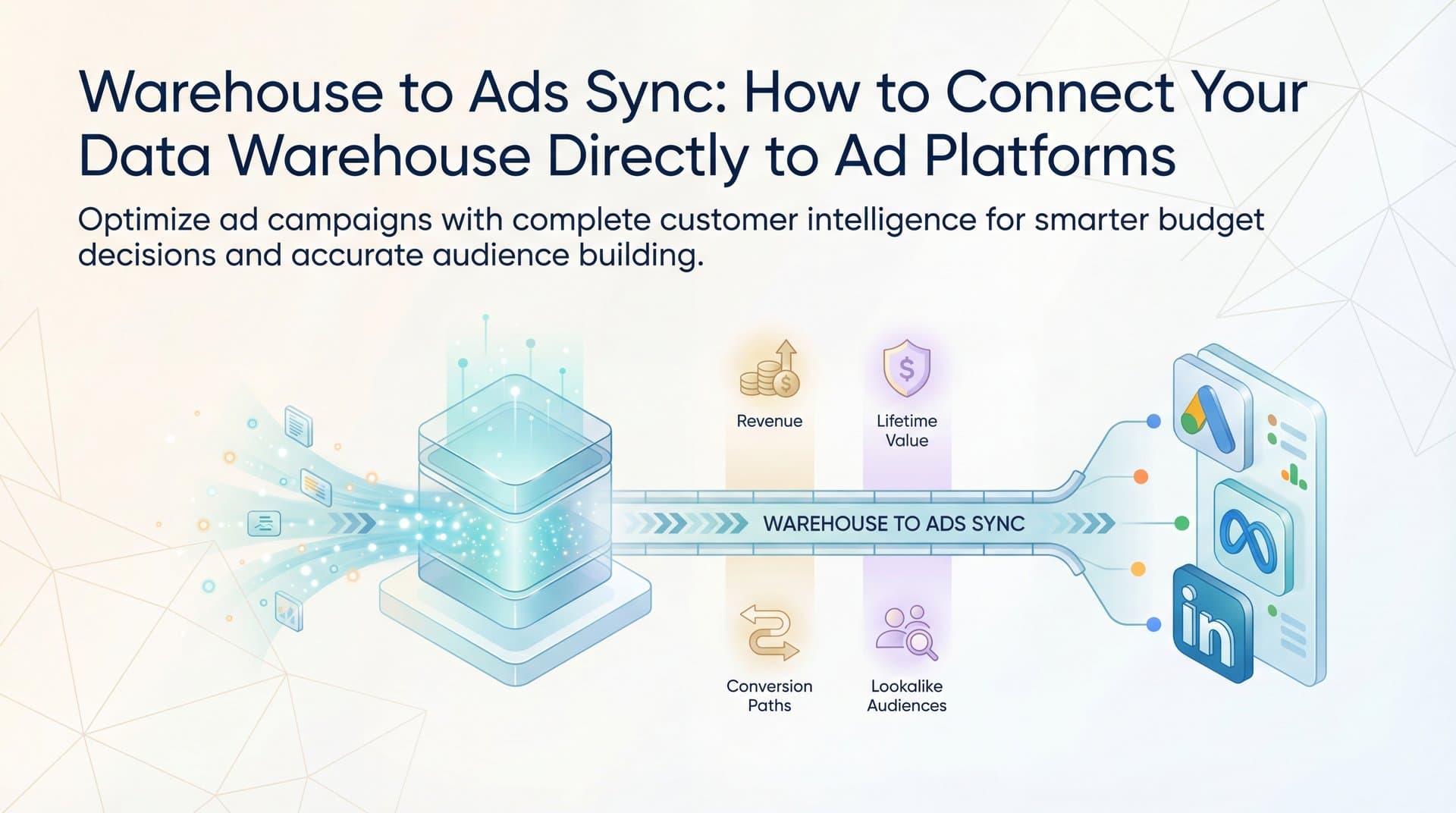
Warehouse to ads sync changes this equation entirely. It creates a direct pipeline from your first-party data to ad platform algorithms, feeding them the enriched conversion signals they need to make smarter decisions. Think of it as giving your ad platforms X-ray vision into what actually matters—not just who clicked, but who bought, who stayed, and who's worth acquiring more of.
This approach represents the evolution beyond traditional tracking methods that struggle with iOS privacy restrictions, cookie deprecation, and cross-device attribution gaps. Instead of hoping pixels capture everything, you're proactively sending the complete story directly to the platforms that need it most.
The Data Gap Draining Your Ad Budget
Traditional pixel-based tracking was built for a simpler time. A user clicks your ad, lands on your site, converts—the pixel fires, the platform records the conversion, everyone's happy. Except that's not how modern customer journeys actually work.
Your warehouse tells a different story. It shows that the "conversion" your pixel tracked was actually a free trial signup that never activated. Or it reveals that the lead Facebook claimed credit for had actually engaged with three other channels first. Or it demonstrates that the customer Google Ads thinks converted for $50 actually spent $5,000 over the next six months.
This data gap creates a cascade of problems. Ad platforms optimize toward the wrong outcomes because they're working with incomplete signals. Your Meta campaigns chase cheap leads that never close because the algorithm can't see which leads actually matter. Your Google Ads bids aggressively on keywords that drive traffic but not revenue because it lacks visibility into downstream value.
The problem intensifies with iOS privacy changes and cookie restrictions. When pixels can only track 60-70% of conversions, ad platforms fill the gaps with modeled data—educated guesses that may or may not reflect reality. Your warehouse doesn't guess. It knows exactly what happened because it captures data from your CRM, payment processor, and every other source of truth in your business.
Consider what your warehouse typically contains that pixels miss entirely: offline conversions from sales calls, product returns that negate initial purchases, subscription renewals that reveal true customer value, lead quality scores from your sales team, cross-device conversions that pixels attribute incorrectly.
Warehouse to ads sync bridges this gap by sending your first-party data directly to ad platforms via server-side APIs. Instead of hoping pixels capture everything, you're proactively telling platforms what actually happened—with complete accuracy, proper attribution, and enriched context they can use to optimize future campaigns.
The platforms want this data. Meta's Conversions API, Google's Enhanced Conversions, and similar tools from TikTok and LinkedIn exist specifically to receive enriched first-party data. They're designed to improve both measurement accuracy and algorithm performance when fed better signals.
When you sync conversions to ad platforms, you're not just fixing attribution—you're fundamentally improving how platforms optimize your campaigns. Better data in means better results out.
The Technical Architecture Behind Warehouse Sync
Warehouse to ads sync operates through a straightforward technical flow, though the implementation details matter significantly. At its core, the process moves data from your centralized warehouse to advertising platform APIs in a format they can consume and act on.
The journey starts in your data warehouse—typically Snowflake, Google BigQuery, Amazon Redshift, or Databricks. This is where your business consolidates data from multiple sources: your CRM, payment processor, customer support system, and website analytics. The warehouse already contains the complete customer picture; the challenge is getting it to ad platforms in the right format.
The transformation layer sits between your warehouse and ad platforms, handling the critical work of preparing data for sync. This layer performs several essential functions: hashing personally identifiable information using SHA-256 encryption to maintain privacy compliance, standardizing data formats to match what each platform expects, deduplicating events to prevent overcounting, and mapping your internal event names to platform-specific conversion events.
The final step pushes transformed data to ad platform APIs. Meta receives data through its Conversions API, which accepts server-side conversion events with enriched parameters. Google processes offline conversions and enhanced conversion data through dedicated endpoints. TikTok, LinkedIn, and other platforms offer similar server-side APIs designed specifically for first-party data ingestion.
The types of data typically synced fall into several categories. Offline conversion events represent actions that happen outside the browser—closed deals from your CRM, in-store purchases, phone call conversions, or subscription activations. Revenue and value data attach actual business outcomes to conversions, enabling value-based optimization. Lead quality scores from your sales team tell platforms which leads actually matter, not just which ones converted fastest.
Customer segments represent another powerful sync type. You can send lists of high-lifetime-value customers for lookalike audience building, or create exclusion lists of churned customers to prevent wasted impressions. Product purchase data enables dynamic remarketing with actual purchase history rather than just browsing behavior.
Sync frequency represents a critical decision point. Real-time syncing sends data immediately as events occur, providing the fastest feedback loop to ad platforms. This approach works well for high-velocity businesses where conversion signals need immediate action—think e-commerce sites processing hundreds of orders daily.
Batch processing syncs data on a schedule—hourly, daily, or weekly depending on your needs. This approach suits businesses with longer sales cycles where immediate syncing provides minimal benefit. A B2B company with monthly deal cycles doesn't need real-time sync; daily updates provide sufficient freshness while reducing technical complexity.
The choice between real-time and batch processing depends on your business model, technical resources, and campaign optimization needs. Higher-frequency syncing provides faster optimization but requires more robust infrastructure and monitoring.
Enriched Data That Actually Improves Ad Performance
The power of warehouse to ads sync lies not just in sending more data, but in sending smarter data that platforms can actually use to improve performance. Understanding what to sync and how platforms leverage it separates effective implementations from those that simply check a technical box.
Closed-won deal syncing represents one of the highest-impact use cases. When your sales team closes a deal, that information flows into your CRM and warehouse. Syncing this event back to Meta or Google tells the platform which leads actually converted to revenue. The algorithm learns to prioritize similar prospects, shifting budget toward audience segments and creative that drive real business outcomes rather than just form fills.
This feedback loop becomes particularly powerful for B2B companies with long sales cycles. A lead might convert on your site today but not close for 60 days. Without warehouse sync, ad platforms optimize on the initial conversion, treating all leads equally. With sync, platforms learn which initial conversions predict eventual deals, fundamentally improving lead quality over time.
High-lifetime-value customer lists enable sophisticated audience targeting. Export your top 20% of customers by revenue, sync them to Meta, and build lookalike audiences that mirror your most valuable segments. This approach outperforms standard lookalikes built from all converters because it teaches the algorithm to find more high-value prospects, not just more converters.
Lead scoring integration creates immediate optimization improvements. When your sales team qualifies leads as hot, warm, or cold, sync those scores back to ad platforms as custom conversion events. A "qualified lead" event carries more weight than a generic "lead" event, helping platforms understand which traffic sources deliver quality versus quantity. Understanding what leads are and how to qualify them becomes essential for this process.
Revenue data transforms value-based optimization from theoretical to practical. Instead of telling Meta every purchase is worth the same, send actual order values. The algorithm shifts budget toward campaigns, audiences, and creative that drive higher-value transactions. For e-commerce businesses, this often reveals that certain audience segments consistently purchase more expensive products or have higher average order values.
Enriched conversion data improves ad platform machine learning in concrete ways. Platforms use conversion data to train models that predict which users are likely to convert. Better training data produces better predictions. When you send complete, accurate conversion data with value information and lead quality context, you're literally teaching the algorithm to make smarter bidding decisions.
Compliance considerations matter significantly when syncing warehouse data to ad platforms. All personally identifiable information must be hashed using SHA-256 before transmission. This includes email addresses, phone numbers, and other identifiers. Platforms match hashed data against their user graphs to attribute conversions while maintaining privacy standards.
Match rates determine how effectively platforms can connect your warehouse data to their users. Typical match rates range from 40-70% depending on data quality and the identifiers you provide. Higher match rates come from sending multiple identifiers per conversion—email, phone, and user ID together match better than email alone.
The privacy-safe approach to warehouse sync relies on server-side transmission of hashed data rather than client-side tracking that exposes user information. This method complies with privacy regulations while providing platforms the signals they need for optimization.
Choosing Your Implementation Path
The decision to implement warehouse to ads sync splits into two primary approaches: building a custom solution or adopting a platform that handles the technical complexity. Each path carries distinct tradeoffs that affect both immediate implementation and long-term maintenance.
The DIY approach typically leverages reverse ETL tools like Census, Hightouch, or RudderStack. These platforms specialize in moving data from warehouses to various SaaS applications, including advertising platforms. You configure data mappings, set sync schedules, and manage transformations through their interfaces. This approach offers maximum flexibility and control over exactly what data flows where.
Building custom solutions provides the ultimate control but reveals hidden complexity quickly. You're responsible for maintaining API connections as platforms update their specifications. Meta's Conversions API, Google's Offline Conversions, and other endpoints evolve regularly—breaking changes require immediate attention to prevent sync failures.
Schema changes present another maintenance burden. When your warehouse structure changes—new fields added, naming conventions updated, data types modified—every downstream sync configuration needs corresponding updates. A simple CRM migration can break multiple ad platform integrations simultaneously.
Data freshness becomes your problem to solve. If your sync job fails overnight, do you have monitoring in place to catch it? When conversions stop flowing to ad platforms, campaign performance degrades quickly. Building robust error handling, retry logic, and alerting systems adds significant engineering overhead.
Troubleshooting sync failures requires deep technical knowledge across multiple systems. Is the problem in your warehouse query? The transformation logic? The API connection? Platform-side validation errors? Each layer introduces potential failure points that need diagnosis and resolution.
Purpose-built marketing platforms take a different approach by integrating tracking, attribution, and conversion sync into a unified system. These platforms already capture conversion data from your website and CRM, making them natural hubs for syncing that data back to ad platforms.
The integrated approach eliminates many technical headaches. Schema mappings are pre-configured for common use cases. API connections are maintained by the platform team, not your engineers. Data freshness is handled automatically as part of the core product functionality.
Marketers increasingly choose integrated solutions because they want to focus on campaign optimization, not data engineering. When your attribution platform already tracks every conversion, syncing that data to ad platforms becomes a configuration toggle rather than a months-long engineering project.
The cost equation extends beyond initial implementation. DIY approaches seem cheaper initially—reverse ETL tools charge based on data volume, often starting under $1,000 monthly. But factor in engineering time for setup, ongoing maintenance, troubleshooting, and you're looking at significant hidden costs.
Integrated platforms bundle tracking, attribution, and sync into a single price point. You're paying for the platform's core value—accurate attribution—with conversion sync as a natural extension. For many teams, this represents better total cost of ownership than cobbling together separate tools.
The right choice depends on your team's technical capabilities, the complexity of your data, and how central warehouse sync is to your marketing strategy. Teams with strong data engineering resources and unique requirements often build custom solutions. Marketing teams who want results without technical overhead typically choose integrated platforms.
Measuring Real Impact on Campaign Performance
Implementing warehouse to ads sync means nothing if you can't measure its impact on actual campaign performance. The challenge lies in isolating the effect of better data from other variables that influence ad results. Smart measurement approaches combine quantitative metrics with qualitative observations to build a complete picture.
Cost-per-acquisition represents the most direct metric to track. Measure CPA in the 30 days before implementing warehouse sync, then compare it to the 30-60 days after. Allow time for ad platform algorithms to learn from the new data—most platforms need 1-2 weeks to incorporate enriched signals into optimization. Many businesses see 15-30% CPA improvements once algorithms adapt to better conversion data.
Lead quality metrics reveal improvements that CPA alone might miss. Track the percentage of leads that reach qualified status, the conversion rate from lead to opportunity, and ultimately the close rate. Warehouse sync should increase these percentages as ad platforms learn to target prospects more likely to convert downstream. If your CPA drops but lead quality also declines, you're optimizing toward the wrong outcome. Learning how to track sales leads effectively becomes critical for measuring these improvements.
Return on ad spend provides the ultimate performance measure for e-commerce and businesses with clear revenue attribution. Calculate ROAS before and after implementing warehouse sync, accounting for the full customer journey. When you sync actual revenue data back to platforms, they optimize toward higher-value transactions. ROAS improvements of 20-40% are common when platforms shift from optimizing on conversions to optimizing on revenue.
Match rate monitoring helps diagnose sync effectiveness. Most ad platforms report what percentage of synced events they successfully matched to users in their system. Low match rates suggest data quality issues—missing identifiers, formatting problems, or stale customer data. Aim for match rates above 60%; rates below 40% indicate problems worth investigating.
The attribution connection creates a virtuous cycle that amplifies results over time. When you feed better data back to ad platforms, they make smarter optimization decisions. Those smarter decisions improve campaign performance. Better performance generates more conversions. More conversions provide more data to feed back to platforms. The cycle reinforces itself, with improvements compounding over weeks and months.
Attribution platforms excel at measuring this cycle because they track both sides of the equation. They see which ad touchpoints drive conversions, and they sync those conversions back to platforms to improve future targeting. This closed-loop visibility reveals exactly how warehouse sync affects campaign performance across every channel and touchpoint.
Common pitfalls can undermine warehouse sync effectiveness if left unaddressed. Data latency issues occur when conversion events reach ad platforms too slowly to influence optimization. If your sales team closes a deal but that data doesn't sync for 48 hours, platforms lose the opportunity to capitalize on real-time signals. Aim for same-day sync at minimum; hourly or real-time sync provides optimal results.
Match rate problems stem from insufficient or poorly formatted identifiers. Sending only email addresses yields lower match rates than sending email, phone, and user ID together. Hash your identifiers correctly—platforms reject improperly hashed data. Include external IDs like client user IDs that platforms can match against their own systems.
Diagnosing sync failures requires systematic troubleshooting. Check your warehouse queries first—are they pulling the correct data? Verify transformation logic—is PII being hashed properly? Test API connections—are platforms receiving your data? Review platform-side validation errors—are events being rejected for formatting issues? Most sync problems trace to one of these four areas.
Set up monitoring and alerting before problems affect campaigns. Track daily sync volumes—sudden drops indicate failures. Monitor match rates—declining rates suggest data quality degradation. Alert on API errors—platforms return specific error codes when syncs fail. Proactive monitoring catches issues before they impact campaign performance.
Why Attribution Platforms Lead in Warehouse Syncing
Attribution platforms occupy a unique position in the warehouse sync ecosystem. They already track the complete customer journey from first touchpoint to final conversion, making them natural hubs for sending enriched data back to advertising platforms. This architectural advantage creates better outcomes than treating attribution and conversion sync as separate functions.
The logic is straightforward: if a platform already knows which ad clicks, social touches, and email interactions led to each conversion, it possesses exactly the data ad platforms need to optimize. There's no need to build separate pipelines or maintain duplicate tracking infrastructure. The attribution system becomes the source of truth for both measuring performance and improving it.
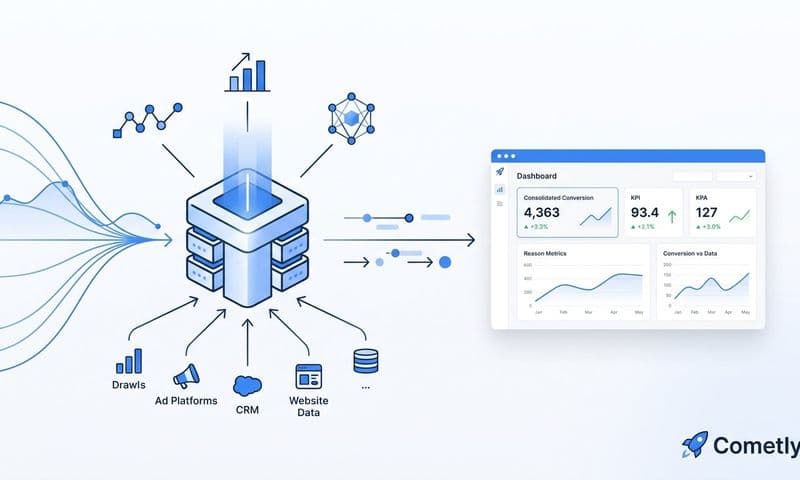
Cometly exemplifies this integrated approach through its Conversion Sync feature. The platform tracks every touchpoint across your marketing channels—ad clicks, website visits, CRM events, and conversions. It attributes each conversion to the marketing touches that influenced it. Then it syncs those enriched conversion events back to Meta, Google, and other platforms to improve their optimization algorithms.
This creates a closed loop where every touchpoint is captured, attributed, and fed back to optimize future campaigns. You're not just measuring what happened; you're actively using that measurement to improve what happens next. The distinction matters because it transforms attribution from a reporting tool into an optimization engine.
Conversion Sync sends enriched, conversion-ready events that include critical context ad platforms need. When a customer converts, Cometly syncs the event with proper attribution to the originating ad click, revenue data for value-based optimization, lead quality scores from your CRM, and customer segment information. This enriched data teaches platforms which campaigns, audiences, and creative drive the outcomes you actually care about.
The technical implementation happens automatically once configured. Cometly maintains API connections to major ad platforms, handling authentication, rate limiting, and error handling. Schema mappings are pre-built for common conversion events. Data transformations—hashing PII, formatting parameters, deduplicating events—happen behind the scenes without requiring engineering resources.
The attribution connection delivers dual benefits: improved measurement and improved optimization simultaneously. When you know which channels drive conversions, you make better budget allocation decisions. When you sync that conversion data back to platforms, they make better targeting decisions. Both improvements compound over time, creating performance gains that exceed what either capability delivers alone.
Consider how this works in practice. A prospect clicks your Meta ad, visits your site, downloads a guide, then converts via a Google search three days later. Cometly attributes the conversion across both touchpoints using multi-touch attribution. It syncs the conversion back to both Meta and Google with proper attribution weights, teaching each platform that their touchpoint contributed to the outcome. Both platforms optimize toward similar prospects, improving performance across your entire marketing mix.
This cross-channel optimization represents the future of digital marketing. Siloed platforms optimizing in isolation miss the interconnected reality of customer journeys. Attribution platforms that sync data back to all contributing channels create coherent optimization across your entire marketing ecosystem.
The AI-powered features in modern attribution platforms amplify these benefits. Cometly's AI analyzes attribution data to identify high-performing ads and campaigns across every channel, then provides specific recommendations for scaling what works. When combined with Conversion Sync feeding better data to platform algorithms, you're optimizing from both directions—human insight plus machine learning working together.
The platform's server-side tracking foundation ensures data accuracy that client-side pixels can't match. Server-side tracking captures conversions that iOS restrictions and cookie limitations cause pixels to miss. This complete data set becomes the foundation for accurate attribution and effective conversion sync. You can't send good data to ad platforms if you're not capturing it correctly in the first place.
Integration with CRMs and other business systems enriches the data available for sync. When Cometly connects to your CRM, it captures lead scores, deal stages, and revenue data automatically. This information flows into attribution analysis and gets synced back to ad platforms without manual data wrangling. The entire system operates as a unified intelligence layer across your marketing stack.
Building Your Data Activation Strategy
Warehouse to ads sync represents more than a technical implementation—it's a fundamental shift from passive tracking to active data activation. The marketers seeing the best results are those who treat their first-party data as a strategic asset that continuously improves campaign performance rather than a reporting artifact that explains what already happened.
This shift requires rethinking how data flows through your marketing operations. Traditional approaches treat data as output: campaigns run, conversions happen, reports get generated. The data activation model treats data as input: conversions inform platforms, platforms optimize campaigns, better campaigns generate better conversions. The feedback loop becomes continuous rather than one-directional.
The platforms that excel at this approach combine attribution tracking with conversion syncing into a unified system. They capture every touchpoint, attribute each conversion accurately, and feed that intelligence back to ad platforms to improve future performance. This closed-loop architecture delivers compounding improvements over time as better data drives better optimization drives better data.
Cometly's Conversion Sync exemplifies this integrated approach. The platform doesn't just measure which ads drive conversions—it actively uses that measurement to improve how ad platforms target and optimize. Every conversion becomes a learning signal that makes future campaigns smarter. Every attribution insight translates into actionable optimization across your entire marketing mix.
The AI-driven recommendations layer adds intelligence on top of data activation. Instead of just syncing data and hoping platforms optimize correctly, you get specific guidance on which campaigns to scale, which audiences to expand, and which creative to iterate. The combination of better data flowing to platforms plus strategic recommendations creates performance improvements that exceed what either capability delivers alone.
Getting started with warehouse to ads sync doesn't require months of engineering work or complex data pipelines. Platforms like Cometly handle the technical complexity—server-side tracking, attribution modeling, API integrations, and conversion sync—so you can focus on strategic decisions rather than technical implementation.
The results speak for themselves. Marketers using integrated attribution and sync platforms consistently report improved cost-per-acquisition, higher lead quality, better return on ad spend, and clearer visibility into what's actually driving revenue. They're making decisions based on complete data rather than partial signals. They're optimizing campaigns with confidence rather than guessing which channels work.
Your data warehouse contains the intelligence your ad platforms need to perform better. The question isn't whether to activate that data—it's how quickly you can implement a system that turns your first-party data into a competitive advantage. Every day that intelligence sits unused is another day your competitors gain ground by feeding their platforms better signals.
Ready to elevate your marketing game with precision and confidence? Discover how Cometly's AI-driven recommendations can transform your ad strategy—Get your free demo today and start capturing every touchpoint to maximize your conversions.