

You log into your Meta Ads Manager and see 2,847 clicks this week. Google Ads shows 1,923. LinkedIn delivered another 412. The numbers look solid. Your campaigns are running, people are clicking, and the dashboards glow with green arrows pointing upward.
Then you check your CRM.
Where are the leads? Where's the revenue? The math doesn't add up. You're spending thousands on ads every month, but somewhere between the click and the conversion, your budget is vanishing into thin air.
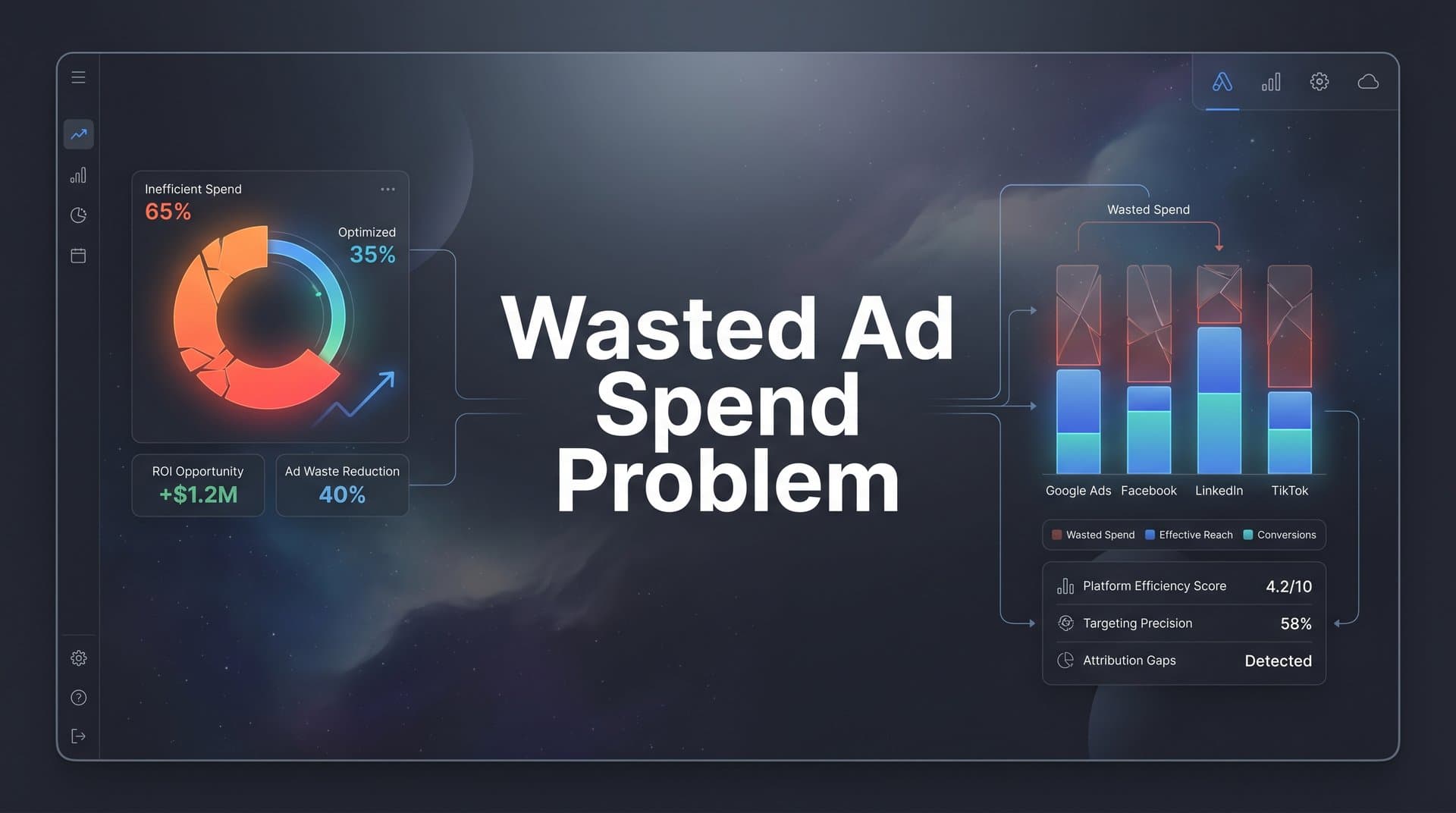
This is the wasted ad spend problem, and it's costing businesses millions every day. The frustrating part? Most marketers don't even realize how much they're losing until they dig deeper. Your ad platforms tell you everything is working. Your bank account tells a different story.
The good news is that wasted ad spend isn't inevitable. Once you understand where the leaks are happening and why your data is lying to you, you can plug those holes and start making every dollar count. Let's break down exactly where your marketing budget is disappearing and how to get it back.
Where Your Ad Budget Actually Goes (And Where It Vanishes)
Here's what should happen: You run ads, people click them, some percentage converts, and you can trace each sale back to the campaign that drove it. Clean. Simple. Measurable.
Here's what actually happens: Your budget gets scattered across dozens of campaigns, multiple platforms, and countless audience segments. Some ads drive genuine interest. Others attract click-happy browsers who were never going to buy. Many reach people who would have found you anyway. And a significant chunk goes to campaigns that look great in your ad dashboard but contribute absolutely nothing to your bottom line.
The gap between what your ad platforms report and what actually happens in your business is often staggering. Meta might claim 50 conversions. Google says 35. But when you check your actual sales data, you only see 40 new customers total. The platforms are double-counting, taking credit for organic traffic, and attributing conversions that would have happened regardless of your ads.
Poor targeting is one obvious budget drain. When your audience parameters are too broad, you're paying to show ads to people who will never convert. This is a classic case of ad spend wasted on wrong audience segments. But even well-targeted campaigns can waste money if you're optimizing for the wrong metrics. Getting cheap clicks means nothing if those clicks don't turn into customers.
Tracking gaps create another massive leak. When your tracking breaks, you're flying blind. You can't see which campaigns actually work, so you keep funding underperformers while potentially underfunding your best channels. It's like trying to fix a car engine while wearing a blindfold.
Multi-platform advertising compounds everything. Running ads on Meta, Google, TikTok, and LinkedIn simultaneously means you're juggling four different tracking systems, four different attribution models, and four different versions of the truth. Each platform wants credit for every conversion. None of them can see the full customer journey. The result? You have no idea which platform actually deserves your budget.
Think about a customer who sees your Facebook ad, searches for your brand on Google three days later, clicks a retargeting ad on Instagram, and finally converts after receiving an email. Facebook claims the conversion. Google claims it. Instagram wants credit too. Who actually drove that sale? Without proper attribution, you're making budget decisions based on incomplete, conflicting data.
The platforms aren't lying exactly. They're just showing you their piece of the puzzle and pretending it's the whole picture. And when you're spending serious money on ads, that partial view costs you dearly.
The Hidden Culprit: Broken Attribution and Tracking Gaps
Remember when tracking was simple? A user clicked your ad, a cookie followed them around the internet, and you could see exactly what they did on your site. Those days are over.
Apple's App Tracking Transparency framework changed everything. When iOS users can opt out of tracking with a single tap, and most of them do, suddenly a huge chunk of your mobile traffic becomes invisible. You're still paying for those clicks. You're still getting conversions from iOS users. But your tracking can't connect the dots anymore.
Browser restrictions pile on top of that. Safari's Intelligent Tracking Prevention, Firefox's Enhanced Tracking Protection, and Chrome's gradual cookie phase-out all chip away at your ability to track user behavior. Third-party cookies are dying. First-party cookies get deleted. The tracking methods that worked for years are breaking down.
The result? Your ad platforms are reporting conversions based on increasingly incomplete data. They're using modeling and estimation to fill in the gaps. Sometimes those estimates are close. Sometimes they're wildly off. Either way, you're making million-dollar budget decisions based on educated guesses instead of facts. Understanding ad spend wasted from poor tracking is the first step toward fixing it.
Platform-reported conversions often overcount results because each platform only sees its own touchpoints. If someone clicks your Facebook ad, later clicks a Google ad, and then converts, both platforms might claim that conversion. You see two conversions in your dashboards. Your business sees one actual customer. Your perceived cost per acquisition looks great. Your actual cost per acquisition is double what you think it is.
Misattribution is even more dangerous than overcounting. When your tracking attributes a conversion to the wrong source, you make terrible budget decisions with total confidence. You scale the campaign that's getting credit while cutting budget from the channel that actually drove the sale. You're actively optimizing your ad spend in the wrong direction.
The real cost of broken attribution isn't just wasted money on individual campaigns. It's the compounding effect of making wrong decisions month after month. You double down on underperforming channels because your data says they're working. You cut budget from your best campaigns because you can't see their true impact. Over time, your entire marketing strategy drifts further from reality.
And here's the twist: the better you think your campaigns are performing based on platform data, the more likely you are to have serious attribution problems. When the numbers look too good to be true, they usually are.
Signs Your Campaigns Are Bleeding Budget
How do you know if you have a wasted ad spend problem? Start by looking for disconnects between what your ad platforms tell you and what's actually happening in your business.
Your ad accounts show strong conversion numbers, but your sales team says lead quality has dropped. That's a red flag. It means you're optimizing for conversions that don't turn into customers. You're paying for leads that go nowhere.
Your cost per conversion keeps dropping, but your customer acquisition cost keeps rising. Another warning sign. It suggests your tracking is counting micro-conversions or low-value actions while missing the bigger picture of what it actually costs to acquire a paying customer. This is a common ad spend not matching results scenario.
You're seeing the same conversion reported across multiple platforms with suspiciously similar timestamps. That's overcounting in action. When Meta and Google both claim credit for the same sale within minutes of each other, at least one of them is wrong.
Your return on ad spend looks healthy in your dashboards, but your overall marketing ROI is disappointing. This disconnect means your attribution is giving you a false sense of success. The numbers you're optimizing for don't reflect actual business outcomes.
You can't explain which specific campaigns or channels are driving your best customers. If someone asks "where do our highest-value customers come from?" and you can't answer with confidence, your attribution system isn't working. You're spending blind.
Here's how to audit your current spend for inefficiencies. Pull your ad platform conversion data for the last 90 days. Now pull your actual sales data for the same period. Compare the numbers. If your platforms report significantly more conversions than you have actual customers, you've found your first leak. For a deeper dive, explore wasted ad spend identification strategies that can help you pinpoint exactly where money is disappearing.
Next, track a sample of conversions manually. When someone converts, check their actual journey through your ad platforms, website analytics, and CRM. How many touchpoints did they really have? Which platforms are claiming credit? You'll often find that the platform reporting the conversion wasn't even the primary driver.
Look at your campaign performance by cohort. Don't just measure immediate conversions. Track which campaigns drive customers who stick around, make repeat purchases, and generate real lifetime value. You might discover that your "best performing" campaigns according to platform metrics actually attract your worst customers.
Run a holdout test. Pause one of your "top performing" campaigns for two weeks and watch what happens to your actual sales. If revenue barely changes, that campaign was taking credit for sales that would have happened anyway. You just found pure waste.
Building a Leak-Proof Attribution System
Fixing the wasted ad spend problem starts with fixing your tracking. You need a foundation that captures accurate data even when browsers block cookies and users opt out of tracking. That foundation is server-side tracking.
Server-side tracking works differently than the pixel-based tracking most marketers rely on. Instead of depending on browser cookies that can be blocked or deleted, server-side tracking sends data directly from your server to your analytics and ad platforms. Users can't opt out of it. Browsers can't block it. You get complete, accurate data about what's actually happening.
But server-side tracking alone isn't enough. You need to connect all your data sources into a unified system that sees the complete customer journey. That means integrating your ad platforms, website analytics, CRM, and sales data into one place where they can talk to each other. A robust ad spend attribution platform can help unify these disparate data sources.
When these systems are connected, you can finally see the truth. A customer doesn't just "come from Facebook" or "convert from Google." They see your Facebook ad, visit your site, leave, search your brand name, click a Google ad, sign up for your email list, receive three emails, click a retargeting ad, and then convert. That's the real journey. Your attribution system needs to capture all of it.
Multi-touch attribution models help you understand which touchpoints actually contribute to conversions versus which ones just happened to be there. First-touch attribution gives all credit to the initial interaction. Last-touch gives it all to the final click. Both are wrong because they ignore everything in between.
Better attribution models distribute credit across the entire journey based on each touchpoint's actual influence. Did that Facebook ad introduce a cold prospect to your brand? It deserves credit. Did that Google search ad capture someone actively looking for a solution? Credit there too. Did the retargeting ad remind them to complete their purchase? Also valuable.
When you can see which combinations of touchpoints drive conversions, you stop making either/or budget decisions. You don't have to choose between Facebook and Google. You can see that they work together, with Facebook introducing prospects and Google capturing high-intent searches. Your budget allocation becomes strategic instead of reactive.
The key is moving from platform-centric tracking to customer-centric tracking. Instead of asking "how many conversions did Facebook drive?" you ask "what role did Facebook play in our customers' journeys?" The first question leads to wasted spend. The second question leads to optimization.
A leak-proof attribution system also feeds data back to your ad platforms. When you send accurate conversion data to Meta, Google, and other platforms, their algorithms can optimize for the outcomes you actually care about. Instead of optimizing for clicks or platform-reported conversions, they optimize for real revenue. The AI gets smarter. Your campaigns perform better. Your cost per acquisition drops.
Turning Data Into Smarter Budget Decisions
Accurate attribution data is worthless if you don't act on it. The goal isn't just to see where your budget goes. It's to reallocate that budget to channels and campaigns that actually drive revenue.
Start by identifying your vanity metrics. Clicks, impressions, and even conversions can be vanity metrics if they don't correlate with revenue. A campaign that drives 100 conversions at $10 each sounds better than one that drives 20 conversions at $50 each. But if the first campaign's conversions never turn into customers and the second campaign's conversions have a 50% close rate, the expensive conversions are actually your bargain.
Shift your optimization focus from cost per conversion to cost per customer and customer lifetime value. When you can see which campaigns attract customers who stick around and buy repeatedly, you can afford to pay more upfront to acquire them. Your competitors are still optimizing for cheap conversions. You're optimizing for profitable customers. That's an unfair advantage.
Reallocate budget based on revenue attribution. If your data shows that LinkedIn drives fewer conversions than Facebook but those conversions turn into customers at twice the rate, LinkedIn deserves more budget even though its surface metrics look worse. Make decisions based on what drives revenue, not what makes your dashboards look pretty. Learning how to optimize ad spend across platforms is essential for this kind of strategic reallocation.
Feed your improved conversion data back to ad platforms through conversion APIs and server-side tracking. When Meta's algorithm knows which conversions actually led to sales, it can find more people like your real customers instead of more people like your tire-kickers. The platform's AI becomes your optimization partner instead of a black box you're fighting against.
Create a continuous optimization loop. Review your attribution data weekly. Identify campaigns that are overperforming or underperforming based on actual revenue. Make incremental budget shifts toward what works. Test new approaches in your underperforming segments. Measure the results. Adjust again.
This isn't a one-time fix. Markets change. Audiences shift. What works today might not work next quarter. But when you have accurate attribution and a systematic optimization process, you can adapt quickly instead of wasting months on campaigns that stopped working.
The businesses that win at paid advertising aren't the ones with the biggest budgets. They're the ones with the clearest view of what's actually working. They make data-driven decisions while their competitors make guesses. They scale winners and kill losers with confidence. They don't waste money on campaigns that look good but deliver nothing.
Your Action Plan: Reclaiming Your Ad Budget Today
You don't have to fix everything at once. Start with these immediate steps to begin identifying and eliminating wasted spend.
First, audit your current attribution setup. Compare your platform-reported conversions to your actual customer data for the last 90 days. Document the gaps. This becomes your baseline for measuring improvement.
Second, implement server-side tracking if you haven't already. This is your foundation for accurate data. Without it, you're building on sand. Addressing ad spend tracking issues early prevents compounding problems down the road.
Third, connect your ad platforms to your CRM and sales data. You need to see the complete journey from ad click to closed deal. Partial visibility leads to partial optimization.
Fourth, switch from last-click attribution to a multi-touch model that shows the full customer journey. Start seeing which channels work together instead of competing for credit. This helps solve the attribution problem in marketing that plagues most advertisers.
Fifth, identify your three worst-performing campaigns based on actual revenue attribution, not platform metrics. Cut or dramatically reduce their budgets this week. Reallocate that money to campaigns with proven revenue impact.
Long-term, build a systematic approach to attribution and optimization. Review your data weekly. Make budget adjustments based on revenue outcomes. Feed better conversion data back to your ad platforms. Test, measure, and refine continuously.
The businesses that eliminate wasted ad spend don't do it with one big fix. They do it through consistent, data-driven decision-making backed by accurate attribution. They know what's working because they can measure it properly. They scale with confidence because they're not guessing.
Stop Guessing, Start Growing
Wasted ad spend isn't inevitable. It's a symptom of broken tracking, incomplete attribution, and decisions based on platform-reported data that doesn't reflect reality. Once you understand where the leaks are happening and build a system to capture accurate data, you can plug those holes and make every dollar count.
The causes are clear: privacy changes breaking traditional tracking, multi-platform attribution challenges, overcounting and misattribution from ad platforms, and the disconnect between platform metrics and actual business outcomes. The solution is equally clear: server-side tracking for accurate data collection, unified attribution that connects all your marketing touchpoints, and optimization based on revenue instead of vanity metrics.
When you can see the complete customer journey from first touch to final sale, advertising stops being a guessing game. You know which campaigns drive real customers. You know which channels work together. You know where to invest more and where to cut back. Your ad platforms' algorithms get smarter because you're feeding them better data. Your budget works harder because you're allocating it based on facts instead of estimates.
The marketers who win in 2026 and beyond won't be the ones with the biggest budgets. They'll be the ones with the clearest view of what's actually working. They'll make confident, data-driven decisions while their competitors waste money on campaigns that look good in dashboards but deliver nothing to the bottom line.
Ready to elevate your marketing game with precision and confidence? Discover how Cometly's AI-driven recommendations can transform your ad strategy. Get your free demo today and start capturing every touchpoint to maximize your conversions.



