Website conversion optimization is all about turning more of your visitors into customers. It’s the process of figuring out how people actually use your site, finding the friction points stopping them from taking action, and then methodically testing changes to smooth out the user experience. The end goal? Get more value from the traffic you already have.
Why Most Conversion Optimisation Efforts Fall Flat
Let's be real for a second: a lot of the advice out there on website conversion optimisation feels like a total guessing game. You change a button color from blue to green, tweak a headline, and cross your fingers, hoping for a miracle. When nothing happens, it's easy to feel like you're just spinning your wheels.
The hard truth is that most of these well-intentioned efforts fail because they're built on a shaky foundation of incomplete or, even worse, misleading data.
The biggest culprit? Relying on vanity metrics from your ad platforms. Clicks, impressions, and even the platform-reported "conversions" often tell a dangerously incomplete story. A sky-high click-through rate means absolutely nothing if those users bail the second they hit your site without taking a meaningful action.
The Danger of a Fragmented View
This problem gets a whole lot worse when you have a fragmented view of the customer journey. If you can't connect a user's first ad click to their final purchase—and all the little steps in between—you're basically operating with blinders on.
You might end up giving all the credit to the last ad they clicked, completely ignoring the five other touchpoints that warmed them up and nurtured them along the way. This leads to some seriously flawed assumptions and a ton of wasted ad spend. You might scale a campaign that looks good on paper but is actually bringing in low-quality traffic, or you might cut a top-of-funnel campaign that was secretly your best source for introducing new customers to your brand.
Without a single source of truth, your optimization efforts are just shots in the dark.
The core issue is that marketers often optimize for intermediate actions reported by ad networks instead of the ultimate goal: revenue. A successful CRO strategy requires connecting every test and change directly to its impact on actual sales and profitability.
Shifting to a Revenue-Focused Framework
To break out of this cycle, you need a framework grounded in accurate, unified data. This means ditching the siloed platform analytics and building a complete picture of how users interact with your brand across every single channel.
When you can confidently attribute revenue back to specific campaigns, ads, and on-site experiences, your decisions become infinitely more powerful. To prevent your optimization efforts from falling flat, a comprehensive guide on How to Improve Ecommerce Conversion Rates offers practical strategies. This is the shift from just tinkering with your website to strategically engineering a path to purchase based on what truly drives business growth.
Building a Foundation with Accurate Conversion Tracking
Effective website conversion optimisation isn't about guesswork; it's about making smart decisions based on reliable data. The problem is, the traditional ways of collecting that data are falling apart.
If your entire strategy hangs on client-side pixels—those little snippets of code from platforms like Meta or Google that fire in a user's browser—you're operating with a massive blind spot.
These pixels are getting less reliable by the day. The rise of ad blockers, strict browser privacy settings, and game-changing updates like Apple's iOS 14 mean a huge chunk of your conversion events are never even recorded. This leads directly to underreported sales, skewed campaign data, and a fundamentally flawed picture of your marketing performance.
You could be making critical decisions on data that's missing 15-30% of your actual conversions. That's a gap that makes true optimization impossible.
The Shift to Server-Side Tracking for Data Integrity
To fight back against this data loss, the answer is to move your tracking from the user's browser to your own server. Server-side tracking establishes a direct, secure pipeline between your website's backend and the ad platforms. When a user completes an action, like making a purchase, the event is recorded on your server first and then sent to the ad networks.
This method completely sidesteps the vulnerabilities of browser-based tracking.
- Immunity to Ad Blockers: Because the data is sent from your server, ad blockers and browser restrictions can't touch it.
- Complete Data Capture: You get a near-perfect picture of every single conversion, ensuring your analytics are accurate and trustworthy.
- Enhanced Security: It’s a much safer way to handle sensitive customer data, which helps build trust and maintain compliance.
Making this shift ensures your attribution data is as close to 100% accurate as possible. It’s the bedrock of any successful optimization strategy.
Uncovering the Full Story with Multi-Touch Attribution
Capturing all your data is one thing; understanding it correctly is another. So many marketers fall into the trap of last-click attribution, where 100% of the credit for a sale is handed to the very last ad a customer clicked. This model is dangerously simplistic because it ignores the complex journey most customers take.
Think about it. A customer might first discover your brand through a TikTok ad, do some research via a Google search, and then finally convert after seeing a retargeting ad on Facebook. In a last-click world, Facebook gets all the glory, and you might mistakenly slash the budget for the channels that actually did all the heavy lifting.
Multi-touch attribution models fix this by distributing credit across multiple touchpoints. It reveals how different channels work together to drive a single conversion, giving you a holistic view and helping you understand the true value of each campaign.
This more nuanced approach leads to much smarter budget allocation and a far more accurate analysis of your entire marketing ecosystem.
Tying It All Together with a Unified Platform
Let's be honest: manually setting up server-side tracking and multi-touch attribution can be a complex, code-heavy nightmare. This is where a unified platform like Cometly becomes a lifesaver. It streamlines the entire workflow with a zero-code setup that can be up and running in minutes, not weeks.
This flow chart below perfectly illustrates the common failure points of CRO that come from relying on incomplete, vanity-focused metrics.
 A Modern Guide to Website Conversion Optimisation
As you can see, vanity metrics lead directly to flawed assumptions, which in turn results in wasted ad spend—a vicious cycle that accurate tracking is designed to break.
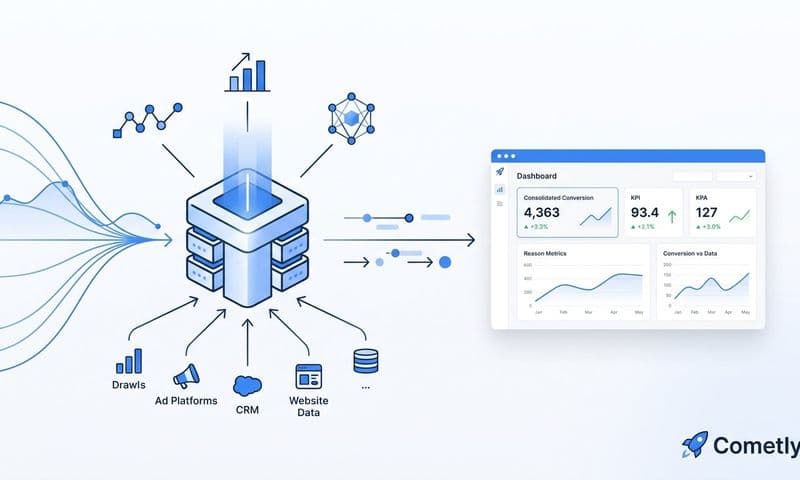
With a tool like Cometly, you can pull all your data sources into a single, intuitive dashboard. This gives you a clear line of sight into every touchpoint, from the first ad click to the final sale, letting you attribute revenue with precision. You can explore a detailed guide to learn more about the fundamentals of accurate conversion tracking and the impact it can have.
This is critical, especially when you realize the average website conversion rate across all industries is a mere 2.9%. Data from a 2025 analysis by Ruler Analytics shows that top-performing sites can hit rates over 11.45%. That highlights the immense opportunity for growth when you eliminate wasted ad spend through precise analytics.
A unified dashboard provides the clarity you need to make data-driven decisions confidently, turning raw numbers into actionable insights for your optimization efforts.
Analyzing the Full Customer Journey to Find Opportunities
Okay, so your data is clean and accurate. Now the fun begins. You can finally stop guessing and start seeing what’s really happening on your website. This is where real website conversion optimisation starts—not with random A/B tests, but with a deep dive into the complete path customers take from discovery to purchase.
Instead of trying to piece together isolated metrics from different platforms, a unified attribution dashboard lets you map out these journeys from start to finish. You can finally connect the dots between a user’s first click on a top-of-funnel ad and their final purchase, revealing which touchpoints actually drive decisions. This holistic view is the raw material for powerful, data-backed optimization ideas.
 A Modern Guide to Website Conversion Optimisation
Identifying Your Most Valuable Channels and Campaigns
First things first, let's zoom out. The goal here is to pinpoint which marketing efforts are bringing in your highest-value customers, not just the most clicks or cheapest leads. A proper attribution dashboard connects every ad click, email open, and organic search visit directly to revenue. This clarity helps you answer the big questions that used to be impossible to solve.
- Which channel brings in customers with the highest Lifetime Value (LTV)? You might find that organic search converts less often but brings in customers who spend way more over time.
- Which specific ad campaign is driving the most profitable sales? This goes beyond simple Return On Ad Spend (ROAS) and gets down to actual profit margins.
- Are your top-of-funnel awareness campaigns actually contributing to conversions? Multi-touch attribution uncovers all the assists, showing you the true value of campaigns that don't get that final click.
Getting this right is a game-changer. I've seen it countless times: a team thinks a specific TikTok campaign is crushing it because it's driving a ton of low-cost leads. Meanwhile, a seemingly expensive Google Ads campaign is quietly producing their best customers. Without a unified view, the default move is to scale the TikTok ads and cut the Google budget—a potentially fatal mistake.
Pinpointing Funnel Drop-Off Points
Once you know where your best customers come from, you can zoom in and analyze their on-site behavior. The mission is to find the points of friction—the spots where users get stuck or just give up. This is about way more than broad metrics like bounce rate; it's about finding specific, actionable problems.
A unified analytics platform lets you build conversion funnels that track users from a landing page all the way through checkout. By analyzing these funnels, you can spot the exact pages or steps where you’re losing the most people.
A high drop-off rate between adding an item to the cart and initiating checkout isn't just a number—it's a massive red flag. It could be unexpected shipping costs, a confusing form, or a lack of trust signals screaming "abandon ship!"
Combine this funnel data with tools like session recordings or heatmaps, and you can literally watch users interact with these problem pages. Do they hesitate? Do they rage-click on non-clickable elements? This visual context helps you understand the why behind the drop-off, turning a vague problem into a concrete hypothesis you can actually test. Understanding these nuances is a core part of effective customer journey analytics.
Segmenting Your Audience for Deeper Insights
Here's a hard truth: not all visitors are the same. Trying to optimize for a single "average" user is a surefire way to get mediocre results. The real breakthroughs in website conversion optimisation happen when you understand and cater to different audience segments. Your data is the key to grouping users based on meaningful criteria.
Here are a few segmentation strategies I always start with:
- By Traffic Source: Compare the behavior of visitors from Google Ads versus those from an email newsletter. They have completely different levels of intent and product awareness.
- By Device: Analyze mobile and desktop journeys separately. A checkout process that’s buttery smooth on a desktop can be an absolute nightmare on a small screen.
- By New vs. Returning Visitors: A first-time visitor needs to be sold on your value proposition. A returning visitor might just be looking for the search bar. Their journeys—and your optimization strategies—should be completely different.
Segmenting your analysis will uncover opportunities you'd otherwise miss entirely. Maybe you discover that mobile users from Facebook ads are dropping off at a specific form field, while desktop users from organic search are converting perfectly. That's not just an interesting data point; it's a clear signal to create a targeted fix for that specific group, leading to much bigger conversion lifts.
How to Generate and Test Smart Hypotheses
Your journey analysis just handed you a roadmap, showing you exactly where people are getting stuck, confused, or just plain dropping off. Now it's time to turn those data-backed insights into real, testable ideas. This is where we move from just looking at data to actually doing something with it—and I'm not talking about low-impact tweaks like changing button colors.
A strong hypothesis isn’t just a random guess. It’s an educated, testable statement rooted in the problems you've already found. It should spell out what you think is happening, why it’s happening, and how a specific change is going to fix it.
 A Modern Guide to Website Conversion Optimisation
From Problem to Powerful Hypothesis
Let’s say your funnel analysis shows a huge drop-off on your product page. People are adding items to their cart, but they bail before heading to checkout. Your heatmaps confirm they're all hovering over the shipping information section right before they leave. This is the gold you've been digging for.
A weak hypothesis would be: "Changing the product page will increase conversions." It's vague and you can't really test it.
A strong hypothesis, on the other hand, looks like this: "We believe that showing estimated shipping costs directly on the product page will reduce user anxiety and checkout friction, leading to a 10% increase in 'add to cart' to 'initiate checkout' conversions."
See the difference? This version is specific, measurable, and directly tackles the user behavior you observed. It’s a clear "if we do this, then this will happen" statement that you can actually validate.
Prioritizing Your Tests for Maximum Impact
You’ll probably end up with a long list of potential hypotheses, but you can’t test everything at once. This is where prioritization becomes your best friend. I've always found a simple framework works best, scoring each idea based on two things:
- Potential Impact: How big of a lift could this really be if you're right? A change to your checkout flow is almost always going to have a higher potential impact than changing an icon in your footer.
- Implementation Effort: How much time and how many resources will it take to get this test live? A simple headline change is low effort, while a full page redesign is obviously high effort.
Zero in on the tests that score high on impact and low to medium on effort. These are your quick wins. They build momentum, prove the value of your work, and can even help fund more complex experiments down the line. To dig deeper on this, check out our guide on building an accelerated testing strategy to get results faster.
When you're sorting through your ideas, it helps to see what moves the needle versus what’s just noise.
High-Impact vs. Low-Impact CRO Tests
When optimizing a website or funnel, there are several test areas that can deliver varying levels of impact with relatively low implementation effort. One of the highest-impact opportunities is rewriting the main headline (H1) to more clearly communicate the core value proposition, which typically requires minimal effort. Similarly, changing call-to-action text from something generic like “Submit” to a more benefit-driven phrase such as “Get Your Free Quote” can significantly improve conversions with little work.
The checkout process is another critical area, where removing unnecessary form fields or offering a guest checkout option can have a very high impact, though it usually requires a moderate level of effort to implement. Adjusting page layout and flow, such as moving key information above the fold on a product page, can also produce strong results with a medium level of implementation effort.
Adding social proof, like customer testimonials or recognizable logos placed near a call-to-action, often delivers medium-to-high impact and is relatively easy to execute. On pricing pages, highlighting a “Most Popular” plan or clarifying feature differences can help guide decision-making and improve conversions, though this typically takes a bit more effort.
Lower-impact tests include visual tweaks such as changing a button color, swapping a stock photo for a team photo, or reorganizing footer links. While these changes are easy to implement, they generally produce minimal gains. Minor copy edits, such as adjusting a sentence within body text, also fall into this category and usually have very low impact despite requiring little effort.
Focusing on the top half of that table is how you get big results. The small stuff might feel productive, but it rarely delivers a meaningful lift.
Choosing the Right Testing Methodology
With a prioritized hypothesis ready to go, the next step is picking the right way to test it. The kind of test you run really depends on what you're trying to learn.
- A/B Testing: This is your go-to, the workhorse of CRO. You compare two versions of a page (Version A vs. Version B) to see which one performs better against a single goal. It’s perfect for testing focused changes like a new headline, a different call-to-action (CTA), or a revised value prop.
- Multivariate Testing: This is A/B testing's more complex cousin. Instead of testing one change, you test multiple changes at once (e.g., three headlines and two images) to find the winning combination. Use this when you want to see how different elements on a page interact, but be warned—it needs a lot of traffic to get a clear result.
- Personalization: This isn't a "test" in the traditional sense, but more of a strategy for showing the right experience to the right people. For instance, you could show a unique offer to returning visitors or display different testimonials to users who came from a specific ad campaign. It’s about creating relevance, not just finding one "winner" that works for everyone.
The goal isn’t to run random experiments; it’s to build a systematic, repeatable process for continuous improvement. Every test, whether it wins or loses, should provide a valuable learning that informs your next hypothesis.
A systematic approach keeps you from chasing shiny objects and ensures your website conversion optimisation efforts are always grounded in data. Simple changes, driven by real user friction, can have a massive impact. For example, UK insurer Enhance Insurance added above-the-fold CTAs with audience-specific wording and saw their landing page conversion rate jump by 138%. In another case, the kitchen tool site Yuppiechef simply removed the main navigation from a landing page, which doubled sign-ups from 3% to 6%. These examples prove that the biggest wins come from understanding your users, not just from aesthetic guesswork.
So, you’ve run a successful A/B test and the numbers look great. High fives all around, right?
Not so fast. A higher conversion rate on a landing page is a good sign, but it’s still just a proxy metric. The real celebration starts when you can prove that change actually made the business more money. After all, the entire point of website conversion optimization is to grow revenue, not just get more clicks or sign-ups.
This is the final, most critical step: closing the loop. It’s where you take your winning variations, push them live, and then meticulously measure their direct impact on the bottom line. An experiment is only a true success when you can see a direct line from a lift in on-page conversions to a measurable increase in sales, customer lifetime value, and overall return on investment (ROI).
Without this connection, you risk falling into the classic trap of optimizing for vanity metrics. For example, you might discover that a super-simple lead form doubles your sign-up rate. But what if those new leads are lower quality and never become paying customers? Your so-called "win" has actually hurt the business by bogging down your sales team with junk leads.
Validating Wins with an Attribution Platform
This is where a solid attribution platform becomes your best friend. It’s your single source of truth, letting you move beyond simple session-based conversion rates and connect every single change you make on-site to actual revenue. By integrating with your payment processor or CRM, it confirms that the traffic hitting your "winning" page is genuinely producing more paying customers.
Think of it this way: your A/B testing tool tells you what change won. Your attribution platform tells you how much that win is really worth.
It helps you answer the questions that the C-suite actually cares about:
- Did our new landing page not only boost trial sign-ups but also improve the trial-to-paid conversion rate?
- Are customers who went through the new checkout flow spending more on average?
- Is the lifetime value of customers from the winning variation higher than the control group?
Answering these questions transforms your CRO work from a marketing task into a core driver of business growth.
The real power of conversion optimization is unlocked when you can confidently walk into a meeting and say, "This headline change drove an extra $50,000 in revenue last month." That's a statement that gets budgets approved and cements your value.
This level of detail is essential for building a strong business case. If you're looking to understand how to structure this analysis, our guide on choosing the right revenue attribution model provides a deep dive into connecting marketing actions to financial outcomes.
Creating a Powerful Feedback Loop
But the impact of a validated win doesn’t stop at your website. The real magic happens when you feed this high-quality conversion data back into your advertising platforms. This creates a powerful, self-improving feedback loop that amplifies your results.
When you improve your website's conversion rate, you're making every single click you buy more valuable. But if your ad platforms are blind to this success because of tracking gaps, their algorithms can't learn from it. They just keep chugging along with old, inaccurate data, which severely limits your ability to scale.
This is where one-click conversion syncs come into play. By pushing accurate, server-side conversion data back to platforms like Meta and Google, you’re giving their machine learning algorithms the high-octane fuel they need to perform better.
You can sync this data across a huge range of platforms, creating a unified and intelligent ecosystem.
.png)
Connecting everything from Shopify and Stripe to your ad networks ensures a seamless and accurate flow of data.
This feedback loop has a massive cascading effect on your entire marketing operation:
- Smarter Algorithms: With better data, the ad platforms get much, much better at finding more people who look just like your actual paying customers, not just window shoppers.
- Lower Acquisition Costs: As targeting sharpens, your Customer Acquisition Cost (CAC) naturally drops because you're wasting less money on audiences that were never going to convert anyway.
- Confident Scaling: Armed with accurate data showing a profitable ROI, you can ramp up your ad spend with confidence, knowing every dollar is being deployed effectively.
This cycle—where website optimizations improve ad performance, which in turn drives more high-quality traffic back to your optimized site—is how you achieve exponential growth. It transforms website conversion optimization from an isolated project into the central engine of your entire customer acquisition strategy.
Common Questions About Website Conversion Optimisation
Even with a solid framework, some questions always pop up when you start putting theory into practice. Let’s tackle a few of the most common hurdles marketers face when they dive into website conversion optimisation. My goal is to give you clear, straightforward answers so you can move forward with confidence.
How Long Does It Take to See Results?
This is the classic "it depends" scenario, but the biggest factor is your website's traffic. If you're running a high-traffic e-commerce site, an A/B test might hit statistical significance in just a few days or a week. On the other hand, a lower-traffic B2B site might need a month or more to gather enough data for a confident result.
The real key here is to shift your mindset. Don't look for a single, magical fix. Instead, focus on building a consistent process of testing and iterating. A steady, disciplined approach to optimisation will almost always produce measurable gains in leads or sales within a single quarter.
What Is a Good Conversion Rate to Aim For?
I see this question all the time. While you'll see industry-wide benchmarks floating around the 2-5% mark, chasing a universal number is usually a distraction. A "good" conversion rate is completely relative to your business model, industry, price point, and even your traffic source.
For example, an online store selling affordable t-shirts might reasonably aim for a 4% conversion rate. But for a SaaS company selling enterprise software for five figures, a 0.5% demo request rate would be a massive success.
Your most important benchmark is your own baseline. The real goal of website conversion optimisation is to be consistently better than you were last month. Focus on incremental improvement rather than getting hung up on external averages.
Should I Focus on Small Tweaks or Big Redesigns?
Both have their place in a smart CRO strategy. Small, focused changes—like rewriting a headline or changing CTA button text—are low-risk and perfect for continuous improvement. They let you steadily optimize existing pages based on specific data points you've gathered.
However, if a core page like your homepage or checkout flow is fundamentally broken or just severely underperforming, a complete redesign might be exactly what's needed. A great approach is to use the insights from your smaller tests to inform the direction of a larger overhaul. This ensures your big strategic shifts are guided by proven user preferences, not just guesswork. If you want more practical ideas, you can explore these proven CRO tips for improving website conversion rates.
How Does Accurate Attribution Affect CRO?
Accurate attribution is everything. It's the absolute foundation of any meaningful optimisation effort. Without it, you’re flying blind.
You might find yourself optimising a landing page for "conversions," only to realize those conversions are low-quality leads who never buy anything. A tool that provides multi-touch attribution, however, shows you which channels and campaigns are actually delivering your most valuable customers.
This lets you optimize your website experience for the right audience and measure the impact of your tests on actual revenue, not just vanity metrics. For a deeper dive, our guide on what a conversion rate is in marketing explains why this context is so crucial. It ensures your CRO efforts are always directly tied to profitable business growth.
Ready to stop guessing and start connecting your marketing efforts directly to revenue? Cometly provides the accurate, unified attribution you need to make smarter decisions, eliminate wasted ad spend, and confidently scale what works. Request your personalized demo today and see how it works.