You just spent $50,000 on marketing last quarter. Sales increased by $200,000. But here's the million-dollar question: which $15,000 of that marketing spend actually drove those sales, and which $35,000 was essentially burned cash?
This isn't a hypothetical scenario. It's the daily reality for thousands of business owners and marketing leaders who find themselves drowning in data but starving for answers. Your analytics dashboard shows impressive numbers—clicks are up, impressions are climbing, engagement looks healthy. Yet when leadership asks which specific marketing activities are actually generating revenue, you're left piecing together incomplete stories from disconnected platforms.
The frustration runs deeper than just reporting challenges. Every day you continue marketing without clear attribution, you're potentially throwing money at channels that don't work while under-investing in the ones that do. Your competitors who've mastered marketing analysis aren't just making better decisions—they're operating with a fundamental competitive advantage that compounds over time.
Here's what makes this problem so critical: modern customers don't follow simple paths to purchase. They see your Facebook ad, ignore it, then search for your brand three days later. They read your blog post, subscribe to your email list, click a retargeting ad, and finally convert after seeing a Google search ad. Traditional reporting gives credit to that final Google ad, completely missing the crucial role your content and email played in the journey.
Marketing analysis changes everything. It's not just another reporting exercise or a fancy dashboard to show stakeholders. It's the systematic process of understanding which marketing activities actually drive business outcomes, why they work, and how to optimize them for maximum return. It transforms marketing from an expense you hope pays off into a predictable revenue engine you can scale with confidence.
The difference between businesses that analyze effectively and those that don't shows up directly in their bottom line. Companies with systematic marketing analysis capabilities typically identify 15-30% improvement opportunities in their existing campaigns—not through increased spending, but through smarter allocation of resources they're already investing.
In this guide, you'll learn exactly what marketing analysis is, why it's become non-negotiable for competitive businesses, and how to implement it effectively without needing a data science degree. We'll break down the essential components, show you how to avoid common pitfalls that waste time and mislead strategy, and give you a practical action plan to start analyzing your marketing performance today.
By the end, you'll understand not just what marketing analysis is, but how to use it as a strategic weapon that turns your marketing spend into measurable, optimizable business growth. Let's dive in.
Decoding Marketing Analysis: Beyond Basic Reporting
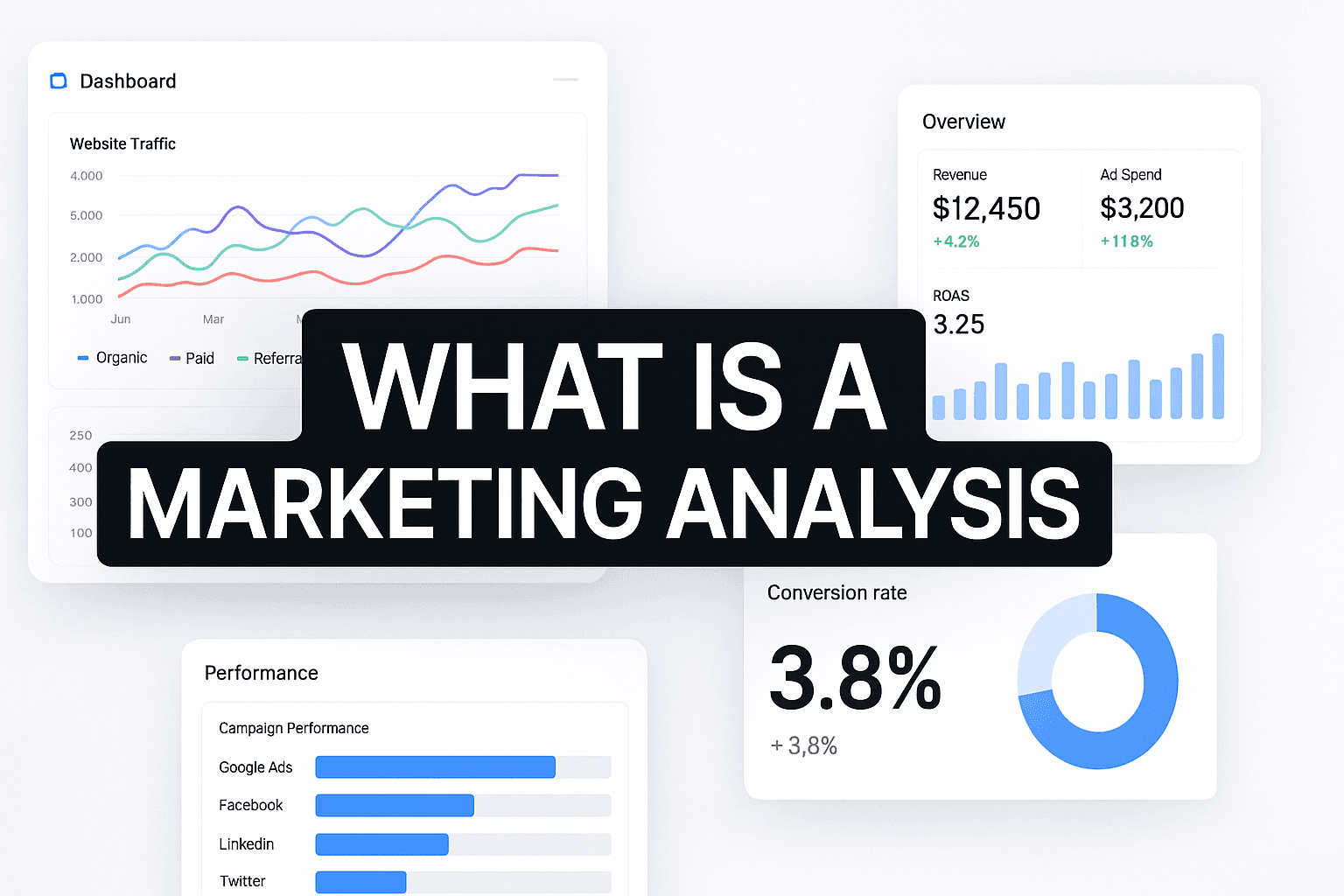
Marketing analysis is the systematic evaluation of marketing performance data to uncover why campaigns succeed or fail, which channels drive the most valuable customers, and where to invest your next dollar for maximum return. It's not just collecting numbers—it's detective work that reveals the cause-and-effect relationships hiding in your data.
Here's the critical distinction most businesses miss: reporting tells you what happened, while analysis tells you why it happened and what to do about it. Your monthly report might show that email generated 1,000 clicks last month. That's reporting. Analysis reveals that email subscribers who engage with educational content convert at three times the rate of promotional-only subscribers, and that social media visitors who later sign up for email have 60% higher lifetime value. That's intelligence you can act on.
Think of it this way: if your marketing data were a crime scene, reporting would be the photographs documenting what's there. Analysis would be the detective work connecting evidence, identifying patterns, and solving the case. Most marketing teams stop at the photographs.
Effective marketing analysis examines customer behavior patterns across the entire journey, not just isolated campaign metrics. It tracks how prospects move between channels, which touchpoints influence purchase decisions, and how different marketing activities work together to drive conversions. This reveals optimization opportunities that remain completely invisible in basic reporting dashboards.
Consider a common scenario: your Google Ads report shows strong conversion numbers, so you increase that budget. But deeper analysis might reveal that 70% of those "Google Ads conversions" actually started with organic content that built initial awareness, followed by email nurture sequences that created consideration, with Google Ads simply capturing the final click. Without this context, you'd be over-investing in bottom-funnel channels while starving the top-funnel activities that actually create demand.
The intersection of marketing and business analytics transforms campaign metrics into strategic intelligence that guides product development, pricing decisions, and market expansion strategies. This is where marketing performance analysis becomes a competitive weapon rather than just an operational necessity.
Understanding the broader role of analytics in marketing helps contextualize how specific analysis activities fit into comprehensive marketing intelligence systems. Marketing analysis serves as the crucial input that informs budget allocation across channels, guides product positioning decisions, and provides early warning signals for market shifts that require strategic pivots.
The real power of marketing analysis lies in its ability to answer questions that reporting can't touch: Why did campaign performance suddenly drop? Which audience segments have the highest lifetime value? How do different marketing channels influence each other? What's the optimal budget split across channels for our specific business model?
This is why sophisticated marketing teams have moved beyond celebrating vanity metrics like impressions and clicks. They're focused on understanding the complete customer journey, identifying the marketing activities that genuinely drive business growth, and optimizing their entire marketing system for maximum efficiency and profitability.
The Core Components of Marketing Analysis
Marketing analysis operates through four interconnected components that work together to transform raw data into actionable intelligence. Understanding these components helps you build a systematic approach rather than relying on ad-hoc reporting that misses critical insights.
The foundation is data collection and integration. This means gathering information from every customer touchpoint—your website, advertising platforms, email system, CRM, and sales data—then connecting these disparate sources into a unified view. Most businesses collect plenty of data but fail at integration, leaving them with fragmented insights that can't reveal the complete customer journey.
Without proper integration, you're essentially blind to how your marketing channels work together. You might see that Facebook generated 500 leads and Google Ads generated 300 conversions, but you can't see that 200 of those Google conversions actually started with Facebook awareness. This integration challenge is why understanding mobile marketing attribution has become essential for businesses with significant mobile traffic.
The second component is attribution modeling—determining which marketing touchpoints deserve credit for conversions. This goes far beyond last-click attribution that gives all credit to the final interaction before purchase. Sophisticated attribution reveals how awareness-stage content, mid-funnel nurture, and bottom-funnel conversion tactics each contribute to revenue.
Customer journey mapping forms the third component. This visualizes how prospects move through your marketing ecosystem, identifying the typical paths to purchase, the touchpoints that accelerate decisions, and the friction points that cause drop-off. Journey mapping reveals patterns that remain invisible when you only look at individual channel performance.
The fourth component is performance benchmarking and trend analysis. This compares current performance against historical baselines, industry standards, and your own goals. It identifies whether changes in metrics represent meaningful trends or normal fluctuation, and it spots emerging opportunities or problems before they significantly impact results.
These components don't operate in isolation. Effective marketing analysis cycles through all four continuously: collecting integrated data, applying attribution models to understand contribution, mapping customer journeys to identify optimization opportunities, and benchmarking performance to measure progress. This systematic approach transforms marketing from guesswork into a predictable, scalable growth engine.
The sophistication of your analysis should match your business complexity. A local service business with a simple funnel might need basic multi-touch attribution and journey mapping. An e-commerce company with multiple product lines, various traffic sources, and complex customer paths requires advanced market analysis models that can handle the complexity.
Why Marketing Analysis Matters More Than Ever
The marketing landscape has fundamentally changed in ways that make analysis non-negotiable for competitive businesses. Three major shifts have transformed marketing analysis from a nice-to-have into a survival requirement.
First, customer journeys have become exponentially more complex. A decade ago, a typical B2B buyer might interact with your brand 3-5 times before purchasing. Today, that same buyer touches your brand 20-30 times across multiple channels before making a decision. They research on mobile, compare on desktop, read reviews on social media, and convert through various paths. Without systematic analysis, you're flying blind through this complexity.
This complexity means traditional gut-feel marketing decisions no longer work. What seems like your best-performing channel might actually be capturing demand created by other channels you're considering cutting. The only way to navigate this reality is through rigorous analysis that reveals true cause-and-effect relationships.
Second, marketing costs have increased dramatically while attention has become scarcer. Facebook ad costs have risen 90% in the past three years. Google Ads competition intensifies quarterly. Organic reach on social platforms continues declining. In this environment, efficiency isn't optional—it's the difference between profitable growth and burning cash.
Marketing analysis directly addresses this challenge by identifying where your budget generates real returns versus where it's wasted. Companies that analyze effectively typically find 20-40% of their marketing spend is either redundant or targeting low-value segments. Reallocating that budget to high-performing channels and audiences can double marketing ROI without increasing total spend.
Third, privacy changes and data restrictions have made traditional tracking methods obsolete. iOS privacy updates, cookie deprecation, and GDPR regulations have created massive blind spots in marketing data. Businesses that relied on simple pixel tracking now face incomplete customer journey visibility.
This shift makes sophisticated analysis more important, not less. When you can't track every click, you need analytical methods that can infer customer behavior from incomplete data, use statistical modeling to fill gaps, and focus on business outcomes rather than vanity metrics. Modern AI-driven marketing recommendations help bridge these data gaps through predictive modeling and pattern recognition.
The competitive advantage of marketing analysis compounds over time. Every optimization you make based on solid analysis improves your baseline performance. Your competitors who aren't analyzing effectively continue making decisions based on incomplete information, slowly falling further behind. Over months and years, this creates an insurmountable gap in marketing efficiency and effectiveness.
Consider the cumulative impact: if your analysis helps you improve conversion rates by 10%, reduce customer acquisition costs by 15%, and increase customer lifetime value by 20%, you're not just 45% better than competitors—you're operating in a completely different league. You can outbid them for customers while maintaining better margins, invest more in brand building while they're trapped in direct response, and scale confidently while they're guessing.
Common Marketing Analysis Mistakes That Cost Businesses Millions
Even businesses that recognize the importance of marketing analysis often implement it poorly, leading to misleading insights that drive bad decisions. Understanding these common mistakes helps you avoid expensive pitfalls.
The most damaging mistake is over-relying on last-click attribution. This gives all credit to the final touchpoint before conversion, completely ignoring the awareness and consideration activities that made the conversion possible. Businesses using last-click attribution systematically under-invest in top-funnel marketing and over-invest in bottom-funnel channels, creating a demand generation problem that worsens over time.
Here's why this matters: if you're only crediting the final click, you might see that Google search ads generate 70% of conversions and conclude you should shift more budget there. But deeper analysis might reveal that 80% of those searchers first discovered your brand through content marketing, social media, or display advertising. Cut those "low-performing" channels and your Google search conversions will plummet because you've eliminated the demand generation that feeds them.
The second major mistake is analyzing channels in isolation rather than understanding how they work together. Marketing channels don't operate independently—they influence each other in complex ways. Your email marketing makes your paid ads more effective. Your content marketing improves your conversion rates across all channels. Your retargeting campaigns depend on other channels driving initial traffic.
When you analyze channels separately, you miss these interaction effects and make optimization decisions that hurt overall performance. You might pause a "low-performing" display campaign without realizing it was driving awareness that made your other channels more efficient. Understanding when to adjust your analytical approach, including when to switch attribution models, prevents these costly mistakes.
The third mistake is focusing on vanity metrics rather than business outcomes. Impressions, clicks, and engagement rates feel good to report but don't necessarily correlate with revenue. A campaign with lower click-through rates might generate higher-quality leads that convert at better rates and have higher lifetime value. A channel with fewer conversions might attract customers who spend more and refer others.
Effective marketing analysis always connects metrics back to business outcomes: revenue, profit, customer lifetime value, and return on ad spend. Everything else is just a leading indicator that needs validation against actual business results.
The fourth mistake is insufficient data integration. When your advertising data lives in one system, your website analytics in another, your CRM in a third, and your sales data in a fourth, you can't see the complete picture. You end up making decisions based on partial information that misses critical context.
This integration challenge particularly affects marketing agencies managing multiple clients across various platforms. Without proper integration, they're forced to piece together insights from disconnected sources, leading to incomplete analysis and suboptimal recommendations.
The fifth mistake is analysis paralysis—collecting endless data and running countless reports without ever taking action. Analysis only creates value when it drives better decisions. Some businesses get so caught up in perfecting their analytics that they never actually optimize their marketing based on the insights they're generating.
The solution is implementing a regular analysis-to-action cycle: analyze performance weekly or monthly, identify the top 2-3 optimization opportunities, implement changes, measure results, and repeat. This creates a rhythm of continuous improvement rather than endless analysis that never impacts performance.
Implementing Marketing Analysis: A Practical Action Plan
Building effective marketing analysis capabilities doesn't require a data science team or six-figure analytics platforms. Here's a practical approach that works for businesses at any stage.
Start with clear objectives tied to business outcomes. What specific questions do you need marketing analysis to answer? Common starting points include: Which channels drive the highest lifetime value customers? What's the optimal budget allocation across channels? Which audience segments are most profitable? Where are we losing potential customers in the funnel?
These questions guide what data you need to collect and how you need to analyze it. Without clear objectives, you'll end up with generic dashboards that look impressive but don't drive decisions.
Next, audit your current data collection and identify gaps. Map out every customer touchpoint and determine whether you're capturing data from it. Common gaps include offline conversions, phone calls, in-person interactions, and cross-device behavior. Identify which gaps matter most for your business and prioritize filling them.
Implement proper tracking infrastructure before trying to analyze anything. This means setting up comprehensive event tracking on your website, ensuring your advertising pixels fire correctly, connecting your CRM to your marketing platforms, and establishing a single source of truth for customer data. Poor data quality makes even sophisticated analysis worthless.
Choose an attribution model that matches your business reality. If you have a simple, short sales cycle, multi-touch attribution might be sufficient. If you have a complex B2B sales process with long consideration periods, you'll need more sophisticated modeling. The key is matching your attribution approach to how customers actually buy from you.
Build analysis into your regular workflow rather than treating it as a separate project. Schedule weekly or monthly analysis sessions where you review performance, identify trends, and make optimization decisions. This creates a rhythm of continuous improvement rather than sporadic analysis that doesn't drive consistent action.
Start simple and add sophistication over time. You don't need to implement advanced statistical modeling on day one. Begin with basic multi-touch attribution and customer journey mapping. As you get comfortable with these fundamentals and identify their limitations, gradually add more advanced techniques.
Invest in tools that match your current needs and budget. Small businesses might start with Google Analytics and basic attribution features in their advertising platforms. Growing companies might add dedicated attribution software. Enterprises might build custom analytics infrastructure. The key is choosing tools you'll actually use rather than over-investing in capabilities you're not ready to leverage.
Finally, create a culture of data-driven decision making. The best analytics infrastructure is worthless if your team continues making decisions based on intuition or politics. Establish clear processes for how analysis informs strategy, budget allocation, and campaign optimization. Make data the tiebreaker when opinions differ.
Remember that marketing analysis is a capability you build over time, not a one-time project. Start with the basics, prove value through better decisions and improved results, then gradually expand your analytical sophistication as your business grows and your marketing becomes more complex.
Conclusion: From Marketing Expense to Revenue Engine
Marketing analysis transforms how you think about and execute marketing. It shifts marketing from an expense you hope pays off into a predictable revenue engine you can confidently scale. The businesses winning in today's complex, expensive marketing landscape aren't necessarily spending more—they're analyzing better and optimizing smarter.
The core insight is simple but powerful: you can't optimize what you don't measure, and you can't measure what you don't understand. Marketing analysis provides that understanding, revealing the cause-and-effect relationships between your marketing activities and business outcomes. It shows you which channels actually drive valuable customers, how different marketing touchpoints work together, and where your next dollar will generate the highest return.
This isn't about collecting more data or building fancier dashboards. It's about asking better questions, connecting marketing metrics to business outcomes, and using insights to make smarter decisions. It's about understanding that the Facebook ad that "only" generated awareness actually made your Google search ads 3x more effective. It's about recognizing that the email sequence with lower open rates attracts higher-value customers who stay longer and spend more.
The businesses that master marketing analysis gain a compounding competitive advantage. Every optimization improves their baseline performance. Every insight helps them allocate resources more efficiently. Over time, this creates an insurmountable gap between them and competitors who are still making decisions based on incomplete data and gut feel.
Start implementing marketing analysis today, even if you begin with basic multi-touch attribution and simple customer journey mapping. Build the habit of connecting marketing activities to business outcomes. Establish regular analysis cycles that drive continuous optimization. As you prove value and build confidence, gradually expand your analytical sophistication.
The question isn't whether you can afford to invest in marketing analysis. It's whether you can afford not to. Every day you continue marketing without systematic analysis, you're potentially wasting money on ineffective channels while under-investing in the activities that actually drive growth. Your competitors who've embraced analysis aren't just making better decisions—they're operating with a fundamental advantage that compounds over time.
Marketing analysis isn't the future of marketing—it's the present. The businesses that recognize this and act on it will thrive. Those that don't will find themselves increasingly unable to compete as marketing costs rise and customer journeys become more complex. The choice is yours.
Ready to elevate your marketing game with precision and confidence? Discover how Cometly's AI-driven recommendations can transform your ad strategy—**Get your free demo** today and start capturing every touchpoint to maximize your conversions.