

You're spending thousands on Facebook and Google ads. Your campaigns are running. Clicks are coming in. But here's the problem: your ad platforms are making optimization decisions based on incomplete information.
iOS privacy changes block conversion tracking. Browser restrictions prevent pixels from firing. Third-party cookies are disappearing. The result? Meta and Google's algorithms are working blind, optimizing campaigns with only a fraction of your actual conversion data.
This isn't just a tracking inconvenience. It's costing you real money. When ad platforms can't see which clicks lead to actual customers, they optimize for the wrong audiences, waste budget on low-quality traffic, and never unlock the performance your campaigns are capable of.
Conversion sync changes this equation entirely. Instead of relying on browser-based pixels that get blocked and degraded, conversion sync sends enriched, accurate conversion events directly from your systems to your ad platforms through server-side connections. It's the bridge between what actually happens in your business and what your ad platforms need to know to find more of your best customers.
The Core Mechanics: How Conversion Sync Actually Works
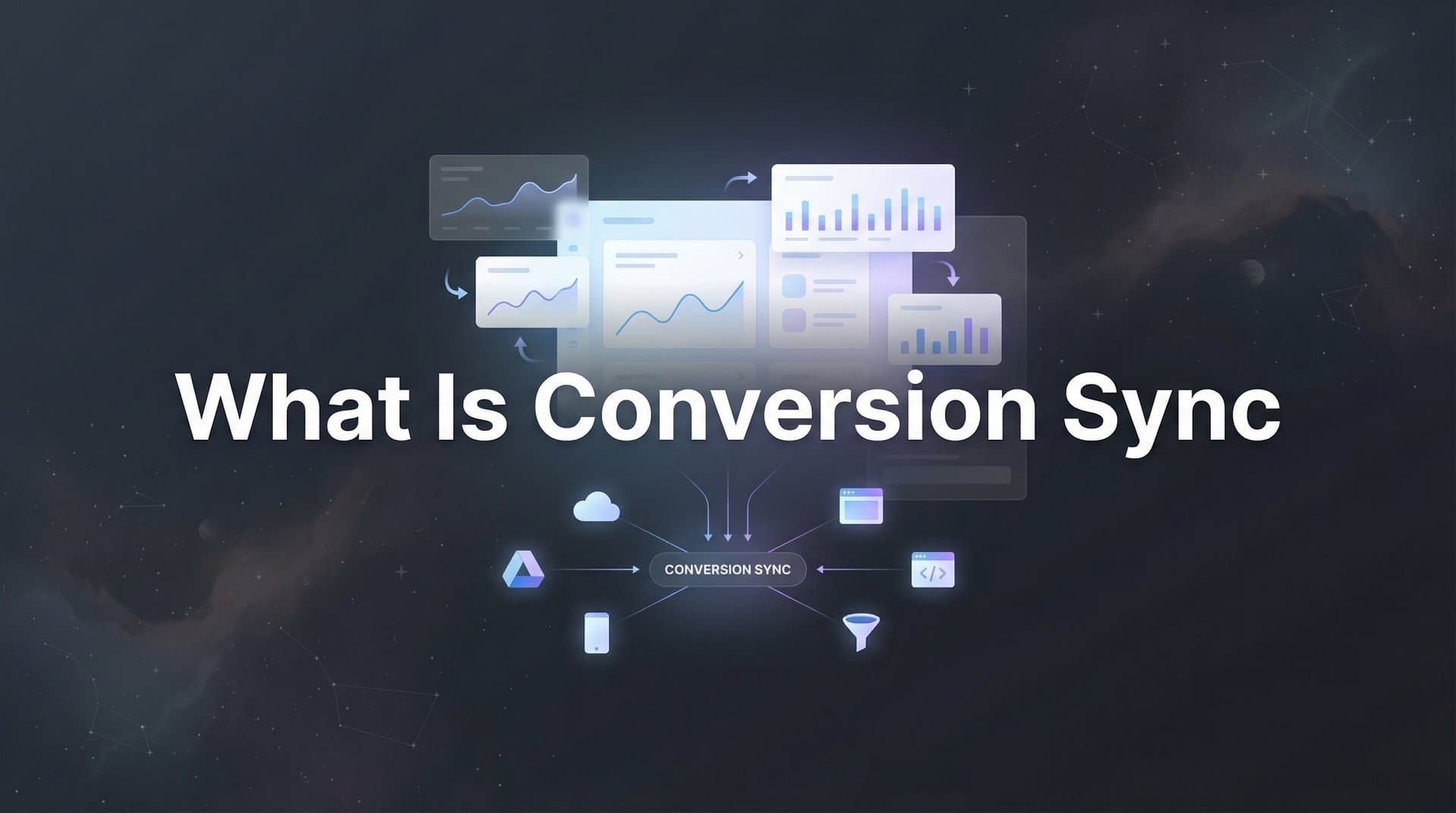
Think of conversion sync as a direct communication line between your business systems and your ad platforms. While traditional tracking relies on pixels embedded in web pages, conversion sync operates through server-to-server API connections that bypass all the limitations of browser-based tracking.
Here's the technical flow: when a conversion happens in your CRM, payment processor, or backend system, conversion sync captures that event and sends it back to the ad platform that drove the original click. This happens through official platform APIs like Meta's Conversions API or Google's Enhanced Conversions, creating a reliable data pipeline that isn't vulnerable to ad blockers, browser restrictions, or cookie limitations.
The critical difference lies in where the data originates. Traditional pixel tracking is client-side, meaning it depends on the user's browser to fire tracking codes and send conversion signals. If the user has an ad blocker installed, uses Safari with Intelligent Tracking Prevention, or opts out of tracking on iOS, that conversion signal never reaches the ad platform.
Conversion sync is server-side. It captures conversion events from your first-party systems, where you have complete visibility into what actually happened. A customer purchases your product, and your payment system records that transaction. Conversion sync takes that confirmed conversion and sends it to your ad platforms, regardless of what's happening in the customer's browser.
But conversion sync doesn't just send basic conversion signals. It sends enriched data that pixels can't capture. This includes customer lifetime value, lead quality scores, and downstream conversion events that happen days or weeks after the initial click.
For example, someone clicks your ad, fills out a form, but doesn't purchase immediately. Your pixel might capture the form submission, but it has no visibility into what happens next. Three weeks later, your sales team closes that lead for a $5,000 contract. Conversion sync can send that revenue event back to the ad platform, connecting it to the original ad click through matching identifiers like email addresses or click IDs.
This enriched data transforms how ad platforms understand your conversions. Instead of just knowing someone clicked and maybe filled out a form, platforms now know which clicks led to high-value customers, which campaigns drive actual revenue, and which audiences contain your best prospects.
The matching process works through hashed identifiers. When you send a conversion event via conversion sync, you include information like the customer's email address or phone number (securely hashed for privacy). The ad platform matches this against their records to connect the conversion back to the specific ad click, allowing them to attribute the conversion correctly and use that signal to improve optimization.
Why Ad Platform Algorithms Need Better Data
Meta, Google, and TikTok don't just show your ads randomly. Their algorithms constantly analyze conversion patterns to identify which audiences, placements, and creative combinations drive results. Then they automatically optimize your campaigns to show ads to more people who look like your converters.
This optimization engine is incredibly powerful, but it has one fundamental requirement: it needs to know who actually converted. When your tracking is incomplete, the algorithm builds its understanding on a distorted view of reality.
Here's the problem: if your pixel only captures 60% of conversions due to iOS blocking and browser restrictions, your ad platform thinks the other 40% never happened. It sees someone click your ad, but no conversion signal returns, so the algorithm assumes that audience segment doesn't convert well. It then reduces spend on that audience and shifts budget toward segments that happen to have better pixel coverage.
You're not optimizing for the best customers. You're optimizing for the customers whose conversions happen to be trackable by pixels. That's a critical distinction.
The garbage in, garbage out principle applies directly here. When platforms receive incomplete conversion data, they build lookalike audiences based on a biased sample. If iOS users convert at higher rates but their conversions aren't tracked, your lookalike audiences will underweight iOS user characteristics. Your campaigns will systematically avoid your best prospects.
Consider how Meta's algorithm learns. Every time it receives a conversion signal, it analyzes hundreds of attributes about that user: demographics, interests, behaviors, device type, time of day, ad placement, and countless other factors. It identifies patterns among converters and uses those patterns to find similar users.
When you feed the algorithm data on actual revenue-generating customers instead of just form fills or add-to-carts, everything changes. The platform can now distinguish between someone who filled out a form and never responded versus someone who became a $10,000 customer. It optimizes for revenue, not just top-of-funnel actions.
This matters enormously for Smart Bidding and automated optimization features. Google's Smart Bidding uses machine learning to set bids based on conversion likelihood. If it only sees partial conversion data, it's making bid decisions based on incomplete information. Feed it comprehensive conversion data through conversion sync, and suddenly it can bid more accurately for high-value conversions.
The compounding effect is real. Better data leads to better optimization, which leads to better results, which generates more conversion data, which further improves optimization. Marketers who establish this positive feedback loop consistently outperform competitors who rely on degraded pixel tracking.
Conversion Sync vs. Standard Tracking: A Direct Comparison
Standard pixel tracking served marketers well for years, but its limitations have become critical liabilities. Understanding the direct comparison reveals why conversion sync has become essential for serious advertisers.
Pixel tracking relies on JavaScript code embedded in your website. When someone converts, their browser executes that code and sends a signal to the ad platform. This approach is vulnerable to multiple failure points. Ad blockers prevent the pixel from loading. Browser privacy features like Safari's Intelligent Tracking Prevention limit how long pixels can track users. iOS App Tracking Transparency means many mobile users never allow tracking in the first place.
Conversion sync eliminates these vulnerabilities. It doesn't depend on the user's browser or device settings. Your server captures the conversion event in your backend systems and sends it directly to the ad platform through a secure API connection. This is the foundation of server-side conversion tracking that modern marketers rely on.
The timing advantage is equally significant. Pixels can only capture conversions that happen during the browser session or shortly after. If someone clicks your ad, browses your site, then returns three days later on a different device to make a purchase, the pixel likely won't connect that conversion back to the original ad click.
Conversion sync handles delayed conversions elegantly. A lead clicks your ad today, enters your sales pipeline, and closes 30 days later. Your CRM records that closed deal, and conversion sync sends that conversion event back to the ad platform with the original click ID, maintaining attribution accuracy across long sales cycles. Understanding click to conversion time becomes crucial for setting appropriate attribution windows.
This capability transforms B2B marketing and high-consideration purchases. If your average sales cycle is 45 days, pixel-based tracking gives ad platforms almost no useful optimization data. By the time conversions happen, the attribution window has expired. Conversion sync ensures platforms receive conversion signals even for lengthy sales processes.
Cross-device journeys present another challenge for standard tracking. Someone sees your ad on mobile, researches on their laptop, and purchases on a tablet. Pixels struggle to connect these touchpoints. Conversion sync uses identifier matching (email, phone number) to attribute conversions accurately regardless of device switching.
As third-party cookies disappear completely, pixel tracking becomes even less reliable. Cookies enabled cross-site tracking and retargeting, but browsers are systematically eliminating them. Conversion sync doesn't rely on cookies at all. It uses first-party data from your systems, making it future-proof against ongoing privacy changes.
The data quality difference is measurable. Companies using conversion sync typically report 20-40% more conversions tracked compared to pixel-only implementations. That's not because conversion sync creates new conversions. It's capturing the conversions that were always happening but pixels couldn't see.
Real-World Applications Across Marketing Channels
Each major ad platform has built conversion sync capabilities into their infrastructure, recognizing that server-side conversion data is essential for modern advertising. Understanding platform-specific applications helps you maximize the value of conversion sync.
Meta and Facebook Ads: Meta's Conversions API (CAPI) represents their conversion sync solution. It allows you to send conversion events directly from your server to Meta, bypassing the Facebook Pixel's limitations. The most powerful application is sending offline conversions and CRM events that the pixel never sees.
For example, you run lead generation campaigns where conversions happen in phone calls or in-person meetings. The pixel captures form submissions, but Meta's algorithm has no visibility into which leads actually close. By connecting your CRM to Meta through conversion sync, you can send "purchase" or "qualified lead" events when deals close, teaching Meta's algorithm which ad interactions lead to actual revenue.
This dramatically improves Custom Audience quality. When you build lookalike audiences based on purchasers, Meta can now include all purchasers, not just the ones whose conversions were tracked by pixels. Your lookalike audiences become more accurate and campaigns perform better.
Google Ads: Google offers Enhanced Conversions and offline conversion imports as their conversion sync solutions. Enhanced Conversions works by sending hashed customer data (email, phone, address) along with conversion events, allowing Google to match conversions more accurately even when cookies aren't available.
The impact on Smart Bidding is substantial. Google's automated bidding strategies rely on conversion data to optimize bids in real-time. When you implement conversion sync, Smart Bidding receives more complete conversion signals, improving its ability to identify high-value traffic and adjust bids accordingly.
Offline conversion imports are particularly valuable for businesses with complex sales processes. You can upload conversion data from your CRM or point-of-sale system, connecting online ad clicks to offline purchases. Retail businesses use this to track in-store purchases driven by online ads. B2B companies use it to attribute closed deals back to the original ad interactions.
Multi-Platform Scenarios: The real power emerges when you implement conversion sync across all your ad platforms simultaneously. Learning how to sync conversions to ad platforms ensures consistent, accurate conversion data flows to Meta, Google, TikTok, and LinkedIn, allowing each platform's algorithm to optimize with complete information.
This unified approach prevents the common problem where different platforms report wildly different conversion numbers due to varying tracking capabilities. When all platforms receive the same server-side conversion data, your reporting becomes consistent and trustworthy.
Attribution also improves across channels. Conversion sync can send the same conversion event to multiple platforms with appropriate attribution weights, helping you understand how different channels work together to drive conversions rather than each platform claiming 100% credit.
Setting Up Conversion Sync: Key Requirements and Considerations
Implementing conversion sync requires more technical infrastructure than dropping a pixel on your website, but the setup process is manageable with the right components in place.
The essential foundation is a system that captures conversion events reliably. This typically means integrating with your CRM, payment processor, or backend database where conversion actions are recorded. You need a way to capture when conversions happen and extract the relevant data: customer identifiers, conversion value, timestamp, and any other attributes you want to send to ad platforms.
Server-side tracking infrastructure comes next. You need a server environment that can receive conversion events from your business systems and make API calls to ad platforms. This might be a custom application, a tag management solution like Google Tag Manager Server-Side, or specialized conversion sync tools that handle the technical complexity.
Ad platform API connections require setup on each platform. For Meta, you'll configure the Conversions API with your pixel ID and access token. For Google, you'll set up Enhanced Conversions or offline conversion imports with the appropriate conversion actions defined. Each platform has specific requirements and authentication processes.
Data matching is critical for conversion sync to work. Ad platforms need to connect your conversion events back to specific ad clicks. This happens through matching identifiers. The most reliable identifiers are email addresses and phone numbers (sent as hashed values for privacy). Click IDs provide another matching method, where you capture the platform's click identifier when someone clicks your ad and include it when sending the conversion event.
The quality of your data matching directly impacts match rates. If you send conversion events with email addresses but those emails don't match what users provided to the ad platform, the conversion won't attribute correctly. Clean, standardized customer data improves match rates significantly.
Privacy compliance is non-negotiable. Conversion sync uses first-party data, which you collect directly from customers. This data usage must comply with GDPR, CCPA, and other privacy regulations. You need proper consent mechanisms, clear privacy policies, and secure data handling practices. Understanding the difference between first-party and third-party cookies helps clarify why this approach is more privacy-compliant.
The good news is that server-side conversion sync can actually improve privacy compliance compared to third-party tracking. You control what data gets sent, you can anonymize or hash sensitive information before transmission, and you're not relying on third-party cookies or cross-site tracking that privacy regulations increasingly restrict.
Testing and validation should happen before you rely on conversion sync for optimization. Most platforms provide tools to test API connections and verify that conversion events are being received correctly. Start with a small subset of conversions, confirm they're attributing properly, then scale up to full implementation.
Ongoing monitoring matters too. API connections can break due to authentication issues, system changes, or platform updates. Regular checks ensure your conversion sync continues flowing data reliably.
Measuring Success: What Changes When Conversion Sync is Active
The impact of conversion sync becomes visible across multiple metrics, though some changes appear immediately while others compound over time.
Match rates provide the first indicator of success. When you implement conversion sync, check your ad platform's reporting to see what percentage of your conversion events are successfully matching back to ad clicks. Strong implementations typically achieve 70-85% match rates for email-based matching. Lower match rates suggest data quality issues or technical problems that need addressing.
ROAS reporting accuracy improves noticeably. Before conversion sync, your reported ROAS might have been artificially low because many conversions weren't being tracked. After implementation, you'll likely see reported ROAS increase as platforms finally see the full picture of conversions your campaigns are driving.
This doesn't mean your campaigns suddenly got better. It means your reporting now reflects reality. The increase in reported conversions should roughly correspond to your previous tracking gap. If pixels were capturing 60% of conversions, implementing conversion sync should increase your tracked conversions by approximately 40%.
Campaign optimization improvements take longer to manifest but become substantial. Ad platforms need time to accumulate conversion data and retrain their algorithms. Over 2-4 weeks, you should see optimization metrics improve: cost per conversion decreasing, conversion rates increasing, and ad delivery shifting toward better-performing audiences.
The validation process is straightforward: compare platform-reported conversions to actual CRM data. Pull a report of conversions that happened in your CRM during a specific period, then check how many of those conversions appear in your ad platform reporting. The gap between these numbers represents your tracking accuracy.
Before conversion sync, this gap might be 30-50% or more. After implementation, it should narrow to 10-20%, accounting for conversions that legitimately can't be attributed (organic traffic, direct visits, conversions outside attribution windows).
The compounding effect emerges as your most significant long-term benefit. As ad platforms receive better conversion data, their algorithms continuously refine their understanding of your best customers. Lookalike audiences become more accurate. Automated bidding strategies get smarter. Creative optimization improves.
This creates a positive feedback loop. Better data leads to better optimization, which drives better results, which generates more conversion data, which further improves optimization. Marketers who establish this loop early gain a sustained competitive advantage.
You might also notice improved performance in automated features you previously avoided. Smart Bidding, Dynamic Creative Optimization, and Advantage+ campaigns all rely heavily on conversion data. With conversion sync providing comprehensive signals, these automated features often outperform manual optimization.
The Future of Marketing Attribution Starts With Better Data
Conversion sync represents more than a technical improvement. It's a fundamental shift in how marketers communicate with ad platforms, moving from incomplete, browser-dependent signals to comprehensive, first-party conversion data that platforms can actually use to optimize effectively.
The marketing landscape is clear: privacy regulations are tightening, browser restrictions are expanding, and third-party tracking is disappearing. The marketers who thrive in this environment are those who adapt by building direct, reliable data pipelines between their business systems and their ad platforms.
This isn't about finding workarounds or trying to preserve old tracking methods. It's about embracing a better approach that respects user privacy while giving ad platforms the conversion signals they need to optimize campaigns intelligently.
The performance gap between marketers using conversion sync and those relying solely on pixel tracking will only widen. As tracking degradation continues, pixel-only approaches will capture progressively less data, while conversion sync maintains consistent, accurate conversion tracking regardless of external changes.
Your competitive advantage comes from feeding ad platforms better data than your competitors. When your campaigns optimize based on actual revenue-generating customers while competitors optimize based on partial, biased conversion samples, you win consistently.
The time to implement conversion sync is now, before tracking degradation erodes your campaign performance further. Every day you wait is another day of incomplete data flowing to your ad platforms, another day of suboptimal optimization, another day of competitive disadvantage.
Ready to elevate your marketing game with precision and confidence? Discover how Cometly's AI-driven recommendations can transform your ad strategy. Get your free demo today and start capturing every touchpoint to maximize your conversions.



