
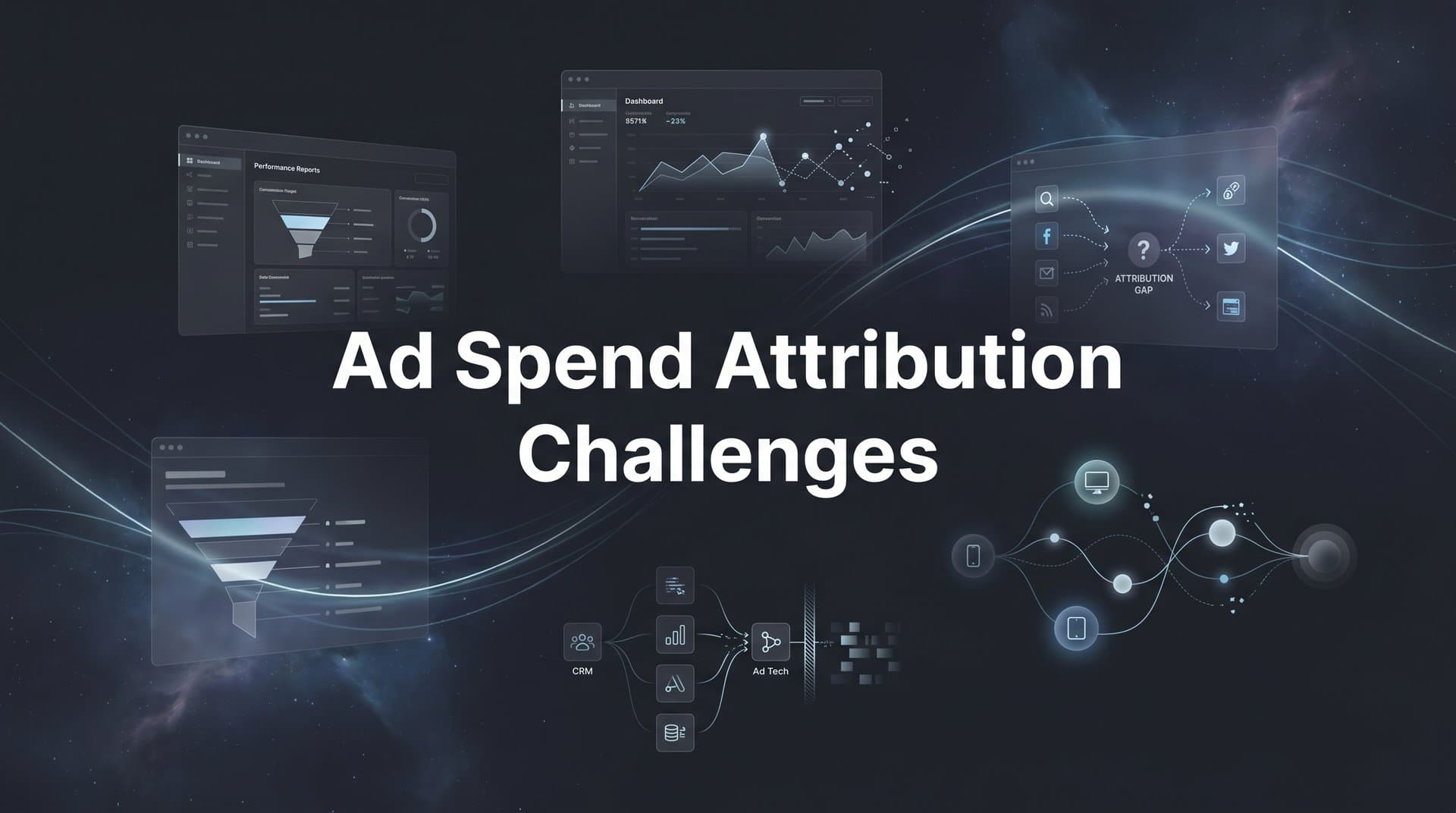
You're staring at three different dashboards on a Tuesday morning. Meta Ads Manager says it drove 47 conversions yesterday. Google Ads claims 52. Your CRM? It logged 38 new customers. The math doesn't work. Someone's lying, or everyone's telling a partial truth.
This isn't just a reporting headache. It's a budget crisis waiting to happen.
When your attribution data doesn't add up, you're making million-dollar decisions based on incomplete information. You might be scaling the wrong campaigns, starving your best performers, or feeding ad platform algorithms data so fragmented they can't optimize effectively. Every misallocated dollar compounds over time.
The frustrating part? This problem has gotten worse, not better. Modern marketing technology promised clarity. Instead, we got more complexity, more data silos, and more conflicting reports.
Here's what we're going to break down: why attribution became so difficult in the 2020s, the specific challenges draining your ad budget right now, and the practical strategies that actually work for getting clearer, more actionable data. Because solving attribution isn't about finding perfect data. It's about building a system reliable enough to make confident decisions.
The Perfect Storm: Why Attribution Broke in the 2020s
Attribution didn't gradually decline. It shattered.
April 2021 marked the turning point. Apple rolled out App Tracking Transparency with iOS 14.5, requiring every app to ask permission before tracking users across other apps and websites. The result? Most users tapped "Ask App Not to Track." Overnight, advertisers lost visibility into massive portions of their customer journeys.
Meta publicly estimated this change would cost them $10 billion in 2022 revenue. That wasn't Meta's money disappearing. It was advertisers suddenly unable to track whether their ads actually worked, forcing them to pull back spend or operate blind.
But privacy changes were just the opening act.
Google announced plans to deprecate third-party cookies in Chrome, the world's most popular browser. Despite multiple delays, the writing is on the wall: the tracking mechanisms that powered digital advertising for two decades are being systematically dismantled. GDPR in Europe and CCPA in California added legal complexity, making marketers nervous about aggressive tracking even when technically possible.
Meanwhile, customer behavior evolved in the opposite direction. Your buyers now research on their phone during lunch, compare options on their laptop at home, ask colleagues in Slack, revisit your site on their tablet, and finally convert on desktop three days later. The average customer journey spans three to five devices. Each device switch creates a data gap, making cross-device attribution one of the most pressing issues for modern marketers.
Think about your own buying behavior. When was the last time you saw an ad and immediately purchased? You probably clicked, browsed, left, came back through Google, maybe clicked another ad, read reviews, and eventually converted through a completely different channel than where you started.
Now imagine trying to connect those dots when half your tracking pixels don't fire, cookies get deleted between sessions, and each platform only sees its own slice of the journey.
The final nail in the coffin? Walled gardens got taller. Meta, Google, TikTok, LinkedIn, and Amazon all operate closed ecosystems. They track users within their platforms beautifully. But they don't share that data with each other or make it easy to connect to your other systems. Each platform reports in isolation, each using different attribution windows, different conversion definitions, and different ways of claiming credit.
This created the perfect storm: more complex customer journeys, less ability to track them, and platforms that actively resist sharing data. The result is the conflicting dashboard nightmare you're living with right now.
Five Core Attribution Challenges Draining Your Ad Budget
Let's get specific about what's actually broken. These five challenges show up in almost every marketing operation, and each one costs you money.
Challenge 1: The Double-Counting Problem
When someone converts, every platform they touched wants credit. Meta says their ad drove it. Google says their search ad closed it. Your email platform claims the nurture sequence sealed the deal. Add them all up and you've got 200% attribution for 100% of your conversions.
This isn't academic. If Meta reports 50 conversions and Google reports 50 conversions, but you only got 60 actual customers, you're making scaling decisions based on inflated numbers. You might double down on both channels thinking they're crushing it, when really they're just both claiming credit for the same buyers.
The math breaks completely when you try to calculate return on ad spend. If you spent $5,000 on Meta and they report $15,000 in revenue, that looks like a 3x ROAS. But if half those conversions also got counted by Google, your real ROAS is closer to 1.5x. That's the difference between "scale aggressively" and "proceed with caution." Understanding how to fix attribution data discrepancies becomes essential for accurate reporting.
Challenge 2: Last-Click Bias Murders Your Awareness Campaigns
Default attribution models give all the credit to whoever touched the customer last. Someone sees your Facebook ad, watches your YouTube video, clicks a LinkedIn post, then finally Googles your brand name and converts. Google Search gets 100% of the credit.
This makes awareness campaigns look terrible. You're running top-of-funnel ads that introduce your brand to cold audiences. They work. People remember you, search for you later, and buy. But your attribution data says those awareness campaigns generated zero conversions because they weren't the last click.
So you cut the campaigns that actually fill your pipeline. Your search volume drops. Your remarketing pools shrink. Three months later, you're wondering why your "efficient" bottom-funnel campaigns aren't performing anymore. You starved the top of your funnel and didn't realize it until the pipeline dried up.
Challenge 3: Delayed Conversions Fall Through the Cracks
Most attribution windows are ridiculously short. Meta's default is seven days. Someone clicks your ad on Monday, thinks about it, compares options, and buys on the following Tuesday. That's nine days. Meta doesn't count it.
For B2B or high-consideration purchases, this is devastating. Your sales cycle might be 30, 60, or 90 days. Someone downloads your whitepaper, gets nurtured through email, has three sales calls, and signs a contract six weeks later. Your ad platforms see zero conversions from that campaign because the window closed.
You're left looking at campaigns that drove real revenue and seeing goose eggs in your reporting. The temptation is to kill them. After all, the data says they don't work. Except they do work. Your attribution just can't see it.
Challenge 4: Cross-Device Tracking Is Still Mostly Broken
Your customer clicks a Meta ad on their iPhone during their commute. They visit your site, browse around, but don't buy. That evening, they're on their laptop, Google your brand, and purchase. Meta has no idea that mobile click led to a desktop conversion.
Platforms are getting better at this through logged-in users, but most of your audience isn't logged into Facebook or Google on every device they use. The gaps remain massive. You're essentially tracking fragments of journeys and trying to piece together the full story with missing chapters.
Challenge 5: Platform Reporting Optimizes for Platform Interests
Here's an uncomfortable truth: ad platforms benefit from generous attribution. When Meta's algorithm can claim credit for more conversions, it makes their platform look more effective. Their reporting isn't technically lying, but it's definitely optimistic.
They use view-through attribution (someone saw but didn't click your ad, then converted later), they extend attribution windows when it suits them, and they make it difficult to compare their numbers against external sources of truth. You're trying to make objective decisions using data from parties with a vested interest in the outcome.
The Hidden Cost of Attribution Gaps
Bad attribution doesn't just create confusing reports. It actively destroys marketing efficiency in ways that compound over time.
Budget Misallocation Becomes Your Default State
Without accurate attribution, you're flying blind on the most important question in marketing: where should I spend more money? You end up making decisions based on incomplete data, gut feeling, or whoever's dashboard looks prettiest.
Maybe you're overspending on branded search because it shows amazing ROAS, not realizing those people would have found you anyway. Or you're cutting display campaigns that actually drive significant awareness and consideration, just because they rarely get last-click credit. Every dollar in the wrong place is a dollar not invested in your actual winners. These ad spend optimization challenges plague marketing teams across industries.
This compounds monthly. If you're misallocating 20% of your budget and spending $50,000 per month, that's $10,000 wasted. Over a year, that's $120,000 that could have gone to channels actually driving growth. The opportunity cost is even higher when you consider what those properly allocated dollars could have returned.
Ad Platform Algorithms Can't Optimize Blind
Here's something most marketers don't fully appreciate: Meta's algorithm, Google's Smart Bidding, and TikTok's optimization all depend on conversion data to learn and improve. When you can't accurately track conversions, you're not just losing reporting clarity. You're crippling the AI.
These algorithms need to know: which users converted, what they did before converting, and what characteristics they share. With fragmented data, the algorithm sees a fraction of actual conversions. It thinks certain audience segments don't convert when they actually do. It optimizes toward the wrong signals.
The result? Your campaigns underperform not because your creative is bad or your offer is weak, but because the optimization engine is learning from corrupted data. You're competing against advertisers who solved attribution and are feeding their algorithms complete conversion data. They're training smarter models. You're stuck in mediocrity wondering why your performance plateaued.
True CAC and LTV Become Impossible to Calculate
Customer acquisition cost is simple math: ad spend divided by customers acquired. Except when you don't know how many customers each channel actually acquired, the math breaks.
You think your CAC is $85 based on last-click attribution. In reality, when you account for all the touchpoints, it's $140. That changes everything. Your unit economics might not work. Your pricing might be too low. Your growth strategy might be unsustainable.
Lifetime value calculations suffer even more. If you can't connect customers back to their acquisition source accurately, you can't segment LTV by channel. You don't know if Google customers are worth more than Meta customers. You can't optimize toward high-LTV audiences because you don't know which channels reach them.
This keeps you stuck in short-term thinking. You optimize for immediate conversions because that's all you can measure, missing the channels that drive customers who stick around and spend more over time.
First-Party Data: Your Foundation for Better Attribution
The solution to attribution chaos isn't better guessing. It's better data infrastructure. Specifically, it's building a first-party data system that you own and control.
Server-Side Tracking Bypasses the Browser Battlefield
Traditional tracking relies on pixels and cookies in users' browsers. That's exactly where privacy changes hit hardest. Browsers block third-party cookies. Users decline tracking permissions. Ad blockers strip pixels. Your data collection fails before it starts.
Server-side tracking flips the model. Instead of relying on browser-based pixels, your server sends conversion data directly to ad platforms. When someone converts on your site, your server captures that event and forwards it to Meta, Google, and your analytics platform. No browser involvement. No cookies required.
This isn't a workaround or a hack. It's the architecture that major platforms now recommend. Meta's Conversions API, Google's Enhanced Conversions, and TikTok's Events API all work this way. They're designed for a post-cookie world.
The practical benefit? You capture significantly more conversions. While browser-based tracking might miss 30-40% of events due to blockers and privacy settings, server-side tracking captures nearly everything. That's not just better reporting. It's better data for ad platform algorithms to optimize against.
CRM Integration Connects Ads to Actual Revenue
Ad platforms track conversions. Your CRM tracks customers and revenue. The gap between those two systems is where attribution dies.
Someone fills out a lead form after clicking your ad. Meta counts a conversion. But that lead never responds to sales outreach. Or they do respond, but they don't buy. Or they buy, but they churn in 30 days. Or they buy and become your best customer, referring three others.
Your ad platform has no idea about any of that. It thinks all conversions are equal. Your CRM knows the truth but can't connect it back to marketing sources.
Integrating your CRM with your attribution system solves this. You can pass revenue data, customer lifetime value, churn rates, and sales cycle length back to your marketing analytics. Suddenly you're not optimizing for conversions. You're optimizing for revenue and customer quality. This is where channel attribution and revenue tracking become game-changers.
This changes your entire strategy. You might discover that LinkedIn drives fewer conversions than Meta, but LinkedIn customers have 3x higher LTV. Or that Google Search converts faster but has higher churn. You can't make those insights actionable without connecting marketing data to business outcomes.
Building a Unified Customer Journey View
The goal isn't just collecting more data. It's connecting the dots across every touchpoint to see complete customer journeys.
This means tracking ad clicks, website visits, email opens, sales calls, demo requests, and purchases in one system. When you can see that a customer first discovered you through a LinkedIn ad, returned via organic search, downloaded a resource, attended a webinar, and then converted after a sales call, you understand what actually drives conversions.
Most businesses have this data scattered across six different tools that don't talk to each other. Your ad platforms know about clicks. Google Analytics knows about website behavior. Your email platform knows about engagement. Your CRM knows about sales. None of them share a common customer ID or unified timeline.
Building that unified view requires technical infrastructure: a customer data platform or attribution system that can ingest data from all sources, match users across touchpoints, and construct complete journey maps. It's not trivial to set up, but it's the foundation that makes everything else possible.
Choosing the Right Attribution Model for Your Business
Once you have solid data infrastructure, you need to decide how to assign credit across touchpoints. There's no universal "best" model. The right choice depends on your business model, sales cycle, and what decisions you're trying to make.
When Last-Click Still Makes Sense
Last-click attribution gets criticized heavily, but it's not always wrong. For businesses with short sales cycles and primarily bottom-funnel marketing, it can be perfectly appropriate.
If you sell impulse purchases or low-consideration products, most customers convert quickly after discovering you. There isn't a long nurture process. The last touchpoint really is the most important one. A local restaurant running Google Search ads for "pizza delivery near me" doesn't need multi-touch attribution. The search ad drove the order.
Last-click is also the simplest to understand and explain. Your team, your executives, and your stakeholders immediately grasp it. When you're building buy-in for attribution as a discipline, starting with last-click and evolving from there can be smarter than jumping straight to complex models nobody trusts.
The key is knowing its limitations. If you're running awareness campaigns, have a long sales cycle, or use multiple channels that work together, last-click will mislead you. Use it consciously, not by default.
Multi-Touch Attribution for Complex Journeys
When customers interact with multiple touchpoints before converting, multi-touch models attempt to distribute credit more fairly. Linear attribution gives equal credit to every touchpoint. Time-decay gives more credit to recent interactions. Position-based gives extra credit to the first and last touchpoints. Understanding the difference between single-source and multi-touch attribution models helps you choose the right approach.
These models better reflect reality for complex B2B sales or high-consideration consumer purchases. If your average customer journey includes five or six touchpoints over several weeks, giving all the credit to the last click ignores 80% of what actually influenced the decision.
The challenge is choosing which multi-touch model to use. Linear feels fair but might overweight irrelevant touchpoints. Time-decay makes intuitive sense but still undervalues early awareness. Position-based is a compromise but feels arbitrary.
Here's the practical approach: run multiple models in parallel and compare them. Look at how credit distribution changes. If every model tells roughly the same story, you can be confident in your conclusions. If they wildly disagree, you need to dig deeper into why and what that reveals about your customer journey.
Data-Driven Attribution: Letting Algorithms Decide
The most sophisticated approach is data-driven attribution, where machine learning analyzes your actual conversion data to determine how much credit each touchpoint deserves. Instead of applying a predetermined rule, the algorithm looks at patterns: when this touchpoint appears in a journey, how much does it increase conversion likelihood?
Google Analytics and some attribution platforms offer this. It requires significant data volume to work well, typically thousands of conversions. Below that threshold, the algorithm doesn't have enough signal to identify meaningful patterns.
When it works, data-driven attribution is powerful because it's specific to your business. It learns that your webinar touchpoint is incredibly influential, or that social media plays a key awareness role but rarely drives direct conversions. It adapts as your marketing mix changes.
The downside? It's a black box. You can't easily explain why the algorithm assigned 23% credit to a particular touchpoint. For some stakeholders, that lack of transparency is a dealbreaker. You need to balance sophistication with explainability.
Putting Better Attribution Into Practice
Understanding attribution challenges is one thing. Actually solving them requires systematic implementation. Here's how to move from theory to practice.
Start With Tracking Infrastructure, Not Models
The biggest mistake is jumping straight to attribution models before fixing your data collection. Sophisticated models applied to broken data just give you sophisticated garbage.
Your first priority is ensuring you're actually capturing conversion data accurately. Implement server-side tracking. Set up proper conversion events. Make sure your tracking survives browser restrictions and privacy settings. Verify that conversions are being recorded consistently across platforms. Investing in affordable attribution tracking solutions can help you build this foundation without breaking the budget.
Test your tracking by making test purchases or conversions yourself. Check if they appear in all your systems. Look for discrepancies. If your website analytics shows 100 conversions but your CRM only shows 85, you have a data integrity problem to solve before worrying about attribution models.
This foundation work isn't glamorous, but it's essential. You can't attribute conversions you're not tracking in the first place.
Feed Enriched Data Back to Ad Platforms
Once you're capturing complete conversion data, send it back to your ad platforms. This creates a virtuous cycle: better data leads to better optimization, which leads to better performance, which generates more data to learn from.
Use Meta's Conversions API, Google's Enhanced Conversions, and similar tools to send server-side conversion events. Include as much detail as possible: conversion value, customer information, and any custom parameters that help the algorithm understand quality.
If you've integrated your CRM, you can send revenue data and customer lifetime value back to ad platforms. This lets their algorithms optimize not just for conversions, but for valuable conversions. Meta can learn to find more customers like your high-LTV segment. Google can bid more aggressively for searches likely to drive quality leads.
This is where attribution infrastructure pays immediate dividends. You're not just getting better reports. You're making your ad campaigns smarter and more efficient.
Establish a Regular Attribution Review Cadence
Attribution isn't a set-it-and-forget-it system. Customer behavior changes. New channels emerge. Your marketing mix evolves. You need regular reviews to ensure your attribution approach still makes sense.
Set a monthly or quarterly cadence to examine attribution data and adjust strategy. Look at how credit is being distributed across channels. Compare different attribution models. Identify channels that might be over or undervalued. Implementing cross-channel attribution tracking gives you the visibility needed for these reviews.
Use these reviews to make concrete budget decisions. If multi-touch attribution consistently shows that LinkedIn plays a crucial role early in the journey, but last-click gives it zero credit, that's a signal to invest more in LinkedIn even if immediate conversions don't justify it.
Make attribution a team conversation, not just a dashboard you check. Bring together marketing, sales, and analytics to discuss what the data is telling you and what actions to take. The best insights come from combining quantitative attribution data with qualitative understanding of your customer journey.
The Path Forward
Ad spend attribution challenges aren't going away. Privacy regulations will continue tightening. Customer journeys will keep getting more complex. Walled gardens won't suddenly start sharing data freely. The environment is only getting harder.
But here's the opportunity: most of your competitors are still stuck with broken attribution, making budget decisions based on incomplete data, and wondering why their campaigns underperform. They're operating in the dark.
When you solve attribution, you gain a massive competitive advantage. You know which channels actually drive revenue. You can feed ad platform algorithms complete conversion data so they optimize better. You can calculate true customer acquisition costs and lifetime value. You make confident decisions about where to scale and where to cut.
The solution isn't finding perfect data. It's building infrastructure that captures as much of the customer journey as possible, choosing attribution models appropriate for your business, and continuously feeding better data back into your marketing ecosystem. Start with solid tracking. Connect your systems. Test different models. Make it a discipline, not a one-time project.
The marketers who crack attribution in 2026 and beyond won't just have clearer dashboards. They'll have fundamentally better marketing efficiency, higher returns on ad spend, and the confidence to make bold scaling decisions backed by real data.
Ready to elevate your marketing game with precision and confidence? Discover how Cometly's AI-driven recommendations can transform your ad strategy. Get your free demo today and start capturing every touchpoint to maximize your conversions.