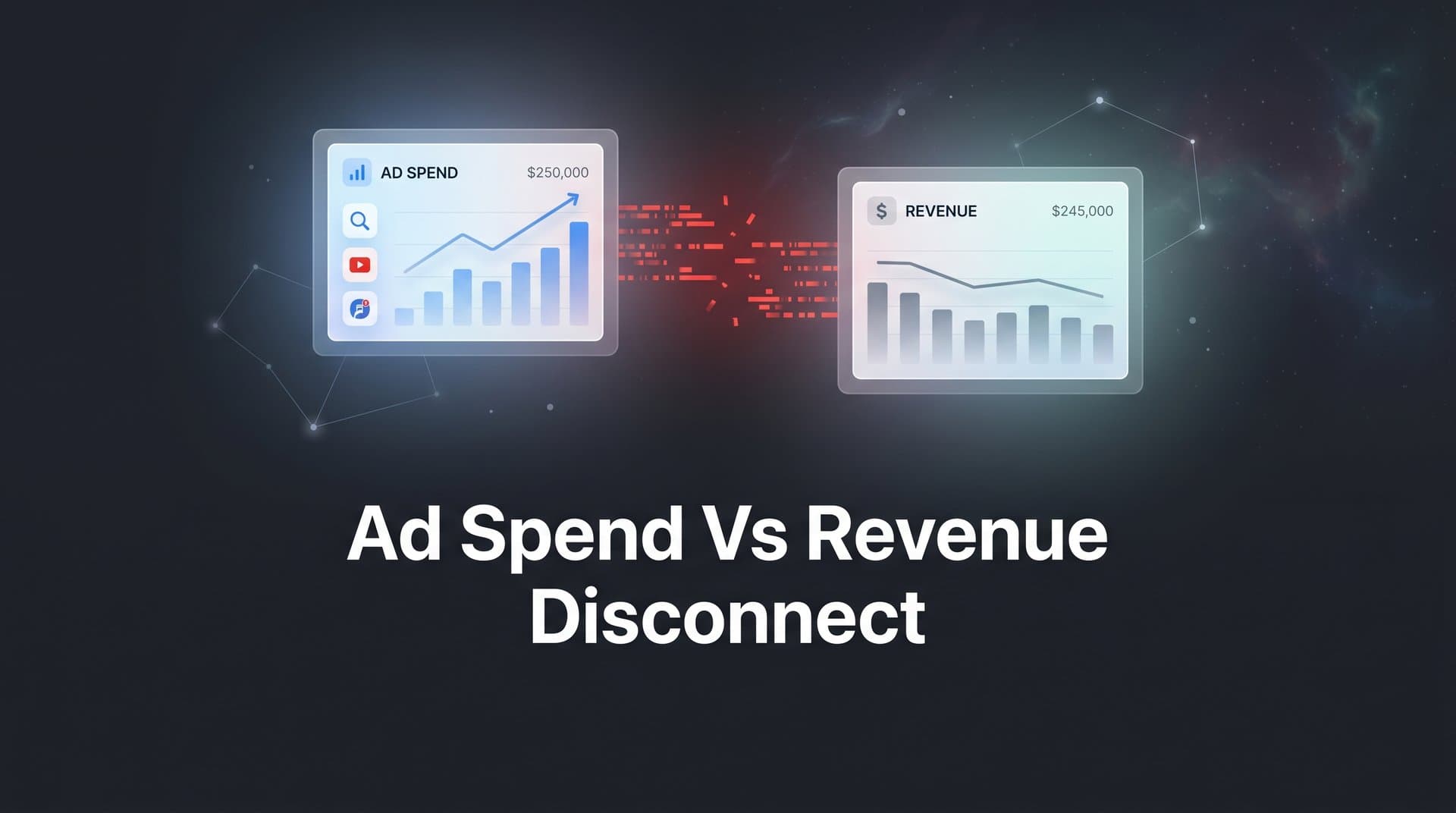
You are pouring budget into paid campaigns across Meta, Google, TikTok, and more. Platform dashboards show strong ROAS numbers. But when you pull up actual revenue in your CRM or accounting software, the numbers just do not match.
This gap between what your ad platforms report and what your business actually earns is the ad spend vs revenue disconnect, and it is one of the most common and costly problems in digital advertising today.
The disconnect happens for many reasons: duplicate conversions, broken tracking pixels, iOS privacy changes stripping attribution data, siloed reporting across platforms, and long sales cycles that ad platforms simply cannot follow. Left unchecked, this misalignment leads to wasted budget on underperforming campaigns and underinvestment in channels that actually drive revenue.
The good news is that this problem is solvable. In this guide, we will walk through seven actionable strategies that help you close the gap between ad spend and real revenue, so every dollar you invest is backed by accurate data and clear performance insights.
1. Implement Server-Side Tracking to Reclaim Lost Data
The Challenge It Solves
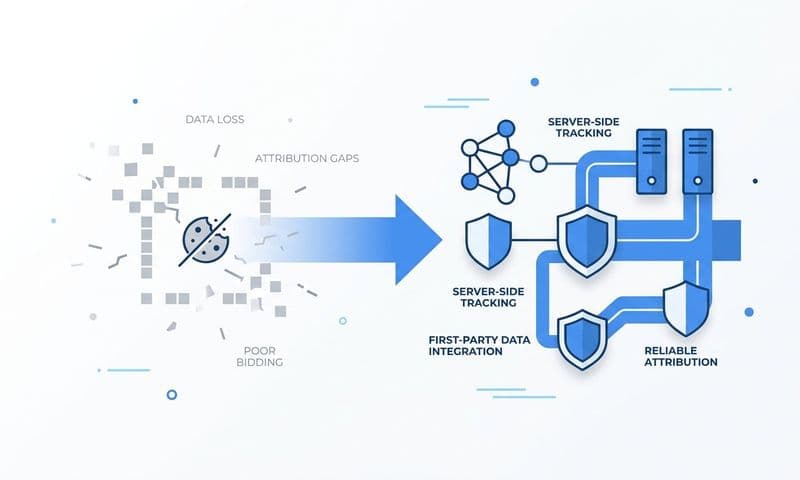
Browser-based pixels are increasingly unreliable. Apple's App Tracking Transparency framework, introduced in iOS 14.5, significantly reduced the data available to ad platforms. Ad blockers, cookie restrictions, and browser-level privacy controls compound the problem further. The result is a growing blind spot in your conversion data, where real customer actions go unrecorded and your platform dashboards underreport actual performance.
The Strategy Explained
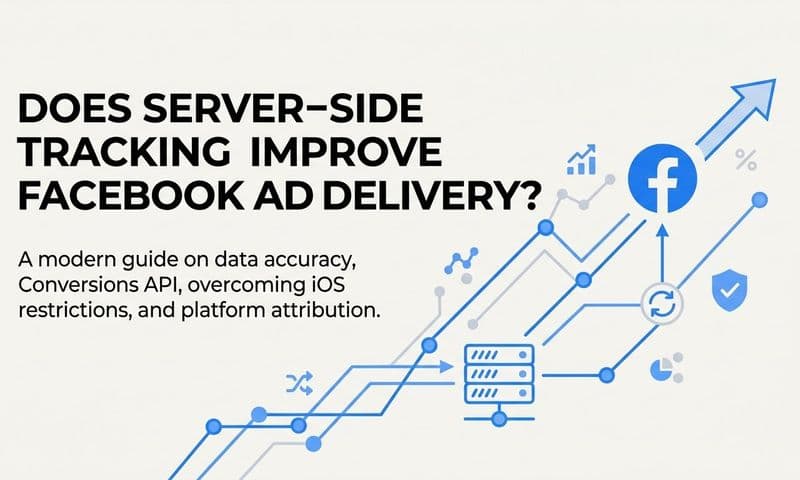
Server-side tracking moves the conversion measurement process from the user's browser to your own server infrastructure. Instead of relying on a pixel firing in someone's browser, your server directly communicates verified conversion events to ad platforms through their APIs, such as Meta's Conversions API or Google's Enhanced Conversions.
This approach bypasses the conditions that cause browser-based tracking to fail. It does not depend on cookies, it is not affected by ad blockers, and it is not subject to the same iOS privacy restrictions. The signal you send to platforms is cleaner, more complete, and more accurate. Addressing these issues is critical when dealing with lost ad revenue from tracking issues that silently erode your campaign performance.
Implementation Steps
1. Audit your current pixel setup to identify where data loss is occurring. Compare browser-reported events to server-confirmed events to quantify the gap.
2. Set up a server-side event stream using your ad platforms' native APIs or a tag management solution that supports server-side containers.
3. Deduplicate events by passing a consistent event ID that both browser and server can reference, so conversions are not double-counted when both fire.
4. Validate your implementation by comparing server-side data to your CRM and confirming that the numbers align more closely than before.
Pro Tips
Prioritize server-side tracking for your highest-value conversion events first, such as purchases, demos booked, or qualified leads. These are the events that most directly influence your ad platform's optimization algorithms, and improving their accuracy will have the fastest impact on your campaign performance. Cometly's server-side tracking is built specifically to address this challenge, helping you recover lost signal and feed cleaner data to every platform.
2. Unify Your Attribution Model Across Every Channel
The Challenge It Solves
Each major ad platform uses different default attribution windows. Meta defaults to a 7-day click and 1-day view window. Google Ads uses a 30-day click window by default. When you sum conversion totals across platforms without accounting for these differences, you end up counting the same conversion multiple times and inflating your reported ROAS significantly. The problem is not that any single platform is lying. It is that they are each telling their own version of the truth.
The Strategy Explained
The fix is to apply one consistent attribution model across all of your channels using a neutral, third-party attribution system rather than relying on each platform's native reporting. This gives you a single source of truth that is not biased toward any one channel claiming credit.
Multi-touch attribution models, such as linear, time decay, or data-driven attribution, distribute credit across every touchpoint in the customer journey. This approach is far more representative of how your customers actually make decisions, especially when they interact with multiple ads across multiple platforms before converting. Many teams struggle with ad spend attribution challenges precisely because they lack this unified view.
Implementation Steps
1. Choose an attribution model that fits your sales cycle. Shorter cycles often work well with last-touch or time-decay models. Longer B2B cycles typically benefit from linear or data-driven models.
2. Implement a cross-channel attribution platform that ingests data from all your ad sources and applies your chosen model consistently.
3. Compare your unified attribution report to each platform's native report to understand where discrepancies exist and which channels are over- or under-claiming credit.
4. Use the unified view as your primary decision-making dashboard, not the individual platform dashboards.
Pro Tips
Resist the urge to optimize each platform in isolation using its own native data. When you do that, you are optimizing for each platform's version of success, not your business's actual revenue. A unified model keeps your entire strategy aligned toward the same goal. Cometly's multi-touch attribution makes this possible by connecting every touchpoint across channels into one coherent view.
3. Connect Ad Data Directly to CRM Revenue Events
The Challenge It Solves
Most ad platforms track conversions at the top of the funnel: form fills, page visits, add-to-carts, or even just clicks. But for many businesses, especially in B2B or high-consideration verticals, the actual revenue event happens weeks or months later when a deal closes in the CRM. Without a direct connection between your ad data and CRM revenue events, you are optimizing campaigns toward proxy metrics that may not correlate with actual revenue.
The Strategy Explained
CRM integration bridges the gap by tying closed deals and actual revenue amounts back to the original ad touchpoints that influenced them. When a deal closes in your CRM, that event, along with its revenue value, is passed back to your attribution system and mapped to the specific campaign, ad set, and creative that started the customer journey.
This transforms your reporting from "we generated 200 leads" to "we generated $180,000 in pipeline from these three campaigns." That level of clarity changes how you allocate budget and which campaigns you scale. Teams that master this process achieve accurate revenue attribution tracking that directly ties every dollar of ad spend to real business outcomes.
Implementation Steps
1. Connect your CRM to your attribution platform using a native integration or API connection. Common CRMs like Salesforce and HubSpot have well-documented integration pathways.
2. Map the CRM deal stages that represent meaningful revenue milestones, such as opportunity created, proposal sent, and deal closed.
3. Pass revenue values from closed deals back to your attribution system so you can calculate true revenue-based ROAS, not just lead volume or estimated pipeline.
4. Build reports that show revenue by campaign, channel, and ad creative, and use this as your primary performance view.
Pro Tips
Make sure you are passing actual deal values, not estimated or placeholder amounts. The quality of your CRM data directly determines the quality of your revenue attribution. If your CRM records are incomplete or inconsistently updated, clean that up first before investing heavily in the integration. Cometly connects your ad platforms, CRM, and website to track the entire customer journey in real time, giving you revenue-level clarity on every campaign.
4. Feed Enriched Conversion Data Back to Ad Platform Algorithms
The Challenge It Solves
Ad platform algorithms are only as smart as the data you feed them. When platforms receive incomplete or inaccurate conversion signals because of iOS restrictions, pixel failures, or missing revenue values, their optimization algorithms make poor decisions. They target the wrong audiences, allocate budget inefficiently, and optimize toward low-quality conversions. The result is a self-reinforcing cycle where bad data leads to bad targeting, which leads to worse results.
The Strategy Explained
Conversion sync closes this loop by taking the verified, enriched conversion events from your attribution system and sending them back to Meta, Google, and other platforms. Instead of letting platforms work with incomplete browser-based signals, you are giving them a richer, more accurate picture of which users actually converted and what those conversions were worth.
This process, often called offline conversion import or conversion API integration, allows platforms to retrain their algorithms on real revenue data. Over time, this improves audience targeting, reduces wasted spend, and increases the quality of conversions the platform delivers. Learning how to optimize ad spend with data like this is essential for maximizing your return on every campaign.
Implementation Steps
1. Set up conversion sync between your attribution platform and each major ad platform you run. Meta's Conversions API and Google's Enhanced Conversions are the primary channels.
2. Include revenue values with each conversion event so platforms can optimize toward high-value customers, not just any conversion.
3. Use consistent event naming conventions across platforms so your attribution system can match events accurately.
4. Monitor the impact over several weeks. Improved signal quality typically leads to better audience matching and more efficient spend over time.
Pro Tips
The more complete and timely your conversion data, the better the platform algorithms perform. If your sales cycle is long, consider syncing pipeline milestones as intermediate conversion events, not just final closed deals. This gives platforms a faster feedback loop to work with. Cometly's Conversion Sync is designed to feed enriched, conversion-ready events back to Meta, Google, and more, improving targeting, optimization, and ad ROI.
5. Audit and Eliminate Duplicate Conversion Counting
The Challenge It Solves
Duplicate conversion counting is one of the most common and underappreciated causes of inflated ROAS. It happens when the same conversion is tracked and reported multiple times: once by a browser pixel, once by a server-side event, and potentially once more by a third-party tag. It also happens when multiple platforms each claim full credit for the same conversion. The end result is that your reported conversion totals look far stronger than your actual business results.
The Strategy Explained
A systematic deduplication audit involves reviewing every tracking tag, pixel, and API integration in your stack to identify where the same event is being fired more than once. Once identified, you eliminate redundant tags, implement event ID deduplication logic, and establish clear rules for which system gets credit for which conversion type. This is a core part of any serious ad spend not matching results investigation.
This is not a glamorous task, but it is one of the highest-leverage activities you can do to bring your reported numbers closer to reality. Teams that complete a thorough deduplication audit often find that their actual conversion volumes are lower than reported, but the quality and reliability of those conversions is much higher.
Implementation Steps
1. Use a tag auditing tool or browser extension to document every tracking tag firing on your key conversion pages.
2. Identify any events that are being fired by both a browser pixel and a server-side integration without deduplication logic in place.
3. Implement event ID matching so that when both browser and server fire the same event, the platform recognizes them as one conversion, not two.
4. Review cross-platform attribution overlap by comparing conversion totals across all platforms against your CRM. If the sum of platform conversions significantly exceeds CRM records, you have a duplication problem.
Pro Tips
Schedule deduplication audits quarterly, not just as a one-time project. New tags get added, integrations change, and tracking configurations drift over time. Building this into a regular review process keeps your data clean on an ongoing basis rather than letting problems accumulate for months before being discovered.
6. Align Reporting Timeframes Between Spend and Revenue
The Challenge It Solves
Comparing ad spend from one period to revenue from the same period is a fundamentally flawed approach for most businesses. If your sales cycle is 30, 60, or 90 days, the revenue generated this month was largely influenced by ads you ran last month or the month before. When you compare same-period spend and revenue, you are measuring two things that are not causally connected in the way you think they are. This leads to incorrect conclusions about which campaigns are working.
The Strategy Explained
Cohort-based reporting solves this by grouping customers based on when they first engaged with your ads, then tracking the revenue that cohort generates over the weeks and months that follow. Instead of asking "how much revenue did we earn in April?" you ask "how much revenue have customers acquired in January eventually generated?"
This approach is particularly important for B2B and SaaS businesses, but it applies to any business with a meaningful lag between first ad interaction and final purchase. It gives you a much more accurate picture of true campaign ROAS over time. Understanding how to attribute revenue to marketing channels with proper time alignment is what separates data-driven teams from those flying blind.
Implementation Steps
1. Define your typical sales cycle length by analyzing historical CRM data. Understand the average and 90th percentile time from first touch to closed deal.
2. Build cohort reports that group ad spend by the week or month it was incurred, then track revenue from that cohort over a defined window matching your sales cycle.
3. Set a standard reporting lag for your business. For example, if your average sales cycle is 45 days, evaluate campaign performance at the 60-day mark to capture most of the revenue it generated.
4. Adjust your optimization cadence accordingly. Avoid making major budget decisions based on campaigns that have not yet had enough time to generate revenue.
Pro Tips
Cohort analysis requires patience, but it pays off in dramatically better budget decisions. If you are currently pausing campaigns after two weeks because they "are not converting," you may be cutting off campaigns that would have generated significant revenue over the following month. Let the data mature before drawing conclusions. Cometly's analytics dashboard helps you track the full customer journey in real time, making it easier to build these cohort-based views across all your channels.
7. Use AI-Powered Analysis to Surface Hidden Spend Inefficiencies
The Challenge It Solves
Even with clean data and unified attribution, manually reviewing performance across dozens of campaigns, ad sets, and creatives is time-consuming and prone to human error. Patterns that are obvious in hindsight often go unnoticed for weeks, costing budget that could have been redirected to better-performing campaigns. The sheer volume of data in modern paid advertising makes it nearly impossible to catch every inefficiency through manual analysis alone.
The Strategy Explained
AI-powered analysis tools continuously monitor your campaign data and surface insights that would take a human analyst hours to find. They identify underperforming campaigns that are consuming budget without generating revenue, flag creative fatigue before it significantly impacts performance, and recommend budget reallocations toward channels and campaigns that are driving real results. Proven wasted ad spend identification strategies like these can recover significant budget that would otherwise be lost.
The key advantage is speed and scale. An AI system can analyze performance patterns across your entire account in real time and surface actionable recommendations before small inefficiencies become large budget drains.
Implementation Steps
1. Ensure your attribution data is clean and unified before relying on AI analysis. The quality of AI recommendations depends entirely on the quality of the data it analyzes.
2. Connect your attribution platform to an AI analysis tool that can ingest cross-channel data and identify patterns across campaigns, ad sets, and creatives.
3. Set up automated alerts for significant performance shifts, such as a sudden drop in conversion rate or a spike in cost per acquisition.
4. Review AI recommendations on a regular cadence, such as weekly, and use them to inform your budget allocation decisions rather than relying solely on manual review.
Pro Tips
Treat AI recommendations as a starting point for analysis, not a final answer. Use them to direct your attention toward areas that warrant deeper investigation, then apply your own judgment before making major budget changes. The best outcomes come from combining AI-powered pattern recognition with human strategic thinking. Cometly's AI Ads Manager and AI Chat are built to do exactly this: identify high-performing and underperforming campaigns across every channel and give you clear, actionable recommendations to scale what works and cut what does not.
Putting It All Together
Closing the ad spend vs revenue disconnect is not a one-time fix. It requires a layered approach that addresses tracking accuracy, attribution consistency, CRM integration, algorithm optimization, deduplication, reporting alignment, and intelligent analysis.
Start with the strategies that address your biggest data gaps first. For most teams, that means implementing server-side tracking and unifying attribution as foundational steps. These two changes alone can dramatically improve the reliability of your performance data.
From there, layer in CRM integration and conversion sync to close the loop between ad spend and actual revenue. Then use cohort-based reporting to align your timeframes and AI-powered analysis to continuously surface inefficiencies before they compound.
The goal is not just better reports. It is better decisions. When you can trust that your data accurately reflects which campaigns drive real revenue, you can scale what works, cut what does not, and invest every dollar with confidence.
If you are ready to bridge the gap between what your ad platforms report and what your business actually earns, Cometly can help you track the full customer journey, unify attribution across channels, and feed better data back to your ad platforms so their algorithms work harder for you.
Ready to elevate your marketing game with precision and confidence? Discover how Cometly's AI-driven recommendations can transform your ad strategy. Get your free demo today and start capturing every touchpoint to maximize your conversions.