
You've just closed a $10,000 deal. Your sales team is celebrating. Your CFO wants to know which marketing campaign deserves credit. You open your ad dashboards and see three different platforms claiming responsibility for the same conversion. Facebook says it was their retargeting ad. Google Ads points to a search click from two weeks ago. LinkedIn insists their sponsored content started the journey.
Sound familiar?
This isn't just a reporting headache. It's a strategic nightmare that costs businesses real money every single day. When you can't confidently answer "which campaigns actually drove that sale?" you're essentially flying blind with your marketing budget. You might be pouring thousands into channels that look good on paper but contribute nothing to your bottom line, while starving the campaigns that genuinely drive revenue.
Accurate revenue attribution tracking solves this problem by connecting every marketing touchpoint to actual revenue, not just clicks, impressions, or even conversions. It's the difference between knowing someone clicked your ad and knowing that click led to a $50,000 annual contract six weeks later. This comprehensive guide will walk you through everything you need to understand, implement, and optimize attribution tracking so you can make marketing decisions based on real revenue data instead of incomplete platform reports.
Why Traditional Tracking Falls Short in Multi-Channel Marketing
Here's the uncomfortable truth: the conversion numbers your ad platforms show you are often wildly different from the revenue actually hitting your bank account. You might see Facebook reporting 50 conversions this month while your CRM shows only 32 new customers, and your actual revenue doesn't match either number.
This gap isn't a glitch. It's the inevitable result of how traditional tracking works in today's fragmented digital landscape.
Platform-based tracking relies heavily on browser cookies and pixels that fire when someone completes an action on your website. The problem? These methods were designed for a simpler internet that no longer exists. When Apple introduced App Tracking Transparency in iOS, it fundamentally broke the tracking model that marketers had relied on for years. Suddenly, a massive portion of your mobile traffic became invisible to your pixels.
But iOS changes are just one piece of the puzzle. Third-party cookies are being phased out across all major browsers. Chrome, Firefox, and Safari have all implemented restrictions that make traditional pixel-based tracking increasingly unreliable. Your conversion tracking might capture 60-70% of actual conversions if you're lucky, leaving a substantial blind spot in your data. Understanding why you're dealing with inaccurate conversion tracking data is the first step toward fixing it.
Then there's the cross-device reality of modern customer journeys. Someone discovers your brand on their iPhone during their morning commute, researches on their work laptop during lunch, and finally converts on their home computer that evening. Traditional tracking treats these as three separate users, fragmenting the journey and making it impossible to see the complete picture.
The real cost of this incomplete data shows up in your budget allocation. When you're making decisions based on platform reports that only capture a fraction of the truth, you might be cutting budgets from campaigns that actually drive significant revenue while scaling campaigns that look good in dashboards but contribute little to your bottom line. You're essentially making million-dollar decisions with thousand-dollar data.
Attribution also gets messy when platforms compete for credit. Each platform uses its own attribution window and methodology, leading to the scenario where multiple platforms claim the same conversion. Without a unified view that connects these touchpoints to actual revenue, you're left trying to reconcile conflicting reports instead of optimizing your marketing.
The Anatomy of Accurate Revenue Attribution
Accurate revenue attribution isn't about adding another tracking pixel to your website. It's about fundamentally rethinking how you collect, connect, and analyze data across your entire marketing ecosystem.
Think of it like building a bridge between three islands: your ad platforms, your website interactions, and your CRM data. Most marketers only have visibility into one or two of these islands at a time. They can see ad clicks in Facebook Ads Manager, website behavior in Google Analytics, and closed deals in their CRM, but these systems don't talk to each other in any meaningful way.
Accurate attribution builds that bridge by creating a unified customer journey that follows each prospect from their very first interaction with your brand all the way through to becoming a paying customer. When someone clicks your Facebook ad, visits your website, downloads a resource, attends a webinar, and eventually requests a demo, you need a system that connects all those dots and attributes the final revenue to the appropriate touchpoints.
This is where the technical foundation matters enormously. Server-side tracking has emerged as the gold standard for accuracy because it operates independently of browser restrictions, ad blockers, and privacy changes that cripple pixel-based tracking.
Here's the difference: Traditional pixel-based tracking relies on JavaScript code running in someone's browser. If they're using an ad blocker, browsing in private mode, or have tracking prevention enabled, your pixel never fires and you lose that data point entirely. Server-side tracking, by contrast, sends data directly from your server to your attribution platform, bypassing all those browser-level restrictions.
The impact is substantial. While pixel-based tracking might capture 60-70% of conversions, server-side tracking can achieve 95%+ accuracy because it's not dependent on browser cooperation. You're finally seeing the complete picture instead of a partial snapshot. The right revenue attribution tracking tools make this level of accuracy achievable.
But tracking method is only half the equation. The other half is first-party data collection, which has become absolutely essential as third-party data sources crumble. First-party data means information you collect directly from your customers and prospects through their interactions with your website, forms, emails, and other owned channels.
When you combine server-side tracking with robust first-party data collection, you create a foundation for attribution that's both accurate and privacy-compliant. You're not relying on sketchy third-party cookies or hoping browsers don't block your pixels. You're building a direct relationship with your data that gives you visibility into every meaningful touchpoint.
The key is connecting this data back to individual customer journeys. When Jane Smith clicks your LinkedIn ad, visits your pricing page, signs up for your newsletter, and eventually becomes a customer, your attribution system needs to recognize that these are all the same person and connect them into a coherent journey. This requires sophisticated identity resolution that matches data points across devices, sessions, and platforms.
Once you have this unified view, you can finally see which marketing activities genuinely contribute to revenue. Not just which campaigns drove clicks or even conversions, but which specific ads, keywords, emails, and touchpoints led to actual dollars in your bank account.
Attribution Models That Actually Reflect Your Sales Cycle
Now that you're capturing accurate data across the entire customer journey, you need to decide how to distribute credit for revenue across those touchpoints. This is where attribution models come in, and choosing the right one makes the difference between insights that drive growth and reports that mislead you.
Let's start with the simplest approaches and why they often fall short. First-touch attribution gives 100% of the credit to whatever brought someone into your ecosystem initially. If they clicked a Facebook ad three months ago and eventually became a customer, Facebook gets all the credit regardless of what happened in between.
This model makes sense for top-of-funnel awareness campaigns where you're trying to understand what brings people into your orbit. But it completely ignores everything that happened afterward. What about the retargeting campaigns that kept your brand top-of-mind? What about the email nurture sequence that educated them? What about the webinar that finally convinced them to buy?
Last-touch attribution swings to the opposite extreme, giving 100% credit to the final touchpoint before conversion. If someone clicked a Google search ad right before purchasing, Google gets all the glory even if they'd been engaging with your content for months through other channels.
This model is popular because it's simple and because it often aligns with how sales teams think about closing deals. But it systematically undervalues all the marketing work that happened earlier in the journey. Your brand awareness campaigns look worthless because they rarely get credit for the final click.
Linear attribution tries to split the difference by giving equal credit to every touchpoint in the journey. If someone had ten interactions with your brand before converting, each interaction gets 10% of the credit. This feels fair and democratic, but it treats all touchpoints as equally important when they clearly aren't.
Your initial brand awareness ad probably didn't contribute as much to the final purchase decision as the product demo they attended last week. Linear attribution ignores this reality and dilutes your insights by treating everything the same. Understanding marketing funnel attribution tracking helps you see where each touchpoint fits in the buyer's journey.
This brings us to multi-touch attribution models, which attempt to distribute credit more intelligently based on where touchpoints fall in the customer journey. Time-decay models give more credit to recent interactions while still acknowledging earlier touchpoints. Position-based models might give 40% credit to the first touch, 40% to the last touch, and distribute the remaining 20% across everything in between.
The right model depends entirely on your business reality. If you're running e-commerce with short sales cycles where people discover your brand and buy within hours or days, last-touch attribution might actually work reasonably well. The journey is compressed enough that the final touchpoint probably does deserve most of the credit.
But if you're selling enterprise software with six-month sales cycles involving dozens of touchpoints across multiple decision-makers, you need a sophisticated multi-touch model that reflects this complexity. You might even use different models for different purposes: time-decay for understanding what drives deals to close, first-touch for evaluating awareness campaigns, and multi-touch for overall marketing effectiveness.
The key insight is that there's no universally "correct" attribution model. The goal is to choose a model that matches your actual customer journey and provides insights that help you make better budget decisions. If your typical customer engages with your brand 15 times over three months before buying, your attribution model needs to reflect that reality rather than oversimplifying it.
Building Your Revenue Attribution Tech Stack
Understanding attribution theory is one thing. Actually implementing it requires connecting a constellation of tools and platforms into a cohesive system that tracks revenue accurately. Let's break down what you need and how it all fits together.
Your attribution tech stack starts with your ad platforms: Facebook Ads, Google Ads, LinkedIn Ads, TikTok, or wherever you're running campaigns. These platforms need to send data about ad clicks, impressions, and costs to your central attribution system. Most modern marketing attribution platforms offer native integrations that pull this data automatically, eliminating manual CSV exports and ensuring you're always working with current information.
Next, you need robust website analytics that captures visitor behavior, page views, form submissions, and other on-site interactions. This is where you see what people actually do after clicking your ads. Are they bouncing immediately? Exploring multiple pages? Downloading resources? This behavioral data is crucial for understanding which campaigns drive engaged traffic versus low-quality clicks.
Then comes your CRM system, which is arguably the most critical integration because it's where actual revenue lives. Whether you're using Salesforce, HubSpot, Pipedrive, or another platform, your attribution system needs a direct connection that tracks when leads become opportunities, when opportunities become customers, and how much revenue each customer generates.
This CRM integration is what transforms attribution from tracking conversions to tracking revenue. Instead of just knowing that 50 people filled out your demo request form, you can see that 12 of those became customers worth a combined $240,000 in annual recurring revenue, and you can trace each of those deals back to the specific marketing touchpoints that influenced them.
Here's where server-side tracking becomes essential infrastructure rather than a nice-to-have feature. Traditional pixel-based tracking struggles to maintain data accuracy as browser restrictions tighten. Server-side tracking ensures that even as the digital landscape becomes more privacy-focused, you're still capturing complete, accurate data about customer journeys.
The implementation typically involves installing tracking code on your website that sends data to your server, which then forwards it to your attribution platform. This server-to-server communication bypasses browser restrictions entirely, giving you visibility that pixel-based systems simply can't achieve anymore. For businesses running paid search, proper Google Ads attribution tracking is essential to this setup.
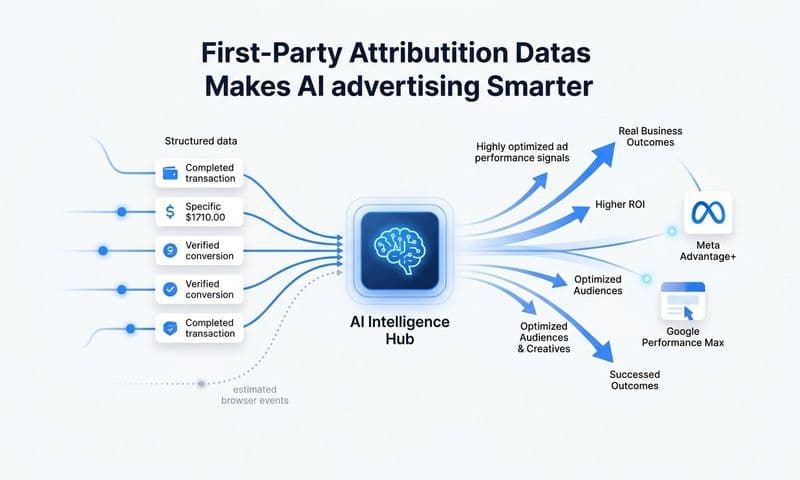
But the data flow isn't one-way. Modern attribution platforms also offer conversion sync, which sends enriched conversion data back to your ad platforms. This creates a powerful feedback loop where your attribution system tells Facebook, Google, and other platforms which conversions led to actual revenue, allowing their algorithms to optimize for real business outcomes rather than proxy metrics.
When Facebook's algorithm knows that certain types of leads consistently turn into high-value customers, it can find more people who match those patterns. This improves your targeting, reduces your cost per acquisition, and ultimately drives better ROI. You're feeding the machine learning systems better data, which makes them work harder for you.
The final piece is ensuring all these systems can talk to each other through a common customer identifier. When someone clicks your ad, visits your website, fills out a form, and eventually appears in your CRM, your attribution platform needs to recognize these as the same person. This requires sophisticated identity resolution that matches data points across platforms, devices, and sessions.
From Data to Decisions: Using Attribution Insights to Scale
You've built your attribution system. Data is flowing from ad platforms through website interactions into your CRM and back again. Now comes the part that actually matters: using these insights to make smarter marketing decisions that drive revenue growth.
The first shift is moving from vanity metrics to revenue metrics. Most marketers are drowning in data that looks impressive but doesn't actually indicate business success. High click-through rates, lots of website traffic, even form submissions—none of these guarantee revenue unless they're connected to actual customer acquisition and lifetime value.
Accurate attribution lets you cut through the noise and identify which ads and channels genuinely drive revenue. You might discover that your LinkedIn campaigns have a lower conversion rate than Facebook but generate customers with 3x higher lifetime value. Or that your Google search campaigns convert quickly but your content marketing efforts drive customers who stay longer and spend more over time. Implementing cross channel attribution tracking reveals these hidden patterns across your marketing mix.
These insights fundamentally change how you allocate budget. Instead of simply scaling what has the lowest cost per click or even cost per conversion, you can scale based on true return on ad spend calculated against actual revenue. This often reveals surprising truths about which campaigns deserve more investment.
Let's say your Facebook retargeting campaigns show a $50 cost per conversion in the platform dashboard, while your Google search campaigns show $30. Traditional logic says scale Google and cut Facebook. But when you connect to revenue data, you discover that Facebook conversions close at 40% and average $5,000 in contract value, while Google conversions close at 15% and average $2,000. Suddenly Facebook's higher upfront cost looks like a bargain.
This is where AI-powered recommendations become incredibly valuable for identifying patterns humans might miss. Modern attribution platforms can analyze thousands of data points across campaigns, ad sets, and individual ads to spot high-performing combinations that deserve more budget. They can also flag campaigns that look good on surface metrics but consistently fail to drive revenue.
The AI might notice that campaigns targeting certain job titles convert at twice the rate of others, or that ads with specific messaging themes lead to higher-value customers, or that certain times of day or days of week consistently outperform. These insights let you optimize not just which channels to use but exactly how to use them for maximum revenue impact. Learn more about how ad tracking tools can help you scale ads using accurate data.
Budget reallocation becomes a continuous optimization process rather than a quarterly planning exercise. When you can see in real-time which campaigns are driving revenue and which are burning cash, you can make agile adjustments that compound over time. Cut 20% from underperforming campaigns and reallocate to proven winners. Test new channels with confidence because you'll know quickly whether they're working.
The competitive advantage is enormous. While your competitors are making budget decisions based on incomplete platform data or gut feel, you're operating with clarity about what actually drives revenue. You can confidently scale campaigns that work and quickly kill ones that don't. This data-driven approach to marketing transforms it from an expense that's hard to justify into a predictable growth engine that delivers measurable ROI.
Your Revenue Attribution Implementation Roadmap
You understand the why and the what. Now let's talk about the how: a practical roadmap for implementing accurate revenue attribution tracking without getting overwhelmed by the complexity.
Start by auditing your current tracking setup. What data are you actually capturing today? Which platforms are connected to each other? Where are the gaps? Most marketers discover they have islands of data that don't communicate: ad platforms that don't talk to analytics, analytics that don't connect to CRM, CRM that doesn't feed back to ad platforms. Map out these gaps before trying to fix them.
Next, prioritize your integrations based on where you spend the most money and where you have the biggest blind spots. If you're spending $50,000 monthly on Facebook ads but can't connect those clicks to CRM revenue, that's your first integration. If you're running Google search campaigns without server-side tracking, that's a critical gap to address. Focus on high-impact connections before worrying about perfect coverage. Following attribution tracking best practices from the start saves headaches later.
Implement server-side tracking as your technical foundation. This typically involves working with your development team to install tracking code that sends data from your server to your attribution platform. Yes, it requires technical implementation, but the payoff in data accuracy is worth the investment. Don't try to build sophisticated attribution on top of unreliable pixel-based tracking.
Connect your CRM integration carefully, ensuring that you're tracking not just when leads are created but when they progress through your sales pipeline and ultimately close as customers. This is what transforms attribution from tracking conversions to tracking revenue. Set up custom fields if needed to capture deal value, close dates, and other revenue metrics that matter to your business.
Common pitfalls to avoid: Don't try to implement everything at once. Start with your highest-spend channels and expand from there. Don't obsess over perfect attribution before you have basic tracking working. Don't ignore data quality issues like duplicate records, missing UTM parameters, or inconsistent naming conventions. Clean data is more valuable than comprehensive but messy data.
Also avoid the trap of analysis paralysis. You don't need to choose the perfect attribution model on day one. Start with a reasonable model that matches your sales cycle, gather insights, and refine over time. The goal is progress, not perfection. If you're ready to dive in, here's how to get started with attribution tracking.
Test your tracking thoroughly before relying on it for budget decisions. Run test conversions through your system and verify they're showing up correctly in your attribution platform with the right source data and revenue amounts. Check that your conversion sync is feeding data back to ad platforms accurately. Validate that your reports match reality before betting your marketing budget on them.
Moving Beyond Guesswork to Revenue-Driven Marketing
Accurate revenue attribution tracking transforms marketing from a creative guessing game into a data-driven growth engine. When you can confidently answer "which campaigns actually drove that sale?" you stop wasting budget on channels that look good in dashboards but contribute nothing to your bottom line. You start investing aggressively in the campaigns that genuinely drive revenue, even if they don't have the lowest cost per click.
This clarity creates a massive competitive advantage. While other marketers are flying blind, making budget decisions based on incomplete platform reports or gut instinct, you're operating with precision. You know which ads work, which audiences convert, which channels deserve more investment, and which should be cut. This isn't just better reporting—it's a fundamental shift in how you approach marketing strategy.
The businesses that win in today's complex marketing landscape aren't the ones with the biggest budgets. They're the ones with the clearest visibility into what's working. They're the ones who can spot a high-performing campaign and scale it confidently. They're the ones who eliminate waste ruthlessly because they can see exactly where their money is going and what it's producing.
The journey from scattered data to unified revenue attribution takes effort. It requires technical implementation, platform integrations, and a commitment to data quality. But the payoff is enormous: marketing decisions based on revenue reality instead of platform promises, budget allocation driven by actual ROI instead of vanity metrics, and the confidence to scale what works while cutting what doesn't.
Ready to elevate your marketing game with precision and confidence? Discover how Cometly's AI-driven recommendations can transform your ad strategy—Get your free demo today and start capturing every touchpoint to maximize your conversions.