

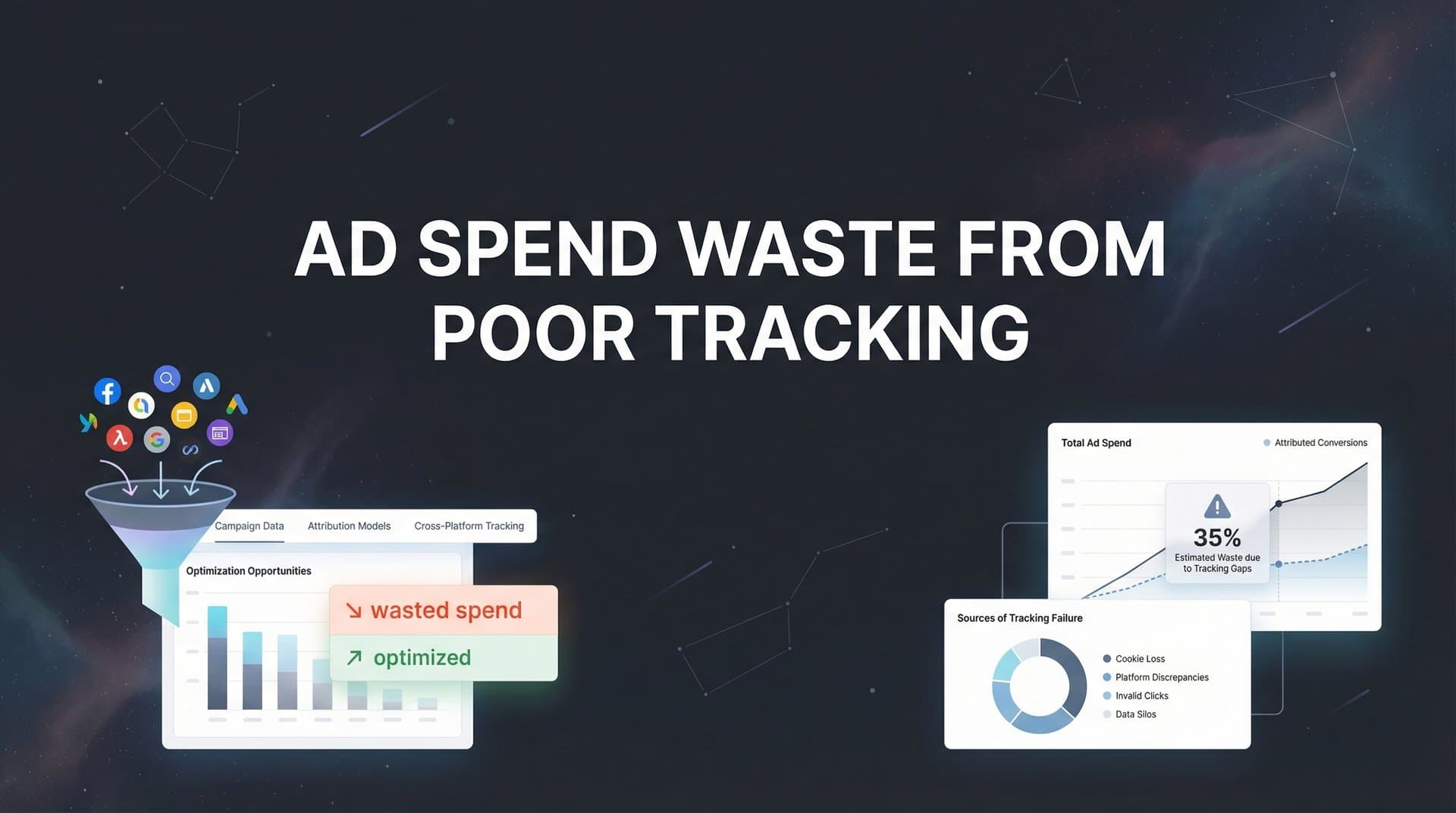
Your ad dashboard shows a 4x ROAS. Your sales team says leads are down 30%. Something doesn't add up.
This disconnect isn't just confusing. It's expensive. Every day, marketing teams pour budget into campaigns that look successful in their ad platforms but fail to deliver actual revenue. They cut spending on channels that quietly drive conversions but never get credit. They feed optimization algorithms incomplete data, teaching them to target the wrong audiences.
The culprit? Tracking systems that can't capture what's really happening. When your attribution setup misses conversions, misattributes touchpoints, or simply can't connect ad clicks to revenue, you're making budget decisions in the dark. And in the dark, money disappears fast.
Understanding where your tracking fails is the first step toward stopping the leak. Let's break down exactly how poor tracking drains your marketing budget and what you can do about it.
The Hidden Mechanics of Tracking Failures
Traditional tracking relied on a simple assumption: when someone clicked your ad, a pixel in their browser would fire, and you'd know exactly what happened next. That world no longer exists.
iOS 14.5 changed everything when it introduced App Tracking Transparency. Suddenly, users could opt out of tracking with a single tap. Many did. The result? Ad platforms lost visibility into a massive portion of conversions, particularly on mobile devices where most users browse and buy.
Browser-based tracking faces similar challenges. Third-party cookies, once the backbone of digital attribution, are being phased out across major browsers. Safari already blocks them by default. Firefox follows suit. Even Chrome, despite delays, is moving toward deprecation. Each restriction creates another blind spot in your tracking. Understanding the full impact of losing tracking data from cookies is essential for modern marketers.
When a pixel can't fire, the conversion simply disappears from your data. Your ad platform thinks the campaign failed. You think the campaign failed. But your customer just completed a purchase that nobody tracked.
The gap between what platforms report and what actually happens in your CRM tells the real story. A marketing team might see 100 conversions in Facebook Ads Manager but only 65 new leads in their CRM. The missing 35? They're real conversions that tracking couldn't capture. And when you optimize based on incomplete data, you're optimizing toward the wrong conclusion.
Cross-device journeys amplify the problem. Someone sees your ad on their phone during their morning commute. They research on their laptop at lunch. They convert on their tablet that evening. Traditional tracking sees three separate users, not one customer journey. The mobile ad that started everything gets zero credit. You cut mobile spend. Revenue drops. The cycle continues.
Cross-channel attribution creates similar blind spots. Your customer discovers you through a LinkedIn ad, clicks a Google search ad the next day, reads your blog, then converts through a Facebook retargeting campaign. Which channel deserves credit? Last-click attribution gives it all to Facebook. But without LinkedIn and Google, that conversion never happens. Your tracking system can't see the full picture, so your budget decisions reflect a partial truth.
Where Your Budget Actually Disappears
Poor tracking doesn't just hide conversions. It actively misdirects your spending in three devastating ways.
First, you double down on campaigns that look successful but actually underperform. Your Facebook campaign shows a 5x ROAS in Ads Manager. You increase budget by 50%. But that 5x ROAS is based on incomplete conversion data. The platform is only seeing 60% of your actual conversions. Your real ROAS is closer to 3x. Still profitable, but not worth the aggressive scaling you just committed to. This is a prime example of ad spend waste from unknown conversions.
Meanwhile, you're cutting spend on channels that drive real conversions but get no credit. Your Google Search campaigns show modest performance in platform reporting. You reduce budget to reallocate toward "better performing" channels. But those search campaigns were actually introducing customers who later converted through other touchpoints. You just cut the top of your funnel without realizing it.
The compounding effect hits hardest when you feed ad algorithms incomplete data. Meta's algorithm, Google's Smart Bidding, TikTok's automated targeting—they all learn from the conversion data you send them. When that data is incomplete, they optimize toward the wrong audiences.
Think about what happens when your tracking only captures 60% of mobile conversions. The algorithm thinks mobile users don't convert well. It shifts budget toward desktop. But mobile users actually convert fine—your tracking just can't see it. Now you're systematically underinvesting in your best audience segment. This is how wasted ad spend on wrong channels compounds over time.
This creates a feedback loop of waste. Incomplete data leads to poor optimization. Poor optimization leads to worse performance. Worse performance leads to more budget shifts based on bad data. Each cycle moves you further from profitable spending.
The math is brutal. If you're spending $50,000 monthly on ads and your tracking captures only 70% of conversions, you're making budget decisions based on $35,000 worth of data while ignoring $15,000 worth of results. That's not a small margin of error. That's a fundamental disconnect between what you think is working and what actually drives revenue.
Warning Signs Your Tracking Is Costing You Money
Most tracking problems don't announce themselves. They hide in small discrepancies that marketers explain away or ignore. But these warning signs reveal exactly where your budget is leaking.
The clearest signal? Your platform-reported ROAS doesn't match actual revenue. Facebook says you generated $100,000 in revenue from $20,000 in spend. Your finance team says total revenue for the period was $75,000 from all sources. Either Facebook is drastically overcounting, or something else is broken. Either way, you can't trust the numbers driving your budget decisions.
Watch for unexplained gaps between ad clicks and CRM leads. Your Google Ads dashboard shows 200 form submissions. Your CRM shows 140 new leads for the same period. Where did 60 conversions go? Maybe tracking pixels didn't fire. Maybe form submissions failed. Maybe leads came from other sources and got misattributed. Whatever the cause, you're flying blind on 30% of your lead generation. Implementing proper attribution tracking for lead generation solves this visibility gap.
Declining ad performance despite increased optimization efforts is another red flag. You're testing new creative. You're refining targeting. You're adjusting bids. But performance keeps sliding. The likely culprit? You're optimizing based on incomplete conversion data. The algorithm is learning the wrong lessons because it can't see the full picture of what actually converts.
Look for attribution inconsistencies across platforms. Facebook claims 100 conversions. Google claims 80 conversions. LinkedIn claims 30 conversions. But your total conversions for the period? Only 150. The platforms are overcounting because they're all taking credit for the same conversions. Without proper deduplication and multi-touch attribution, you're making budget decisions based on inflated numbers.
Revenue attribution that doesn't align with sales team feedback reveals another tracking failure. Your attribution shows that paid social drives 60% of revenue. Your sales team says most customers mention finding you through organic search or referrals. Someone's wrong, and it's probably your tracking. When the people talking to customers tell a different story than your data, trust the people.
These warning signs compound over time. Small discrepancies become major budget misallocations. Campaigns that should scale get cut. Channels that should be cut get scaled. And every decision moves you further from profitable growth.
Building a Tracking System That Captures Reality
Fixing tracking problems starts with understanding what actually works in the current digital landscape. The solution isn't more pixels. It's fundamentally different infrastructure.
Server-side tracking forms the foundation. Instead of relying on browser-based pixels that can be blocked, server-side tracking sends conversion data directly from your servers to ad platforms. When a customer converts, your server immediately notifies Facebook, Google, and every other platform you're using. No cookies required. No browser restrictions. No iOS opt-outs blocking the signal. Understanding the difference between server-side tracking vs pixel tracking is crucial for modern attribution.
This approach captures conversions that traditional tracking misses. A customer opts out of app tracking on their iPhone, browses your site, and makes a purchase. Browser-based pixels see nothing. But server-side tracking captures the conversion because it happens on your backend, not in the customer's browser. Your ad platforms receive accurate conversion data. Their algorithms learn from complete information. Your budget decisions reflect reality.
Connecting ad platforms directly to CRM and revenue data closes the attribution loop. When someone becomes a lead in your CRM, that event should flow back to the ad platforms that influenced the conversion. When a lead becomes a customer, that revenue data should update your attribution models in real time. This connection transforms your tracking from "clicks and conversions" to "actual revenue impact."
The difference is enormous. Platform-level conversion tracking tells you that Campaign A generated 50 conversions. CRM-connected tracking tells you that Campaign A generated 50 conversions worth $75,000 in pipeline, with 15 already closed for $22,000 in revenue. Now you can optimize toward actual business outcomes, not just conversion volume.
Multi-touch attribution reveals the complete customer journey. Instead of giving all credit to the last click, multi-touch models distribute attribution across every touchpoint that influenced the conversion. The LinkedIn ad that created awareness gets credit. The Google search that showed intent gets credit. The Facebook retargeting ad that closed the deal gets credit. Each channel's true contribution becomes visible. Explore different attribution tracking methods to find the right approach for your business.
This visibility transforms budget allocation. You discover that LinkedIn drives high-value leads but rarely gets last-click credit. You realize that Google Search introduces customers who convert weeks later through other channels. You see that email nurture sequences consistently push prospects toward conversion. With multi-touch attribution, you can invest in the full funnel, not just the final touchpoint.
The technical implementation matters. Look for platforms that offer native integrations with your ad channels, CRM, and analytics tools. The easier the data flows between systems, the more complete your attribution becomes. Manual CSV uploads and disconnected dashboards create gaps where conversions slip through.
Turning Accurate Data Into Smarter Spending Decisions
Accurate tracking is only valuable if it changes how you allocate budget. The goal isn't just to see what's happening. It's to make better decisions based on complete information.
Start by using enriched conversion data to improve ad platform optimization. When your tracking system sends complete conversion data back to Meta, Google, and other platforms, their algorithms receive the full signal they need to find similar high-value customers. Instead of optimizing based on 60% of conversions, they optimize based on 95%. The improvement in targeting quality is immediate and measurable.
Conversion sync capabilities make this possible. Every time someone converts, your attribution platform sends that event back to the originating ad platform with all relevant context. The ad network learns which audiences convert, which creative resonates, and which placements drive results. Over time, the algorithm gets smarter because it's learning from complete data. Discover how ad tracking tools can help you scale ads using accurate data.
Budget reallocation based on true revenue attribution follows naturally. When you can see which channels drive actual revenue, not just last-click conversions, your spending priorities shift. You might discover that your "underperforming" LinkedIn campaigns actually introduce 40% of your high-value customers. You'll increase LinkedIn budget accordingly. You might find that your "high-performing" display campaigns generate clicks but rarely lead to revenue. You'll cut display spend and reallocate it to channels with proven ROI.
The key is moving from cost-per-conversion metrics to cost-per-revenue metrics. A channel that costs $50 per conversion looks expensive. But if those conversions are worth $500 each in customer lifetime value, that's an incredible return. Another channel might cost only $20 per conversion, but if those conversions are worth $100 each, it's actually less profitable. Revenue-based attribution reveals these differences. Proper ad spend ROI tracking makes this level of insight possible.
Create a feedback loop between tracking data and campaign strategy. Review attribution reports weekly. Identify which campaigns drive revenue, not just conversions. Test hypotheses about which touchpoints matter most. Adjust budget based on what the data reveals, then measure the impact of those changes. This continuous optimization cycle, powered by accurate data, is how you scale profitably.
Use AI-powered recommendations to accelerate decision-making. Modern attribution platforms analyze your complete conversion data and surface insights you might miss. They identify high-performing audiences worth scaling. They flag underperforming campaigns worth cutting. They suggest budget reallocations based on revenue impact. These recommendations, built on accurate multi-touch attribution, help you make confident decisions faster.
Putting It All Together: From Leaky Tracking to Confident Scaling
Ad spend waste from poor tracking isn't a minor inefficiency. It's a systematic problem that drains budgets, misdirects optimization, and prevents profitable scaling.
The tracking-to-revenue connection is clear: when you can't accurately measure which campaigns drive actual revenue, you can't make smart budget decisions. You scale campaigns that look good but underperform. You cut campaigns that quietly drive high-value conversions. You feed ad algorithms incomplete data that teaches them to target the wrong audiences. Each mistake compounds over time.
Start with an honest audit of your current tracking setup. Compare platform-reported conversions to CRM lead counts. Check whether your ROAS calculations match actual revenue. Look for attribution gaps where conversions happen but don't get tracked. Identify cross-device and cross-channel journeys that your current system can't capture. These gaps reveal exactly where your budget is leaking.
Modern attribution platforms solve these challenges by combining server-side tracking, CRM integration, and multi-touch attribution into a single system. They capture conversions that traditional tracking misses. They connect every touchpoint to actual revenue. They send enriched conversion data back to ad platforms so algorithms can optimize toward real business outcomes. And they provide the visibility you need to allocate budget with confidence.
The difference between guessing and knowing is the difference between wasted spend and profitable growth. When you can see which campaigns truly drive revenue, you can scale them aggressively. When you can identify which channels get credit they don't deserve, you can cut them without hesitation. When you can feed ad platforms complete conversion data, their algorithms find better customers automatically.
Stop Guessing, Start Scaling
Every day you operate with incomplete tracking data is another day of wasted ad spend. The campaigns you think are working might be underperforming. The channels you're cutting might be driving your best customers. And the optimization decisions you're making might be based on a fraction of the truth.
Solving this problem doesn't require more pixels or more dashboards. It requires attribution infrastructure that captures the complete customer journey, from first touchpoint to final revenue. It requires server-side tracking that works regardless of browser restrictions or iOS opt-outs. It requires multi-touch attribution that shows which channels truly contribute to conversions. And it requires the ability to send enriched conversion data back to ad platforms so their algorithms can optimize toward real results.
Cometly connects every touchpoint to actual revenue, giving you the complete picture you need to make confident budget decisions. From ad clicks to CRM events, the platform tracks it all, providing AI with a complete, enriched view of every customer journey. You'll know what's really driving revenue, get AI-powered recommendations for scaling high-performing campaigns, and feed ad platform algorithms better data that improves targeting and optimization.
Ready to elevate your marketing game with precision and confidence? Discover how Cometly's AI-driven recommendations can transform your ad strategy. Get your free demo today and start capturing every touchpoint to maximize your conversions.



