

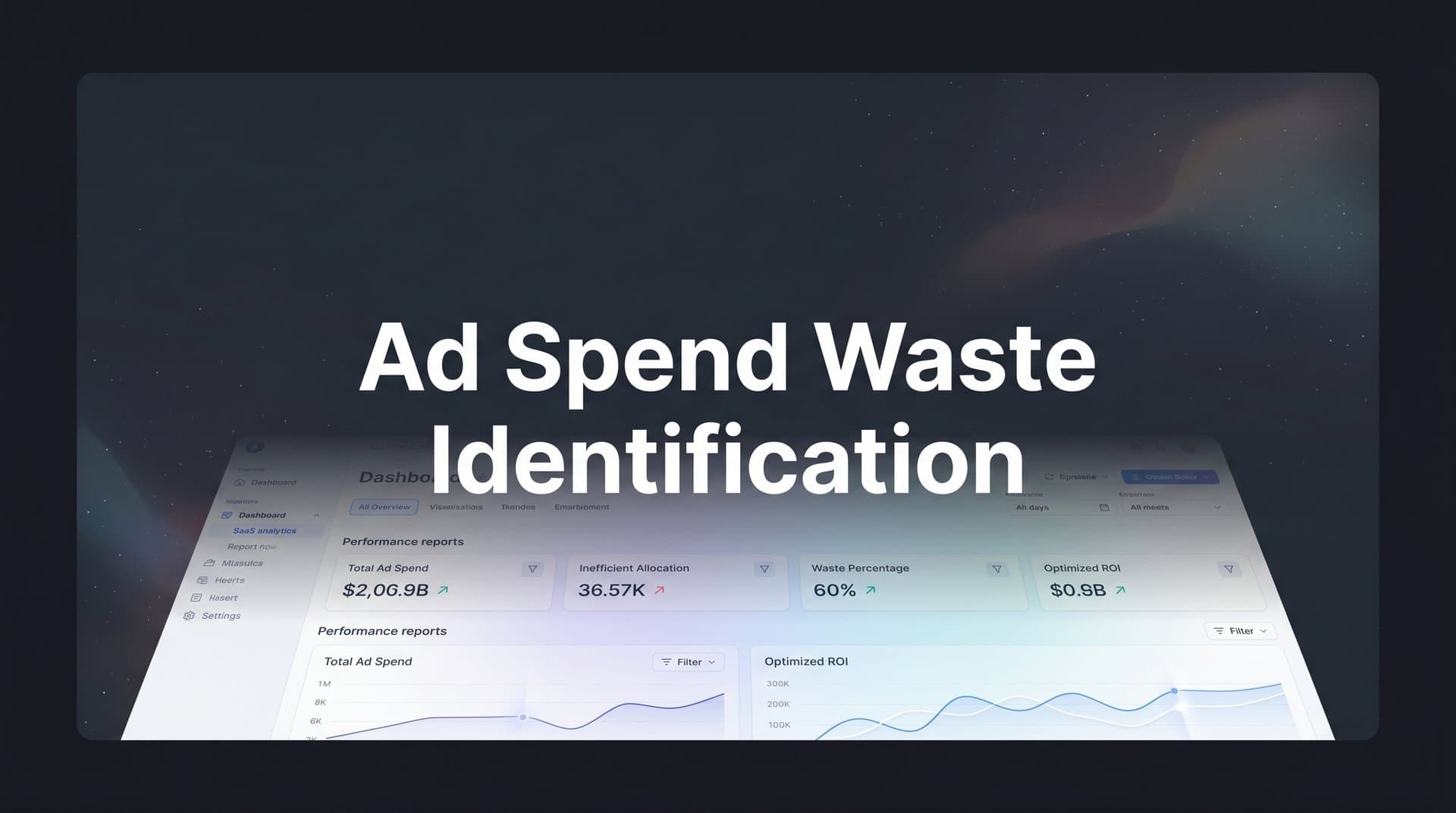
You're running ads across Meta, Google, TikTok, and LinkedIn. Your dashboards show clicks, impressions, and conversions. The platforms tell you everything is working. But when you look at actual revenue, the numbers don't add up. Something's draining your budget, and you can't quite pinpoint where.
This is the reality for marketing teams everywhere. Ad spend waste isn't always obvious. It hides behind promising metrics, scattered across platforms, disguised as campaigns that look successful until you connect them to actual business outcomes.
The difference between high-performing marketing teams and those constantly defending their budgets comes down to one skill: the ability to identify where money flows without generating meaningful results. This isn't about cutting budgets or playing it safe. It's about redirecting wasted dollars toward campaigns that actually drive revenue.
The Hidden Culprits Draining Your Ad Budget
Platform dashboards paint an incomplete picture. Meta reports conversions. Google claims credit for the same sale. TikTok shows engagement. Each platform operates in its own silo, optimizing for its own definition of success.
The disconnect happens because platforms measure actions, not outcomes. A click is a click. A conversion is whatever you've defined in your pixel. But these metrics exist separately from what happens in your CRM, your sales pipeline, and your actual revenue.
This creates a dangerous gap. You might see 500 conversions in your Google Ads dashboard while your CRM shows only 200 new leads from paid channels. The difference? Double-counting, bot traffic, accidental clicks, or conversions that never made it into your actual customer database.
Audience overlap silently multiplies your costs. When you're running campaigns across multiple platforms, the same high-intent prospects see your ads on Meta, then Google, then LinkedIn. Each platform charges you to reach the same person. Each platform claims credit when that person converts. This is a common form of ad spend wasted on wrong audience targeting.
Geographic misalignment wastes budget on regions that never convert. Your campaigns might target entire countries when your actual customers cluster in specific metros. You're paying to reach millions who will never buy while under-investing in the concentrated markets that drive revenue.
Poor dayparting compounds the problem. Your ads run 24/7, but your conversions happen during specific windows. You're spending money to show ads at 3 AM to audiences who browse but never convert outside business hours. That's budget flowing to impressions that statistically won't generate outcomes.
The attribution gap is where waste really accumulates. When you can't track the complete customer journey from first click to closed deal, you keep funding channels that look good in isolation but fail in context. That LinkedIn campaign might show conversions, but if those users already clicked your Google ad yesterday, you're paying twice for the same customer.
Incomplete tracking creates blind spots. iOS privacy changes, browser restrictions, and cookie limitations mean a significant portion of your conversions go untracked. When you can't see what's working, you can't cut what's not. You keep spending on faith rather than data. Understanding ad spend waste from poor tracking is essential to closing these gaps.
Building Your Waste Detection Framework
Waste identification starts with visibility. You need to see all your ad platforms in one unified view, not scattered across separate dashboards. When Meta, Google, TikTok, and LinkedIn data live in different places, patterns of waste stay hidden.
Cross-platform visibility means connecting every ad account to a central analytics system where you can compare performance using consistent metrics. Not what each platform claims worked, but what actually drove leads and revenue in your CRM. The right ad spend tracking across platforms makes this possible.
This unified view reveals the truth. That Google campaign with a $50 cost-per-click might generate leads worth $5,000 each. That Meta campaign with a $5 cost-per-click might generate leads that never respond. Platform metrics alone can't tell you this. You need conversion data flowing from ads through to actual business outcomes.
Defining waste thresholds gives you objective benchmarks. What's your maximum acceptable cost-per-acquisition? What ROAS makes a campaign worth continuing? What conversion rate indicates a targeting or messaging problem?
These thresholds vary by business model and customer lifetime value. A SaaS company with $10,000 annual contracts can afford higher acquisition costs than an e-commerce brand with $50 average orders. Your thresholds should reflect your unit economics, not industry averages.
Set clear rules for what constitutes waste. Any campaign running more than two weeks below your ROAS threshold gets flagged. Any audience segment with conversion rates 50% below your account average gets reviewed. Any geographic region with zero conversions after $500 spend gets paused.
Create a systematic audit schedule. Waste detection isn't a one-time project. It's a recurring discipline. High-performing teams audit their ad spend weekly, reviewing which campaigns hit benchmarks and which are burning budget without returns.
Your audit process should follow a consistent pattern. Export performance data from all platforms. Compare platform-reported conversions against CRM outcomes. Identify discrepancies. Investigate campaigns where spend increased but revenue didn't. Flag audiences that consume budget without converting.
This systematic approach catches waste before it compounds. A campaign that's slightly underperforming today becomes a major budget drain over months. Weekly audits let you course-correct while the problem is still small.
Five Warning Signs You're Overspending on Ads
High click volume with low downstream conversions is your first red flag. Your ads are getting clicked. People are visiting your landing pages. But they're not filling out forms, starting trials, or making purchases.
This pattern indicates a disconnect between your targeting and your offer. You're reaching people interested enough to click but not qualified enough to convert. That's wasted spend on traffic that was never going to become customers.
The solution isn't better landing pages. It's better targeting. You need to refine your audiences to reach people with actual purchase intent, not just curiosity. Look at which audience segments do convert and double down there while cutting the browsers.
Rising CPMs without corresponding increases in conversion quality signal auction fatigue. Your costs are climbing because you're competing harder for the same audiences. But the incremental traffic you're buying at higher prices converts worse than your initial audience.
This happens when you've saturated your best audiences and platforms automatically expand to reach less qualified prospects. You're paying more to reach people less likely to buy. That's a compounding waste pattern. Learning how to reduce wasted ad spend starts with recognizing these signals early.
Track your CPM trends against your conversion quality metrics. If CPMs rise 30% while conversion rates drop 20%, you're in a negative spiral. Pause the audience expansion and focus budget on your proven segments.
Campaigns with strong platform metrics but weak CRM outcomes reveal attribution blind spots. Google reports 100 conversions. Your CRM shows 40 new leads from paid search. The gap represents double-counting, bot traffic, or tracking errors.
This discrepancy means you're making decisions based on inflated numbers. You think a campaign is performing well because the platform says so. In reality, it's generating half the results at twice the actual cost-per-acquisition. This is a classic case of ad spend not matching results.
Connect your ad platforms directly to your CRM. Track conversions all the way to sales-qualified leads or closed deals, not just form submissions. This reveals which campaigns generate real pipeline versus which generate junk leads that clog your sales process.
Geographic performance disparities indicate targeting waste. You're spending equally across all regions, but 80% of your conversions come from 20% of your targeted locations. The other 80% of your geographic spend is waste.
Analyze conversion rates and customer acquisition costs by city, state, or country. You'll often find dramatic differences. Some regions convert at 5% while others convert at 0.5%. Cut the low-performers and reallocate budget to your high-converting geographies.
Frequency fatigue shows up as declining engagement from the same audiences. Your ads performed well initially, but now the same people are seeing your message repeatedly without converting. Each additional impression costs money while generating diminishing returns.
Monitor frequency metrics across your campaigns. When you're showing ads to the same users 10+ times without conversion, you've crossed into waste territory. Either refresh your creative or exclude these audiences and find new prospects.
From Detection to Action: Reallocating Rescued Budget
Identifying waste is only half the battle. The real value comes from what you do with that information. Not all underperforming campaigns deserve immediate cuts. Some need optimization. Others need complete elimination.
Prioritize cuts based on severity and recoverability. Campaigns spending heavily with zero conversions get paused immediately. These are clear losers consuming budget with no path to profitability. Every day they run is money lost.
Campaigns with poor but not catastrophic performance get a chance at optimization. If your target ROAS is 400% and a campaign is delivering 250%, test creative variations, adjust targeting, or modify your landing page before cutting it entirely. There might be a winning campaign hidden under poor execution.
Set a testing window. Give optimization efforts two weeks to show improvement. If performance doesn't move toward your benchmarks, pause the campaign and redirect the budget. Don't let hope override data.
Reinvestment strategies should favor proven winners identified through accurate attribution. When you know which campaigns, audiences, and creatives actually drive revenue, scaling becomes straightforward. Take the budget you've cut from waste and add it to your top performers. Effective ad spend budget optimization depends on this data-driven approach.
This is where multi-touch attribution becomes critical. You need to understand which touchpoints genuinely influence conversions versus which simply appear in the customer journey. That bottom-of-funnel retargeting campaign might show great ROAS, but if it's only converting people who were already going to buy, it's not driving incremental revenue.
Look for campaigns that introduce new customers to your brand or accelerate consideration. These are your true growth drivers. Scale them aggressively with your rescued budget.
Feed better conversion data back to ad platforms to improve algorithmic targeting. When you send enriched conversion events that include customer lifetime value, purchase amount, and lead quality scores, platform algorithms learn what "good" looks like for your business.
This creates a positive feedback loop. Better data leads to better automated targeting. Better targeting generates higher-quality conversions. Higher-quality conversions provide even better training data for the algorithms. Your campaigns become more efficient over time instead of degrading.
Track the impact of your reallocation decisions. When you cut a campaign and move that budget elsewhere, measure whether overall performance improved. Did your total conversions increase? Did your blended cost-per-acquisition decrease? This validates your waste identification process.
Preventing Future Waste With Smarter Tracking
The best waste identification system is one that prevents waste from accumulating in the first place. This requires tracking infrastructure that captures the complete customer journey, not just the fragments visible to browser-based pixels.
Server-side tracking has become essential as browser restrictions and privacy changes limit traditional pixel tracking. When conversions happen on iOS devices or in browsers with tracking prevention enabled, standard pixels miss them entirely. You're making budget decisions based on incomplete data.
Server-side tracking captures conversions that browser-based methods miss. By processing conversion events on your server before sending them to ad platforms, you bypass browser restrictions and get a more accurate count of your actual results. This reveals campaigns that were performing better than you thought and campaigns that were performing worse. Implementing proper ad spend waste prevention requires this level of tracking accuracy.
Connect your ad platforms directly to your CRM for complete customer journey visibility. When someone clicks your ad, fills out a form, becomes a sales-qualified lead, and eventually closes as a customer, you need to see that entire path attributed back to the original campaign.
This end-to-end visibility prevents waste by showing you which campaigns generate customers, not just clicks or form fills. You stop funding campaigns that generate low-quality leads that never convert to revenue. You scale campaigns that consistently produce customers with strong lifetime value.
The connection between ad platforms and CRM also enables you to build better audiences. When you know which customers came from which campaigns, you can create lookalike audiences based on actual buyers, not just website visitors or form fillers. This improves targeting precision from the start.
Use AI recommendations to identify optimization opportunities before waste accumulates. AI can process campaign data at scale, surfacing patterns that would take hours of manual analysis to discover. It can flag when a previously strong campaign starts declining, when audience fatigue sets in, or when geographic performance shifts. Leveraging ad spend optimization recommendations powered by AI accelerates this process.
These early warning systems let you intervene before small problems become expensive ones. Instead of discovering waste during your weekly audit, you get alerts the moment performance drops below thresholds. You can pause or adjust campaigns in real time rather than letting them burn budget for days.
AI analysis also reveals positive opportunities. It can identify which creative elements correlate with higher conversion rates, which audience characteristics predict customer lifetime value, and which times of day generate the most efficient conversions. This intelligence helps you prevent waste by optimizing campaigns proactively.
Build feedback loops that continuously improve targeting. Every conversion should teach your campaigns something. Every non-conversion should too. When you feed detailed conversion data back to ad platforms, including which leads became customers and which didn't, the algorithms learn to find more of the good and fewer of the bad.
Putting Your Waste Identification System Into Practice
Start this week with a focused audit. Pull performance data from all your active ad platforms. Export it into a single spreadsheet or analytics dashboard where you can compare campaigns side by side using consistent metrics.
Calculate your actual cost-per-acquisition for each campaign by dividing total spend by conversions tracked in your CRM, not conversions reported by platforms. This reveals your real efficiency, not the inflated version platforms show you. Proper ad spend ROI tracking makes these calculations reliable.
Identify your three worst-performing campaigns based on CPA or ROAS. Pause them immediately if they're clearly unprofitable. If they're borderline, set a two-week testing period with specific improvement targets. If they don't hit those targets, cut them.
Take the budget from paused campaigns and add 50% of it to your top performer. Keep the other 50% for testing new approaches. This balanced approach lets you scale what works while exploring new opportunities.
Set up a weekly audit ritual. Every Monday or Friday, review campaign performance, compare platform data against CRM outcomes, and make reallocation decisions. This consistent rhythm prevents waste from hiding in campaigns you've forgotten about.
Build a culture of continuous optimization rather than set-and-forget campaigns. The moment you launch a campaign and stop monitoring it closely, waste begins accumulating. Audiences fatigue. Competition changes. Market conditions shift. What worked last month might waste money this month.
Train your team to think in terms of testing and iteration. Every campaign is a hypothesis. You're testing whether a specific audience, creative, and offer combination generates profitable conversions. When the data says no, you pivot. When it says yes, you scale. Mastering eliminating wasted ad spend techniques becomes second nature with this mindset.
Document your learnings. Keep a record of what you've tested, what worked, and what failed. This institutional knowledge prevents you from repeating expensive mistakes and helps you identify patterns across campaigns.
Making Waste Identification Your Competitive Advantage
Ad spend waste identification isn't a one-time cleanup project. It's an ongoing discipline that separates marketing teams who consistently hit their targets from those who struggle to justify their budgets quarter after quarter.
The marketers who outperform aren't necessarily more creative or more aggressive with spending. They're more precise. They know exactly what drives revenue because they've built systems to track it. They cut ruthlessly when data shows waste. They scale confidently when data shows opportunity.
This precision comes from having clear visibility into what actually works, not just what looks good in platform dashboards. It comes from connecting your ad spend all the way through to business outcomes and making decisions based on that complete picture.
Every dollar you rescue from waste is a dollar you can invest in growth. When you eliminate campaigns that burn budget without generating customers, you free up resources to scale the campaigns that genuinely drive your business forward. Your overall marketing efficiency improves while your total results increase.
The tools and techniques for waste identification have evolved dramatically. Server-side tracking captures conversions that browser-based pixels miss. Multi-touch attribution reveals which touchpoints genuinely influence purchase decisions. AI-powered analysis surfaces optimization opportunities at scale. These capabilities make it possible to eliminate waste with a precision that wasn't available even a few years ago.
But technology alone isn't enough. You need the discipline to act on what the data reveals. To pause campaigns that aren't working, even if you personally like the creative. To reallocate budget away from comfortable channels toward ones that actually drive results. To continuously test, measure, and optimize rather than setting campaigns and hoping for the best.
Ready to elevate your marketing game with precision and confidence? Discover how Cometly's AI-driven recommendations can transform your ad strategy. Get your free demo today and start capturing every touchpoint to maximize your conversions.



