Running paid ads without proper tracking is like pouring water into a bucket full of holes. You might be generating leads, but you have no reliable way to know which ads, channels, or campaigns actually drove them. For marketers managing budgets across Meta, Google, LinkedIn, and other platforms, this blind spot leads to wasted spend, misallocated budgets, and scaling decisions based on guesswork rather than data.
Ad tracking for lead generation solves this by connecting every click, form fill, and conversion event back to the specific ad that started the journey. When done right, it gives you a clear picture of your cost per lead by channel, reveals which creatives and audiences produce qualified pipeline, and lets you double down on what works with confidence.
The challenge is that most tracking setups are incomplete. Marketers install a pixel, set up a form submission event, and call it done. But that only captures a fraction of the story. Without downstream data from your CRM, without server-side tracking to fill the gaps left by privacy restrictions, and without a unified view across every channel, you are still flying partially blind.
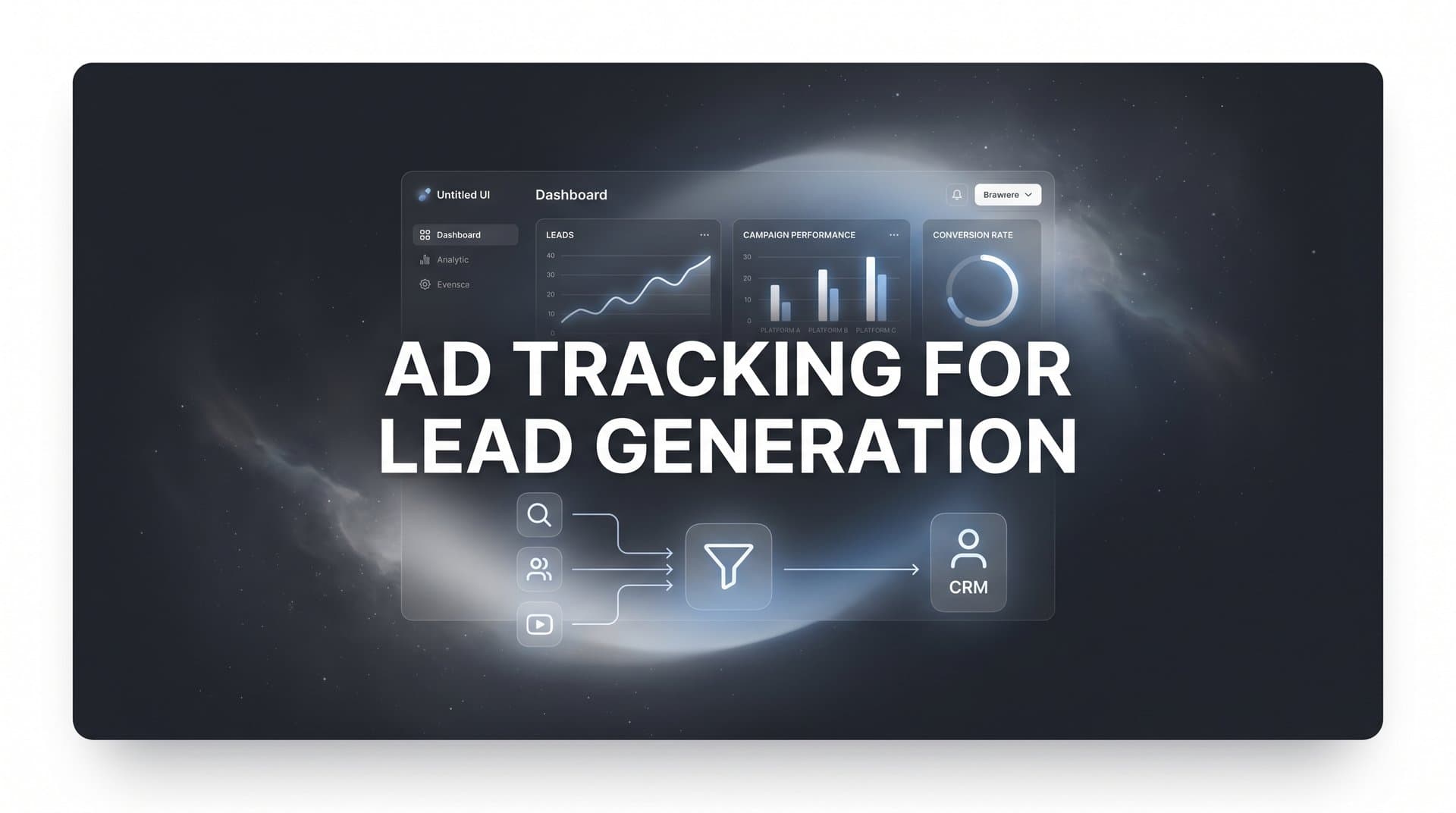
This guide walks you through the entire process of setting up ad tracking that captures the full lead generation journey, from the first ad click all the way through to CRM events like booked demos or closed deals. Whether you are starting from scratch or patching gaps in your current setup, these six steps will help you build a tracking system that gives you accurate, actionable data across every campaign you run.
Step 1: Define Your Lead Stages and Conversion Events
Before you touch a single tracking tool, you need a clear map of your lead funnel. This sounds obvious, but it is the step most teams skip, and it is the reason their tracking ends up inconsistent, incomplete, or misleading.
Start by listing every meaningful stage a lead passes through from first contact to closed deal. A typical lead generation funnel includes stages like ad click, landing page visit, form submission, marketing qualified lead (MQL), sales qualified lead (SQL), demo booked, proposal sent, and deal closed. Your specific funnel may have fewer or more stages depending on your sales cycle, but the principle is the same: every meaningful transition should have a corresponding conversion event.
Once you have your stages mapped, assign a specific event name and an estimated value to each one. For example, a form submission might be labeled lead_form_complete, a booked demo might be demo_scheduled, and a closed deal might be deal_won. Consistent naming conventions across platforms prevent the confusion that comes when Meta is tracking "Lead" while your CRM calls the same event "Form Fill" and Google calls it "Conversion." Using a dedicated conversion tracking for lead generation approach helps standardize these events from the start.
Next, decide which events are primary conversions and which are secondary. Primary conversions are the events you want ad platforms to optimize toward. Secondary conversions are tracked for reporting purposes but do not feed directly into bidding algorithms. For most lead generation campaigns, you want to be deliberate here. Optimizing toward a raw form fill might generate volume but poor quality. Optimizing toward a demo booked or MQL event typically produces better-qualified pipeline.
Common pitfall to avoid: Only tracking the top-of-funnel form fill and ignoring everything that happens after. When you do this, you lose the ability to measure lead quality by channel. You might find that Meta drives twice the form fills of LinkedIn, but LinkedIn leads close at a much higher rate. Without downstream CRM event tracking, you would never know, and you would make budget decisions based on volume rather than revenue impact.
Take the time to document your conversion events in a simple spreadsheet: event name, stage, platform it fires on, whether it is primary or secondary, and its estimated value. This becomes your tracking blueprint for every step that follows.
Step 2: Implement Server-Side Tracking Alongside Pixel-Based Tags
Once your conversion events are defined, the next challenge is capturing them accurately. Most marketers rely on browser-based pixels: a snippet of JavaScript that fires when a user takes an action on your site. The problem is that browser-based tracking has become increasingly unreliable, and this trend is only accelerating.
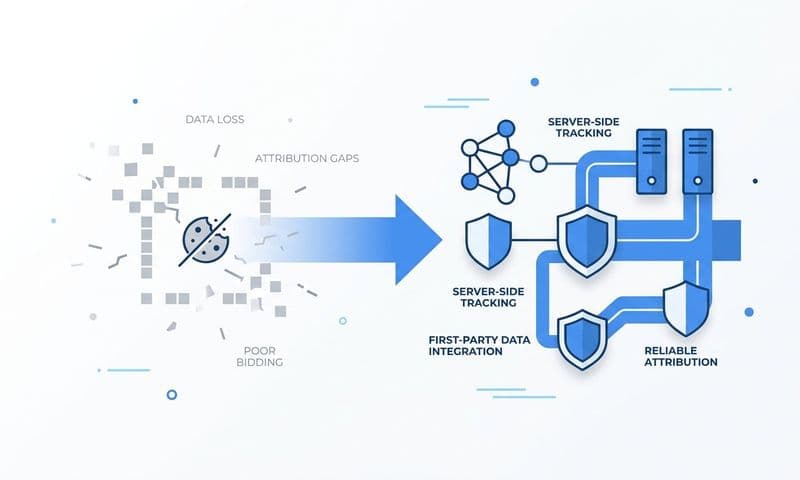
Apple's App Tracking Transparency framework, introduced in 2021 and continuously tightened since, significantly reduced the ability of ad platforms to track user behavior across apps and websites on iOS devices. Add to that the growing adoption of ad blockers, the deprecation of third-party cookies across major browsers, and the result is a tracking environment where pixel-only setups routinely miss a significant portion of conversions. For lead generation campaigns where every qualified lead matters, these gaps can distort your data and lead to poor optimization decisions. Shifting toward first-party data tracking for ads is essential to maintaining signal quality in this environment.
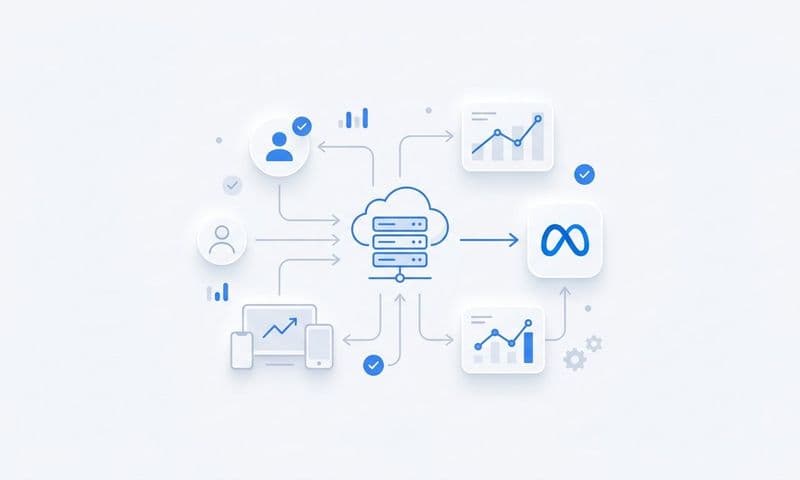
Server-side tracking addresses this directly. Instead of relying on a browser to fire a tracking event, server-side tracking fires the event from your own server directly to the ad platform's API. Because the event originates server-side rather than from the user's browser, it bypasses ad blockers, is unaffected by iOS privacy restrictions, and does not depend on third-party cookies. The result is more complete, more accurate conversion data.
Here is how the flow works in practice. When a user submits a form on your landing page, your server receives that event. Your server-side tracking system then sends a verified conversion event directly to Meta's Conversions API, Google's Enhanced Conversions API, or whichever platform you are running ads on. The ad platform receives a clean, first-party signal that the conversion happened, without any of the browser-side noise or data loss.
Setting this up used to require significant developer resources. Today, platforms like Cometly have built server-side tracking that connects directly to your ad platforms and CRM, making the implementation far more accessible for marketing teams. The key is to run server-side tracking alongside your existing pixels rather than replacing them entirely. Pixels still provide useful browser-side signals; server-side tracking fills the gaps they miss. Together, they give you the most complete picture possible.
Tip: When implementing server-side tracking, make sure you are passing first-party identifiers like hashed email addresses or phone numbers when available. These help ad platforms match your conversion events to the right users, improving the quality of the signal you send back for optimization.
You will know this step is working when the conversion counts in your ad platforms align more closely with what you see in your CRM and analytics tools. A significant gap between platform-reported conversions and actual leads in your CRM is a reliable sign that your browser-side tracking is missing events.
Step 3: Connect Your Ad Platforms, Website, and CRM Into One System
Even with server-side tracking in place, you can still end up with a fragmented view of performance if your ad platforms, website, and CRM are not connected to a single attribution system. This is one of the most common and costly problems in lead generation tracking.
Here is why it matters. Meta has its own attribution model. Google has its own. LinkedIn has its own. Each platform measures conversions using its own logic, its own attribution windows, and its own definition of credit. When a lead interacts with a Meta ad on Monday and then clicks a Google ad on Thursday before converting, both platforms will likely claim full credit for that conversion. Add LinkedIn into the mix and you can easily find yourself looking at total reported conversions across platforms that are two or three times your actual lead count. Using a unified ad tracking platform for multiple channels eliminates this double-counting problem.
The solution is to integrate all of your paid channels into a single attribution platform that acts as the neutral source of truth. This means connecting Meta, Google, TikTok, LinkedIn, and any other paid channels you run into one system where conversions are deduplicated and attributed consistently.
Equally important is linking your CRM. Whether you use HubSpot, Salesforce, or another platform, your CRM holds the downstream data that tells you what happened after the form fill. Which leads became MQLs? Which booked demos? Which closed? Without connecting your CRM to your tracking system, you can only measure the top of your funnel, and top-of-funnel metrics alone are a poor proxy for revenue impact.
When setting up these integrations, pay close attention to how data passes between systems. UTM parameters need to be captured and stored at the lead level in your CRM so you can trace every contact back to the specific campaign, ad set, and ad that drove them. Click IDs from each platform (Meta's fbclid, Google's gclid, and so on) should also be captured and passed through, as these enable more accurate matching between ad platform data and your own records. A robust lead generation tracking solution handles this data flow automatically.
A practical check: Open a new lead record in your CRM and confirm that the UTM source, medium, campaign, and ad details are populated. If those fields are empty, you have a data flow problem that needs to be fixed before your attribution will be meaningful.
Platforms like Cometly are designed specifically to unify this data layer, connecting your ad platforms, website events, and CRM into a single view so you can see the complete customer journey without manually reconciling data from five different dashboards.
Step 4: Set Up Multi-Touch Attribution to See the Full Journey
With your data unified in one system, you are now ready to configure attribution. And for lead generation, the attribution model you choose matters more than most marketers realize.
Multi-touch attribution is the practice of distributing credit for a conversion across all of the touchpoints a lead interacted with before converting, rather than giving all the credit to a single ad or channel. This is particularly important for B2B and high-consideration lead generation, where prospects typically interact with multiple ads, across multiple channels, over days or weeks before submitting a form or booking a demo. Understanding attribution for lead generation campaigns is critical to making this work effectively.
Think about a typical B2B buyer journey. They might see a LinkedIn thought leadership ad, later click a Google search ad for a branded term, then engage with a retargeting ad on Meta before finally converting. Last-touch attribution would give all the credit to the Meta retargeting ad. First-touch attribution would give all the credit to the LinkedIn ad. Neither tells the full story.
Here is a breakdown of the main attribution models and when each makes sense:
First-touch attribution: Gives full credit to the first interaction. Useful for understanding which channels are best at generating initial awareness and bringing new prospects into your funnel.
Last-touch attribution: Gives full credit to the final interaction before conversion. Useful for understanding which channels are best at closing or converting leads who are already in your funnel.
Linear attribution: Distributes credit equally across all touchpoints. A balanced starting point that acknowledges every interaction without requiring complex modeling.
Data-driven attribution: Uses machine learning to assign credit based on which touchpoints actually correlate with conversion. The most accurate model when you have sufficient data volume, but requires a meaningful conversion history to be reliable.
For most lead generation setups, the right approach is to use multi-touch attribution as your primary reporting model while also monitoring first-touch and last-touch views for specific insights. Your attribution window should reflect your actual sales cycle. If your typical lead-to-close timeline is 30 days, a 7-day attribution window will miss a large portion of your conversions.
Cometly's multi-touch attribution connects every touchpoint across channels so you can see which combination of ads and interactions actually drives qualified leads, not just which ad happened to be last in line. This gives you the insight to invest in the full funnel rather than just the bottom of it.
Step 5: Sync Conversion Data Back to Ad Platforms for Smarter Optimization
Most marketers think of tracking as a one-way street: you capture data from your ads and use it to inform decisions. But the most sophisticated lead generation setups treat tracking as a two-way loop, where you also send enriched conversion data back to your ad platforms to improve their optimization algorithms.
This practice is called conversion syncing, and it is one of the most impactful things you can do to improve the quality of leads your campaigns generate over time. Implementing tracking conversions for lead generation as a bidirectional process is what separates high-performing teams from the rest.
Here is the problem it solves. When you only send top-of-funnel events like form fills back to Meta or Google as your optimization signal, you are essentially telling those platforms: "Find me more people who fill out forms." But not everyone who fills out a form is a qualified lead. Some are competitors researching you. Some are students doing homework. Some simply do not fit your ideal customer profile. If the ad platform's algorithm is optimizing for form fills, it will get very good at generating form fills, regardless of quality.
Conversion syncing lets you close this loop. Instead of only sending form fill events, you configure your tracking system to also send downstream CRM events back to the ad platform. When a lead becomes an MQL, that event gets synced back to Meta. When a demo gets booked, that event gets synced back to Google. Now the ad platform's algorithm has a much richer signal: it can see not just who clicked and converted, but who actually became a qualified lead or booked a meeting.
The practical result is that the algorithm learns to find more people who look like your best leads, not just people who are likely to fill out any form. Over time, this reduces your cost per qualified lead and improves the overall health of your pipeline.
To set this up, you need to configure your CRM to trigger events when leads reach specific stages, then pass those events through your server-side tracking system to the relevant ad platform APIs. Cometly's Conversion Sync feature is built specifically for this workflow, sending enriched, conversion-ready events back to Meta, Google, and other platforms so their algorithms have the best possible data to work with.
Start with your most valuable downstream event. If demo booked is your most reliable indicator of a qualified lead, start by syncing that event. Once you confirm it is working and the data volume is sufficient for the algorithm to learn from, you can add additional CRM-stage events to further enrich the signal.
Step 6: Analyze, Optimize, and Scale With Confidence
With accurate tracking in place, unified data across platforms, multi-touch attribution configured, and conversion data flowing back to your ad platforms, you now have something most marketing teams lack: a reliable foundation for decision-making. The final step is building the analysis and optimization habits that turn that data into compounding results.
Start with the metrics that actually matter for lead generation. Cost per click and click-through rate are useful diagnostic metrics, but they should not drive your optimization decisions. The metrics that connect directly to business outcomes are cost per lead, cost per MQL, cost per SQL, cost per demo booked, and ultimately cost per closed deal. When you compare these across channels and campaigns, you often find surprising results. A channel that looks expensive on a cost-per-click basis might deliver the lowest cost per qualified lead. A campaign that generates high volume might produce leads that rarely convert downstream. Leveraging ad performance tracking across platforms makes these cross-channel comparisons far more reliable.
Use your analytics dashboard to build a regular view of these metrics segmented by channel, campaign, ad set, and creative. Look for patterns: which audiences generate the highest lead-to-MQL conversion rates? Which ad formats produce the best demo-booked rates? Which channels contribute most to first-touch versus last-touch conversions?
From there, reallocation becomes straightforward. Shift budget away from campaigns generating high-volume, low-quality leads toward campaigns generating fewer but better-qualified leads. This is a counterintuitive move for marketers who are used to optimizing for volume, but it is the shift that connects ad spend to revenue rather than just to top-of-funnel activity. For B2B teams in particular, understanding marketing attribution for B2B lead generation is what makes this budget reallocation possible.
Establish a reporting cadence that matches your audience. Campaign managers benefit from weekly performance reviews that catch issues early and surface optimization opportunities. Stakeholders and leadership typically need monthly or quarterly summaries that connect ad performance to pipeline and revenue outcomes. Align your reporting to these different needs rather than sending everyone the same dashboard.
AI-powered recommendations can accelerate this process significantly. Rather than manually combing through data to identify trends, tools like Cometly's AI Ads Manager surface insights about high-performing ads and campaigns across every channel, flagging scaling opportunities and underperforming segments that might otherwise go unnoticed. Think of it as having an analyst who never stops reviewing your data and always has a recommendation ready when you need one.
The goal of this step is not just to review what happened but to build a continuous cycle of testing, learning, and scaling. Run creative tests. Test new audiences. Experiment with different landing pages. Let your tracking data tell you what works, and then scale those winners with confidence.
Putting It All Together: Your Ad Tracking Checklist
Setting up ad tracking for lead generation is not a one-time project. It is an ongoing system that gets more valuable the longer you maintain and refine it. Here is a quick-reference summary of everything covered in this guide:
1. Define your lead stages and conversion events. Map every stage of your funnel, assign consistent event names and values, and decide which events are primary conversions versus secondary reporting events.
2. Implement server-side tracking alongside your pixels. Use server-side tracking to capture conversions that browser-based pixels miss due to ad blockers, iOS privacy changes, and cookie limitations. Run both in parallel for the most complete data.
3. Connect your ad platforms, website, and CRM into one system. Integrate all paid channels into a single attribution platform, link your CRM to track leads through the full funnel, and ensure UTM parameters and click IDs pass cleanly between systems.
4. Configure multi-touch attribution. Choose an attribution model that reflects your actual sales cycle length, set attribution windows that match your lead-to-close timeline, and use multi-touch views to understand the full path to conversion.
5. Sync conversion data back to your ad platforms. Send enriched CRM-stage events back to Meta, Google, and other platforms so their algorithms can optimize for qualified leads rather than raw form fills.
6. Analyze, optimize, and scale based on real revenue data. Focus on cost per MQL, cost per demo, and cost per deal rather than vanity metrics. Build a reporting cadence, reallocate budget toward high-quality lead sources, and use AI-powered recommendations to find scaling opportunities faster.
Each of these steps reinforces the others. Server-side tracking makes your attribution more accurate. Accurate attribution makes your CRM integration more meaningful. Better CRM data makes your conversion syncing more powerful. And better conversion signals make your ad platform algorithms smarter over time. The entire system compounds.
If you are ready to stop reconciling spreadsheets across five different platforms and start making decisions from a single, accurate source of truth, Cometly is built for exactly this. It unifies your tracking, attribution, and optimization in one platform designed for marketers who want clear, accurate data without the manual overhead. Get your free demo today and start capturing every touchpoint to maximize your conversions.