
You've just spent $50,000 on lead generation campaigns across Meta, Google, and LinkedIn. The leads are rolling in. Your sales team is working them. But when you ask which campaigns are actually driving closed deals, you get silence. Your ad platforms show conversions. Your CRM shows revenue. But nothing connects the two.
This is the attribution black hole that haunts lead generation marketers. Unlike ecommerce where someone clicks an ad and buys immediately, lead generation involves weeks or months of nurturing, multiple decision-makers, and countless touchpoints before a deal closes. That first click might have happened 60 days ago. The prospect might have visited from three different devices. Your sales team might have had five conversations before closing.
Without proper attribution, you're flying blind. You might be doubling down on campaigns that generate leads who never convert while starving the channels that actually drive revenue. This guide shows you how to build attribution that works for the complexity of lead generation, connecting every dollar spent to every dollar earned.
Why Lead Generation Creates Unique Attribution Challenges
The moment someone clicks your ad and fills out a form isn't the finish line. It's the starting line. This fundamental difference makes lead generation attribution exponentially more complex than tracking ecommerce purchases.
Think about the timeline. An ecommerce customer might click an ad and complete a purchase within minutes. Your attribution is clean and immediate. But a B2B lead? They download your whitepaper today, attend a webinar next week, request a demo two weeks later, and close a deal three months down the road. During that journey, they've interacted with your brand across multiple channels and devices. Standard analytics tools lose the thread after the first session.
Here's where it gets messier. Lead generation rarely involves a single decision-maker. While one person might click your LinkedIn ad and fill out the form, the actual buying decision involves their manager, the finance team, and possibly C-level executives who never clicked any of your ads. These stakeholders research your company through organic search, visit your pricing page directly, and influence the deal without leaving any attribution trail connected to your original campaign.
The data lives in silos. Your ad platforms report conversions based on form submissions. Google Analytics shows website behavior. Your CRM contains the actual revenue data. But these systems don't talk to each other automatically. Meta thinks it drove 200 conversions this month because 200 people filled out forms after clicking your ads. Your CRM shows only 50 of those leads became opportunities, and just 10 closed as customers. Without connecting these data sources, you have no idea which campaigns drove the revenue versus which ones generated dead-end leads.
Privacy restrictions compound the problem. iOS tracking limitations mean a significant portion of your mobile traffic is invisible to browser-based pixels. Cookie deprecation is making cross-device tracking increasingly unreliable. Someone might click your ad on their phone during their commute, research your solution on their work laptop, and convert on a tablet at home. Traditional tracking sees three separate anonymous users, not one prospect moving through your funnel. Understanding tracking attribution for lead generation becomes essential in this fragmented landscape.
The result? Marketers optimize for metrics that don't matter. Cost per lead becomes the north star because it's easy to measure, even though a $50 lead that never closes is infinitely more expensive than a $200 lead that turns into a $50,000 customer. You scale campaigns based on volume rather than quality because your attribution can't tell the difference.
Attribution Models That Work for B2B and Lead-Based Businesses
Not all attribution models are created equal, and choosing the wrong one for lead generation can lead you to completely backwards conclusions about what's working.
First-touch attribution gives all credit to the initial interaction. If someone clicked your Google ad three months ago and just closed as a customer today, Google gets 100% of the credit. This model answers a specific question: What's getting people into my funnel? It's useful for understanding awareness channels and top-of-funnel performance. If you're testing new audience targeting or trying to identify which channels introduce you to high-quality prospects, first-touch data reveals which campaigns are best at starting relationships.
But first-touch has a fatal flaw for lead generation. It completely ignores everything that happened after that initial click. Maybe that Google ad started the relationship, but your nurture email campaign, retargeting ads, and sales team's outreach are what actually closed the deal. Optimizing purely on first-touch data means you'll invest heavily in top-of-funnel channels while potentially underinvesting in the middle and bottom-of-funnel touchpoints that convert interest into revenue.
We cover this in more depth in our guide to AI powered tools for optimizing ad targeting.
Last-touch attribution swings to the opposite extreme. It gives all credit to the final interaction before conversion. If someone clicked your retargeting ad right before requesting a demo that eventually closed, that retargeting campaign gets 100% credit. This model is useful for understanding what pushes prospects over the finish line. It shows you which channels are effective at converting warm leads who are already familiar with your solution.
The problem? Last-touch ignores the entire journey that made that final touchpoint possible. Your retargeting ad only worked because someone saw your initial campaign, visited your website multiple times, engaged with your content, and built trust over weeks or months. Optimizing for last-touch alone means you might kill top-of-funnel campaigns that are essential for filling your pipeline, just because they don't get credit for the final conversion.
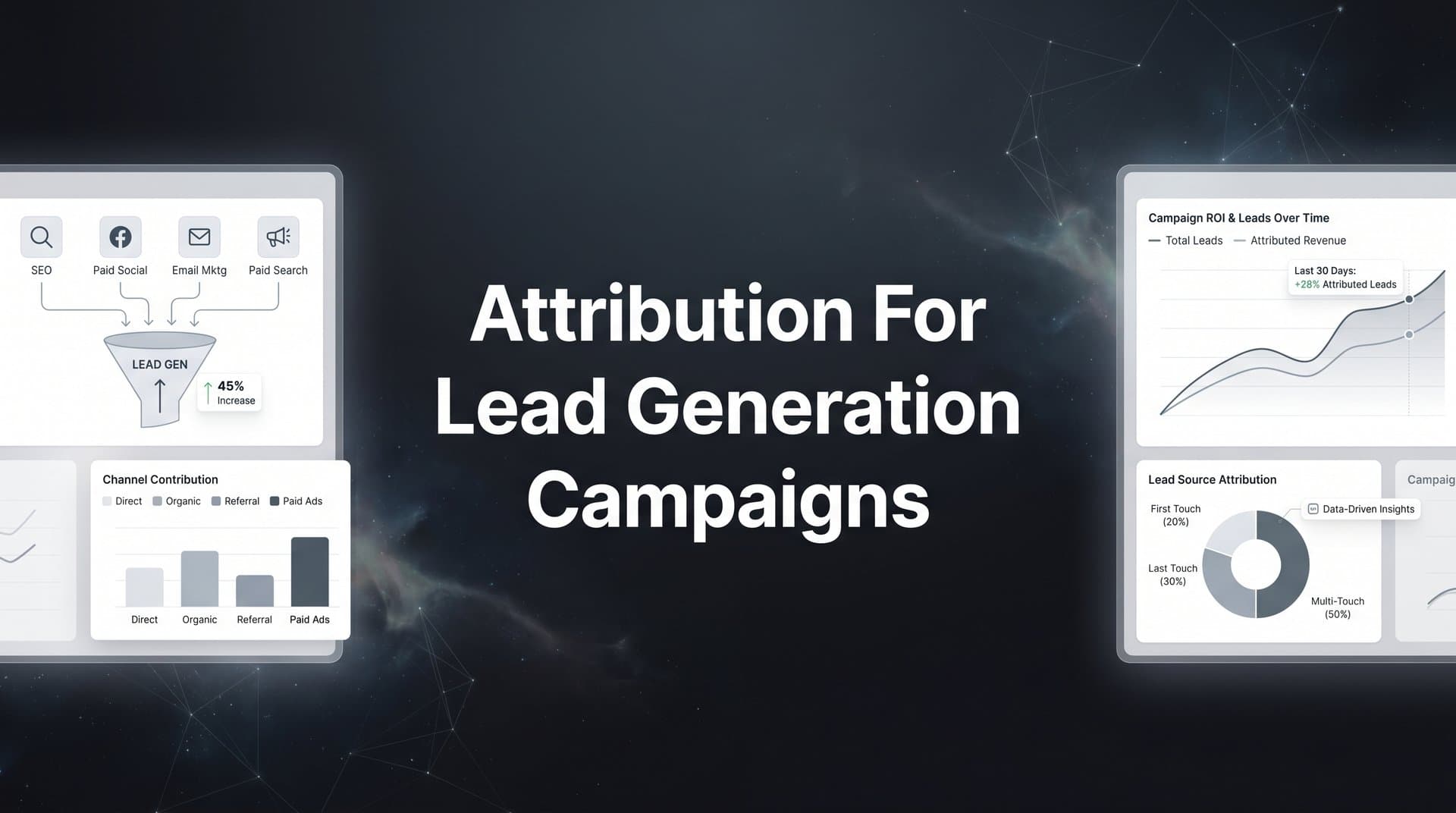
Multi-touch attribution distributes credit across the entire customer journey. Linear models split credit equally among all touchpoints. Time-decay models give more credit to interactions closer to conversion. Position-based models (also called U-shaped) emphasize both the first and last touchpoints while giving some credit to everything in between. Understanding what attribution model is best for optimizing ad campaigns helps you make the right choice for your business.
For lead generation, multi-touch attribution reveals the full story. You can see that LinkedIn drove initial awareness, Google search captured intent, your webinar built trust, and email nurture sequences kept prospects engaged until they were ready to buy. This visibility helps you understand not just which channels work, but how they work together. You might discover that LinkedIn alone doesn't drive many direct conversions, but leads who start with LinkedIn and later engage with your content marketing close at twice the rate of other sources.
Data-driven attribution takes multi-touch to the next level by using machine learning to analyze actual conversion patterns rather than applying predetermined rules. Instead of arbitrarily deciding that the first and last touchpoints deserve 40% credit each, data-driven models look at thousands of customer journeys to identify which touchpoints actually correlate with closed deals. If your data shows that prospects who engage with your case studies are 3x more likely to close regardless of other touchpoints, the model weights those interactions accordingly.
The choice between these models isn't binary. Smart marketers use multiple attribution models to answer different questions. First-touch shows what's filling your pipeline. Last-touch reveals what's closing deals. Multi-touch and data-driven models show the full journey and help you optimize the entire funnel rather than individual touchpoints in isolation.
Connecting Ad Platforms to Your CRM for Full-Funnel Visibility
Your ad platforms and your CRM are telling completely different stories about your marketing performance. The gap between these stories is costing you money.
Platform-reported conversions are notoriously unreliable for lead generation. Meta's dashboard might show 500 conversions this month. But when you check your CRM, you only have 300 new leads from Meta campaigns. What happened to the other 200? Some are duplicates from people who filled out forms multiple times. Others are spam submissions or competitors doing research. Some are legitimate leads, but the platform's tracking miscounted them due to browser restrictions or cookie blocking.
The bigger problem is that platform conversions measure form submissions, not revenue. Meta doesn't know that 50 of those 300 leads became qualified opportunities while 250 went nowhere. Google can't tell you that the $100 cost-per-lead campaign generated leads who closed at a 20% rate while the $50 cost-per-lead campaign's leads never made it past the first sales call. Without CRM integration, you're optimizing for volume and efficiency metrics that have zero correlation with actual business outcomes. Implementing proper marketing attribution platforms for revenue tracking solves this disconnect.
This is where server-side tracking changes everything. Browser-based pixels are increasingly blocked by privacy settings, ad blockers, and tracking restrictions. When someone converts on iOS with tracking limited, your Meta pixel might not fire. When someone uses Firefox with enhanced tracking protection, your Google tag might be blocked. These aren't edge cases anymore. They represent a significant and growing portion of your conversions that simply disappear from platform reporting.
Server-side tracking captures conversions directly from your server to the ad platform's API, completely bypassing browser restrictions. When someone fills out a form, your server sends that conversion event directly to Meta's Conversions API or Google's server-side tagging. The ad platform receives accurate conversion data regardless of browser settings, cookie blocking, or device limitations. Your conversion tracking becomes dramatically more complete and reliable.
But the real power comes from syncing CRM events back to your ad platforms. When a lead becomes a qualified opportunity in your CRM, you can send that event back to Meta and Google. When they close as a customer, you send a purchase event with the actual revenue value. This creates a feedback loop where ad platforms optimize for the outcomes you actually care about, not just form submissions.
Think about how this transforms campaign optimization. Without CRM integration, Meta's algorithm optimizes for people who are likely to fill out forms. With CRM data flowing back, it optimizes for people who are likely to become customers. The algorithm learns that certain audience segments generate leads who never convert, while others consistently produce high-value deals. Over time, it automatically shifts delivery toward the profiles that drive real revenue.
The technical implementation requires connecting your CRM to your ad platforms through APIs or integration platforms. When a lead progresses through your pipeline, those milestone events get sent back to the originating ad platform. The platform can then attribute that progression to specific campaigns, ad sets, and creative variations. You gain visibility into which campaigns generate leads that actually move through your funnel versus those that create dead ends.
This integration also solves the attribution window problem. Ad platforms typically use short attribution windows like 7 or 28 days. But B2B sales cycles often extend beyond these windows. When you sync CRM conversions back to platforms, you can attribute revenue to campaigns even when the purchase happens months after the initial click, maintaining accurate performance data across your entire sales cycle.
Building Your Lead Attribution Tech Stack
Accurate attribution for lead generation requires more than just installing a tracking pixel. You need a tech stack that captures data at every stage and connects the dots between first click and closed revenue.
Start with proper UTM tracking across all campaigns. UTM parameters are the foundation that lets you identify traffic sources in your analytics. Every ad, email, and social post should include UTM tags that specify the source, medium, campaign, and content. This seems basic, but inconsistent UTM implementation is one of the most common reasons attribution breaks down. When your team uses different naming conventions or forgets UTM tags on certain campaigns, you lose the ability to track performance accurately.
Server-side event capture is your next essential component. This means implementing tracking that sends conversion events from your server rather than relying solely on browser pixels. Whether you use Meta's Conversions API, Google's server-side tagging, or a customer data platform that handles server-side tracking across multiple platforms, this layer ensures you capture conversions that browser-based tracking misses. The technical implementation varies, but the goal is the same: reliable conversion data that isn't affected by browser restrictions.
CRM integration bridges the gap between marketing activity and revenue outcomes. Your CRM contains the ground truth about which leads became opportunities and which opportunities closed as customers. Without connecting this data to your marketing attribution, you're missing the most important part of the story. The integration needs to be bidirectional. Marketing data flows into your CRM so sales teams can see which campaigns generated each lead. CRM data flows back to your attribution platform and ad platforms so marketing teams can see which campaigns drive revenue. For B2B companies, specialized marketing attribution platforms for B2B handle these complex integrations seamlessly.
A central attribution platform unifies all this data in one place. This is where tools like Cometly become essential. Rather than logging into Meta, Google, LinkedIn, and your CRM separately to piece together campaign performance, an attribution platform connects to all these sources and shows you the complete customer journey in a single dashboard. You can see that a prospect clicked your Google ad, visited from a LinkedIn post two weeks later, attended a webinar, and eventually closed as a customer after a nurture email sequence.
Cometly specifically addresses lead generation attribution by tracking the full journey from first click to closed deal. It captures touchpoints across all your ad channels, connects them to CRM events, and shows you which campaigns are driving actual revenue rather than just form submissions. The platform handles server-side tracking automatically, ensuring you capture conversions that browser pixels miss. And because it integrates with your CRM, you can track attribution across the entire B2B sales cycle, not just the initial lead capture.
The final piece is setting up conversion events that matter. Most marketers track form submissions as their primary conversion event. That's fine for measuring top-of-funnel activity, but it's not enough. You need to track qualified leads, opportunities created, and closed deals as separate conversion events. This multi-stage tracking shows you where leads drop off in your funnel and which campaigns generate leads that progress all the way to revenue. Proper conversion tracking for lead generation captures all these critical milestones.
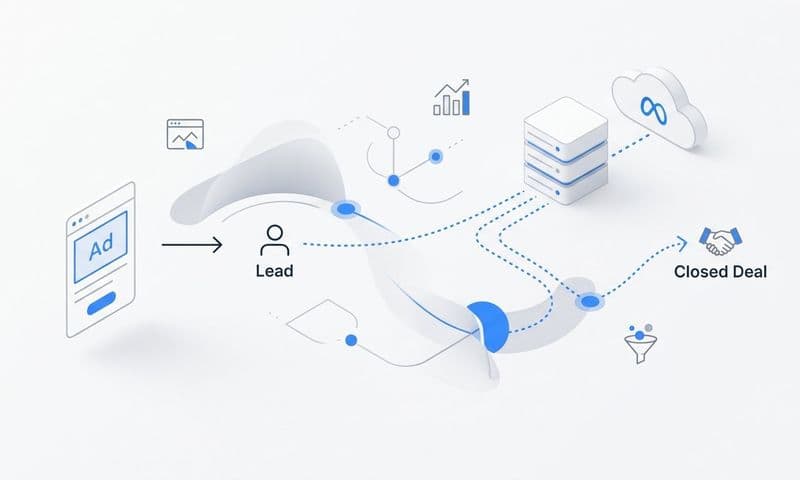
When these components work together, you get complete visibility. A prospect clicks your Meta ad, and UTM tracking identifies the source. They fill out a form, and server-side tracking sends that conversion to Meta's API regardless of browser settings. The lead enters your CRM, and the integration connects it back to the originating campaign. As they progress through your pipeline, each milestone gets tracked and attributed. When they close, your attribution platform shows you every touchpoint that contributed to that revenue.
Using Attribution Data to Optimize Campaign Spend
Having attribution data is only valuable if you actually use it to make better budget decisions. The insights you gain should directly change how you allocate spend across campaigns and channels.
The first step is identifying which campaigns generate leads that actually close versus those that create pipeline but never convert. Look beyond cost per lead to cost per closed deal. You might have a Google campaign with a $150 cost per lead and a LinkedIn campaign with a $75 cost per lead. Conventional wisdom says double down on LinkedIn because it's more efficient. But when you track those leads through to revenue, you discover the Google leads close at a 15% rate while LinkedIn leads close at 3%. Suddenly, Google's higher cost per lead translates to a much lower cost per customer.
This kind of analysis reveals uncomfortable truths about campaign performance. Campaigns that look efficient at the top of the funnel often fall apart when you track them to revenue. The cheap leads from broad targeting might fill your CRM with contacts who never engage with sales. Meanwhile, expensive leads from highly targeted campaigns might have lower volume but dramatically higher close rates and deal sizes. Implementing attribution tracking for multiple campaigns helps you compare performance across your entire portfolio.
Reallocating budget based on revenue attribution rather than cost per lead metrics transforms your ROI. Instead of optimizing for the cheapest leads, you optimize for the most profitable customer acquisition. This might mean shifting budget away from high-volume, low-quality sources toward lower-volume, high-quality channels. It feels counterintuitive when you're used to tracking vanity metrics like lead volume and cost efficiency, but it's how you scale revenue rather than just scaling activity.
Multi-touch attribution data reveals which channel combinations work best together. You might discover that leads who engage with both paid search and content marketing close at 3x the rate of leads who only interact through one channel. This insight should influence your strategy. Rather than treating channels as isolated campaigns competing for budget, you start thinking about how they work together to move prospects through your funnel. Mastering attribution modeling for multi-channel campaigns unlocks these cross-channel insights.
AI-powered recommendations can surface scaling opportunities that manual analysis would miss. When you're managing campaigns across multiple platforms with hundreds of ad sets and audience segments, identifying which specific combinations drive the best results becomes overwhelming. AI analyzes patterns across all your campaigns to identify which audiences, creative variations, and targeting parameters correlate with closed deals. It can flag underperforming campaigns that are burning budget on leads who never convert, and highlight winning combinations that deserve more investment.
The optimization cycle becomes continuous. Review your attribution data weekly to identify trends. Are certain campaigns consistently generating leads that stall in your pipeline? Cut or reduce their budgets. Are other campaigns producing leads that move quickly through sales cycles and close at high rates? Increase their budgets incrementally and monitor whether performance holds as you scale. Make small adjustments based on data rather than large shifts based on hunches.
Attribution data also informs creative and messaging decisions. When you can see which ad creative variations generate leads that actually close, you learn what messaging resonates with your best customers. The ad that gets the most clicks might not be the ad that drives the most revenue. Attribution shows you which value propositions, pain points, and calls-to-action attract prospects who become customers versus those that attract tire-kickers.
Putting It All Together: Your Attribution Action Plan
Implementing proper attribution for lead generation doesn't happen overnight, but you can start making progress immediately with a clear action plan.
Start by auditing current tracking gaps between your ad platforms and CRM data. Log into each ad platform and compare reported conversions to actual leads in your CRM for the same time period. Document the discrepancies. Check how many leads in your CRM are missing source attribution. Identify where your tracking is breaking down. This audit reveals your biggest data gaps and helps you prioritize what to fix first.
Implement server-side tracking to capture the touchpoints browsers block. If you're running Meta ads, set up the Conversions API. For Google, implement server-side tagging. This technical work might require developer resources, but it's essential for accurate conversion tracking in the current privacy landscape. The sooner you implement server-side tracking, the sooner you stop losing visibility into a significant portion of your conversions. Choosing the right attribution software for lead generation simplifies this implementation significantly.
Connect your CRM to your attribution platform so you can track leads through to revenue. Configure the integration to sync lead status changes, opportunity creation, and closed deals back to your marketing attribution. Set up custom conversion events that track these pipeline milestones, not just initial form submissions. This connection is what transforms attribution from a vanity metric exercise into a revenue optimization tool.
Review attribution data weekly to make incremental budget shifts toward revenue-generating campaigns. Don't wait for monthly or quarterly reviews. Set up a recurring calendar event to analyze which campaigns are driving qualified opportunities and closed deals. Make small budget adjustments based on what you learn. Over time, these incremental optimizations compound into significantly better ROI.
Your Path to Data-Driven Lead Generation
Attribution for lead generation requires connecting the dots from first click to closed revenue. The complexity of B2B sales cycles, multiple decision-makers, and extended timelines means you need more sophisticated tracking than ecommerce businesses. But when you implement proper attribution, you transform budget decisions from guesswork into data-driven strategy.
The components are clear: server-side tracking to capture complete conversion data, CRM integration to connect marketing activity to revenue, multi-touch attribution to understand the full customer journey, and a central platform that unifies all this data in one place. Each piece builds on the others to give you visibility into which campaigns actually drive business outcomes.
The payoff is substantial. Instead of scaling campaigns based on cost per lead while hoping they generate revenue, you scale based on actual ROI data. You identify which channel combinations work best together. You optimize creative and targeting based on what converts prospects into customers, not just what generates form submissions. You feed better data back to ad platforms so their algorithms optimize for quality rather than just volume.
Ready to elevate your marketing game with precision and confidence? Discover how Cometly's AI-driven recommendations can transform your ad strategy. Get your free demo today and start capturing every touchpoint to maximize your conversions.