You're spending thousands on ads across Meta, Google, TikTok, and LinkedIn. Your dashboard shows clicks, impressions, and conversions. But when your CEO asks which campaigns actually drive revenue, you hesitate. The truth? Your current attribution setup probably can't answer that question with confidence.
This isn't just a reporting problem—it's a strategic blindness that costs real money. When you can't connect ad spend to actual revenue, you're making budget decisions based on incomplete data. You might be pouring money into channels that look good on paper but don't actually convert, while starving the touchpoints that genuinely drive growth.
Advanced marketing attribution solves this black box problem. It moves beyond the oversimplified last-click model to reveal the complete customer journey—every ad they saw, every email they opened, every page they visited before converting. This isn't about collecting more data for data's sake. It's about finally understanding which marketing touchpoints actually matter so you can scale what works and cut what doesn't.
The Fatal Flaw in Your Current Attribution Setup
Last-click attribution tells a dangerously incomplete story. It gives 100% credit to the final touchpoint before conversion—usually a branded search ad or a retargeting click—while ignoring every interaction that brought the customer to that moment.
Picture this: A potential customer sees your Facebook ad, visits your site but doesn't convert. Three days later, they see a LinkedIn post from your company, click through, and browse your pricing page. A week later, they search your brand name on Google, click your ad, and finally purchase. Last-click attribution gives all the credit to that final Google search ad.
But here's what actually happened: Facebook introduced them to your solution. LinkedIn kept you top-of-mind during their consideration phase. The Google search was simply the final step in a journey your other channels created. Under last-click attribution, you'd conclude that branded search is your best performer and potentially cut budget from the channels that actually built awareness and consideration.
This misattribution becomes even more problematic in today's privacy-first landscape. iOS 14.5 and subsequent updates fundamentally broke traditional pixel-based tracking. When users opt out of tracking—and many do—browser-based attribution systems simply miss those conversions or misattribute them. Third-party cookie deprecation compounds this problem, creating blind spots in your customer journey data that make last-click attribution even less reliable than before. Understanding these attribution challenges in marketing analytics is the first step toward solving them.
The real cost shows up in your budget allocation. You're likely over-investing in bottom-funnel retargeting and branded search while under-investing in the top and middle-funnel channels that actually generate demand. You're optimizing for the last touchpoint instead of the entire journey that creates conversions.
How Multi-Touch Models Reveal What's Really Working
Multi-touch attribution distributes credit across every touchpoint in the customer journey. Instead of giving 100% credit to one interaction, it acknowledges that conversions happen because of multiple engagements across channels and time.
The linear attribution model takes the simplest approach: equal credit to every touchpoint. If a customer interacted with five different marketing channels before converting, each gets 20% credit. This model works well when you're just starting to move beyond last-click and want to understand the full scope of your marketing ecosystem without making assumptions about which touchpoints matter most.
Time-decay attribution assumes that touchpoints closer to conversion matter more. A customer's first interaction might get 5% credit, while their final interaction before purchase gets 40%. This model makes sense for businesses with longer sales cycles where recent interactions often indicate higher purchase intent. If you're selling enterprise software with 90-day sales cycles, time-decay helps you identify which channels effectively move prospects through the final stages.
Position-based attribution—sometimes called U-shaped—typically assigns 40% credit to the first touchpoint, 40% to the last, and splits the remaining 20% among middle interactions. This model recognizes two critical moments: the initial awareness that brought someone into your funnel, and the final conversion touchpoint. It's particularly useful when you need to balance investment in demand generation with conversion optimization. For a deeper dive into these frameworks, explore our guide on what is marketing attribution model.
But here's where it gets interesting: data-driven attribution uses machine learning to analyze your actual conversion patterns and assign credit based on what genuinely influences purchases. Instead of following a predetermined formula, it learns from thousands of customer journeys to identify which touchpoint combinations actually lead to conversions.
Data-driven models might discover that customers who see your YouTube ad followed by an email campaign convert at 3x the rate of those who only see one or the other. Or that LinkedIn engagement early in the journey strongly predicts eventual conversion, even when it's not the last click. This approach adapts to your specific business, channels, and customer behavior rather than forcing your data into a generic framework. When comparing approaches, understanding multi touch attribution vs marketing mix modeling helps you choose the right methodology for your needs.
Choosing the right model depends on your sales cycle and channel mix. Short sales cycles with few touchpoints? Linear or position-based models provide clear insights without overcomplicating analysis. Complex B2B sales with dozens of touchpoints over months? Data-driven attribution helps you cut through the noise to identify what actually influences decisions.
Why Server-Side Tracking Changes Everything
Browser-based tracking has a fundamental problem: it only sees what happens in the browser, and even then, only when tracking isn't blocked. Ad blockers, privacy settings, and cross-device journeys create massive blind spots in your attribution data.
When someone clicks your Facebook ad on their phone during their commute, browses your site on their work laptop during lunch, and finally converts on their tablet at home, traditional pixel-based tracking often sees these as three separate, unconnected users. You're not tracking one customer journey—you're seeing fragments that never connect into a complete picture.
Server-side tracking solves this by capturing conversion events directly on your server, independent of browser restrictions. When a conversion happens, your server sends that data to your attribution platform and ad networks, bypassing the limitations and restrictions that plague client-side tracking. This represents one of the latest trends in marketing attribution technology that forward-thinking marketers are adopting.
This approach captures touchpoints that browser-based methods miss entirely. Users with ad blockers? Tracked. Safari users with Intelligent Tracking Prevention? Tracked. Cross-device journeys? Connected through first-party identifiers like email addresses or customer IDs that link interactions across devices and sessions.
The accuracy improvement is substantial. Where browser-based tracking might capture 60-70% of conversions, server-side tracking captures closer to 95%+. That difference isn't just about better reporting—it's about having confidence in your data when making six-figure budget decisions.
Server-side tracking also enables you to connect data sources that traditional attribution can't link. Your CRM knows which leads became customers and their lifetime value. Your ad platforms know which campaigns drove clicks. Your website analytics show the browsing behavior between ad click and conversion. Server-side attribution ties all these data points together, creating a unified view of the customer journey from first impression to final purchase and beyond. This is why marketing attribution software vs traditional analytics represents such a significant leap forward.
Turning Attribution Data Into Revenue-Driving Decisions
Accurate attribution data only matters if it changes what you do. The goal isn't prettier dashboards—it's making smarter budget allocation decisions that improve your return on ad spend.
Start by identifying your true top-performers. With multi-touch attribution, you'll often discover that channels you thought were underperforming actually play crucial roles in the conversion path. That podcast sponsorship that generates few last-click conversions might be your most effective awareness channel, consistently appearing early in high-value customer journeys. That insight transforms it from "nice to have" into "protect this budget."
Use attribution data to optimize your channel mix dynamically. If your data shows that customers who engage with both paid social and email convert at 4x the rate of those who only see one channel, you can deliberately design campaigns that drive prospects through both touchpoints. You're not just spending more efficiently—you're architecting customer journeys based on what actually works. Effective channel attribution in digital marketing revenue tracking makes this level of optimization possible.
Attribution insights also reveal your highest-performing creative and messaging at each funnel stage. You might discover that educational content drives awareness-stage engagement, while case studies and ROI calculators strongly predict conversion. This knowledge lets you match creative strategy to funnel position, showing prospects the right message at the right time based on where they are in their journey.
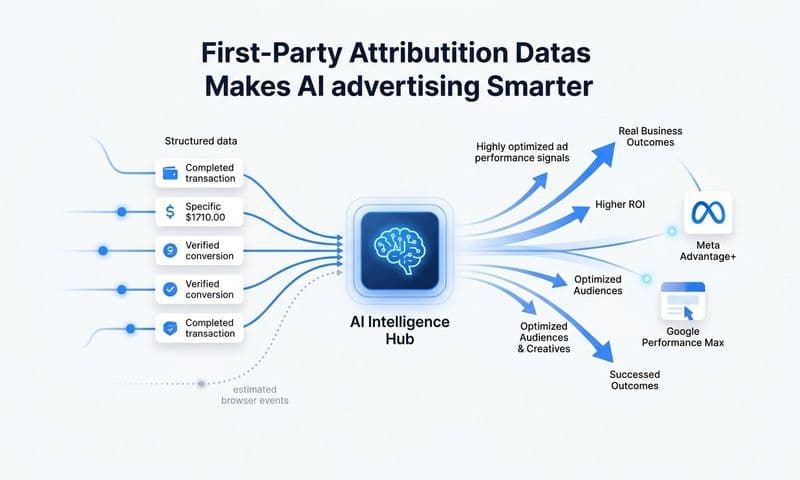
Here's where advanced attribution creates a compounding advantage: feeding enriched conversion data back to your ad platforms. Meta's algorithm, Google's Smart Bidding, and other platform AI systems optimize based on the conversion signals they receive. When you send them complete, accurate conversion data through server-side tracking, their algorithms can identify patterns and optimize targeting more effectively.
This conversion sync capability means your attribution platform isn't just helping you make better decisions—it's helping your ad platforms make better automated decisions on your behalf. The platforms can identify which audiences, placements, and creative variations actually drive conversions, then automatically shift budget toward what works. Leveraging AI powered marketing attribution tools amplifies these benefits even further.
The practical impact shows up in your campaign performance. Better conversion data helps platforms find more customers who look like your actual converters, not just people who look like your last-click converters. Your CPAs often decrease while conversion volume increases because the platform algorithms finally have accurate signals to optimize against.
Building Your Attribution System Without Getting Overwhelmed
Advanced attribution sounds complex, but implementation follows a clear path. Start with the foundation: connecting your key data sources.
Your ad platforms come first. Connect Meta, Google Ads, LinkedIn, TikTok, and any other paid channels you run. This integration captures impression data, click data, and ad-level details that show which specific campaigns and creative variations appear in conversion paths. Reviewing the top digital marketing attribution software tools can help you identify the right solution for your tech stack.
Next, integrate your CRM. This connection is crucial because it tells you which conversions actually became customers and their value over time. Attribution based solely on form fills or trial signups misses the most important part of the story—did they buy, and how much did they spend? CRM integration connects marketing touchpoints to actual revenue.
Website tracking comes third. Install your attribution platform's tracking script to capture on-site behavior between ad clicks and conversions. This reveals how prospects engage with your content, which pages they visit, and how long they spend in consideration before converting.
The most common implementation pitfall is incomplete data coverage. If you track conversions on your website but not in your mobile app, you're missing part of the journey. If you integrate Google Ads but not Meta, you can't see cross-platform attribution. Gaps in your data create gaps in your insights, so prioritize comprehensive coverage over perfect configuration of individual channels. For B2B companies specifically, understanding B2B marketing attribution 101 helps avoid common mistakes.
Another pitfall: not defining your conversion events clearly. What counts as a conversion? Form submissions? Trial signups? Purchases? Demo requests? Define these upfront and implement consistent tracking across all touchpoints. Inconsistent event definitions create attribution chaos where different channels report different conversion counts for the same action.
Test your implementation before trusting it for budget decisions. Make a test purchase or conversion yourself and verify it appears correctly in your attribution platform with all touchpoints captured. Check that conversions sync back to your ad platforms accurately. Validate that your CRM data flows through properly. This testing phase catches configuration issues before they corrupt your decision-making.
Measuring attribution success requires looking at specific indicators. First, check your data completeness: what percentage of conversions have full journey data versus appearing as "direct" or "unknown source"? If more than 20% of conversions lack attribution, you likely have tracking gaps to address.
Second, validate that your attributed conversions match your actual conversions. If your attribution platform reports 500 conversions but your CRM shows 600, something's not syncing correctly. The numbers should align within a small margin of error.
Third, monitor your ad platform performance after implementing conversion sync. You should see improvements in campaign efficiency as the platforms receive better conversion data. If performance doesn't improve or actually declines, investigate whether your conversion events are configured correctly or if you're sending low-quality signals.
Making Attribution Your Competitive Advantage
Advanced marketing attribution transforms how you approach growth. Instead of making budget decisions based on incomplete data and educated guesses, you're operating from a position of clarity. You know which channels drive awareness, which nurture consideration, and which close deals. You can confidently scale what works and cut what doesn't because you're seeing the complete picture.
This visibility creates a compounding advantage. While competitors waste budget on misattributed channels, you're investing in the touchpoints that actually drive revenue. While they struggle to prove marketing ROI, you're showing exactly how marketing spend connects to business outcomes. While their ad platform algorithms optimize against incomplete signals, yours are learning from accurate, enriched conversion data.
The marketers who win in 2026 and beyond won't be those with the biggest budgets—they'll be those with the clearest data. Advanced attribution gives you that clarity. It shows you not just what happened, but why it happened and how to make it happen more efficiently.
Ready to elevate your marketing game with precision and confidence? Discover how Cometly's AI-driven recommendations can transform your ad strategy—Get your free demo today and start capturing every touchpoint to maximize your conversions.