You're managing campaigns across Meta, Google, TikTok, and three other platforms. Your dashboard shows thousands of data points. Meta says one ad set is your top performer. Google Analytics credits a different source entirely. Your CRM insists the real winners are somewhere else. Meanwhile, you're supposed to decide where to allocate tomorrow's budget.
This is the daily reality for modern marketers: drowning in data while starving for clarity.
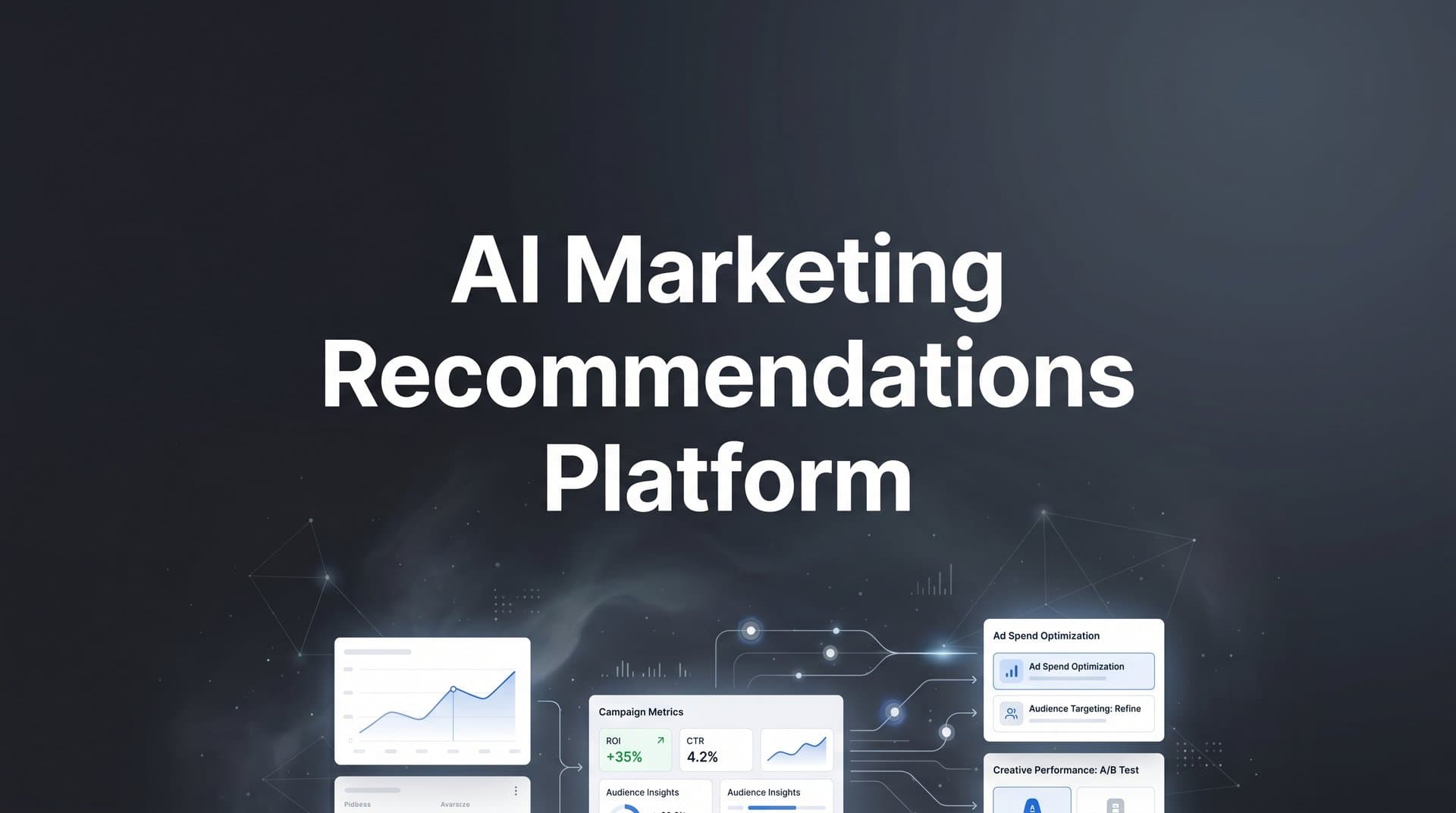
Enter the AI marketing recommendations platform—technology designed to cut through the noise and tell you exactly what to do next. These platforms don't just report what happened yesterday. They analyze patterns across every touchpoint, predict what will drive results tomorrow, and recommend specific actions to improve performance right now. For marketing teams managing complex, multi-channel campaigns, they're becoming less of a nice-to-have and more of a competitive necessity.
The Technology Behind Intelligent Marketing Guidance
Think of traditional analytics as a rearview mirror. You see where you've been, but you're still guessing about where to go next. An AI marketing recommendations platform functions more like a GPS with real-time traffic updates—it knows your destination, sees the entire landscape, and actively guides you toward the fastest route.
The foundation is cross-platform data integration. These systems connect to your ad accounts, website analytics, CRM, and any other tool in your marketing stack. But here's where it gets interesting: they don't just collect this data. They unify it into a single source of truth, matching anonymous website visitors to ad clicks, linking form submissions to revenue events, and building complete customer journey maps that span weeks or months.
Machine learning models then analyze these unified journeys to identify patterns that would be impossible for humans to spot manually. Which ad creative consistently leads to high-value customers three weeks later? What combination of touchpoints predicts a conversion with 80% accuracy? When does increasing spend on a campaign typically hit diminishing returns?
The AI doesn't just answer these questions in hindsight. It builds predictive models that forecast campaign performance based on current trends. If a campaign's conversion rate is declining in a pattern the system has seen before, it flags the issue before you've wasted significant budget. If an audience segment is showing early signals of strong performance, it recommends scaling before your competitors notice the opportunity.
Real-time processing makes these insights actionable immediately. Traditional analytics might show you last week's performance in yesterday's report. Real-time marketing analytics platforms analyze data as it arrives—often within minutes of a conversion or click—and surface opportunities while they're still fresh.
The sophistication varies by platform, but the best systems employ multiple specialized models working together. One model might focus on attribution accuracy, another on creative performance patterns, and another on budget optimization. They collaborate to provide recommendations that account for the full complexity of your marketing ecosystem.
This isn't magic. It's mathematics applied to massive datasets with one clear goal: tell marketers what action to take next to drive better results.
From Raw Data to Revenue-Driving Insights
Your customer's journey doesn't start and end with a single click. Someone sees your Instagram ad on Monday, visits your website via Google search on Wednesday, receives a retargeting ad on Thursday, and finally converts through a direct visit on Friday. Which touchpoint deserves credit for the revenue?
This is where attribution models become the engine powering intelligent recommendations. An AI marketing recommendations platform doesn't just track these scattered interactions. It assembles them into coherent journeys and applies sophisticated attribution logic to understand what actually drives conversions.
First-touch attribution would credit that initial Instagram ad. Last-touch would give all the credit to the direct visit. Both perspectives are incomplete and misleading. Multi-touch attribution distributes credit across the entire journey based on each touchpoint's actual influence on the final conversion.
Here's why this matters for recommendations: when you know which touchpoints genuinely contribute to revenue, you can make smarter decisions about where to invest. The platform might reveal that your Facebook ads rarely close deals directly but play a crucial role in introducing prospects who convert later through other channels. Without proper attribution, you might cut that budget and unknowingly damage your entire funnel.
The journey from raw data to actionable insight follows a clear path. First, the platform captures every interaction: ad impressions, clicks, website sessions, form submissions, email opens, CRM activities, and purchase events. Second, it matches these anonymous events to known users, building unified profiles that span devices and platforms. Third, it applies attribution models to understand which touchpoints influenced each conversion.
But the real power emerges in the fourth step: pattern recognition across thousands of these attributed journeys. The AI identifies that customers who engage with educational content before seeing product ads convert at higher rates. It notices that certain geographic regions respond better to specific messaging. It discovers that the optimal time between first touch and conversion varies by customer segment.
These patterns become the foundation for recommendations. The platform doesn't just tell you what happened. It suggests what to do about it: shift budget toward the channels that start high-value journeys, adjust your creative strategy for segments with different conversion timelines, or increase spend in regions showing strong attribution patterns.
The complete context matters. When the system knows that a prospect clicked three ads, visited five pages, and engaged with two emails before converting, it can make recommendations that account for this complexity rather than oversimplifying to single-touch thinking.
Five Ways AI Recommendations Transform Daily Campaign Management
Let's get specific about how these platforms change your actual workflow. The value isn't theoretical—it's in the daily decisions that compound into significant performance improvements.
Budget Allocation Based on Real Revenue Impact: Instead of distributing spend based on last-click conversions or gut feeling, the platform analyzes attributed revenue across all channels and recommends optimal budget distribution. It might suggest moving 20% of your budget from Google Search to Meta because attribution data shows Meta-initiated journeys drive higher customer lifetime value, even though they take longer to convert. These recommendations update continuously as performance patterns shift.
Creative Performance Insights That Go Beyond Surface Metrics: The AI doesn't just report click-through rates. It connects creative elements to downstream revenue. It might identify that ads featuring customer testimonials generate fewer immediate clicks but lead to customers who spend 40% more over time. Or it could flag that a specific headline variation consistently attracts low-intent traffic. These insights help you double down on what actually works and kill what looks good but performs poorly.
Audience Targeting Recommendations From Journey Analysis: By analyzing which audience segments produce the most valuable customer journeys, the platform suggests targeting adjustments you wouldn't discover manually. It might recommend creating a lookalike audience based on customers who engaged with specific content combinations, or suggest excluding segments that click frequently but rarely convert beyond the first touchpoint.
Scaling Signals That Identify Expansion Opportunities: This is where AI recommendations become genuinely valuable. The platform monitors campaign performance for specific patterns that indicate readiness to scale: stable cost per acquisition, consistent conversion rates despite increased spend, strong attribution across multiple touchpoints, and positive trends in customer quality metrics. When these signals align, it recommends increasing budget with specific suggested amounts based on historical scaling patterns.
Underperformance Alerts Before Significant Budget Waste: Traditional reporting shows you problems after they've already cost money. AI-powered marketing insights flag declining performance in real-time by comparing current patterns to historical baselines. If a campaign's conversion rate drops below expected ranges or if cost per acquisition starts trending upward in a concerning pattern, you get actionable alerts while there's still time to adjust before burning through your budget.
The transformation happens in aggregate. Each individual recommendation might save a few percentage points or identify a modest optimization opportunity. But when you're making dozens of these data-driven decisions weekly instead of relying on incomplete information and intuition, the cumulative impact reshapes your entire marketing performance.
Feeding Better Data Back to Ad Platforms
Here's something most marketers don't fully appreciate: your ad platforms are only as smart as the data you feed them. When you tell Meta or Google about a conversion, their algorithms use that signal to find more people like the converter and optimize delivery. But what if the conversion data you're sending is incomplete, delayed, or inaccurate?
This is where AI marketing recommendations platforms create a powerful feedback loop that improves your ad performance at the source.
Standard pixel-based tracking faces serious limitations. iOS privacy changes block a significant portion of conversion data. Browser restrictions prevent accurate cross-device tracking. Ad blockers eliminate visibility into certain user segments entirely. The result? Your ad platforms are optimizing based on maybe 60-70% of your actual conversions, and they're missing crucial context about conversion quality.
Server-side tracking solves this by capturing conversion data on your server and sending it directly to ad platforms through their APIs. This approach bypasses browser restrictions, overcomes iOS limitations, and ensures that platforms receive complete, accurate conversion signals. When Meta's algorithm can see 95% of your conversions instead of 65%, it makes fundamentally better optimization decisions.
But accuracy is just the beginning. The real power comes from enrichment. An AI marketing recommendations platform doesn't just send "conversion happened" signals. It sends enriched events that include attribution data, customer value indicators, and journey context. Instead of telling Meta "this person converted," you're telling them "this person converted, they're a high-value customer based on attribution analysis, and they typically engage with educational content before purchasing."
This enriched data enables ad platforms to optimize for quality, not just quantity. Google's algorithm can prioritize audiences that generate high-lifetime-value customers. Meta can identify creative variations that attract engaged, conversion-ready prospects. The platforms' machine learning models get better training data, which leads to better targeting, which generates better results.
The compounding effect is significant. Better data leads to better optimization, which drives better performance, which generates more quality data to feed back into the system. Over time, your campaigns become increasingly efficient as the ad platforms learn to identify and target your most valuable potential customers. Understanding how attribution platforms track revenue is essential to maximizing this feedback loop.
This closed-loop approach also enables more sophisticated optimization strategies. You can create custom conversion events based on attribution insights—like "high-value journey initiated" or "engaged prospect"—and optimize campaigns specifically for these predictive signals rather than waiting for final conversions that might happen weeks later.
Choosing the Right Platform for Your Marketing Stack
Not all AI marketing recommendations platforms are created equal. The market includes everything from basic analytics tools with AI-flavored features to sophisticated systems that genuinely transform campaign management. Choosing wisely requires understanding what actually matters.
Attribution Depth and Model Flexibility: The foundation of intelligent recommendations is accurate attribution. Evaluate whether the platform offers true multi-touch attribution or just repackaged last-click reporting. Can it handle complex, multi-week customer journeys? Does it support multiple attribution models so you can compare perspectives? The depth of attribution directly determines the quality of recommendations you'll receive.
Integration Breadth and Data Unification: A platform that only connects to three ad channels can't provide comprehensive recommendations. Look for systems that integrate with all your critical tools: ad platforms, analytics, CRM, email marketing, and any other touchpoint in your customer journey. More importantly, evaluate how well the platform unifies this data. Can it match anonymous website visitors to known leads? Does it connect ad clicks to CRM revenue events?
AI Sophistication and Recommendation Transparency: Some platforms use "AI" as a marketing term without meaningful machine learning capabilities. Ask specific questions: What patterns does the AI analyze? How are recommendations generated? Can you understand the reasoning behind suggestions? The best platforms provide transparent recommendations with clear explanations, not black-box outputs you're expected to trust blindly. When choosing a marketing analytics platform, prioritize those that explain their methodology.
Real-Time Processing vs. Batch Reporting: Daily reports of yesterday's performance are table stakes. You need a platform that processes data in real-time and surfaces recommendations while opportunities are still actionable. Can it alert you to performance changes as they happen? Does it update recommendations based on current campaign status?
Server-Side Tracking and Data Accuracy: Given the tracking challenges posed by iOS changes and browser restrictions, server-side capabilities are increasingly essential. Does the platform offer server-side tracking? Can it send enriched conversion data back to ad platforms? How does it handle cross-device attribution in a privacy-conscious environment?
Scalability and Performance at Volume: A platform that works well with $10,000 monthly ad spend might struggle at $100,000 or $1,000,000. Evaluate whether the system can handle your data volume without performance degradation. Can it process thousands of daily conversions? Does recommendation quality improve or degrade as data volume increases?
Team Collaboration and Workflow Integration: The best insights are worthless if your team can't easily act on them. Consider how recommendations are surfaced: through dashboards, alerts, integrations with tools you already use? Can multiple team members collaborate on optimization decisions? Does the platform fit naturally into your existing workflow? For agencies managing multiple clients, marketing analytics platforms for agencies offer specialized collaboration features.
Your choice should align with your specific marketing complexity. A small business running basic campaigns might not need enterprise-grade attribution. But if you're managing multi-channel campaigns with complex customer journeys, settling for a platform that can't handle that complexity will limit your growth potential.
The right platform becomes a force multiplier for your marketing team, enabling smarter decisions at scale and freeing your team from manual analysis to focus on strategy and creative work.
The Competitive Edge of Intelligent Marketing
We've moved beyond the era when marketing success came from simply outspending competitors or having better creative instincts. Today's winning marketers combine those traditional strengths with something more powerful: data-driven intelligence that turns information into action.
AI marketing recommendations platforms represent this shift from reactive to proactive marketing. Instead of analyzing last week's performance and hoping to apply those lessons to next week's campaigns, you're receiving real-time guidance based on patterns across your entire marketing ecosystem. You're making optimization decisions based on attributed revenue rather than surface-level metrics. You're feeding enriched data back to ad platforms, improving their algorithms and creating a compounding advantage over time.
The combination of accurate attribution, complete journey tracking, and intelligent analysis enables something that wasn't possible even a few years ago: confident decision-making at scale. You can manage campaigns across a dozen platforms without drowning in data. You can identify winning patterns before they're obvious. You can scale successful campaigns with precision instead of guesswork.
This isn't about replacing human judgment with automation. The best marketing still requires strategic thinking, creative excellence, and deep customer understanding. But when you augment those human capabilities with AI-powered recommendations grounded in comprehensive data, you make better decisions faster and more consistently than teams relying on intuition alone.
The marketers and agencies adopting these tools today are building a significant competitive advantage. They're capturing revenue that competitors miss because of attribution gaps. They're optimizing campaigns while others are still generating reports. They're improving ad platform performance through better data while competitors struggle with iOS limitations.
The question isn't whether AI marketing recommendations will become standard in your industry. The question is whether you'll be among the early adopters who benefit from the advantage or the late majority playing catch-up.
Ready to elevate your marketing game with precision and confidence? Discover how Cometly's AI-driven recommendations can transform your ad strategy—Get your free demo today and start capturing every touchpoint to maximize your conversions.