You're staring at three browser tabs. Meta Ads Manager says your campaign drove 47 conversions. Google Ads claims credit for 52. TikTok's dashboard shows 31. You know for a fact that you only had 38 actual sales this week.
Sound familiar?
This isn't just an annoying data discrepancy—it's the reality of modern digital marketing. Each platform lives in its own bubble, using its own tracking pixels, applying its own attribution rules, and confidently declaring itself the hero of every conversion. Meanwhile, you're left toggling between dashboards, exporting CSV files, and building spreadsheets that are outdated the moment you finish them.
The problem gets worse when you factor in iOS privacy restrictions, cookie blockers, and increasingly complex customer journeys where buyers interact with multiple ads across multiple platforms before they ever convert. You're not just dealing with messy data—you're making budget decisions based on incomplete information.
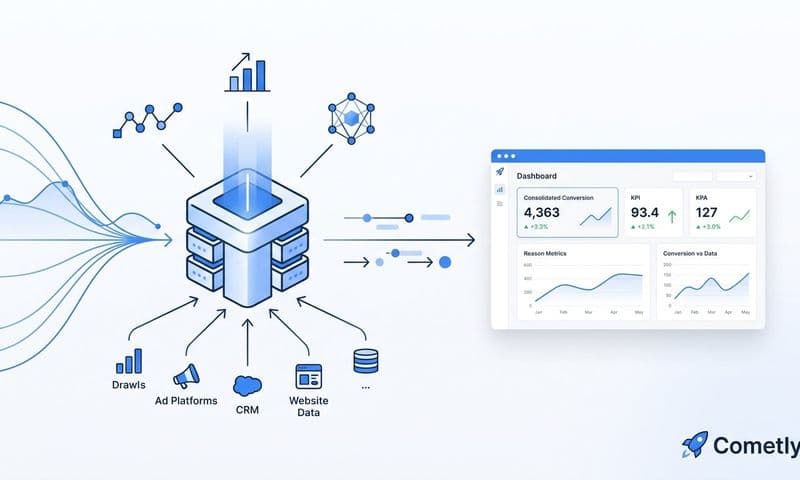
This is exactly why cross platform marketing analytics dashboards have become essential infrastructure for serious marketers. These unified systems pull data from every ad platform, your CRM, and your website into a single source of truth. They show you which channels actually drive revenue, how your campaigns work together, and where to allocate budget for maximum return.
In this guide, we'll break down what these dashboards really do, why they matter more than ever in 2026, and how to evaluate them for your specific marketing stack. Whether you're managing campaigns in-house or running an agency with multiple clients, you'll learn how to move from scattered data and guesswork to confident, data-driven decisions.
Why Scattered Data Leads to Costly Marketing Decisions
Here's what happens when your marketing data lives in silos: every platform becomes an unreliable narrator of its own success story.
Meta's Ads Manager uses last-click attribution within its own ecosystem. So does Google Ads. And TikTok. And LinkedIn. When a customer sees your Meta ad on Monday, clicks a Google search ad on Wednesday, and converts on Friday after clicking another Meta ad, all three platforms claim full credit for that sale. You're not getting three times the conversions—you're getting three versions of the same story, each one self-serving.
This attribution chaos creates real financial consequences. You might be scaling a Facebook campaign that looks like a winner in Meta's dashboard, while the data you can't see shows that channel is actually just intercepting customers who were already going to buy after discovering you through organic search. Or you're cutting budget from Google Ads because the cost-per-click looks high, not realizing those clicks are essential first touchpoints that introduce customers who later convert through other channels.
The blind spots get even worse when you factor in what's happening outside the ad platforms. Your CRM knows which leads actually turned into paying customers and what they're worth over time. Your website analytics show the full browsing behavior before conversion. Your email platform tracks nurture sequences. But none of these systems talk to each other automatically, so you're missing the connective tissue that explains how marketing actually works.
Think about the customer journey for a B2B software purchase. A prospect might see your LinkedIn ad, visit your website but not convert, receive a retargeting ad on Meta, click through to read a blog post, sign up for your email list, receive a nurture sequence, click a Google search ad weeks later, and finally request a demo. That's six or seven touchpoints across four different platforms. If you're only looking at last-click data from Google Ads, you're crediting the entire sale to that final search click—and you might decide to cut all the earlier touchpoints that actually built awareness and trust.
The real cost of scattered data isn't just confusion—it's misallocated budget. You waste money scaling channels that look good in isolation but don't actually drive incremental revenue. You cut spending on channels that appear expensive but play crucial roles in the conversion path. And you never develop a clear picture of what's actually working, so you're constantly reacting to surface-level metrics instead of understanding the underlying dynamics of your marketing.
This is the problem that cross platform analytics dashboards solve. Instead of stitching together incomplete stories from multiple sources, you get one complete view of how customers actually find you, what influences their decisions, and which marketing investments drive real revenue.
What a Unified Analytics Dashboard Actually Does
At its core, a cross platform marketing analytics dashboard is a centralized system that aggregates data from all your marketing sources and connects it to actual business outcomes. But the real value isn't just putting everything in one place—it's creating a unified view of the customer journey that no single platform can provide on its own.
Here's how it works: the dashboard integrates with your ad platforms through their APIs, pulling in campaign performance data, ad spend, impressions, clicks, and platform-reported conversions. It connects to your website through tracking pixels or server-side integrations to capture visitor behavior, page views, and on-site events. It syncs with your CRM to match anonymous website visitors with known leads and customers. And it ties everything together with a unique identifier system that follows individual users across touchpoints.
For a deeper dive, see our guide to pay per click campaign management.
This integration creates something powerful: a complete timeline of every customer's journey from first awareness to final purchase. You can see that a customer first clicked your Meta ad on January 15th, visited three blog posts, left without converting, saw a retargeting ad on Google Display Network on January 18th, clicked through again, signed up for your email list, received your welcome sequence, clicked a promotional email on January 22nd, and finally purchased. Every touchpoint is visible in sequence, with timestamps and source attribution.
But data aggregation is just the foundation. The real functionality comes from what the dashboard does with that unified data.
First, it provides real-time performance tracking across all channels in a single view. Instead of logging into five different platforms to check how your campaigns are performing, you see everything on one screen: total ad spend, total conversions, revenue by channel, cost per acquisition, and return on ad spend—all calculated using the same attribution methodology so the numbers actually add up correctly.
Second, it enables cross-channel attribution analysis. You can compare how different attribution models—first-click, last-click, linear, time-decay, position-based—credit conversions across your marketing mix. This reveals patterns that single-platform dashboards hide. You might discover that TikTok is an excellent awareness channel that rarely gets last-click credit but influences 60% of conversions when you look at first-touch or multi-touch models.
Third, it visualizes customer journey paths. You can see the most common sequences of touchpoints that lead to conversion, identify drop-off points where prospects disengage, and understand how long the typical buying cycle takes. This insight helps you optimize not just individual campaigns, but the entire funnel from awareness to purchase.
Fourth, it connects marketing data to revenue outcomes. Instead of just tracking conversions, the dashboard pulls in customer lifetime value data from your CRM, showing which channels acquire customers who spend more and stick around longer. A channel that looks expensive on a cost-per-acquisition basis might actually be your most profitable when you factor in long-term customer value.
There's an important distinction to make here: not all "unified dashboards" are created equal. Basic data aggregation tools can pull reports from multiple platforms and display them side-by-side, but they don't actually connect the dots between touchpoints. They might show you that Meta drove 50 conversions and Google drove 40, but they can't tell you how many of those were the same customers who interacted with both platforms.
True attribution dashboards go deeper. They use sophisticated tracking and identity resolution to follow individual users across platforms and devices, connecting anonymous website visits to ad clicks to CRM records. This creates a single, deduplicated view of each customer's journey, so you're not double-counting conversions or crediting multiple channels for the same sale.
This is the foundation that makes everything else possible—accurate budget allocation, meaningful performance comparisons, and confident optimization decisions based on what's actually driving revenue, not just what each platform claims credit for.
Essential Features That Separate Good Dashboards from Great Ones
When you're evaluating cross platform analytics dashboards, three capabilities separate basic reporting tools from platforms that fundamentally transform how you optimize campaigns: multi-touch attribution modeling, server-side tracking, and conversion sync functionality.
Let's start with multi-touch attribution. This is the feature that answers the question every marketer actually cares about: which combination of channels and touchpoints drives conversions?
Single-touch attribution models—like last-click or first-click—assign 100% of the credit for a conversion to one touchpoint. They're simple, but they're also misleading because they ignore the reality that most customers interact with multiple marketing touchpoints before buying. A multi-touch marketing attribution platform distributes credit across the entire customer journey, giving you a more accurate picture of how your channels work together.
The best dashboards offer multiple attribution models so you can analyze your data from different angles. Linear attribution spreads credit evenly across all touchpoints. Time-decay gives more credit to interactions closer to conversion. Position-based (also called U-shaped) gives extra weight to the first and last touchpoints. Each model reveals different insights about your marketing mix, and you need the flexibility to compare them.
But here's what really matters: the dashboard should let you see how attribution model choice affects your understanding of channel performance. You might discover that paid search looks like your top performer under last-click attribution, but when you switch to first-click or linear models, you realize that paid social and content marketing are driving the awareness that makes those search conversions possible. This insight completely changes how you allocate budget.
Next, let's talk about server-side tracking—a feature that's become critical as browser-based tracking gets less reliable.
Traditional marketing tracking relies on pixels and cookies that fire in the user's browser. This worked fine for years, but iOS privacy restrictions, cookie blockers, and browser tracking prevention features now block a significant portion of these tracking mechanisms. You're losing visibility into customer behavior, and your conversion data is incomplete.
Server-side tracking solves this by capturing events on your server instead of in the browser. When a user takes an action on your website—like viewing a product page or completing a purchase—your server logs that event directly and sends it to your analytics dashboard. This happens regardless of whether the user has ad blockers enabled or iOS privacy settings turned on.
The practical impact is substantial. Dashboards with robust server-side tracking capabilities can capture 20-30% more conversion data than browser-only solutions, giving you a more complete picture of campaign performance. You're not making decisions based on partial data—you're seeing the full story.
Look for dashboards that make server-side implementation straightforward, with clear documentation and support for common website platforms and e-commerce systems. The technical setup matters because if implementation is too complex, you'll end up with incomplete tracking that defeats the purpose.
Finally, conversion sync functionality is the feature that closes the loop between your analytics and your ad platforms.
Here's the problem this solves: ad platforms like Meta and Google use their own conversion data to optimize campaign delivery. Their algorithms learn which audiences and placements drive results based on the conversion events they can see. But if their tracking is incomplete due to iOS restrictions or cookie blocking, they're optimizing based on partial information—which means their algorithms can't perform at their best.
Conversion sync sends your complete, server-side conversion data back to the ad platforms. You're feeding Meta and Google more accurate information about which clicks led to actual purchases, including conversions they couldn't track on their own. This enriched data helps their optimization algorithms work better, improving targeting, bidding, and campaign performance.
The best dashboards automate this process, continuously syncing conversion events back to your ad platforms in near real-time. You're not just analyzing data—you're actively improving campaign performance by giving ad platform algorithms better information to work with.
These three capabilities—multi-touch attribution, server-side tracking, and conversion sync—transform a dashboard from a passive reporting tool into an active optimization system. You're not just looking at what happened; you're understanding why it happened and feeding that intelligence back into your campaigns to drive better results.
How Cross Platform Dashboards Transform Campaign Optimization
Once you have unified data and accurate attribution, the way you optimize campaigns fundamentally changes. You move from reactive adjustments based on surface-level metrics to proactive, strategic decisions grounded in a complete understanding of what drives revenue.
Start with budget allocation. Without a unified view, most marketers distribute budget based on each platform's self-reported performance or gut feelings about which channels "seem" to be working. With a cross platform dashboard, you can see exactly which channels drive the highest return on ad spend when measured consistently across your entire marketing mix.
You might discover that your LinkedIn campaigns have a high cost per click but generate leads that convert at three times the rate of other channels and have twice the customer lifetime value. That insight changes everything—suddenly a channel that looked expensive becomes your most profitable investment. Or you might find that display advertising rarely gets last-click credit but plays a crucial role in the awareness stage for 70% of your converters. You stop viewing it as underperforming and start treating it as essential infrastructure.
This visibility enables confident reallocation. You can shift budget from channels that look good in isolation but don't drive incremental revenue, and invest more in channels that might seem expensive but actually generate the highest-value customers. The decisions are backed by data that accounts for the full customer journey, not just the last touchpoint.
Next, consider how unified dashboards change how you identify top-performing campaigns and ads. Platform-specific dashboards show you which campaigns get the most clicks or have the lowest cost per click, but those metrics don't tell you which campaigns drive actual revenue.
A cross platform dashboard connects ad performance to business outcomes. You can see which specific ads, audiences, and campaigns generate customers who actually buy—and not just once, but repeatedly over time. This is the difference between optimizing for engagement metrics and optimizing for revenue.
You might find that your highest-engagement ads on Meta—the ones with the most likes, comments, and shares—actually drive lower-quality traffic that rarely converts. Meanwhile, a straightforward product-focused ad with modest engagement metrics is your top revenue driver. Without unified attribution, you'd keep investing in engagement because that's what the platform dashboard highlights. With complete data, you double down on what actually works.
The same principle applies to audience targeting. You can identify which audience segments convert at the highest rates and have the best lifetime value, then expand your targeting to find more people like them. You're not guessing based on demographics or interests—you're scaling based on proven conversion patterns.
This is where AI-powered recommendations become valuable. The best dashboards don't just show you data—they analyze patterns and suggest specific actions. They might identify that your Google search campaigns perform exceptionally well on weekdays but waste budget on weekends, and recommend a dayparting adjustment. Or they might notice that a particular Meta ad set is hitting diminishing returns and suggest pausing it to reallocate budget to a better-performing campaign.
These recommendations are based on your complete marketing data, not just what's visible in a single platform. The AI can spot cross-channel patterns that would take hours to identify manually: maybe prospects who see both a YouTube ad and a Meta retargeting ad convert at five times the rate of those who only see one or the other. That insight lets you build coordinated campaigns across platforms instead of treating each channel as independent.
The speed of optimization matters too. With scattered data, you might review campaign performance weekly or monthly, spending hours compiling reports before you can make decisions. With a unified dashboard, you see performance in real-time and can act immediately. When a campaign starts underperforming, you catch it in hours instead of days. When an ad is crushing it, you scale it before the opportunity passes.
This shift from periodic reviews to continuous optimization compounds over time. Small improvements made quickly add up to significant performance gains—and you're making those improvements based on accurate, complete data instead of partial information from individual platforms.
Choosing the Right Dashboard for Your Marketing Stack
Not every cross platform analytics dashboard will fit your specific needs. The right choice depends on your marketing stack, your team structure, and how you plan to use the data. Here's what to evaluate.
Start with integration requirements. Make a list of every platform you use for marketing: ad platforms like Meta, Google, TikTok, LinkedIn; your CRM whether that's Salesforce, HubSpot, or something else; your website platform; your email marketing tool; any other systems that touch customer data. The dashboard you choose needs native integrations with all of them, or at minimum, robust API access that lets you build custom connections.
Pay attention to how those integrations work. Some dashboards require manual CSV uploads or periodic syncing that leaves gaps in your data. Others connect in real-time through API integrations, automatically pulling in new data as it happens. Real-time connectivity matters because it enables real-time optimization—you can't act quickly on insights if your data is hours or days old.
Ask about data refresh rates. How often does the dashboard pull new data from your ad platforms and CRM? Hourly? Daily? On-demand? For active campaign management, you want near real-time data so you can respond to performance changes immediately.
Next, consider scalability based on your business model. If you're an in-house marketing team managing campaigns for one company, you need depth: comprehensive attribution models, detailed customer journey analysis, and the ability to drill down into granular performance data for your specific campaigns.
If you're an agency managing multiple clients, you need breadth: the ability to set up separate workspaces for each client, manage permissions so clients can view their own data without seeing other accounts, and generate client-facing reports that are easy to understand. Look for dashboards built with agency workflows in mind, including features like white-labeling and client billing management.
Volume matters too. Some dashboards price based on the number of conversions tracked or amount of data processed. If you're running high-volume campaigns with thousands of daily conversions, make sure the pricing model scales reasonably. You don't want to hit a plan limit that forces you to upgrade dramatically or start sampling data. Understanding cross platform analytics pricing models upfront helps you avoid surprises as you scale.
Data accuracy and attribution methodology deserve careful evaluation. This is where you need to ask vendors specific questions: How do you handle identity resolution across devices and platforms? What happens when you can't definitively match a conversion to a specific touchpoint? How do you deduplicate conversions that multiple platforms claim credit for? Do you support custom attribution models, or only predefined ones?
The answers reveal how sophisticated the platform's attribution engine really is. Basic tools might just pull data from each platform and display it side-by-side without actually connecting the dots. Advanced platforms use probabilistic matching, device graphs, and machine learning to create accurate customer journey maps even when tracking isn't perfect.
Ask about data accuracy validation. Can you compare the dashboard's conversion numbers to your actual sales records to verify they match? If there are discrepancies, how does the vendor help you identify and fix tracking gaps?
Implementation support is another critical factor. Setting up comprehensive tracking across multiple platforms isn't trivial—it requires technical knowledge of pixels, server-side implementations, API configurations, and data mapping. Does the vendor provide dedicated implementation support? Is there documentation and training to help your team get up to speed? What's the typical timeline from signing up to having fully accurate data flowing?
Some dashboards offer white-glove onboarding with implementation specialists who handle the technical setup for you. Others provide self-service documentation and expect you to configure everything yourself. Neither approach is inherently better, but you need to choose one that matches your team's technical capabilities and available time.
Finally, consider the user interface and reporting capabilities. You'll be spending significant time in this dashboard, so it needs to be intuitive and efficient. Can you build custom reports that answer your specific questions? Are the visualizations clear and actionable? Can team members with different roles access the data they need without getting overwhelmed by complexity? A thorough marketing analytics platform comparison should include hands-on testing with your actual data.
Request a demo or trial period that lets you test the dashboard with your actual data. This is the only way to know if it truly meets your needs. During the trial, try to replicate your current reporting workflows and see if the new dashboard makes them easier and more accurate.
Putting Your Unified Data to Work
You've chosen a cross platform analytics dashboard and completed implementation. Now comes the most important part: actually using that unified data to drive better marketing decisions.
Start with an attribution audit. Compare how your current understanding of channel performance changes when you switch from last-click attribution to multi-touch models. Look for channels that have been under-credited or over-credited based on incomplete data. This audit often reveals surprising insights—channels you thought were underperforming might be crucial first-touch drivers, while channels you were scaling aggressively might just be intercepting conversions that would have happened anyway. Understanding common attribution challenges in marketing analytics helps you interpret these findings correctly.
Identify your quick wins. These are opportunities where the data clearly shows you're misallocating budget or missing obvious optimization opportunities. Maybe you're running campaigns during hours when your target audience isn't active. Maybe you're spending heavily on keywords that drive clicks but rarely convert. Maybe you have a star-performing ad that's budget-constrained while underperformers get full funding. Fix these issues first to generate immediate ROI from your new dashboard.
Next, build a regular optimization rhythm. Instead of monthly campaign reviews, establish weekly or even daily check-ins where you review dashboard data and make proactive adjustments. Look at which campaigns are trending up or down. Check if any audiences are hitting saturation. Monitor whether your cost per acquisition is staying within target ranges. The more frequently you review and optimize based on complete data, the better your results become.
Share access across your team to build a culture of data-driven decision making. When everyone from campaign managers to executives can see the same unified view of performance, conversations shift from opinions about what might be working to evidence-based discussions about what the data actually shows. This transparency accelerates decision-making and reduces the political friction that often surrounds budget allocation. The right analytics tools for marketing teams make collaboration seamless.
Use your dashboard's customer journey analysis to inform creative strategy. When you can see the most common paths to conversion, you understand what messages and offers resonate at different stages. Create awareness content for channels that excel at first-touch. Develop conversion-focused creative for channels that close deals. Build retargeting campaigns that address the specific objections or questions that come up mid-journey.
The goal is to move from reactive marketing—responding to whatever each platform's dashboard tells you—to strategic marketing grounded in a complete understanding of how customers actually find you, what influences their decisions, and which investments drive real revenue growth.
Moving Forward with Confidence
Cross platform marketing analytics dashboards aren't just convenient reporting tools—they're essential infrastructure for any marketer who wants to know what's actually driving revenue. The days of trusting each platform's self-reported numbers and making budget decisions based on incomplete data are over. In 2026, with complex customer journeys spanning multiple touchpoints and privacy restrictions limiting traditional tracking, you need a unified view that connects every interaction to real business outcomes.
The shift from scattered data to unified analytics changes everything. You stop guessing which channels deserve more budget and start knowing based on accurate attribution. You stop optimizing for vanity metrics and start optimizing for revenue. You stop reacting to surface-level performance and start understanding the underlying dynamics that drive growth.
This is exactly what Cometly delivers: a comprehensive analytics dashboard that captures every touchpoint across your marketing stack, uses AI to identify high-performing campaigns, and feeds enriched conversion data back to your ad platforms to improve their optimization. You get multi-touch attribution that shows which combinations of channels actually drive conversions, server-side tracking that captures data browser-based pixels miss, and real-time insights that let you optimize with confidence.
Ready to elevate your marketing game with precision and confidence? Discover how Cometly's AI-driven recommendations can transform your ad strategy—Get your free demo today and start capturing every touchpoint to maximize your conversions.